



ARM announces 16nm Cortex-A72 CPU and Mali-T880 GPU

ARM has just announced several new and improved technologies for future mobile devices, including its latest Cortex-A72 CPU and powerhouse Mali-T880 graphics processing unit.
Starting with the new CPU design, the Cortex-A72 is another high performance CPU core design, built on the same ARMv8 architecture as the current Cortex-A53 and A57. According to the release, the Cortex-A72 offers up to 3.5 times the peak performance of the last generation Cortex-A15 CPU, but consumes 75 percent less power. It should also surpass the Cortex-A53’s performance by more than 50 percent.

Part of this power saving comes from the move to a 16nm FinFET manufacturing design, which will improve energy efficiency over the current 20nm designs and/or allow for clock speeds up to 2.5GHz. ARM is also looking to improve its big.LITTLE architecture to make the most of the Cortex-A72, which the company believes can further reduce energy consumption by another 40 to 60 percent, depending on the workload.

To help accomplish this, ARM is introducing its new CoreLink CCI-500 cache coherent interconnect. Along with reducing system power by enhanced big.LITTLE integration, the CCI-500 also improves system bandwidth for faster processor memory performance, up 30 percent compared with the CCI-400, and higher resolution content.

That’s not all, ARM has also announced its latest high-end Mali-T880 GPU design. The T880 is said to offer almost double the performance of the current high-end Mali-T760, found in SoCs such as the Samsung Exynos 5433. Again, rather substantial energy efficiencies have been made, with ARM boasting a 40 percent energy reduction for the same workloads.

Combined with an energy efficient Cortex-A53 big.LITTLE companion and ARM’s Mali-V550 video and Mali-DP550 display processors, the Cortex-A72 and Mali-T880 make up ARM’s latest POP IP specifically designed for 16nm FinFET manufacturing. This reference design will likely find a home in a number of upcoming mobile devices.



Tinder Plus heading to the United States next month, valuable features incoming

So the online dating game is pretty crowded. The options are vast for people of all different tastes. The hottest one right now is Tinder. The app is very simple as it only requires a Facebook account and an able finger to be effective. Tinder recommends people based on their proximity to each other and the social graph developed on Facebook. Swipe left to move on and swipe right if the person on the other end seems appealing. When both people swipe left, Tinder records it as a match and allows the two to start chatting. The problem, though, is that many people swipe left so often that they accidentally do so on someone who could have probably used a swipe right.
That, and more, all changes with the introduction of Tinder Plus.
The premium version of Tinder introduces Undo. This means that accidentally “passing” on that one man or woman who caught your eye can be undone. Of course, he or she has to swipe right on your or else it does not matter. It is unclear how far back a user can undo, but at least the immediate accidental ones can be reevaluated. The other key feature with Tinder Plus is Passport. Passport will allow users to change their location to view a new batch of possible matches. The feeling that you are seeing the same people over and over again due to being in the same place is gone with Passport.
Tinder Plus launched is some locations overseas but will arrive in the United States next month. The premium features have been offered to users for anywhere between $0.99 and $19 as in-app purchases. Clearly, Tinder is testing various price points to see how its users react. A user did provide TechCrunch with a screenshot yesterday of Tinder Plus charging $2.99 per month for unlimited likes among the aforementioned features.
Now, the “one that got away” can’t really get away.. as long as you pay for Tinder Plus.
Via: TechCrunch
Come comment on this article: Tinder Plus heading to the United States next month, valuable features incoming

Samsung to reportedly launch a quad core version of the Galaxy J1

The recently launched Galaxy J1 handset will reportedly get three new models by the end of this month, according to a new report.
These models will be known as the SM-J100F, SM-J100FN and the SM-J100H. The first two will essentially sport the same hardware, with the SM-J100FN believed to be packing a dual SIM feature. On the hardware front, we’re looking at a new Marvel Armada Mobile PXA1908 chip with Cortex-A53 CPU cores on these variants.
The SM-J100H is the model that was unveiled recently and packs a chipset made by Spreadtrum. This model only supports 2G and 3G networks while the aforementioned variants also pack 4G LTE support.
The Galaxy J1 is a budget device catered for key developing markets. It packs a 4.3 inch 480 x 800 resolution display, a 5-megapixel camera on the back, a 2-megapixel front camera, Android 4.4.4 KitKat, 4GB of internal storage, 512MB of RAM and a 1,850 mAh battery.
Via: GSM Arena
Come comment on this article: Samsung to reportedly launch a quad core version of the Galaxy J1
TRENDING APPS: Microsoft Picturesque offers Bing images, news, weather and more on your lock screen
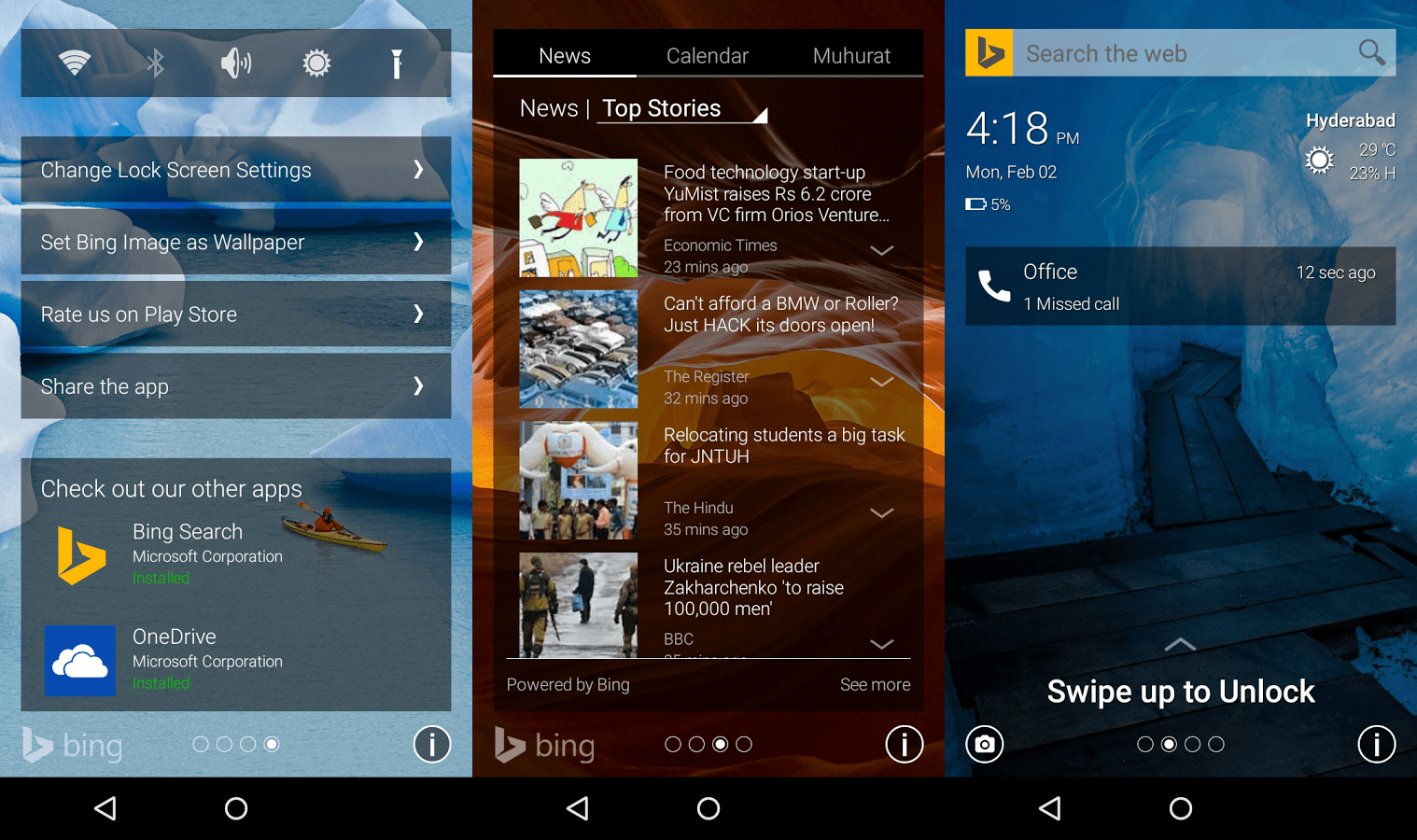
Microsoft Garage, the developmental lab behind a number of Android apps, released another title this week. Called Picturesque, it’s a way for Microsoft to deliver Bing homepage images to your lock screen. Available at no cost, it supports notifications and includes news and weather update integration.
They say:
- Beautiful Bing Homepage images: Your lock screen will be updated with the beautiful daily Bing image; you could swipe through the images from past 6 days or shake your phone to change the image on your lock screen.
- Search on the lock screen: You could search for anything on the web directly from the lock screen and read all the linked pages without having to unlock your phone.
- Latest news: Keep yourself updated with the latest news headlines and tap through to read the full articles.
- Weather: Find out what the weather is at your current location; long tap through on the icons to get the detailed weather predictions for the week.
- Notifications on Screen: See your missed calls and Messages quickly from your lockscreen. Quick call or reply from the notification from Home screen itself.
- Regional Calendars & Muhurats (Only for Indian users): Personalize the lock screen to access your favorite regional calendars and Muhurat. Now you can figure out what festival is on for the day, rahu kalam, chogadiya/hora timings all from the lock screen itself.
- Camera & Phone controls: Access your phone camera from the lock screen; Change your WiFi, Bluetooth, volume, brightness settings; also use your phone as a torch from the lock screen.
We say:
We love to change up our home screens and lock screens and we’re always on the lookout for something from bigger players. We appreciate having the images automatically cycled throughout the day and there’s plenty of customization to be had. Does it try to shoehorn in other Microsoft apps and services? Sure, but we’d expect that. Google does the same every chance it gets so why not?
The post TRENDING APPS: Microsoft Picturesque offers Bing images, news, weather and more on your lock screen appeared first on AndroidGuys.

iOS Continues to Lead in Mobile Ad Revenue Despite Increasing Competition From Android [iOS Blog]
Apple continued to be the leader in mobile ad revenue by a significant margin in 2014, based on the latest insights from Opera Mediaworks (via TechCrunch). According to the report, iOS captured 51.67% of ad revenue and 27.18% of traffic during the fourth quarter to close out the year as the leader in dollars earned. Meanwhile, Android trailed in second in revenue with a 41.20% share despite generating an all-time high in ad impressions and commanding 62.69% of traffic among mobile operating systems.

Android may have expanded and taken the lead in traffic, but iOS retained its solid lead for revenue generation and monetization. Apple’s tenacious grip on revenue generation is driven to a large extent by its favorable market position in western markets, such as the United States, Germany and the United Kingdom. In these markets, rich media and video advertising are more common and the high volume of mobile application usage (vs. mobile browsing) drives a robust user acquisition market.
The mobile advertising market, much like the overall smartphone industry, is largely a two-horse race between iOS and Android. BlackBerry, Symbian and Windows each accounted for around 1% or less in traffic and revenue during the fourth quarter, while all other smaller mobile platforms grouped together held a 5.55% share of traffic and 5.89% share of revenue. Social networking, games, and music, video and media lead the way in traffic volume and revenue generation.

Grim Fandango is back after 17 years and better than ever
Manny Calavera is a travel agent… of sorts. He works for the Department of Death, where he sells travel packages to recently departed souls from the city of El Marrow, the Land of the Dead. This is the setting for one of the most original adventure games ever created, a title originally developed for Windows and published by LucasArts way back in 1998. Now it’s back for Mac, PC, and Linux (with iOS still in the works), and it’s every bit as weird and wonderful as it was 17 years ago — only better.
Grim Fandango is, arguably, the pinnacle of the point-and-click adventure game that LucasArts was at one time renown for making. The game didn’t do particularly well when it was first released, but over time it’s grown to almost-legendary status, often being placed on critics’ top games lists of its era.
Most of us thought we’d seen the last of Grim Fandango years ago, and when Disney bought out LucasArts and made it clear there weren’t plans to resurrect the company’s classic point-and-click adventure games, its fate looked bleak. But that’s where the game’s new developer, Double Fine Productions, comes into play: Double Fine’s pedigree is directly descended from LucasArts. The company is run by Tim Schaefer, who worked as a designer on the original Grim Fandango, along with Full Throttle and The Secret of Monkey Island. Double Fine has produced a number of excellent original titles in its tenure as a game studio, like last year’s Broken Age (which iMore recognized as Mac puzzle game of the year).
The story
Grim Fandango is a weird mix of Aztec folklore and film noir, owing much to classic Humphrey Bogart films like The Maltese Falcon and Casablanca. The tale takes on a nourish caper bent, with Manny as the lovable anti-hero — a slacker travel agent trying to work off a debt in order to pass to the Ninth Underworld, a soul’s final destination after it departs the land of the living. Try as he might, though, Manny can never get ahead.
He finally thinks he’s found his big break when he finagles a dream client — only to have her snatched away. Manny discovers that something fishy is going on, and he’s drawn into a plot involving a revolutionary group trying to overturn a conspiracy within the Department of Death. That’s where the game gets really interesting.
Grim Fandango is divided into four distinct acts, each taking place on November 2nd over several consecutive years. November 2nd, for those not in the know, is the Day of the Dead — a Latin America holiday focused on remembrance of friends and family that have passed away — and as such, it’s no surprise that the game is rich with the cultural artifacts of this holiday. Manny and his character compatriots are all based on calaca figures from Dia de los Muertos artwork and crafts; the setting also owes much to 1930s-era noir Art Deco architecture and design.

I won’t spoil too much more, as I don’t want to take away a big part of the joy of Grim Fandango: discovering how the story unfolds. It’s just a terrific tale; it takes several hours to play through and is loads of fun.
The controls
In Double Fine’s Grim Fandango Remastered, you control Manny and interact with his environment by pointing and clicking; watching how his head tracks will give you an idea of specific hot spots you should click on or characters you should interact with. A pop-up interface lets you either manipulate an object, pick it up and add it to your inventory (Manny’s suit pocket can hold an infinite number of items), or — in the case of other characters — talk to them. Dialogue between characters involves branching choices.

Grim Fandango Remastered is an old game, yes, but it’s not easy. In fact, it’s a lot more challenging than many recent graphic adventures I’ve played. But that doesn’t mean it’s impossible, or that it’s excessively frustrating, either. There’s no way to “die” in this game, so you won’t be smashing your fists against the table in some endless twitch effort, either. The only time the game starts to fray is during the cut scenes, which look really grainy and antiquated compared to what we’ve come to expect out of games today.

The remastering process
The game hasn’t been reworked from scratch: It’s still instantly recognizable as Grim Fandango, with the same story, same puzzles and same jokes that made the game so eminently playable back in the late 1990s. It’s just been updated and tweaked to take advantage of modern processing capabilities, with repainted higher-resolution character textures, new dynamic lighting effects, the score re-recorded by a live orchestra, and some special extras worthy of a Blu-ray disc or DVD release.
Grim Fandango Remastered’s bonus content includes more than two hours of directors’ commentary and a concept art browser; it’s a fun addition that gives the game’s biggest fans get even more out of the experience.
Bottom line
The lack of handholding may frustrate gamers new to the adventure genre, but the good news is that as a 17 year old game, there are plenty of walkthroughs and hint guides that you can find with a quick Google search. But honestly, solving the puzzles yourself is a lot more fun, because it requires you to pay careful attention to the story and to the environment. And Grim Fandango is worth your attention.
Grim Fandango Remastered is available for download through Steam.
- $14.99 – Download now

Yammer now supports Handoff between iOS 8 and Yosemite, as this epic video will tell you
Microsoft’s messaging app Yammer now supports Apple’s Handoff feature on OS X Yosemite and iOS 8. Unlike some implementations of Handoff, which see you switching between corresponding apps on iPhone and Mac, Yammer’s sends you from the iOS app to your Handoff-supporting browser and back again. Sure, it’s not a terribly exciting implementation of the feature, but the video was just insane enough that we had to bring it to you.
Additionally, Yammer’s picked up sharing extension support on iOS 8 and interactive notifications so you can reply straight from Notification Center without leaving the app you’re in right now.
Source: Yammer

OnePlus targets Sony employees in announcing new European R&D center

OnePlus CEO Carl Pei took to Google+ over the weekend to announce the company is building a new research and development center in Europe that the company plans to launch in the latter half of 2015. The wording is a little vague as to whether work has already started on the new facility or if a location has been decided on. The other curious part of the announcement is that Pei linked to an article about Sony cutting 1,000 jobs in its smartphone division, including some in Europe. Apparently OnePlus hopes to scoop up some of these former Sony employees.
Thus far no additional details have been revealed about OnePlus’s plan to open a European R&D center or why they would choose that part of the globe. Some sources suggest OnePlus may be hoping to get a different worldview into their design pipeline, although their devices have certainly not lacked for interest on the part of buyers. Others suggest OnePlus may be hoping a view that European products are more rugged and reliable may rub off on their smartphones.
Whatever the reason OnePlus has picked for pursuing a European based presence with a new R&D center, any impact will not be felt until 2016 devices hit the market given the timeline for the release of the OnePlus 2.
source: +Carl Pei
via: phoneArena
Come comment on this article: OnePlus targets Sony employees in announcing new European R&D center

Saygus V2 available for pre-order at $599, $549 for those that pre-registered

Last week we learned that the Saygus V2’s pre-orders had been delayed a bit, and as a result the company was extending its pre-registration window. Now that time has finally come to a close and those who pre-registered can now grab their pre-orders for the price of $549 with their choice of charcoal, pink or white color variants. For those that didn’t pre-register, you can still pre-order the phone but you’ll have to pay $599 for the privilege.
As for how long the pre-order window will open? Seemingly taking a page out of OnePlus’ book, there is limited window with pre-orders ending this Thursday. It is unclear if or when you’ll get another chance to buy the phone if you miss out on the first round, so we’d jump quickly if you are allured by the idea of Saygus’ unique handset. It is also worth noting that each customer that pre-orders can purchase up to 10 devices, and Saygus is even throwing in a custom glass screen protector and extra battery for free to all those who buy during the pre-order window. Of course Saygus isn’t exactly clear on how long it will take for pre-ordered devices to arrive into the hands of consumers, so keep that in mind.
Have no clue who Saygus is? The relatively unheard of smartphone maker made a fairly big splash at CES 2015 where we were able to try out the phone in person. The biggest claim to fame is the phone’s ability to offer 320GB storage by combining 64GB onboard storage and an additional 256GB split between the phone’s two microSD card slots. Additionally, the phone has high-end specs all around including a durable design, a fingerprint sensor, IP7x waterproofing, a Snapdragon 801 processor, 3GB RAM, a 3100 mAh battery and a 5-inch 1080p display.
What do you think, is the phone worth the asking price or do you feel that taking a risk on an unheard brand just isn’t worth it?

OUYA confirms further moves into China with Alibaba deal

Is Chinese giant Alibaba investing $10 million into California-based game console maker OUYA? That report remains unconfirmed, but OUYA did confirm this morning that Alibaba is getting the OUYA game library on its YunOS platform. Sorry, the what platform? It’s essentially a version of Android that was created by Alibaba, intended to compete with Android in China. So does that mean OUYA is heading to smartphones in China? Not quite.
OUYA says its game service will arrive on Alibaba’s Tmall set-top box, which apparently already has streaming options for more robust games (the press release calls out soccer game Winning Eleven 2014 and fighting game Street Fighter 4). As far as control is concerned, there’s no mention of OUYA shipping its gamepad to China — we’ve asked OUYA reps for more info.
Regardless, how does this impact you? Well, if you don’t live in China, it doesn’t impact you too much — OUYA continues to exist as a platform in North America despite its multiple pushes into China. As far as how OUYA approaches its original North American audience in the future, CEO Julie Uhrman has a quote in the press release that’s telling of long-term plans: “Markets, like China, without the baggage of the US console market, could be the game console leaders in ten years. That’s where OUYA wants to be.”
More bluntly, that’s where OUYA needs to be — the company’s plans to disrupt console gaming in the US faltered after early reviews panned the console and its gamepad. There was even a hardware revision between Kickstarter backers receiving their console and its eventual retail release months later. In so many words, we don’t expect this is the last time we’ll be writing news of OUYA moving into developing markets and out of the shark pond that is North American game console sales.
 AIVAnet