


This week’s sidebar poll: what Android weather app are you using?

Let’s talk about the weather
Weather’s kind of important, especially around this time of year when you can walk outside and either find it 80 degrees or 20. What can I say, Texas winters are a little random. Point is, the weather’s kinda important, and it’s something that you have quite a few options when using. Beyond the plethora of apps available for weather, there are also plugins in many other apps to roll in weather, including Google Now, which will answer your thinking-out-loud “What’s the weather going to be like today?”

New Microsoft ad focuses on the impact of the cloud on cancer research
After debuting a pair of touching commercials showing off how its technologies can improve the lives of others, Microsoft recently debuted another spot that touches on how its Azure cloud technologies are empowering cancer researchers.

Difference in Average Android and iPhone Prices Increasing
 Android has always been known as the cheaper of the two mainstream mobile operating systems due to its open-source nature and lack of extreme markup. However, this past year, the price of an iPhone has grown from $600 in Q1 to $687 in Q4, while the average price of an Android phone has dropped from $350 to $254.
The growth in the price difference is most likely due to the addition of the iPhone 6 Plus, which starts at a price of $750 and goes to $950, however the iPhone 6 is not much cheaper, with a starting price of $650 and high-end price of $850. The drop in Android pricing is most likely due to Android One and Motorola, both of which have been releasing devices with prices in the $100-200 range.
China is also a big player in the realm of smartphones, and serves as an archetype for the world at large as far as mobile devices go. Apple products are seen as a status symbol and are used by the rich, leaving devices like the Samsung Galaxy Note 4 and LG G3 with no demographic to cater to. Xiaomi is leading the charge in China on the low end, with a mean cost for an Android smartphone from the company costing $220 and a mode of $100.
This pattern of Apple catering to the wealthier nations and Android filling in the gaps for the emerging markets is what caused Apple to have record sales last year, while Android faltered a bit. While market share is an exciting figure, and Android has dominated it for quite some time, profit share is an enormous factor in a successful business, especially in the tech world, which may cast an ominous gloom over Android’s stellar emerging market growth.
Do you have something to say about Apple’s rising prices and Android’s falling prices? Got a comment in your head about the changing world of mobile tech sales? Leave a comment below and we’ll start a discussion.
Source: Forbes
Come comment on this article: Difference in Average Android and iPhone Prices Increasing
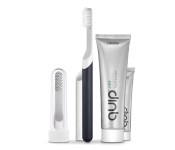
Electric toothbrush mates simplicity with low-cost subscriptions

You could easily argue that many attempts at modernizing the toothbrush are overkill — motion tracking and smartphone tie-ins are a bit much for cleaning that should only take a couple of minutes if you’re doing it right. Quip (no, not that Quip) thinks there’s a better solution. Its newly unveiled combination of a toothbrush and subscription service is just smart enough to keep your teeth in pristine shape. The electric brush’s only proper trick is a vibrating handle that stops when it’s time to scrub another section of your mouth. The real cleverness comes through the low-cost subscription model: you pay $25 to $40 for a starter kit ($5 to $20 for a non-electric brush) and $10 every three months for both new bristles and two tubes of toothpaste. It’s decidedly cheaper than Goodwell’s recently unveiled subscription model ($69 before the plan kicks in), and you can buy things piecemeal if you’re not down with regular payments.
It’s a ridiculously simple strategy, but it might make sense if your biggest challenge is simply covering the basics. If you spring for the electric brush and subscription, you’ll always have a reasonably fresh brush that you know how to use properly. Just be sure to act quickly if you want to give this back-to-basics approach a shot. Quip starts shipping its first kits later this month, but it’s warning of limited supply at the moment.
Filed under: Household
Via: PandoDaily
Source: Quip
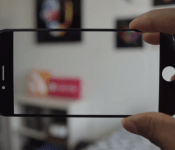
Sapphire Displays to See Major Step Forward With Lower Reflectivity
For several months leading up to the launch of the iPhone 6 and iPhone 6 Plus, it was heavily speculated that the smartphones would be equipped with sapphire crystal displays. Those rumors failed to materialize, however, as Apple opted to continue using ion-strengthened Gorilla Glass for its displays. Just weeks later, Apple sapphire partner GT Advanced filed for bankruptcy in what turned out to be a dramatic fallout between the two companies over strict contract terms and sapphire production issues.
 (Image via MKBHD)
While GT Advanced experienced difficulties with both the quality and quantity of sapphire, it is possible that Gorilla Glass was the better choice for the iPhone 6 and iPhone 6 Plus after all. TIME reported in September that sapphire, in its current form, has several properties that are less ideal than glass, including being thicker and heavier, more expensive, unable to transmit as much light and less durable after exposure to normal wear and tear. Sapphire also has up to double the screen reflectance of glass, especially under bright light, which could make it difficult to read the screen.
The reflective issue in particular could soon be a thing of the past, however, as DisplayMate confirmed to MacRumors that it has lab tested new sapphire technology that it believes will be a major breakthrough for smartphone displays. The display calibration and evaluation company found the production-ready enhanced sapphire to be at an advantage over both regular sapphire and glass based on the results of its testing, and predicted that “rapidly falling production costs” could make the material go mainstream in the near future.
“We have just lab tested an important new sapphire technology that significantly lowers the screen reflectance of sapphire to much lower than glass, turning its former major disadvantage into a major new advantage,” said Dr. Raymond Soneira, DisplayMate President. “A technical note, this isn’t an Anti-Reflection AR coating, which would scratch off easily and defeat sapphire’s tremendous scratch resistance – so the enhanced sapphire is now number one in scratch resistance, low reflectance and performance in high ambient light. In addition, displays using it could run with lower screen brightness and result in increased running time on battery.”
While Apple’s recent partnership with GT Advanced made it clear that the iPhone maker is certainly interested in sapphire, it remains unknown if and when the company will ever use the material for the iPhone or other products. A number of smaller smartphone makers such as Huawei, Kyocera and Vertu have already turned to sapphire crystal displays, and these new technologies lay the foundation for Apple and other handset makers to follow suit.

Amazon, Sprint reportedly looking to buy RadioShack stores

RadioShack has been struggling as of late, with the company’s stocks recently dropping by 13% down to only $.24. After being suspended from the New York Stock Exchange today, the company faces inevitable bankruptcy, according to reports. In a new Bloomberg report from earlier today, mobile carrier Sprint is possibly looking to buy RadioShack stores around the US in hopes to expand the company’s retail presence. RadioShack has over 4,000 brick-and-mortar stores around the US, and is moving toward a deal to sell half of them to Sprint and closing the other half. Sprint has been in talks to buy anywhere from 1,300 to 2,000 of these stores. In their negotiations, both companies have discussed co-branding the stores, keeping both the Sprint and RadioShack names.
Marcelo Claure, Sprint CEO, explained to investors about the company’s future plans:
This is a year in which we intend to grow our distribution dramatically. You are going to see the opening of more and more Sprint stores as this is one area that we work on.
Sprint isn’t the only company looking at RadioShack locations, though. According to ‘two people with knowledge of the matter’, Amazon is looking into buying some RadioShack locations as well. Amazon could use these stores as a showcase for their hardware (Fire Phone, Kindle, Echo Speaker), as well as pick-up and drop-off locations for items purchased and sold online.
If Amazon were to succeed in purchasing a few thousand RadioShack stores, this would be the company’s biggest push into the retail space. Amazon, being mostly online-based, has a great reason to open up retail locations. The majority of Amazon’s hardware is scattered about retail locations around the US, though most Amazon products aren’t displayed in a way for consumers to interact with the products, especially all in one place. With companies like Apple and Microsoft that have thousands of brick-and-mortar locations around the world, this is a great way for Amazon to showcase what they have to offer.
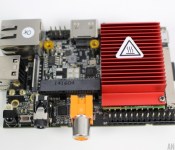
HummingBoard-i2eX review, dual-core SBC which runs Android and Linux
<!–
–>
<!–
By use of this code snippet, I agree to the Brightcove Publisher T and C
found at http://corp.brightcove.com/legal/terms_publisher.cfm.
–>
The Bottom Line
- Dual-core processor
- 1GB memory
- Runs Android & Linux
- More expensive than other SBCs
The HummingBoard-i2eX is a versatile board. It has greater performance than the Raspberry Pi 1 and includes more memory. At $110 it is more expensive than the Raspberry Pi, but you get more for your money.
(function($)
$(document).ready(function()
$(“#aa_bottom_line .aa_bl_pros_cons”).each(function()
var aa_bl_pc=$(this).find(“.aa_bl_pc”);
var aa_bl_pros=$(this).find(“.aa_bl_pros”).height();
var aa_bl_cons=$(this).find(“.aa_bl_cons”).height();
if(window.innerWidth > 480 && aa_bl_pros != aa_bl_cons)
if(aa_bl_pros > aa_bl_cons)
aa_bl_pc.height(aa_bl_pros);
else
aa_bl_pc.height(aa_bl_cons);
)
);
)(jQuery);
The attraction of Single Board Computers (SBCs) for both hobbyists and developers (as a prototyping platform) is clear and their lure has been rising steadily for many years. Probably the most famous SBC is the Raspberry Pi, however there are lots of companies that make these nimble little boards. I recently reviewed the MIPS Creator CI20, a SBC designed around a MIPS based CPU rather than an ARM based one. However the Pi and the CI20 aren’t the only SBCs out there. SolidRun has several different products that use Freescale’s i.MX 6 series of processors. The i.MX 6 range is based on ARM’s Cortex-A9 design and scales from single- to quad-core.

I recently got my hands on a HummingBoard-i2eX from SolidRun. It uses a dual-core i.MX 6 processor, comes with 1GB of RAM, has the same form factor as a Raspberry Pi 1, and can run both Android and Linux. Let’s take a deeper look, shall we?
HummingBoard-i2eX vs the others
The competition is fierce for the top spots in the SBC market, and as a result SolidRun has taken a different approach to some of the other manufacturers. There are two unique aspects to the HummingBoard. First, there are three different off-the-shelf-boards in the series, the i1, the i2 and the i2-eX. Each board offers a different set of features at a different price. Second, for those using the HummingBoard for prototyping, SolidRun offers a way to mix and match its MicroSystem on Module (MicroSOM) with a base board. The MicroSOM includes the processor, memory subsystem, power management subsystem, networking and system interconnectivity, and you can add also Wi-Fi. This means that it is possible to put together a HummingBoard with a quad-core processor, Bluetooth, and Wi-Fi.
Here is a detailed look at how the HummingBoard-i2eX compares to other SBCs:
| Device | HummingBoard i2eX | Raspberry Pi 1 | Raspberry Pi 2 | Creator CI20 |
|---|---|---|---|---|
| CPU | 1GHz i.MX6 dual-core Cortex-A9 CPU | 700MHz ARM11 Broadcom CPU | 900MHz quad-core ARM Cortex-A7 CPU from Broadcom | 1.2GHz dual-core Imagination MIPS32 CPU |
| GPU | GC2000 | Videocore IV | Videocore IV | PowerVR SGX540 |
| Memory | 1GB | 512MB | 1GB | 1GB |
| Storage | SD card slot | SD card slot | SD card slot | 8GB onboard flash, SD card slot |
| Connectivity | 2 x USB, HDMI, Ethernet, 3.5mm audio jack, infra red remote control receiver | 4 x USB, HDMI, Ethernet, 3.5mm audio jack | 4 x USB, HDMI, Ethernet, 3.5mm audio jack | Ethernet, 802.11 b/g/n Wi-Fi, Bluetooth 4.0, 2 x USB, HDMI, 3.5mm audio jack |
| OS | Linux, Android | Linux | Linux, Windows 10 | Linux, Android |
| Connectors | Camera interface (CSI-2), GPIO, UART, SPI, I2C, PCI-Express Gen 2, mSATA II, RTC with backup battery | Camera interface (CSI), GPIO, SPI, I2C, JTAG | Camera interface (CSI), GPIO, SPI, I2C, JTAG | Camera interface (ITU645 controller), 14-pin ETAG connector, 2 x UART, GPIO, SPI, I2C, ADC |
| Price | $110 | $35/£24 | $35/£24 | $65/£50 |

Android 4.4 KitKat
The HummingBoard-i2eX is compatible with Android and currently runs Android 4.4 KitKat. The Android experience is pretty good and for the most part you get the same experience as you would from a smartphone or a tablet. Of course you aren’t using a touch screen, but with a mouse connected to the board you are pretty much able to use Android to its fullest.
The HummingBoard includes Google apps, so you get access to the Play Store as well as other Google services like Gmail, G+, YouTube and so on. In terms of performance the dual-core Cortex-A9 isn’t going to win any speed competitions when pitched against the latest generation of quad-core and octa-core processors. However the board isn’t designed for ultra-high speed, it is designed for embedded solutions. Quickly looking at some benchmarks the HummingBoard-i2eX scored 12198 on AnTuTu, and for Epic Citadel I was getting scores of around 24 to 28 frames per second in High Performance mode. The Epic Citadel results varied slightly from one test run to another.

However in terms of multimedia the CPU and GPU combination performs excellently. The HummingBoard supports accelerated decoding for a large number of video standards including MPEG-4 ASP, XVID, H.264 HP, H.263, and VP8. I tested the HummingBoard using YouTube and using Netflix. Both ran without any problems.
The only minor problem with Android on the HummingBoard is that it doesn’t recognize flash drives when they are plugged into the USB port. This isn’t something that most Android users try with their smartphones, so it isn’t surprising that it doesn’t work. However since the HummingBoard-i2eX does have USB ports, it would have been nice if it worked. As a result, I couldn’t test video performance for files stored on an external USB drive with Android.
Linux
The HummingBoard can run a variety of Linux distributions. In general Linux tends to be the primary operating system for SBCs. Booting the HummingBoard with Linux is quite easy. First you need to download a special firmware called Ignition from SolidRun’s website and write it onto a memory card.

Then you boot the HummingBoard with the Ignition firmware and use its UI to pick which Linux distro you want to use. Ignition will then download the distro and copy it onto the micro SD card. Once copied you just reboot the board and the Linux distro will start-up. If you want a Linux distro that isn’t on the official list in Ignition, then there are plenty of community provided distros which can be written directly onto a micro SD card. You can find full instructions on SolidRun’s website.
Wrap up
The HummingBoard is certainly a feature rich SBC and its support for Android and Linux is excellent. The Cortex-A9 cores used in the i.MX 6 are more advanced than the Cortex-A7 cores used in the Raspberry Pi 2. For example the Cortex-A9 supports out-of-order execution, while the A7 doesn’t. The support for Android is the best I have seen in a SBC, while at the same time the ability to install other operating systems is great.

Like the Raspberry Pi, the HummingBoard has a set of GPIO pins which means the board is an attractive option for hardware enthusiasts. Although the HummingBoard is more expensive than the Raspberry Pi, the extra cost does bring benefits like support for mSATA II and LVDS.
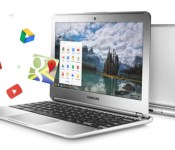
You can finally upload to Google Play Music on an ARM-powered Chromebook

Back in March of last year, Google introduced a web-based way to upload locally stored music files onto Google Play Music. The feature not only played nicely with the Chrome browser, but it also meant that, for the first time, Chromebooks also had an option for Google Play Music uploading. On the downside, the feature only supported Chrome OS devices with Intel processors, leaving ARM users out of luck — until today.
Google’s François Beaufort announced the good news on Google+ today:
Google Play Music upload is now available for ARM Chromebook users thanks to the updated Google Play Music for Chrome App. Make sure you’ve installed the App from the Chrome Web Store first, then go to https://play.google.com/music, click on the “Add Music” orange button and upload your best-loved music directly from your ARM Chromebook.
Considering there are a number of Chromebooks that utilize ARM processors over Intel, personally we feel that Google should have added compatibility long before now, but better late than never. You can grab the updated Google Play Music app from the Chrome Web Store.
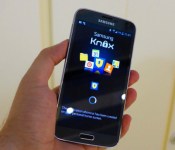
Samsung partners with Good Technology to offer an app ecosystem for enterprise users

Samsung has partnered with Good Technology to create Good for Samsung Knox, which merges Good’s secure app ecosystem with Samsung’s enterprise security platform. Now businesses that have adopted Samsung’s Knox program will have the ability to allow employees to download a multitude of apps on a secure platform. Good is the first enterprise mobility management (EMM) that’s fully integrated directly into Samsung Knox. Samsung hopes this will open up an opportunity for enterprises and government agencies that are looking to accelerate their Android deployment to push mobile security further.
Christy Wyatt, chairman and CEO of Good Technology, says:
Good is trusted in 100-percent of the Fortune 100 commercial banks and aerospace and defense agencies, as well as thousands of other businesses and public agencies. Now the millions of deployed Good-secured apps and containers can be easily integrated with Samsung’s KNOX-secure Android solution.
This announcement follows on the heels of the Samsung Knox and Blackberry partnership from late last year. The partnership integrated BlackBerry’s cross-platform BES12 enterprise mobility management software into Samsung’s Knox security for Android devices. Additionally, certain features of Knox have been rolled into Google’s own “Android for Work” initiative that was announced at last year’s Google I/O.

Verizon’s site now lists the Nexus 6 as “coming soon”

A recent report stated that Google’s Nexus 6 handset would make its way to Verizon sometime in February, but as of now, we still have no idea when the phablet will launch on Big Red. As the rumored mid-February release date approaches, we’re seeing signs of the smartphone pop up on Verizon’s site. As of today, the Nexus 6 is listed on Verizon’s website as “coming soon.” If you’re interested in receiving updates as to when the device will be officially available, follow the Verizon link below to sign up for updates.
The Nexus 6 was launched back in October of 2014 and has since made its way to carriers such as AT&T, T-Mobile, US Cellular, Sprint, and even to Mexico, Canada and various other countries around the world. Given the carrier’s track record with previous Nexus handsets, it should come as no surprise to anyone that Verizon would be one of the last major carriers to make the handset available.
With that said, if you can get your hands on the unlocked Nexus 6, it can be activated on Verizon’s network. However, if you’re not able to front the $649.99 price tag to Google or Motorola, the time to buy the Verizon Nexus 6 on-contract may be almost here.
Since its launch, the Nexus 6 has been extremely difficult to get a hold of. Months after multiple carriers and retailers couldn’t keep the device in stock, Google admitted to not being able to keep up with Nexus 6 supply demands.

