


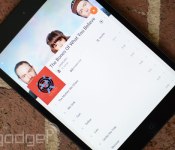
Google Play Music finally equips iPads with its tunes

Even if you prefer iOS, Google Play Music is still a solid option for getting your personal library and access to streaming all in one place. That is, until Apple reveals its plans for Beats Music. While we wait for that announcement, though, Mountain View’s tune-minded app does double duty nicely, and now it properly outfits the iPad. The new version comes with a fresh coat of Material Design, of course, but you’ll still have to contend with Google’s rather frustrating method for uploading files. If you haven’t already been prompted to update, the latest is now available over at iTunes.
Via: The Verge
Source: iTunes
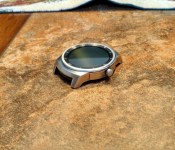
An LG G Watch R owner sanded down his watch and it looks awesome

The LG G Watch R made waves after its announcement, largely due to its round display and premium build quality. In our full review of the device, we said the watch featured a fantastic build quality and a beautiful design. However, that may not be the case for some people. At least, it wasn’t the case for a certain LG G Watch R owner.

On his Google+ profile, Anthony B posted pictures of his G Watch R that’s been sanded down to remove the black paint. And paired with his metal watch band, the combination looks really nice. Now, I’m absolutely not telling you to go out and do this to your own G Watch R. Once you start sanding it down, there’s no turning back. Modifying products like this can always provide mixed results, so if you’re going to try it, be careful! If you are interested in doing it, however, just note that the above image shows some scrapes and scratches from the sandpaper, so you may want to take that into consideration before you do something this drastic.
But if you don’t want to modify your watch, LG just announced the LG Watch Urbane, a new Android Wear-powered smartwatch that gives off a similar look to the sanded down G Watch R.
So, what do you think? Do you prefer this design over the plan black look?

Congressman John Lewis meets with Tim Cook at Apple HQ

Georgia congressman John Lewis visited with Tim Cook at Apple‘s Cupertino headquarters earlier today. Lewis was in the area as part of a book tour for the second part of his graphic novel about the civil rights movement in the United States, titled “March: Book Two.”
Cook tweeted about the visit earlier today, saying the following:
Honored to host @RepJohnLewis at Apple today. His 50-year march for justice and equality inspires us. @MARCHTrilogy pic.twitter.com/I5ye7OdIDi
— Tim Cook (@tim_cook) February 17, 2015
Cook and Lewis also spoke in a private meeting during the visit. While it’s unknown what the two discussed, it most likely centered around diversity in the tech industry, similar to a meeting between Cook and Rev. Jesse Jackson that occurred late last year.
Source: Tim Cook (Twitter)

Amazon’s one-hour delivery is now available in all of Manhattan

Live or work in Manhattan? You now have an all-too-tempting way to impulse shop online. Amazon has confirmed to Mashable that its Prime Now delivery service is now available across the whole of the New York City borough, rather than the tiny area of before. If you just have to get some soap right after a sweaty Central Park run and don’t want to visit a store, you can. It’ll still cost $8 for the one-hour option (it’s free for two) on top of your Prime subscription, of course. The big question is whether or not Amazon can expand Prime Now beyond Manhattan in a timely fashion — that super-fast shipping depends on having a distribution center close by, which isn’t as likely in less densely populated areas.
Via: TechCrunch
Source: Mashable
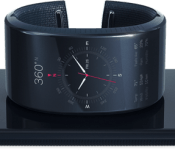
Neptune announces the Duo, a standalone smart wristband and a “Pocket Screen”

Neptune, the folks behind the Neptune Pine, are back with an interesting wearable concept. It’s called the Neptune Duo, and it aims to fix all of your smartphone problems. If you’re unfamiliar with the company’s previous offerings, the Neptune Pine was a full-blown Android smartphone on your wrist. It featured home screens, an app drawer and everything else a normal Android phone has. Unfortunately, the concept fell a bit short, since the end product turned out to be incredibly bulky with a small screen. Though the Pine didn’t really work out, it was an interesting idea. So, in hopes to fix the problems with the Pine, the company released the Duo.

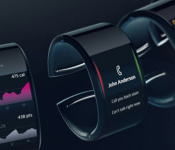
The concept behind the Duo, while a little farfetched, is pretty compelling. The “Hub” or the wearable itself, looks like a big bracelet that has a curved screen. It has a 2.4-inch curved display, a quad-core processor, a 1000mAh battery, 3G/4G connectivity, Wifi, GPS and NFC. The Hub is where Neptune hopes the majority of your interactions will take place. You can read and reply to messages, take phone calls and much more, directly from the watch. But what if your watch screen is too small for the task you’re trying to accomplish? That’s where the “Pocket Screen” comes in.
The Pocket Screen is basically a bigger Hub screen. It doesn’t keep any of your information saved on the device, and is meant to carry out the tasks that the Hub is too small to complete. The Pocket Screen has a 5-inch 1280 x 720 display, an 8MP rear-facing camera, a 2MP front-facing camera, and a microphone, speakers, and loudspeaker so you can carry out your normal smartphone-friendly tasks. It runs Android 5.0 Lollipop and has a 2800mAh battery, so you shouldn’t worry about losing a charge that quickly, especially if your watch is going to do the majority of the work. Neptune explains, “The Pocket Screen isn’t very smart, but it doesn’t need to be.”

Now, this isn’t the worst idea we’ve ever seen, and the Duo actually brings a new idea to the technology world. But don’t get us wrong, there is plenty that could use some work. First, the Hub is big. It resembles a will.i.am PULS, that isn’t exactly known for its great design. The Hub seems very uncomfortable to use, though we haven’t tried it, so we’ll need to reserve our judgement until we have one in-house.
The second, and arguably most interesting aspect of this device, is the Pocket Screen. Our smartphones do a lot for us. They hold information, allow us to make calls, and much more. And sometimes we don’t want to take our gigantic smartphones out of our pockets. That’s where wearables come in. Since our phones are already bulky, the last thing we want is for our wearables to be big and clunky. That’s why Android Wear and Pebble watches work so well, because they’re small enough to not notice them, but large enough to read text and get a few important tasks done without taking out your phone. But the Duo has it backwards, it seems. Not only do users need to carry around an average-sized smartphone-like device, they also need to carry a smart wristband that’s seemingly too bulky. To clarify, users don’t have to carry the Pocket Screen if they don’t want to, the Hub works just fine without it.
Interested in picking one up? The Neptune Duo costs $798 in all, but you can pledge a certain amount if you’re looking to save later. If you pledge $498 now, you’ll save $300 and pay nothing when the device ships. If you pledge $199 now, you’ll save $200 and pay $399 at shipment. Pledging $49 now will save you $100 in the long run, and you’ll need to pay $649 at shipment. If you’d rather pay nothing now, you’ll owe the full $798 when the device ships.
Be sure to check out the promo video below to see the Duo in action. What do you think of the Neptune Duo? Is this a good idea, or do you think it could use some work?
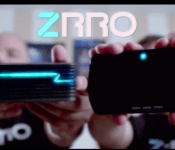
Kickstarter project ZRRO gives you a way to play any Android game on your television
 The market for Android-powered game consoles can seem pretty crazy sometimes, and with the mixed success of devices like the Ouya and Mad Catz’ MOJO, it doesn’t look like any company has the formula nailed down just yet. Google and Amazon are even taking a stab at it with their latest set top boxes, although gaming is not the first priority with either device.
The newest contender in this new market is the ZRRO, which is currently up for funding on Kickstarter. The ZRRO differs from other boxes because it tries to offer a touch screen experience and full compatibility with any and every game available on Google’s Play Store. The device uses a fancy controller that utilizes patented “zTouch” technology; the input device actually tracks where your fingers are hovering over the screen (think Samsung’s S-Pen or Air View) and when you’re actually pressing the screen, which is supposed to allow you to be any Android game on your big screen television.
Hardware on the device is decent enough with a quad-core processor, 2 GB of RAM, and expandable storage, although it’s only going to run Android 4.4 out of the box. Since it mimics a touch screen, any app should work on it, so it should theoretically do much more than just gaming, although that’s what it’s being marketed as.
The ZRRO isn’t on sale just yet, but it is up for backing on Kickstarter if the idea appeals to you. Retail price seems like it’ll land at around $200, which is quite a bit more than something like an Android TV box or Fire TV would cost. It does include the controller, but a high barrier for entry can doom a project before it ever gets off the ground.
Does this kind of console appeal to you? Most of these devices seem like they end up being used as a party trick or emulator/Netflix boxes anyway, so I’m still not convinced that the Android gaming console market is a worthwhile investment. Maybe the ZRRO will change that.
source: ZRRO
via: Android and Me
Come comment on this article: Kickstarter project ZRRO gives you a way to play any Android game on your television
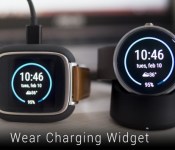
[New Android Wear App] Wear Charging Widget shows you relevent info while your watch is charging

One thing Motorola got right on the Moto 360 was the clock display when charging the device. It’s one thing that I missed greatly when I switched to the G Watch R. Now owners of all Android Wear smartwatches can enjoy the same thing with Wear Charging Widget.
Wear Charging Widget will automatically turn on when you charge your Android Wear watch. It looks very much like what displays on the Moto 360, but it adds the date and weather information, and it can be customized to an extent. The widget shows the current time, date, weather, and the battery charge. It even has that Moto 360-like round circle, giving you a visual of how much the watch has been charged.
The app itself lets you customize the brightness, the clock mode (12h or 24h), how the date is displayed, and whether you want Fahrenheit or Celsius for the temperature. You can even change the orientation of the clock so you can see it better. The app even prevents burn-in by moving the display slightly every minute.
The app is free, but you might notice that Google shows that there are in-app purchases. For now, that’s only for donations, but as the developer, vuxia, adds more options, that could become part of a premium package.


Come comment on this article: [New Android Wear App] Wear Charging Widget shows you relevent info while your watch is charging
Report: US carriers are still making it difficult to unlock phones

It used to be illegal to unlock your phones through wireless carriers, but that all changed last week. The FCC and CTIA came to an agreement on February 11th, 2015 that forced carriers to unlock smartphones and tablets upon the user’s request. But according to a new analysis, unlocking smartphones isn’t going as swimmingly as planned.
Sina Khanifar, a consumer rights activist who was a big advocate against phone unlocking restrictions, has rated the four major US carriers (Verizon, AT&T, Sprint and T-Mobile) on phone unlocking restrictions after the agreements passed. Unfortunately, he found that three of the four carriers are still not complying with all regulations set forth by the FCC.
As a quick overview, mobile service providers are now obligated to unlock users’ phones in addition to meeting six conditions. The carriers must:
- Post clear, concise unlocking polices on their websites
- Provide lenient postpaid policies
- Provide lenient prepaid policies
- Provide eligibility notifications to the customer when their devices are able to be unlocked
- Respond to unlock requests within two business days
- Unlock devices to deployed military personnel
Out of the four major US carriers, Verizon complies with all six agreements, AT&T meets five (maybe not the sixth), T-Mobile complies with three (maybe four) and Sprint only meets three of the six guidelines. Khanifar even created a handy chart for a more concise look:

Now, this chart absolutely requires some explanation.
Verizon
Verizon must follow a more strict unlocking policy because of the conditions the FCC posed on the carrier during a spectrum auction. Khanifar says that Verizon has almost completely stopped locking their smartphones, making it easier to unlock devices from here on out. While the carrier passed on the score card, Khanifar says it’s still a little too difficult to unlock devices through Verizon. He wrote, “Their Bring Your Own Device” program makes it clear that your phone needs to be a “unused Verizon phone” to be elligible.
AT&T
Moving down the line, AT&T scored quite well on the score card. They meet every goal except in providing eligibility notifications to its customers. Khanifar says he was unable to find any notification system on the carrier’s website. On top of AT&T’s site providing unclear results, he spoke to two different customer service representatives, who both gave him conflicting notification delivery methods.
T-Mobile
T-Mobile will unlock postpaid devices, though the carrier posts restrictions on consumers who would like to unlock two devices on the same account within a 12-month period. Postpaid devices on the carrier also need to be active for at least 40 days for the unlocking process to commence. To unlock a prepaid device, the account must be active and in good standing. This means a prepaid device can’t be unlocked if a consumer buys a T-Mobile phone and cancels service within a few months. Additionally, T-Mobile doesn’t notify prepaid or postpaid customers as to when their devices can be unlocked.
Sprint
Last but not least, we have Sprint. The carrier specifically states that they won’t activate a phone that was originally sold by another carrier. Khanifar explains:
In Sprint’s case, those restrictions even apply to their own MVNOs. Virgin Mobile devices run entirely on Sprint’s network. But even if Virgin Mobile unlocks it for you, Sprint won’t activate it for use on a prepaid or postpaid account. It’s patently absurd: there’s simply no good reason to prevent users from bringing their own devices – in fact, it makes it even hard for consumers to switch to your carrier. The only justification for that kind of policy is to gouge customers and force them to buy more expensive, “carrier-approved” devices that come with 2 year contracts.
While Sprint provides unlocking information on their website, it can’t be described as “clear, concise and accessible.” The policy Sprint posted only applies to postpaid devices, and the prepaid device policy is actually a full two links away from the original policy page. For postpaid devices, the carrier will only perform an International SIM Unlock for active customers. Also, customers don’t qualify for an international unlock if they’ve unlocked a device within the last 12 months.
Again, (even for deployed military personnel) the company will refuse to unlock devices if the customer has “previously unlocked another device within the past 12 months.”
What’s the solution?
Khanifar also talks on the Digital Millennium Copyright Act (DMCA), and how exactly Congress needs to revise these “voluntary agreements” that most of the carriers aren’t following. He writes:
There’s a simple and easy fix to all this. Congress could pass a bill clearly stating that it’s not illegal to circumvent a lock as long as there’s no intention of copyright infringement.
This is exactly what the Unlocking Technology Act would have achieved in 2013, but unfortunately the bill was postponed due to “opposition from special interests.”
If you haven’t read Sina Khanifar’s full report, I really urge you to do so. It offers some great insight and analysis as to what exactly the big US carriers are up to.
What are your thoughts on this analysis? Do you think carriers have a right to interpret the rules differently? Or do you think these conditions should be more closely enforced? Let us know your thoughts in the comments.

Daily Roundup: NSA spyware, Apple’s VR headset and more!

Welcome to the Daily Roundup. Security researchers discovered NSA surveillance software in the firmware of some new hard drives. In other news, a UK company works on a self-driving shuttle for public transit and an Apple patent filed in 2008 shows the company has long been interested in VR displays. Catch up on all of today’s top stories past the break.
The NSA hides surveillance software in hard drives

Security researchers at Kaspersky Lab have discovered apparently state-created spyware buried in the firmware of hard drives from big names like Seagate, Toshiba and Western Digital.
The autonomous shuttle hoping to transform public transport

Public transportation is one particular area that could benefit from self-driving vehicles and a UK company is working toward making it a reality.
Apple explores headsets that turn your iPhone into a VR display

The USPTO has granted Apple a patent (originally filed way back in 2008) for a headset design that uses your iPhone as a virtual reality display. The basic concept bears more than a small resemblance to Samsung’s Gear VR.
Behold: a wristband that replaces your phone with a dumber phone

The folks behind the giant and retro (but not quite useful) Neptune Pine smartwatch are back — and this time they’re aiming to flip technology paradigms. Their new product, the Neptune Duo, is made up of two familiar looking devices that don’t work the way you’d expect.
Any app that works with Android Wear now works on your Pebble

A new update for the Pebble smartwatch adds support for Android 4.0 devices, automatic app and watch face updates and Square Cash payments. You’ll need to update your Pebble smartwatch firmware as well as download the very latest edition of of the companion Android app to get rolling.
Sony’s $840 augmented reality glasses are real, just not pretty

Sony’s SmartEyeGlass SED-E1 Developer Edition is coming to 10 countries next month. The glasses use “holographic waveguide technology” to put information directly in the wearer’s eyeline, with simple green monochrome text and diagrams displayed at up to 15fps. The starting price? $840 USD.
The Big Picture: Rosetta gets up close and personal with a comet

This weekend, the ESA’s Rosetta spacecraft took a close approach past Comet 67P/Churyumov-Gerasimenko and captured this stunning photo taken just 5.5 miles above the comet’s surface.
Neptune Duo is a smarter-watch with a companion touchscreen dumb phone
 Neptune has announced the Neptune Pro, and it’s probably the worst idea for a smartphone/smartwatch combination you can imagine. The “brains” of the device are housed in the watch, while the touchscreen companion phone is just a dumb phone that’s linked to your wrist for when you need a bigger phone. Baffled yet? Keep reading.
The actual smartwatch is a little more advanced than most other smartwatches and more along the lines of Samsung’s Gear S watch. You can check texts, answer calls, and a handful of other things normally reserved for your smartphone. When you need a larger screen to tap out longer text messages or take calls without a headset, you can pull out the 5″ touchscreen display of the companion device, which, by the way, is completely useless without the accompanying watch. On its own, it’s just a big slab with nothing going for it in the ways of features and connectivity.
This is probably one of the weirdest concepts for a watch/phone dynamic, and I don’t think it’s going to appeal to very many people. If you have the extra cash to spend and really don’t use your phone for much more than calls and texts, you could get a Neptune Duo and try really hard to reenact some James Bond scenes, but that’s about the extent of it. For $800, you could get a decent phone and a capable smartwatch and get much more bang for your buck.
Of course, if the idea interests you, you can go ahead and pre-order one and get it for $500, which is a full $300 off of the list price everyone else will have to pay when it releases later this year. Otherwise, just wait for some new smartwatches to come out before making a decision.
source: Android Police
Come comment on this article: Neptune Duo is a smarter-watch with a companion touchscreen dumb phone
 AIVAnet