


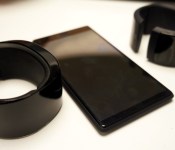
Neptune Duo inexplicably reverses the roles of smartphones and smartwatches

The folks behind the giant and retro (but not quite useful) Neptune Pine smartwatch are back — and this time they’re aiming to flip technology paradigms. Their new product, the Neptune Duo, is made up of two familiar looking devices that don’t work the way you’d expect. The Neptune Hub is a chunky wristband that actually houses all of the technology you’d normally find in a smartphone, and it’s accompanied by the Neptune Pocket, a 5-inch screen that just serves as a wireless dummy display for the Hub. The idea, according its 20-year-old creator Simon Tian, is to evolve our relationship with wearables by putting your primary device on your wrist. The only problem? Tian still isn’t quite clear on why, exactly, you’d want to do that.
After raising more than $800,000 on Kickstarter for the original Neptune Pine, Tian and his small team likely felt emboldened to push boundaries even further with their next project. But, in this case, they may have gone a bit too far. The non-functioning prototypes we tried on felt way too uncomfortable to wear all day, and we were also skeptical of Neptune’s ability to keep a solid wireless connection going between the two devices. It’s annoying enough to deal with apps crashing and reception issues on our smartphones, who needs another inevitable point of failure? Tian mentioned that having your core device on your wrist could also be more secure than carrying it around in your pocket, but that argument also feels thin (thieves have been snatching watches far longer than smartphones, after all).
Under the hood, the Neptune Hub packs in a quad-core processor, LTE, GPS, health tracking sensors, and almost everything else you’d expect from a smartphone. The Pocket, on the other hand, is basically just all screen and battery. It may seem crazy to make a wearable with a small battery your main mobile device, but Neptune notes that you’ll be able to recharge the Hub throughout the day by hooking it up to the Pocket. That’s a novel solution, but it’s certainly not a user-friendly one.
Ultimately, the Neptune Duo reeks of a device built by geeks for geeks, but with little thought about how normal people actually use technology. We can’t imagine too many people would be eager to trade in their slim smartphones for a giant sci-fi movie prop. And there are still plenty of usability concerns to to deal with, like the mere act of taking phone calls. You can use the wearable’s speakerphone or a wireless headset to chat with people, but you can’t take calls over the Pocket (even though that seems like the most obvious way to do so). We’d have a bit more faith in the project if we saw the Duo working, but right now it’s just a dumb prototype.
If you’re still intrigued (despite the many red flags), you can preorder the Neptune Duo today starting at $49 down, with $649 due at shipment. You can also pledge more money up front for a discount: $199 down with $399 due later, or go all in for $498. The company expects to start shipping the Duo by the end of the year.
Microsoft Office for iOS Updated With iCloud Drive Support
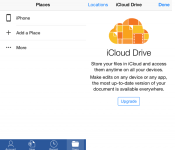
Microsoft today released an update for its suite of Office apps on Apple’s iPhone and iPad App Store for users running iOS 8. The 1.6 updates bring, along with the usual bug fixes and performance enhancements, full support for saving and syncing documents via Apple’s iCloud Drive service (via The Verge).
Microsoft says users of its most popular software like Word, Excel, and PowerPoint can now open, edit, and save their work to iCloud as a storage option in the “Places” section of each iOS app.

The additional storage method doesn’t require users to have an Office 365 subscription and comes as an alternative to Microsoft’s own cloud storage option, OneDrive. As pointed out by The Verge, light restrictions on a few file types may hinder iCloud’s usage on Microsoft’s iOS apps, however.
There’s also restrictions on filetypes, so while you can see a thumbnail preview of text in a document created with TextEdit on a Mac (stored on iCloud), you can’t access the document or edit it. Overall, it’s a fairly basic feature addition, but one that will please (and possibly frustrate) those who use iCloud on a regular basis.
Microsoft most recently added a similar feature to flesh out its iOS offerings with a partnership with Dropbox that let users open, edit, and save their documents using the popular document-saving cloud app. The Word, Excel, and PowerPoint apps launched on the iPhone in early November, bringing free document creation and basic editing to the service.
Microsoft Word [Direct Link], Microsoft Excel [Direct Link], and Microsoft PowerPoint [Direct Link] can all be downloaded from the App Store for free.
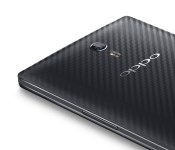
Oppo Find 7 becomes more affordable in the UK, 32GB variant listed for just £310

The Oppo Find 7 has been listed on Amazon UK since late last year, but now the smartphone is readily available and has just had its price cut. You can become the owner of a shiny new 32GB Find 7 (the more expensive version) for just £310, while the 16GB is going for £299.

Predator drones more likely in civil airspace after successful tests

A Predator B drone has successfully completed tests with so-called sense-and-avoid radar, bringing it a step closer to legal operation in US and international airspace. You may be thinking, “haven’t they already operated extensively in places like Iraq?” Yes, but in the US and other nations where skies are packed with traffic, drones are forbidden to operate. The flight test, conducted by Predator manufacturer General Atomics (using a NASA-owned Predator B) consisted of “scripted encounters” with multiple aircraft at Edwards Air Force base. The idea was to test the drone’s ability to detect other planes with air-to-air radar and see how it fared under civilian air traffic control (TCASS II ) systems.
Congress wanted the FAA to get drones into civil airspace by this year. But the necessary sense-and-avoid radar systems have proved more complex than thought, and many experts say that the agency will be lucky to achieve the goal by 2020. The Predator B passed all the tests by automatically avoiding the other aircraft in what General Atomics called a “milestone achievement.” It’ll continue to test the systems aboard NASA’s drone throughout the year, but don’t expect to see military drones hovering over your house anytime soon.
[Image credit: Getty Images]
Filed under: Transportation
Via: Space War
Source: General Atomics
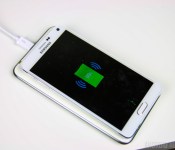
Samsung hints that Galaxy S6 could support multiple wireless charging standards

One “special function” of the Galaxy S6 could be wireless charging that works with any of the current standards.
In a new post on its Samsung Tomorrow blog, the maker of the Galaxy series extols the virtues of wireless charging and promises that 2015 will be a “landmark year” for the technology. This sudden interest in wireless charging is curious, given that Samsung hasn’t really promoted it so far – while competitors like LG or Motorola have shipped devices with built-in wireless charging, Galaxy S and Note phones have lacked this feature out of the box. Samsung users can buy replacement covers fitted with wireless charging coils, but that’s obviously not ideal.
Samsung is now signaling that its 2015 flagships will not only feature wireless charging out of the box, but they will be compatible with multiple standards.
“Last year, components that support multiple standards on a single chip were released. Given that it usually takes around 6 to12 months to integrate new components and put them on the market, it is expected that several of these products will be available to consumers this year”
The company doesn’t spell it out, but given the timing of the post, the above is a strong indication that the Galaxy S6 will be among the first devices with multiple standard compatibility. In fact, this may be the “special function” that Samsung’s head of investors relations Robert Yi hinted at last month.
The multi-standard wireless solution that Samsung mentioned could be thanks to Broadcom – back in May 2014, the chipmaker announced a charging control chip that works with the three main standards, A4WP, PMA, and WPC.
“Samsung will accelerate to democratize this wireless charging technology with compelling smartphones. With our upcoming Galaxy smartphones, users will be able to enter a new wireless world like never before.”
If our assumption is correct, users of the Galaxy S6 and S6 Edge will be able to drop their device on just about any charging surface without worrying about the technology inside. That would be a great user-facing feature, and a great step forward for wireless charging technology, which has been so far held back by fragmentation.
For more about the state of wireless charging, check out our recent look at the technology.
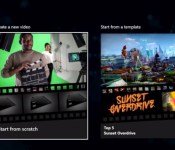
The Xbox One’s built-in video editor just got a lot more powerful

Microsoft has been touting its Upload Studio since before the Xbox One launched, but until now, the video editing suite only offered a few options for gamers. Now its first major update is bringing a ton of new features — it can splice together recordings to run for up to 30 minutes, drop in text overlays and toss in tons of new effects and transitions including many styled for games like Forza Horizon, Halo and Call of Duty. The biggest change, however, may be the ability for players use the Kinect camera to drop themselves into the video, using green screen effects without the need for an actual green screen backdrop. According to Major Nelson, the system can see your body and pick it out of the background, but we’ve seen enough camera glitches and voice commands missed to be skeptical until more people have tried it out. There’s a demo video laying out the new Upload Studio experience embedded after the break (plus a clip I tossed together with the new tools), and if you have an Xbox One the update should be live right now for you to try out.
In the battle of creature features Sony has significantly stepped up its game since launch with augmented reality sets for the Playroom and an improved video editor of its own, and now Microsoft is responding. I gave it a quick est, and while I wasn’t able to check out the green screen effect yet, the new Upload Studio offers budding video editors a lot more than the old one did. With just a little time and effort it should be easy to put together a highlight reel befitting SportsCenter’s Top 10, and sharing it to SkyDrive was painless. It’s a little annoying to have to jump over to the YouTube app to upload it there, but even that only took a couple more clicks once I’d created the video clip.
Old Upload Studio:

New Upload Studio:

https://www.youtube-nocookie.com/embed/DTVAxFcp-Xg?rel=0https://www.youtube-nocookie.com/embed/Lc-jzQBQPxo?rel=0
Filed under: Gaming, HD, Microsoft
Source: Xbox (YouTube)
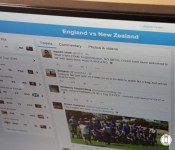
Indian carrier Reliance to provide free Twitter access throughout the Cricket World Cup

The Cricket World Cup is currently underway in Australia, and Indian carrier Reliance has announced today that it is partnering with Twitter to provide free access to the microblogging service to its customers for the duration of the event. If you’re a Reliance subscriber, you can now browse the latest tweets from the Cricket World Cup on Twitter without incurring any data charges.
Reliance has mentioned that anyone visiting www.rcom.co.in/cricket will be able to watch highlights, latest scores, team updates and more from the World Cup for free. There’s also a dedicated page on the carrier’s website through which customers can stay up to date on all the matches from the largest cricketing event in the world.
Arvinder Gujral, head of business development for Twitter in the region, stated that the partnership with Reliance will allow millions of cricketing fans to access all the action in real-time:
“All the exciting action on and off the pitch as well as the roar of the Indian cricket fans from Jamagar to Itanagar, and Srinagar to Coimbatore, will be heard on Twitter. Through this partnership, Reliance Communications will enable millions of subscribers across the country to join this cricket party for free and in real-time via Twitter.”
Indian readers, what are your thoughts on Reliance’s collaboration with Twitter?
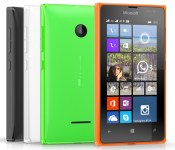
Dual-SIM Lumia 532 launches in India for Rs. 6,499

The Lumia 435 made its way to India earlier this month, and now its time for the Lumia 532 to do the same. Set to go on sale from February 20, the device is priced at Rs. 6,499 ($105), and is branded as “Windows 10 ready”, which means that it will receive the Windows 10 update for phones later this year.
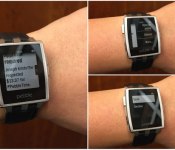
Any app that works with Android Wear now works on your Pebble

It’s been splashing around in beta for a little while, but now your Pebble can respond to notifications direct from that monochrome screen — kind of like Android Wear, sans touchscreen. You’ll need to update your Pebble smartwatch firmware as well as downloading the very latest edition of of the companion Android app to get rolling, but given Pebble’s popularity and price, it should mean far more people are making wrist-based responses to messages. Aside from the ability to set multiple custom notification responses (available to you whenever a compatible app offers a reply option), you can splash cash around with Square Cash approvals. The update also throws in support for Android 4.0 and over devices, as well as automatic app and watch face updates, even when your Kickstarted smartwatch is idle. Oh and you can reply with emoji. Hopefully, that will be enough to keep the Pebble on your wrist on until that fancy new interface arrives in the near future.
Filed under: Wearables, Mobile
Source: Pebble, Pebble (Google Play)
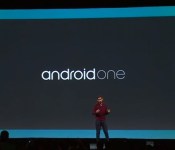
Google is launching Android One devices in the Philippines next

The pursuit to getting the world connected to the internet is moving along slowly but steadily for companies like Google. Keeping that momentum going, Google has just announced a couple new Android One powered devices, destined for the Philippines.
We recently took a shot or two at Android One in our Friday Debate Podcast, our general approach was that the devices did not offer enough bang for the buck vs some of the competition out there right now. As true as they may or may not be, Cherry Mobile and MyPhone will each have a new Android One device on store shelves in the coming weeks.

The Cherry One and the MyPhone Uno will be Android 5.1 Lollipop powered devices, with dual SIM and microSD card slots. Front and rear facing cameras will help users keep up with all the social trends and Google is happy to point out the battery saving and data saving features of Lollipop as benefits to users in the parts of the world, like the Philippines, that do not have power and data readily available for all.
Check out Google’s Asia Pacific focused blog post for all the details, including the fact that the Philippines is the sixth country to launch Android One devices. With more to come.
To all of our readers in the Philippines, are you excited for Android One, or do you already rock something a little bigger and better?
 AIVAnet