


Review: PULSE LED Speaker by Sengled
Back when Thomas Edison invented light bulb, I am sure he never thought a day would come when people would be able to control lights remotely. Like with the help of their smartphone. Oh, and also use those bulbs may some day be used as speakers! Growing up, even I never thought I will see such a day.
I had the opportunity to get my hands on the PULSE LED Speaker by Sengled.
Features and Functionality
 The reason behind the amazing sound quality of PULSE is the 1.75-inch JBL Multi-Channel Stereo Wireless speakers. The voice is loud yet clear; people often asked me where “that sound is coming from” thanks to surround sound effect.
The design of the PULSE reminded me about the shape of a Tulip, and it fits in every E26 standard socket, it can be used in a lamp, or even on the ceiling as well. If you have more than one PULSE, then you can create a Master+Satellite Pair, and they should be in the range of 100 feet.
The way it works is that your Android device is connected with the Master pair via Bluetooth, and then the Master pair sends it to other Satellite pair. With the help of PULSE app, you can control up to eight at a time. Each bulb has a life of 25,000 hours.
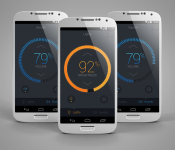
The app allows you to stream music with the help of bluetooth, plus you can adjust the volume and also the intensity of light. It is a very simple app, allowing you to control both options with a dial.
Conclusion
 If you are looking for a LED Speaker for your kitchen, room, office or any other place, PULSE by Sengled is the best choice. This is especially so where you have lights and you would enjoy some music playing in the background.
If you are interested, you can grab it for just $170 and 2 PULSE are included in the box (1 Master and 1 Satellite bulb). With amazing JBL sound quality and energy efficient dimmable LED light, this is the best it can get. It is available at Apple Store, Amazon.com, Home Depot, Sengled.com and SkyMall.
Let us know what are your thoughts in the comment box below.
(function() var script = document.createElement(‘script’);script.src = ‘https://stacksocial.com/widget.js?publisher=androidguys&type=editorial_post_widget_preferences’;script.async = true;var entry = document.getElementsByTagName(‘script’)[0];entry.parentNode.insertBefore(script, entry);)();
http://www.androidguys.com/pubgalaxy/728×90.html
The post Review: PULSE LED Speaker by Sengled appeared first on AndroidGuys.

Google Relaxes Project Zero Bug Disclosure Policy
 Google’s security team Project Zero recently announced some changes to its bug disclosure policy after controversially exposing Apple and Microsoft security flaws when the companies failed to meet the 90-day deadline. The new disclosure deadline has a 14-day grace period and excludes weekends and public holidays, providing tech companies with more time to properly address security vulnerabilities in their software.
“We now have a 14-day grace period. If a 90-day deadline will expire but a vendor lets us know before the deadline that a patch is scheduled for release on a specific day within 14 days following the deadline, the public disclosure will be delayed until the availability of the patch.”
Project Zero is a security team consisting of experienced programmers that look through the code of Google and several of its competitors to discover security flaws, like those uncovered in OS X Yosemite back in January. The team immediately discloses any vulnerabilities found to vendors, providing them with a 90-day deadline to release a software patch before sharing the vulnerabilities with the public.
The role of Google playing security watchdog for other companies has been the subject of much debate, with some believing that the company has a disingenuous agenda and others claiming that it is taking appropriate action. Google claims that it holds itself to the same 90-day policy it enforces on other tech companies, with bugs in the pipeline for Chrome and Android that are subject to the same deadline policy.
PNY hops on the Amazon Deal of the Day bandwagon with Micro SD cards, thumb drives, SSD’s and more on sale
Today is President’s Day here in the US. That means banks, schools and other state/federal workers won’t be out doing their jobs today in observance. It also usually means there are a number of sales happening. While today’s Amazon Deal of the Day isn’t exactly labeled as a President’s Day sale, it is still a […]
The post PNY hops on the Amazon Deal of the Day bandwagon with Micro SD cards, thumb drives, SSD’s and more on sale appeared first on AndroidSPIN.
ASUS won’t be dropping Android Wear, but we can expect a new smartwatch companion in the future
The smartwatch game has been slowly heating up over the last year or so. Much of that is thanks to Google and the Android Wear platform that gave manufacturers a simple to implement OS that would connect to Android devices everywhere. Many of the big players got involved right out of the gate and continue […]
The post ASUS won’t be dropping Android Wear, but we can expect a new smartwatch companion in the future appeared first on AndroidSPIN.
Here’s what our readers think of the Microsoft Band
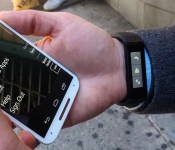
 When we originally reviewed the Microsoft Band, we felt it was more a proof of concept than an actual consumer product. We liked the potential of Microsoft Health as a cross-platform service that went beyond fitness to track your lifestyle for a more comprehensive picture of overall wellness. But we found the hardware to be lacking in one key area: comfort. In particular, we described it as “an ergonomic nightmare,” and we weren’t alone in our assessment. PC Mag called it “wildly uncomfortable” while CNET compared it to a shackle or handcuff.
However, while the critic response to Microsoft’s first fitness tracker has been rather lukewarm, consumers have come out in droves to tell us of their own positive experiences with this new wearable. We certainly found the Band ambitious, but we didn’t think it would be this contentious: While our own review gave it an Engadget Score of 65 (out of 100), the user review average currently stands at 8.8 (out of 10). And plenty of you left comments to tell us why it ranked so highly with you.

As a tracker, the Band was well-liked, with Spineless finding the sleep function “amazing, even though you have to tell it when you are ready to go to sleep.” Not everything worked perfectly, though. Civan93 says, “The GPS antennae are too small, so it takes forever to get a signal.” He also had issues with it counting his steps while driving or on the subway. ChillEDog even had to return the Microsoft Band to the store due to a faulty heart rate monitor. Indeed, Spineless felt it was “more of an activity assistant” than a fitness tracker, and kehoz says that it’s a “great personal device, but a poor fitness tracker.” He says he would have returned it already if it were just a tracker.
“I wouldn’t call it a fitness tracker; it’s more of an activity assistant.”
However, the user experience generally left a good impression, with jtovar liking how intuitive the physical controls are and ssaaxx says that the “simplicity and friendliness of the UI is a blessing.” But even then, not everything was a match made in heaven. Ionothanus thinks that a few of the apps “are slightly less than intuitive,” and DRGDC was “disappointed that alerts will pile up on the Band and not be cleared when they are read/cleared on other devices such as my phone.” Despite that niggle with the notifications, the ability to receive alerts on the Band might have been one of the most-loved features of the device, with kehoz finding them “really, really useful.”
However, users who like to view and analyze their stats walked away unsatisfied, with jtovar noting that “data collection is great, but right now Microsoft does not really give you the ability to do anything with this data.” And ALEXSWLI, who mentions he works for Microsoft, laments that the “only way I can analyze the data is to look up the data night by night and punch it into a spreadsheet on my own.”
 But despite the Band’s plethora of features and a friendly user interface, PC Mag notes that “none of that matters if you can’t stand wearing the thing.” And our users certainly weighed in about how they felt. Or rather, how it felt on their wrists.
Many users reported feeling uncomfortable when they first got it, with kehoz noting it’s “a bit clunkier than I would like and can get caught on my jacket cuffs.” CAL127 also found it “a bit bulky at first and it won’t fit under tight hoodie sleeves,” but he also said that after about a day “you will forget it is there.” Many compared it to getting used to a watch, with onetwright feeling “it disappears as much as any wrist wearable does” and civan93 finds “I don’t even notice it 90 percent of the time.” Ionothanus says that it’s uncomfortable only if you wear it wrong, and says that despite your natural instinct to cinch it tight, you shouldn’t, because “fetishists and felons wear handcuffs this way.” Instead, if you “adjust the Band to be worn loosely as you would wear a watch, it’s suddenly just as comfortable as one.”
“It’s built very well, but I wish the screen were as scratch-resistant as my phone.”
Not everyone was a fan of the ergonomics, though. Xler8r says that the charging port caused allergic reactions, and “it was only comfortable when facing down (which isn’t super useful since it scratches when it’s down).” A highly scratch-prone screen was an issue for many users, with xler8r noting the screen mars “super easily with very light use,” and civan93 says his screen is “pretty well thrashed.” Microsoft does provide a free screen protector, but civan93 feels the scratching issue could have been easily fixed by recessing the screen a bit. The Microsoft Band is well-built otherwise, with boykodaniel reporting that his only had one scratch on it despite him “constantly hitting the Band on something as I’m working” in an R&D lab. Agkremper even beat it up “pretty bad” while doing yard work “and it still keeps going.”
The Microsoft Band’s battery life is about two days — short for a fitness tracker, but not bad for a smartwatch. User reactions were highly dependent on what they expected out of the device, with jtovar calling it “good enough” and calpdx saying it’s “adequate unless you want to use the Band for sleep tracking on a daily basis, then you essentially have no time to charge it.” Ionothanus disagrees, saying that “if you can’t find 30 minutes a day where you are sitting in one place and can plug in the band, buy two, because you’re too active.” Mnm20 just “incorporated charging into my daily schedule so it doesn’t cause much disruption in my usage.”
Ultimately, few users encountered any issues that would be considered dealbreakers. Even minor issues they chalked up to being typical of a first-generation device, with CAL127 saying that though it is “not perfection, it is on the right track.” Dholster feels it “is a great device” for the price. Jtovar says the Band has “a lot of potential, but it definitely is a first-generation device,” while Gmaimone looks forward to “how MS will evolve the next iteration.” But even the Microsoft Band as it currently exists has left a lot of users pleased with their purchase, and ionothanus simply calls it “a magical experience.”
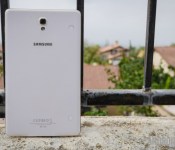
Samsung will reportedly use a metal frame in the Galaxy Tab S2

If all the rumors prove true, we can expect Samsung to unveil the Galaxy S6 and Galaxy S6 Edge on March 1st at the company’s Unpacked event. Today we’re finally getting a break from the Galaxy S6 rumors, this time focusing on the company’s tablet lineup. In a report from SamMobile, Samsung’s Galaxy Tab S2 will allegedly feature a metal frame, and will be significantly thinner than the Tab S, and more specifically, thinner than the Apple iPad Air 2. The Galaxy Tab S is only 6.6mm thin, while the iPad Air 2 is 6.1mm thin. The report doesn’t state whether the Tab S2 will be significantly thinner than 6.1mm. We couldn’t imagine Samsung shrinking it down too much more, or else the company many need to make some big sacrifices when it comes to internals.
The second, and less surprising, rumor in the report is Samsung’s decision to build the Tab S2 with a metal frame. Multiple rumors have surfaced regarding Samsung’s decision to build the Galaxy S6 with a metal chassis. Plus, we’ve heard for months that the company has a ‘Project Zero‘ mentality, with hopes to start from scratch and bring more premium materials to their devices, so this rumor isn’t all that surprising.
The report also mentions that the Galaxy Tab S2 will be available in 8.0-inch and 9.7-inch variants, both with a 4:3 aspect ratio. The current Galaxy Tab S comes in 8.4-inch and 10.5-inch versions, so we can expect to see a slight variation in screen size with these newer models.
No timeframe is mentioned about the release of the Tab S2, but we’ll keep you updated if we hear anything.
Galaxy S 6 could sport a smaller battery than the Galaxy S 5
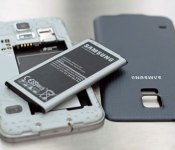
 The Galaxy S 6 will most likely be a lot thinner than the Galaxy S 5, but one major downside could be the battery. Not only will it be non-removable, it actually might be smaller than its predecessor.
One would think that Samsung could fit the new Galaxy S 6 with at least the same size battery as the S5 since battery technology keeps evolving, but unfortunately that won’t be the case. It’s expected to come in at 2600 mAh as opposed to 2800 mAh on the S5, which is about 7% less.
Now the fact that it’s going to be smaller doesn’t have to be a bad thing. The new Exynos 7 processor might add more efficiency in that overall battery life might not suffer at all. Still, the bottomline is that if you are running out of juice, you will not be able to swap batteries. Also, since a Qualcomm chip won’t be present, the S6 won’t feature quick charging capabilities to get you out of trouble faster.
The S6 is supposed to offer wireless charging built-in (no special case required) so that might be of some help. It will be easier to charge more often, but you will also have to own a few charging pads to make use of it.
Come comment on this article: Galaxy S 6 could sport a smaller battery than the Galaxy S 5
Sprint begins roll out of Android 5.0 to LG G3
Almost a week ago AT&T began pushing out the OTA update for the LG G3 that moved the device to Android 5.0 Lollipop. It is usually safe to assume that once one carrier starts, the rest will soon follow. The real questions are who will be next and when will it start. Today Sprint is […]
The post Sprint begins roll out of Android 5.0 to LG G3 appeared first on AndroidSPIN.
Popular Media Player App ‘VLC’ Slowly Returning to the App Store [iOS Blog]
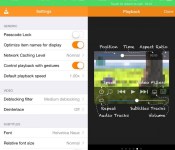
A few users began reporting on Reddit yesterday the return of popular alternative media player app VLC to the iOS App Store. The app, which arrives as a 2.4.1 update including iPhone 6 and 6 Plus support, is still rolling out to all users and currently shows as unavailable in the App Store for most countries, although some users who had previously downloaded the app before its removal have been able to access the new version through their purchase histories.

VLC for iOS was pulled from the App Store around the launch of iOS 8, and the company never officially commented on the reasons behind the mysterious disappearance other than saying it was “working with Apple on a solution.” In late December, the company confirmed the app would return to the storefront in “early 2015.”
The updated app, which allows users to use and watch many non-iOS friendly media files, sees the inclusion of folder support, passcode lock, and optimization for the larger screen sizes of the iPhone 6 and 6 Plus amongst other updates. The app is rolling out to a select few countries first, and is expected to be made widely available to U.S. users soon.
VLC previously saw nearly a three-year hiatus from the App Store when it was taken down in 2010 thanks to licensing issues, finally returning in the summer of 2013.
A future Asus smartwatch won’t use Android Wear

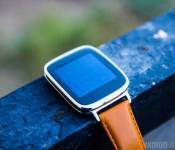
A couple of weeks ago, Jonney Shih, chairman of Asus, began talking about the company’s plans for future smartwatches. Longer battery life was one of the key improvements that the company wants to make, but Asus stated that it may need to leave Android Wear behind to accomplish this. Speaking this Friday, Asus CEO Jerry Shen reaffirmed that the company will be ditching Android Wear for at least one upcoming smartwatch, in order to achieve longer battery life.
No exact hardware details were given out about the new smartwatch, but previously Shih had suggested that Asus was targeting battery life that would last seven days. Shen also let slip that the non-Android Wear smartwatch may be powered by a new MediaTek SoC, which is said to still be under-development.
“We will continue to work with Google on Android Wear, and we will have another (smartwatch) that is not based on Android Wear and features a longer battery life,” – Asus CEO Jerry Shen
Despite the talk of an Android Wear alternative, Asus stated that its second-generation ZenWatch will still make use of Google’s wearable platform.
Instead of abandoning Android Wear completely, the company appears to be planning a separate smartwatch line that will offer a longer battery life at the expense of some of Google’s platform features. Previously, Asus also announced that is has two lower cost “wristband-like” devices in the pipeline, which will focus on the health and fitness market.
 AIVAnet