


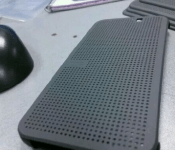
New leak reveals HTC One M9 in the latest Dot View case

A report from last week suggested that HTC would introduce new color variants with the Dot View case for the One M9 smartphone. Today, we’re getting our very first look of the cover (in black) thanks to a new leak. This comes after we stumbled across the back panel of the One M9 yesterday, revealing the camera and LED flash placement on the handset.
At first glance, there’s nothing new with this case compared to the Dot View case from last year. But we’re certain that HTC has some new tricks up its sleeve to show us with the newest iteration of the Dot View case. Nothing more can be ascertained from these leaked images, although we hope to learn more over the coming days.

The One M9 is expected to be packing a Quad HD display, a Snapdragon 810 octa core chip, 32/64GB of storage, 3GB of RAM and Android 5.0 Lollipop with Sense 7.0 UI. The launch of the flagship has been scheduled for the 1st of March in Barcelona.
Source: Weibo
Via: Phone Arena
Come comment on this article: New leak reveals HTC One M9 in the latest Dot View case
Study reveals that teens who use smartphones and computers excessively are less likely to fall asleep

A new study found on the BMJ Open Journal suggests that teenagers who use smartphones, computers and other electronic gadgets excessively prior to sleeping are likely to harm their sleep schedule. This isn’t exactly the revelation of the millennium, but the findings shed light on how it could impact the future of the teenagers.
It is said that people who use computers or smartphones an hour before going to sleep are 53% and 35% less likely to fall asleep, while missing at least 2 hours of sleep. This particular research was conducted among 10,000 teenagers (ages 16-19) in Norway.
Although the researchers haven’t been able to pinpoint the actual cause, it can be accredited to the bright display panels we see on modern electronics. The concerning aspect of this study is the fact that scientists have managed to correlate teenage sleep issues with future trouble such as drug abuse, obesity etc.
So if you happen to find trouble falling asleep, you might want to cut down on smartphone or PC usage prior to sleeping.
Source: BMJ Open Journal
Via: BGR
Come comment on this article: Study reveals that teens who use smartphones and computers excessively are less likely to fall asleep

Stable version of VLC now available on the Play Store

VLC has finally released a stable version of its media player app on Android. The app was available in a Beta for quite some time now, so it’s relieving to know that the stable version is out as well. However, VLC has still kept the Beta version of the app intact for those who would like to play around with it.
The release of a stable version essentially means that the app will not have a lot of bugs and will be as functional as you’ve ever seen it. The app is competing with the likes of MXPlayer and KMPlayer on Android, so it has some competition going around.
VLC for Android comes with support for a wide range of codecs such as avi, mkv, mp4, mov, mp3, flac etc, so you can throw a wide range of video and audio files at it. It is a free download from the Google Play Store, so hit the link below to download the app.
Come comment on this article: Stable version of VLC now available on the Play Store

Apple’s HealthKit takes the early lead over Google Fit in U.S. Hospitals

Apple and Google might battle for supremacy when it comes to smartphones and tablets, but the healthcare sector is going to be another big battleground. It’s still early in the game, but Apple is already winning.
Reuters contacted 23 top U.S. hospitals and 14 of them are conducting a pilot program using Apple’s HealthKit. Google offers Google Fit, which isn’t as advanced at HealthKit, but they have started discussions with a few hospitals. Another player is Samsung, but just like Google, they barely have a foot in the door.
Hospitals hope to use these services to help physicians monitor patients for chronic conditions like diabetes and hypertension. They could provide the information necessary to prevent repeat admissions or to prevent more acute issues.
Probably the biggest reason HealthKit is kicking ass is because there are over 600 developers working with it. Google Fit only has a handful. HealtKit can already detect glucose measurements as well as monitor blood pressure. This is on top of the exercise-tracking apps that both Samsung and Google offer. The Apple Watch will bring even more data to both users and health professionals.
It seems like Apple will always have the edge when it comes to development. Developers flock to their products first. Is this early lead an indication of the future or will Google make a comeback? Once a hospital chooses one service, it’s unlikely to switch that easily.
source: Reuters
Come comment on this article: Apple’s HealthKit takes the early lead over Google Fit in U.S. Hospitals
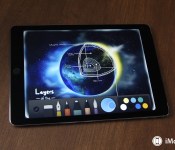
FiftyThree’s Paper tools are now free — draw to your heart’s content

There are a ton of veritable sketching, drawing, and handwriting apps out and about on the App Store, but the one that holds a special place in my dock is FiftyThree’s Paper. The app’s won many a convert for its excellent drawing tools, previously encumbered by an $8 in-app purchase; as of Thursday, however, those tools are now completely free for everyone and anyone to scribble to their heart’s content.
FiftyThree doesn’t give detailed reasoning behind its decision, published in a blog post earlier this morning, though the company does note that it hopes to grow its Mix platform and overall usage of the app:
At FiftyThree, we built Paper to remove barriers to creativity by putting simple, powerful tools into people’s hands. By making Paper accessible to all, we hope to see more great ideas come to life – on Mix and everywhere.
I also wouldn’t be surprised if the company did this in hopes to gain more users of its $60 Pencil stylus, one of FiftyThree’s remaining paid products. The other, a $25 Moleskine print of any of your virtual Paper sketchbooks, may be equally appealing to users who now have to pay nothing to play with the app.
This move may not particularly please the legions of Paper fans who already paid for their tools, but as one of those people, I’m not particularly perturbed: Because of those in-app purchases, I’ve gotten to use the app in full for several years now; if I’d waited until the tools were free, I wouldn’t have had any of that time to sketch, create, or paint what I’d liked.
Despite the move to a fully free app, I’m hoping this doesn’t hinder or otherwise hold up Paper’s development; I’ve been wanting a Procreate Pocket-style iPhone app for years, and there are still plenty of other little quibbles and bug fixes the company could undertake.

ARM’s latest IP could be another boon for China

ARM’s newly announced Cortex-A72 CPU and Mali-T800 GPU IPs are clearly exciting prospects for us consumers, but new technologies also create plenty of business opportunities.
At the top of the list of likely beneficiaries is TSMC, the Chinese chip fabrication company that ARM has been optimising its new physical IP with. TSMC’s 16nm FinFET+ process will be the first foundry to support these new IPs, which will give TSMC a head start over its rivals. Even over those with smaller manufacturing nodes on the way. Support for other foundries will come in time, but the first batch of smartphones powered by these chips will likely contain parts produced by TSMC and are expected to arrive sometime in 2016. Even further into the future, ARM and TSMC have already announced a roadmap to reach 10nm optimized designs.
ARM has hinted that “more than ten partners” are already licensing the Cortex-A72 processor design, three of which are China-based HiSilicon and Rockchip, as well as Taiwan’s MediaTek. Each of these companies will likely be using the new IP for their own line-up of mobile application processors. While Apple, Samsung and Qualcomm leverage ARM’s IP for their own custom SoC designs, Huawei’s HiSilicon and MediaTek traditionally stick closers to ARM’s reference designs, which may allow them to ship products to market in a shorter time frame.

HiSilicon leverages ARM’s IP and TSMC’s foundry to produce a range of SoCs.
Importantly, it is these local SoC designers and manufacturers which power a large percentage of China’s gigantic smartphone and tablet market. Although Western markets still make use of PCs for some of their internet access, a large percentage of China’s growing online population are connecting to the internet entirely through mobile. A Chinese government report counted 649 million internet users by the end of 2014, with 557 million using handsets to go online.
Part of ARM’s approach with this latest generation is too scale performance between low and high power devices. In China, where mobile is much larger market than the West, ARM’s new IP will enable local development and production of more powerful mobile devices, to fill in existing gaps in the market. There are a lot of potential consumers, and the first to market with new and improved technologies will likely secure significant sales figures.

ARM’s Ian Ferguson expects that smartphones will move closer to becoming “primary computing platforms” in 2016, and China’s consumer and manufacturing bases are likely to be at the forefront this movement.

Microsoft acquires Sunrise Calendar for $100 million

Maker of popular Windows products, Microsoft has reportedly shelled out the big bucks to acquire start-up Sunrise Calendar for a hefty $100 million. Precise details regarding the acquisition haven’t been disclosed by either party, but the report seems to be coming from legitimate sources in the industry.
Sunrise Calendar is a cross platform application which can sync calendar data from Google, iCloud and even Microsoft Exchange. There are Windows and Mac variants of the app as well, so it’s one of those apps which practically anybody can access.
This is a strategic move by Microsoft in acquiring one of the popular calendar applications going around. It is being said that Microsoft might keep Sunrise independent, although it goes without saying that some of its technology will be used by the Redmond giant.
Given that Microsoft is touting its new Office products as an entire package rather than individual apps, acquisition of Sunrise (and Acompli recently for $200 million) certainly makes logical sense.
Via: Tech Crunch
Come comment on this article: Microsoft acquires Sunrise Calendar for $100 million
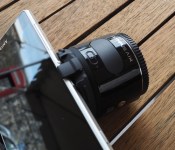
Olympus Air wireless lens camera pairs with your smartphone

Remember Sony’s attachable camera lenses for smartphones – the QX1 and QX30 – from last year? Well, Olympus, which is partially owned by Sony, has its own take on the wireless camera attachment formula, with its newly announced Olympus Air A01.
As far as camera specs go, the Olympus Air features a 16-megapixel Live MOS sensor and can be used with any Micro Four Third lens. The Air can capture fast moving subjects with its 1/16000 ultra-high-speed shutter, allows for continuous shooting of up to 10 frames per second, and there is a three times digital zoom thrown in for extra flexibility. The camera is also capable of taking up to 320 pictures on a single charge of its battery and weighs a reasonable 147g. But the real talking point is that you can partner the lens up with your smartphone to frame, edit and store your shots.

The camera supports both Bluetooth and WiFi connectivity when pairing up with a smartphone, and comes with an app to help setup communications and transfer pictures between the two.
The Olympus Air already works with a series of apps, such as one designed to replicate a physical camera mode dial, capture shots using 14 art filters or 9 different effects, or simply trimming down your snaps. The company is also keeping the Air as an open-platform, allowing third-party developers to come up with their own apps for the device.
The Olympus Air has only been announced for release in Japan so far and will go on sale on March 6th. The retail price is around ¥33,800 ($290) and can also be grabbed with a 14-42mm f/3.5-5.6 lens bundle for ¥49,800 ($425).

US Navy’s firefighting robot finally appears (with a trusty sidekick)

SAFFiR, the humanoid firefighting robot that the US Navy and Virginia Tech engineers have been developing for years, is now more than just a blueprint. In fact, the military division has already demonstrated what the biped can do aboard one of its decommissioned ships. During a series of tests conducted in November 2014, it worked well enough to navigate uneven floors (extremely difficult for humanoid machines), identify equipment using thermal imaging and handle a hose to put out small fires. The Shipboard Autonomous Firefighting Robot did need a bit of help from a sidekick, though. No, not the firefighting snakebot Anna Konda (which is unfortunate, if you think they’re the perfect pair), but a small drone created by Carnegie Mellon’s Robotics Institute.
That drone is an autonomous quadcopter called Damage Control Technologies for the 21st Century (DC-21) designed to be smaller than commercial models hobbyists can buy, so it can fit in tight entrances. It uses infrared to detect fires, depth cameras similar to Kinect’s to map out locations, and it obviously has the capability to communicate, as it was made to relay those data to SAFFiR. Since it’s so small, the battery that can fit in it only lasts for 5 minutes. Its creators are planning to build a version with two large propellers instead of four small ones, though — that way, its power source can last for up to 30 minutes.
As for SAFFiR itself, well, looks like a goofier, less terrifying version of DARPA’s Atlas. It stands at 5-feet-10-inches and weighs 143 pounds, equipped with infrared and a rotating light detection and ranging (LIDAR) laser to be able to make its way through dense smoke. It apparently has the capability to perform tasks autonomously, but since the goal is for people and robots to work together in the face of danger and not to replace the sailors, it was designed to take orders from a human controller.
Despite performing well during the demo last year, that doesn’t mean SAFFiR’s ready to be deployed. It still needs to be tethered to stay upright in its current state, and it’s just much too slow to be a first responder. Plus, the current model is not water- and fire-proof, which sounds like a recipe for disaster since it’s firefighting robot on a ship. That’s why the Navy plans to commission a more advanced design with “enhanced intelligence, communications capabilities, speed, computing power and battery life for extended applications.” Also, SAFFiR will most likely be fitted with more sensors in order to perform mundane tasks and free up sailors to accomplish more complicated ones.
[Image credit: US Navy/John F. Williams/Released]
Filed under: Robots
Via: PCWorld
Source: US Navy, Carnegie Mellon University

Apple Retail roundtable: The stores of today and tomorrow

April will mark the one year anniversary of Apple’s SVP of Retail and Online, Angela Ahrendts, joining the company, and it sounds like the training wheels are off and the retail veteran is ready to start making her mark on the company. Amidst new stores launched and announced, and ongoing rumors of new outfits, new designs, and new areas for the Apple Watch, we decided to put together our own thoughts on Apple Retail, both where it is today and where it looks to be heading tomorrow.
On the styling
 Ren: As a former Apple Retail survivor — one of its few part-time Creatives! Woo! — I can’t help but have an odd fondness for the wooden, glass, and steel architecture of the stores. But I’d be foolish to insist that the Apple Store resist change. They’ve been overcrowded since I worked there back in 2008, with little room for setting up the kinds of displays and jewelry counters an Apple Watch might require. So I’m not opposed to seeing an evolution of the Apple Store design.
As to the Best Buy-colored blue Apple polo shirts, however… they might look a heck of a lot nicer in person, but as someone who worked at the company in its “wear anything under and around your Apple shirt as long as your lanyard and logo are visible” heyday, I can’t see myself getting excited about this change. Tan slacks? No identifying lanyard or business cards? I get that your average Apple Store employee may not dress the way a Burberry salesperson might, but I see that — the personality of the employee — as a bonus, not a drawback. It made everyone human and approachable in a way I don’t think this new outfit will. It might sell more $5000 Apple Watches, but I worry about losing a bit of retail’s soul in the process.
 Ally: When I imagine an Apple Store with Apple Watch displays, I imagine the type of layout you see when you walk into a large department store like Selfridge’s. I’m not quite sure why and maybe it wouldn’t make sense in an Apple Store. However, in my mind a section for Apple Watch complete with jewelry cases and then you walk to the next designated area and you have displays that show off headphones and audio. Similar to how you walk from iMacs in the technology section of Selfridge’s and then you walk 5 feet and you’re in a mini Bose or GoPro store that’s catered to their layout.
As far as uniforms, GTFO. I don’t think I’ll get used to that in an Apple Store. Employees having their own personality in those stores is part of what I think makes employees much more approachable. Don’t take that away.
 Peter: Gold for command, blue for science, red for operations and security. Everything I know about fashion I learned from Star Trek.
Apple’s austere presentation for its products enables the products to lead the customer experience, not the setting. Whatever Apple does to it stores, I hope this basic design philosophy remains in place.
 Rene: Apple’s focus on a small subset of high quality materials is classic — timeless even. Like gray interfaces, they face into the background and let the products be the stars. They’ve started to amp up their photography, though. They’ve gone from those products in super-focus on sterile white backgrounds to frames filled with people and art and life. It’s a subtle but profound change.
I don’t think we’ll be seeing couches in Apple stores any time soon-as-in-ever, but I do think we’ll continue to see those kind of evolutions. It’s the perception of change here that’s important. Apple Retail should never be boring but it should never be alien either.
As to the new blue and beige duds… I share Ren’s concerns. I’m hoping they won’t look as Best Buy in person as they do in the mock ups. But I’ll miss some of the old style and old trappings. I’m all for new, as long as it’s improved, and with trends, only time can tell.
On the checkout process
Ally: I’ve used EasyPay numerous times in Apple Stores. Unfortunately, it solves about as many problems as it creates for employees. Mainly because multiple item support is obnoxious and because people that don’t understand the system can actually create more questions and headaches for employees. For those of us that want to walk in and buy a case and walk out, it’s great. Other than that, most customers don’t know it exists and that should change.
Peter: Apple already makes it dead easy to buy new products, if you’re invested enough to understand the ecosystem and learn how to download an app and sign in using your Apple ID, so you can pay for things. I’m not sure how much easier Apple can make this experience.
Rene: Apple has more customer service staff on the floor than most stores have customers. Sometimes, however, even that doesn’t seem to be enough. I like the self-checkout aspect of the Apple Store App, but only being able to scan and pay for one item at a time can be a drag, especially when you’re stocking up for the holidays. Can we have multi-item checkout please?
As a Canadian, I’m still waiting for — and endlessly complaining about waiting for — Apple Pay. Hopefully that makes the process even more efficient for when the app doesn’t or can’t work.
Ren: Much agreed with Rene on the ease of self checkout, but also the lack of multi-item checkout. There’s also gotta be a better way to advertise and explain the self-checkout process: During the busiest times on the floor, there are often no employees available to assist customers who have questions about EasyPay or getting bags for their lower-cost items. I don’t know if that means making a single employee — say, like the concierges at the front of the store? — available for these issues, but it’s definitely an area worth improving.
On the Genius Bar
Ally: I’ll be the first one to admit that I’m extremely picky about my devices. It’s part of the reason I buy Apple products. Hell, I’ve walked into an Apple Store because my Home button “creaked” funny and walked out with a new iPhone, no questions asked.
Best experience? I had consistent display issues with the first generation 27″ iMac Apple ever produced. I had it in for service three separate times. The fourth time was almost 2.5 years after my initial purchase. I voiced my concern over this happening again after I was out of warranty in a few months. Minutes later a manager walked out with a brand new 27″ iMac box that exceeded the specifications of my current model. I paid for another Apple Care protection plan and walked out with a brand new iMac. I didn’t even ask for one. And to think I couldn’t even get Sony to take responsibility for a bad battery in a Vaio laptop.
Worst experience? A genius that was having a bad day and complained slightly about swapping out an iPad with a bad Power button a few days after the warranty was up. Hey, I’ll take it.
No where else on the planet will you receive the customer service experience you get into an Apple Store. The only thing Apple needs to make more obvious is that you need an appointment beforehand. Many folks don’t realize this and they walk in upset when they find out they can’t be seen for hours.
As for repairs, I like that Apple is making that more accessible. I know some folks want to see Apple do even more but I get why they don’t. No one wants to wait hours to have their phone back. Apple’s concern is the overall experience you have in their stores. Any repair that is going to take away from that, isn’t worth their time. They’ll give you a new device and send your old one out to be repurposed. It’s a balance and Apple’s done a stellar job so far.
$110 for a new screen on an iPhone 6 with zero warranty and no insurance? How could you possibly complain?
Peter: My experience with the Apple Geniuses has been faultless, but I’ve heard plenty of horror stories that reinforce to me that Apple’s batting record isn’t perfect vetting people who know what they’re talking about or explain it effectively enough. But the real problem with the Genius Bar is the wait to talk with someone. You have to make an appointment at just about every Apple Store, which puts people off. No one likes to wait, and no one wants fixing their phone or their Mac to be like bringing the dog to the vet, either.
Rene: A couple years ago my iPhone 4s was hit by New Year’s event fireworks. It mangled the oleophobic coating and made it feel like sandpaper. I brought it in, got a stern lecture on taking better care of my iPhone, and left with a brand new one, already restoring via iCloud, without being charged a penny.
I took my MacBook Pro in a couple of months ago for a battery swap and received just as great service. Apple Genius is so good, my only concern is how Apple can scale it as they become more and more popular.
Maybe they’ll need a bigger bar?
Ren: We’re gonna need a bigger bar, Rene. Or a better one. It’s difficult on a number of levels: one, there’s only so much room in a retail store for repairs, especially for a service that often times results in no sales. Two, as more and more stores open, the talent required to be an Apple Genius has lowered, and that’s resulted in a variety of skill levels and proficiencies. The Genius area has also traditionally been shared by the Personal Training (One to One) program, Personal Setups, and workshops in most stores; while I’d hate to see those go away, they’re also valuable real estate space — especially for iPhone swaps.
What I’d like to see is more initial triage done online: There are questions and tests a user can run online at home, and being able to put that into your initial Genius record may mean less time spent at the Apple Store — both at the table and in the back room.
On training and workshops
Ren: As a part-time One to One trainer for almost two years, I can’t emphasize enough how special that program was for its recipients. It was incredible to work with people of all ages, nationalities, disabilities, and technical levels, and taught me a whole lot about how best to help users with their technology. We taught people how to fish, rather than catching fish for them, and that kind of learning almost always begets excitement and more learning.
It makes me sad to think that it might get shuffled into the background at the expense of a bigger Genius Bar or an Apple Watch area, and I’m hoping that Ahrendts understands the true value of what these sessions and workshops hold.
Ally: I’ve never particularly had any experience with One to One but I know several people that have and I see the sessions when I’m in the store. I also have a good friend who works in an Apple Store and has done training sessions and hosted events like Hour of Code. He loves doing it just as much as customers love attending. This kind of training is something that makes Apple unique and it adds so much value to the brand. I’d like to see Apple find a way to offer this on a different level that address some of the concerns Peter has voiced. And I certainly hope they don’t downscale this kind of offering at the expense of needing floor space.
Peter: The problem right now is that the traffic level in most stores is so high, retaining any of what you’ve learned can be difficult, at best. General workshops for basic stuff might work well in most Apple Store settings, but I think detailed one-on-one training and more involved efforts to teach people lasting skills has to happen in a more calm environment conducive to learning.
Rene: My mom went for one-on-one training when she got her iPhone 5c and loved it. My godkids went to Hour of Code and left thinking they could make video games. That Apple provides so much free and cheap training is of enormous value to their customers.
I do wish some of the more advanced training, like pro-apps, and some of the cooler events, like developer and artists talks, were available at some of the smaller stores as well. I understand supply and demand, but I experience envy and want.
On education and business
Ally: My complaints here are the same as Peter’s and Ren’s. Not a lot of people know these services exist. Even has a small business or a self employed individual, Apple offers wonderful support that consists of IT support, discounts, and much more. The same goes for education. Apple needs to find a way to expand this service. I’d also like to see some lower price points for small business. Some folks can’t justify the hundreds of dollars a year but maybe something scaled back that offers a compromise would be a happy middle ground.
Peter: Apple has a two-tiered approach to education and business: It can and will handle plenty of it through the Apple Stores, but it’s not afraid to defer clients it think will be better handled to Apple Specialists in the area that can tailor their service and support to suit special cases. I earnestly hope that will continue, because there remains a thriving network of third-party specialists willing and able to serve, if Apple’s willing to give them a seat at the table.
Rene: I’ve no experience with education, though I do hope my godkids get to go on one of the field trips Apple offers next year. I do have experience with the business reps and it’s been terrific. If you’re ordering a lot of devices, if you need special configurations, or if you have questions, they’re super helpful. There’s also a discount for some purchases, which is a nice bonus.
The only negative is that I think not enough people are aware of the services.
Ren: Apple’s education services (like Apple Camp) and business department aren’t widely advertised to the average consumer, but they’re very specially targeted to schools and small businesses in the area. They work precisely because they’re not overwhelmed or overcrowded. I am hoping to see more Hour of Code-like workshops for kids, however. I went to one in New York City and it was incredible to observe; the more children we can get excited about coding now, the better.
On the Apple Watch
Ally: I’m not quite sure how I feel about Apple Watch in retail aside from the fact that I want to see every part of it before choosing. That’s a unique problem for Apple. Their stores are so crowded already. It’s going to take some clever displays in order to make that work.
Peter: I think that for many of us, it’s going to be enough to present the Apple Watch in the regular store setting, and that’ll be what we need to get drawn in to use it, decide if it’s right for us, and buy it. But I understand that customers used to buying high-end precision timepieces have a different retail expectation. I’m very curious to see how Apple balances this approach in a way that won’t alienate either the 99 percent or the 1 percent.
Ren: From what I’ve heard about Ahrendts, Peter, I suspect the 1 percent is a big factor in the refactoring of stores for Apple Watch displays. The Apple Watch Edition will likely make or break the fashion-end of the digital watch industry (so far pretty much non-existent), and you know someone with Burberry in their pedigree will do everything they can to give the Watch a smash entrance.
I’m secretly hoping that this really won’t be too different than the Apple Store’s current layout, just with those awesome glass-covered tables we saw at the Apple Watch press event in lieu of your traditional Apple wooden table. When you think about it, Apple stores really aren’t that different than your average jewelry store, with display tables, plenty of salesfolk, and no clear place to check out.
Rene: The Apple Watch is going to change things. It’s the size of an iPad but it’s the breadth and scope of something beyond even the iPhone. People will need to choose their sizes and their materials, and they’ll need to choose their bands. It’s not that different from choosing a screen size, color, and case, but it’s more personal and more fashionable. And actual gold is more involved than gold finishes.
Where will they be placed? How will they be demonstrated and tried on? How will they be serviced and exchanged? There have been reports of special areas, safes, and scales, but how it all plays out will be fascinating — and telling — to see.
Bottom line
Ren: I went to the very first Apple Store opening, and half of my family has worked for Apple at some point. I want Apple’s retail operations to continue, and continue proudly. But as wildly successful as the stores are, they can’t just exist on the success of their past. They have to evolve. How they evolve is up to Ahrendts and Apple. There are going to be a lot of overseas stores opened in the next year, and those may well sport prototypes of the design direction for the future, as well as areas for the Apple Watch.
Ally: For Apple retail to continue offering the same great experience they’ve always offered, they’re going to have to scale. Luckily, scaling is something Apple is very good at. Just look at how they’ve scaled production and assembly lines to meet demand. No other company in the world has scaled manufacturing the way they have. Retail is the same concept. It’s just going to take the right people to figure out how. The current store setup is going to have to evolve to house an all new kind of customer. I’m not sure what the solution is but I hope it doesn’t come at the expense of scaling back the already great services Apple retail offers.
Perhaps I have an “I want it all” mentality and that isn’t realistic. But then again, the experience I get at an Apple Store now isn’t something I would have thought to be realistic in any retail environment 15 years ago.
Peter: I think that for many of us, it’s going to be enough to present the Apple Watch in the regular store setting, and that’ll be what we need to get drawn in to use it, decide if it’s right for us, and buy it. But I understand that customers used to buying high-end precision timepieces have a different retail expectation. I’m very curious to see how Apple balances this approach in a way that won’t alienate either the 99 percent or the 1 percent.
Rene: Apple Retail, like much of the rest of Apple, is mindblowingly successful. Part of Apple’s model for success, however, is continually obsoleting themselves. They don’t care if you buy an iPhone, iPad, or Mac, as long as you’re buying from them. Likewise, Angela Ahrendts in now senior vice president of Apple Retail and Apple Online stores. Those lines could start to blur in interesting ways.
Sure, people joke about selling Apple apparel at retail the way they do at the Company Store in Cupertino, and joked — I swear, joked! — about Apple buying Blue Bottle or Philz and putting a coffee bar next to the Genius Bar. But the truth is, Apple Retail will need to evolve both to serve Apple’s expanding product line and the sensibilities of their customers. Luckily, evolution is something Apple’s typically very good at.
 AIVAnet