


The best pico projector

By Chris Heinonen
This post was done in partnership with The Wirecutter, a buyer’s guide to the best technology. Read the full article here.
After 45 hours of research and hands-on testing with five models, we found the best pico projector is the AAXA P300. It’s bright enough for both dark rooms and those with some light, and it’s easier to position for a large image than its competitors. Plus, it has better contrast ratios, more inputs than other models, and an optional battery for use on the go. Other models might be more portable, but they won’t be as useful as the AAXA P300.
Who this is for
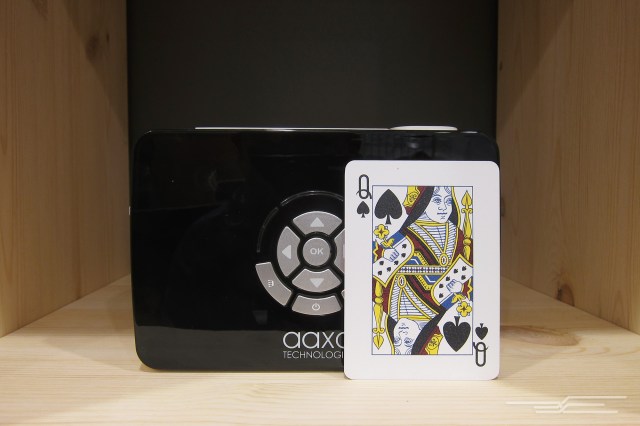
The AAXA P300 is small, making it easy to display content on a wall anywhere.
If you need to be able to show something to a group of people—or to host an impromptu movie night inside—a pico projector makes displaying content on a wall, anywhere, easy. If you own a pico projector but it isn’t bright enough or isn’t battery-powered, upgrading to our pick makes sense. If you have a projector but it’s too large to easily carry around, one of our alternate picks might make the most sense. Overall, a pico projector won’t replace a TV or a full-size projector, but it will work well for occasional use.
How we tested

Our tested models (clockwise from upper left): Brookstone Pocket Projector, LG PH300, Asus S1, AAXA P300, and ZTE Spro 2.
We evaluated each projector in the test group both objectively and subjectively. We took objective measurements using SpectraCal’s CalMAN software with a DVDO AVLab TPG test-pattern generator, an i1Pro 2 spectrophotometer, and a Klein K10-A colorimeter. Subjectively, we watched Blu-ray content and presentations (the latter using a MacBook as the source). We also tested with lights on and lights off, as a pico projector is more likely to be used with the lights on than a traditional projector.
Using an HDMI splitter, we could view the same content on two projectors side by side, an arrangement that allowed us to notice differences in brightness, color, image size, and overall quality more easily. When possible we made the image size the same, although with variable throw distances—and no zoom to make up for this fact—such an adjustment was often impossible due to space issues.
Our pick

The AAXA P300 is very bright with a good selection of inputs, and it can sit closer to the wall than other models.
With both movies and presentations, the AAXA P300 pico projector stood out from the competition, providing a very bright image from a short throw distance. It has the inputs you need, plus a speaker, a tripod mount, and a remote control, and an optional battery is available.
The AAXA P300 was the brightest of the projectors we tested. The manufacturer claims 400 lumens, but in our testing we measured 240 lumens (it’s common for the claimed brightness and the measured result to be different). This was still bright enough for us to project a 50-inch image with the lights on or off and have no trouble seeing it.
Contrast ratios determine how much pop an image has and are the detail your eye picks up on the most. The AAXA P300 has a very decent 813:1 contrast ratio, a figure almost four times higher than that of the LG PH300—combined with the bright image, the impressive contrast ratio helps the AAXA model truly stand apart from the other projectors in our test group. Plus, the AAXA P300 had one of the shortest throw distances of the projectors we tested, and unlike most pico projectors, it includes a remote.
Runner-up

The LG PH300 isn’t as bright as the AAXA P300, and it offers a worse contrast ratio, but it has more accurate colors, an integrated TV tuner, and longer battery life.
If you want a quieter pick or better color, the LG PH300 is the way to go. We measured it at 151 lumens, so it isn’t as bright as the AAXA model, and it has a longer throw distance, so the AAXA’s image will be notably larger from the same distance: From 5 feet away, the LG gives you only a 42-inch image while the AAXA produces a 58-inch image from the same location. However, the LG’s image is more accurate, with a neutral gray and colors that aren’t as saturated.
An ultraportable pick

The ASUS S1 is incredibly small and portable.
If you need the absolute smallest pico projector to carry around for business, the ASUS S1 is a good choice. It packs only 90 lumens, but it is much smaller than the AAXA or the LG, and it comes with a carrying case that shields it from damage while it’s sitting in your bag. Plus, its built-in battery can deliver up to three hours of use. It has a very similar throw ratio to that of the AAXA, so it produces a similarly large image from the same distance, but that image is not nearly as bright: In our tests, though it projected a 62-inch image from 5 feet away, the result was noticeably washed out, and text was somewhat difficult to read. The ASUS model is small enough for you to carry it around in your bag all the time without noticing it too much—something we can’t say about the AAXA or the LG—but you’ll want to use it with the lights at least dimmed due to its lower light output.
Wrapping up
After 45 hours of research and hands-on testing, we found the AAXA P300 is the best pico projector for most people. It’s bright enough for both dark rooms and those with some light, it’s easier to position for a large image than competitors, and it offers a better contrast ratio. If you want a quieter unit with better color (but less brightness), the LG PH300 is our runner-up. If you need a portable pick for business travel, the ASUS S1 is the way to go.
This guide may have been updated by The Wirecutter. To see the current recommendation, please go here.
Microsoft delays Windows 10 Mobile upgrade for older Lumias

If you’ve been itching to try Windows 10 Mobile on your Windows Phone 8.1 device, we’ve got some bad news. Microsoft says older Lumias won’t be upgraded until “early 2016,” which is a slight delay from the “December” timeline it had offered before. For the time being, that means the only way to try the new OS is to buy the Lumia 950 or the 950 XL, the former of which received a lukewarm review from our own Chris Velazco.
Microsoft hasn’t explained the reasons behind the postponement, although we suspect it’s to give its new software some much-needed polish. While testing the Lumia 950, we noticed a number of bugs and performance hiccups that could and should be ironed out. Windows 10 is an important play for Microsoft — it’s now or never if the company wants to gain some mobile market share — and the first step is to get longtime Windows Phone users on side. That first impression is going to count.
In a statement to ZDNet, a Microsoft spokesperson said:
“This November we introduced Windows 10 to phones including brand new features such as Continuum and Universal Windows Apps with the introduction of the Lumia 950 and 950 XL. The Windows 10 Mobile upgrade will begin rolling out early next year to select existing Windows 8 and 8.1 phones.”
It’s also unclear exactly which devices will be eligible for the upgrade next year. Microsoft has confirmed that handsets will need at least 8GB of internal storage, but that’s about it. The launch and support for older hardware has been a far cry from the desktop version of Windows 10, which is an indication perhaps of where Microsoft’s priorities lie.
Source: ZDNet
Humans are smart because we sleep weird

A new study claims to have learned one of the reasons that humans were able to rapidly evolve beyond rival primates, and it’s all down to our weird sleeping patterns. Researchers at Duke University, as reported by the New York Times, believe that our seven-hours-of-straight-shut-eye sleep cycle is something of an aberration. By comparison, chimpanzees enjoy 11.5 hours of rest, but our shorter run enabled us to get a much deeper, more dream-filled snooze. Humans, it seems, have above-average quantities of REM sleep, enabling us to slice valuable hours off the amount of time we’re laid up.
The study claims that one of the causes for this process was humans descent from the trees to laying on the floor. The contention being that you can relax a lot more if you’re not subconsciously worrying about rolling in the middle of the night and landing several feet further down. The team discovered this by watching apes sleep at the Indianapolis Zoo using night-vision cameras to track how much REM sleep orangutans got.
Instead of fussing over finding the strongest tree branch for the night, humans slept on the floor for far shorter, but higher-quality periods of time. This enabled them to have periods of extra time — several more hours each day — that could be dedicated to brain-developing activities. As the Times says, the study raises a few extra questions, since other mammals have higher periods of REM sleep than humans, like the platypus. Maybe it won’t be long before we’re all cowering at fear at a group of super-smart platypuses that have worked out that they should be beating us into second place.
Via: NYT
Source: Duke University, Evolutionary Anthropology
Budget bill heads to President Obama’s desk with CISA intact

Earlier today, the US House of Representatives passed a 2,000-page omnibus budget bill that contains the entirety of the controversial Cybersecurity Information Sharing Act. Just moments ago, the Senate passed it too. Now the bill is on its way to President Barack Obama’s desk, where he has the option to veto it… except he almost certainly won’t. The gargantuan document lays out a $1.15 trillion spending plan that has received solid (if not unanimous) support from both sides of the aisle and should prevent a government shutdown like the one we saw in 2013. But at what cost?
In a nutshell, CISA was meant to allow companies to share information on cyber attacks — including data from private citizens — with other companies and the Department of Homeland Security. Once DHS had all the pertinent details, they could be passed along to the FBI and NSA for further investigation and, potentially, legal action. The thing is, critics saw the bill as way for government agencies to more easily keep tabs on Americans without their knowledge. CISA was derided by privacy advocates and tech titans alike, with companies like Amazon, Apple, Dropbox, Google, Facebook and Symantec (to name just a few) issued statements against an earlier version of the bill.
By sticking CISA into such a huge omnibus bill, there’s basically no way it won’t become law. And if anything, the version of CISA that was quietly slipped into this budget plays with privacy even faster and looser than the original. For one, a previously held prohibition against sharing information with the NSA has been removed, meaning America’s best surveillance agency can receive pertinent data without it being handled by Homeland Security first. More importantly, the provision that required personal information to be scrubbed from cybersecurity reports also seems to have gone missing, leaving that task up to the discretion of which ever agency gets their hands on it. While the federal government has been trying to toughen its stance on cybersecurity in the wake of massive hacks on the Office of Personnel Management and Sony, we wound up with an even more effete version of a questionable plan that will soon become law.
Source: The Hill
Take a VR tour of the White House’s Christmas splendor

Think your Christmas decorations are impressive this year? Think again. Google has released a 360-degree video of the White House today which shows off some of its most impressive Christmas trees and ornaments. The tour winds through a number of lavish rooms and corridors, including the East Colonnade, the East Garden Room and the White House Library, as well as the Vermeil Room and the China Room. It only lasts for five minutes, but during that time you can look around or simply kick back and listen to the narrator explain every bauble and tinsel-covered branch.
The experience was captured using one of Google’s Jump rigs, which consists of 16 camera modules in a circular formation. The contraption was co-designed by GoPro, and costs a steep $15,000 — although for that price, you also get access to Google’s “assembler” software, which stitches together the different video feeds into one seamless 360-degree video.
You can take the White House tour by popping your Android phone into a Google Cardboard, or by simply playing the video on YouTube and panning around with your iPhone or iPad. Google says it’s also made a Google Expedition version so that teachers can guide Cardboard-equipped groups around the building, highlighting points of interest along the way.
[Image Credit: AP Photo/Carolyn Kaster]
Bernie Sanders’ campaign punished for accessing Clinton data

Bernie Sanders‘ National Data Director has been fired amid accusations from the Democratic National Committee that he viewed confidential voter information collected by the Hillary Clinton campaign. The DNC maintains a master list of likely Democratic voters and rents this out to campaigns, which then add their own, confidential data. Firewalls are in place to protect campaigns from viewing rival information, though the Sanders staff says a glitch on Wednesday allowed it to access Clinton’s data. Sanders Campaign Manager Jeff Weaver blamed the DNC’s software vendor, NGP VAN, for allowing the breach, The Washington Post reports.
Security of customers’ data is our top priority. On Wednesday, voter file users experienced a brief, isolated issue. (1/2)
— NGP VAN (@NGPVAN) December 18, 2015
The Sanders campaign held a live press conference about the breach on Friday morning. Weaver argued against the DNC’s decision to block its access to the master list, calling it “sabotage.” He said the campaign will be in federal court later on Friday if it isn’t re-granted access to the data. Weaver called for an independent audit of the DNC’s actions in this case.
“We are running a clean campaign,” Weaver said.
In a blog post, NGP VAN described the Wednesday incident as follows:
“On Wednesday morning, there was a release of VAN code. Unfortunately, it contained a bug. For a brief window, the voter data that is always searchable across campaigns in VoteBuilder included client scores it should not have, on a specific part of the VAN system. So for voters that a user already had access to, that user was able to search by and view (but not export or save or act on) some attributes that came from another campaign.”
NGP VAN determined that only the Sanders campaign had potentially accessed confidential data. The DNC suspended Sanders’ access to the master list, pending an investigation.
Sanders’ National Data Director Josh Uretsky took responsibility for accessing Clinton’s information and was promptly fired, though he says his intentions were exploratory, not predatory.
“We knew there was a security breach in the data, and we were just trying to understand it and what was happening,” Uretsky told CNN on Friday. He continued, “We investigated it for a short period of time to see the scope of the Sanders campaign’s exposure and then the breach was shut down presumably by the vendor. We did not gain any material benefit.”
Uretsky said he was testing the breach, seeing how deep it went and if Sanders’ confidential data were similarly accessible by outside parties. He was about to call the DNC to tell them about the incident, but the DNC called him first, he said.
“This wasn’t the first time we identified a bad breach,” Uretsky told CNN. The Sanders campaign reported a similar breach in October.
Campaign Manager Weaver echoed that sentiment to The Washington Post, saying, “Sadly, the DNC is relying on an incompetent vendor who on more than one occasion has dropped the firewall between the various Democratic candidates’ data.”
DNC spokesman Luis Miranda responded with a statement to The Washington Post.
“The DNC places a high priority on maintaining the security of our system and protecting the data on it,” Miranda said. “We are working with our campaigns and the vendor to have full clarity on the extent of the breach, ensure that this isolated incident does not happen again, and to enable our campaigns to continue engaging voters on the issues that matter most to them and their families.”
[Image credit: Flickr/Phil Roeder]
Via: Reuters
Source: Washington Post
Target working on its own mobile payment system, report says

Initial reports are saying that Target is looking at developing its own mobile payment system similar to that of Android Pay and Samsung Pay. More and more companies are wanting to take tap into the success of these payment systems, with LG and JPMorgan Chase looking at making their own individual mobile payments systems as well.
The report from Reuters says:
“The fourth-largest U.S. retailer has not committed to launch the product, which would allow customers to pay for goods using an app on their mobile phones. The mobile wallet could launch as early as next year, but it is too early to predict, two of the sources said.”
Walmart recently launched its own mobile payment system, which could be encouraging Target to offer their own in order to stay competitive. There’s no telling how Target’s mobile payment system will work at this point, but there’ll no doubt be integration with the retailer’s Red credit and debit cards.
While the Reuters report says Target could launch its mobile wallet app as early as next year, the publication cites sources saying that it hasn’t been tested at any retail locations yet.
source: Reuters
Come comment on this article: Target working on its own mobile payment system, report says
Netflix updated with in-app phone support

Netflix has been updated VoIP support, allowing users to call to customer service within the application. The media streaming company is known for its excellent customer service, and this new update makes it that much more convenient.
The new feature will require users to give the Netflix app a new permission for accessing the system’s microphone. This feature is new, and as a result, there’s still some quirks to work out, but it makes getting support for Netflix much quicker than normal.
Here’s the full changelog:
– Call Netflix Help directly from the app (Microphone permission required)– Bug fixes
Netflix is available to download for free on the Play Store, but requires a subscription to the service to watch the content.
Come comment on this article: Netflix updated with in-app phone support
Look out Apple and Samsung: Huawei shipped over 100 million phones in 2015

When I got my hands on the Huawei Mate 7 for the first time, I knew that this company was on to something. Despite some glaring software issues, the phone was highly attractive, the hardware was excellent, and the rear fingerprint scanner was one of the best implementations I’d ever witnessed. Since then, Huawei has only went uphill, introducing the Huawei Mate S, and more recently the Nexus 6p and Mate 8. Not only is the hardware prowess on the upward march, so is consumer interest it seems.
Huawei has now announced it has shipped more than 100 million smartphones this year, putting in on ground that is almost even with major competitors Samsung and Apple.
.rvs_wrapper
width: 350px;
.rvs_wrapper.align_left
float: left;
.rvs_wrapper.align_right
float: right;
.rvs_wrapper.align_center,
.rvs_wrapper.align_none
width: 100%;
.rvs_wrapper.align_center
text-align: center;
.rvs_wrapper.align_center.cbc-latest-videos ul li
float: none;
display: inline-block;
vertical-align: top;
.rvs_wrapper.cbc-latest-videos:not(.align_none) ul li:nth-child(2n+1)
clear: both;
.rvs_title
font-weight: 600 !important;
margin: 0 !important;
font-size: 24px !important;
.rvs_wrapper.align_right .rvs_title
padding-left: 20px;
.rvs_title a
font-family: ‘Roboto Condensed’;
color: #3a3a3a;
.rvs_wrapper.cbc-latest-videos ul
padding-top: 10px;
.rvs_wrapper.align_left.cbc-latest-videos ul li,
.rvs_wrapper.align_none.cbc-latest-videos ul li
padding: 0 15px 0 0;
.rvs_wrapper.align_right.cbc-latest-videos ul li
padding: 0 0 0 15px;
float: right;
.rvs_wrapper.align_center.cbc-latest-videos ul li
padding: 0 7px;
.rvs_wrapper.cbc-latest-videos ul li > a
font-weight: 400;
.rvs_wrapper.cbc-latest-videos ul li > a .yt-thumbnail
margin-bottom: 0;
@media only screen and (min-width : 480px)
body #page .rvs_wrapper.cbc-latest-videos ul
width: 100% !important;
@media only screen and (max-width : 480px)
body #page .rvs_wrapper.cbc-latest-videos
width: 100%;
float: none !important;
overflow-x: auto;
overflow-y: hidden;
body #page .rvs_wrapper.cbc-latest-videos ul
overflow: auto;
max-height: none;
body .rvs_wrapper.cbc-latest-videos ul li
float: left !important;
clear: none !important;

The big difference between Huawei and the other ‘big two’ is that the bulk of the third largest phone manufacturer lies in China and other parts of Asia. That said, Huawei has made a push towards the western markets in 2015 and in 2016 is reportedly set to bring the Mate 8, Honor 5x, and other key products to the United States. Will this continued push allow Huawei to jump ahead of the current smartphone kings, Samsung and Apple? While it’s hard to say for sure, there is no denying that Huawei is on a roll, like them or not.
For Huawei, it likely will come down to marketing, and software. Huawei has proven that it has the hardware and design side of things down, with the Nexus 6p winning our “people’s choice” award for the best Android phone of the year. If Huawei can find a way to makes it software more western market friendly on its non-Nexus devices, things will only go up from here.
What do you think of Huawei? Impressed by what you’ve seen, or less optimistic? Let us know your thoughts in the comments below.
Report: Samsung Galaxy S7 to have software optimization that rivals the iPhone

This year’s Samsung Galaxy S6 finally brought the major shakeup in design that many had long been hoping for, alongside tweaks and improvements to Touchwiz that made it a bit more streamlined than in years past. While the Galaxy S6 and S6 Edge weren’t without their faults, there’s no denying that their arrival signaled a new era for Samsung. Now the question is where Samsung will go from here.
The rumor mill has been churning with increased intensity as of late and we are starting to get a clearer picture of what the Samsung Galaxy S7 will bring to the table. First, we can reportedly expect only minor changes in design this time around, though the microSD slot could be making a much desired comeback.
Where the Galaxy S7 could really shine is in the software. A new report out of China suggests that Samsung is taking a software-centric approach to their Next Big Thing, and no that doesn’t mean throwing on a bunch of unnecessary extra software features (that’s what the Galaxy S4 and S5 were for).
 See also: Samsung Galaxy S7 rumor roundup: release date, price, specs, features
Reportedly, Samsung has actually teamed up with Google engineers to help optimize and reform TouchWiz in a way that goes above and beyond the positive steps we saw with TouchWiz in 2015. Supposedly Samsung is aiming for optimization levels that would rival or even exceed what Apple has accomplished with iOS.
A lofty goal to say the least. After all, Apple is able to achieve its level of optimization due to its tight control of iOS, an advantage Samsung simply doesn’t have. Regardless, if the rumors prove true, that means we could be looking at a slimmer, faster, and more optimized software experience with the Galaxy S7.
You might be wondering if Google would really lend its engineers to Samsung in such a manner. While the legitimacy of this claim is unknown, we can say that it makes sense on some level. For many casual consumers, there are two accepted choices for smartphones if you want to be trendy: a Galaxy or an iPhone. That means the first taste of Android for many users comes from those who buy a Samsung Galaxy device, and so it isn’t surprising that Google would want to work with Samsung to ensure that the experience is a pleasant one.
For now, we’d take the entire report with a healthy dose of skepticism, but we can’t help but be a little excited over the prospect of a ultra-optimized Samsung Galaxy software experience.
What do you think, would you purchase a Galaxy S7 with more optimized TouchWiz onboard? Do you think that Samsung could achieve the kind of optimization it is hoping for? Share your thoughts in the comments.
Looking back – Samsung Galaxy S6 review
 AIVAnet