


Google Play Music family plan arriving this week for $14.99 per month

Google announced that it would be adding a family plan to Play Music All Access back at the company’s September event, and since then we haven’t really heard too many details regarding the new pricing tier. That’s changing today, as Google has just announced that residents in the U.S., U.K., Canada, Australia, France and Germany will be able to sign up for the Google Play Music family plan “in the coming days.” So, it may not be available yet, but at least we know it will be in a few days’ time.
The family plan will get you a total of up to six subscriptions to Play Music All Access for $14.99 per month. This means your whole family will be able to enjoy ad-free, unlimited access to Play Music’s vast library of songs and artists. Family members can stream simultaneously on any device. This $14.99 price point also gives U.S. residents access to YouTube Red, Google’s advertisement-free version of YouTube. So to clarify, all six family members get access to unlimited, ad-free music streaming and YouTube Red for just $14.99 per month. Not a bad deal!
 See also: 15 best Android apps of 2015
The family plan will be available to all of the countries listed above in the coming days, and Google says more regions will be added in the future. Will you be signing up for a Play Music family plan? Be sure to speak up in the comments!
Jolly Tracker forces holiday cheer with a shock to the face

The holiday season is supposed to be a happy time. But lets be honest, between the stress of picking out gifts, racking up credit card debt you can’t afford and being forced to spend time time with your creepy uncle there isn’t a lot to smile about. Enter the JöLLY Tracker. It’s a wearable of a different kind — one that monitors just how much you smile. And, if you’re not keeping that frown turned upside down, it gives you a gentle “reminder” to smile in the form of an electric shock… to the face.
This is the brainchild of the folks at McKinney, an ad agency that has worked with the likes of Samsung, ESPN and Big Boss Brewing. But for the holidays it’s promoting itself and it’s own work. Its team of creatives and hackers including Peter Nicholson, Danny Lee and John Benedict came up with the concept of a wearable that skips the normal metric tracking and goes straight for keeping you happy (smiling more can in fact make you feel happier). Now, the idea of forcing happiness through negative reinforcement may seem a little counterintuitive, but it does work. It’s hard not to put on the JöLLY Tracker and not smile. For one, you definitely look more than a little ridiculous. But waiting for the shocks to come definitely puts a smile on your face (albeit a nervous one).

The whole thing is pretty simple. A set of five electrodes are placed on your face: two to monitor muscle movement, two to provide the shock and one for ground (that last one is very important). Behind all that fake white facial hair is an Arduino, a Muscle Spiker shield and a TENS unit, which stimulates the nerves in your face with a gentle jolt of electricity. The whole thing is controlled from a simple mobile app that connects via bluetooth to the beard. It counts how many times a minute your smiling, shows the intensity of your smile and provides a handy countdown to your coming shock.
But enough talk. Check out the video above to watch this editor take jolts of electricity to the face. Repeatedly. Oh, and happy holidays!
Cortana exits beta, gets built in to Cyanogen OS
Cortana, the virtual assistant from Microsoft has officially left beta and will now be readily available for anyone to use across Windows, iOS and Android.
Microsoft bills Cortana, named after the Halo character, as a personal assistant with personality. Now you’ll be able to use Cortana cross platform to do things like set location based reminders one one device and have it pop up on another, get missed call alerts and respond to text messages on your Windows 10 computer, and track flights and packages.
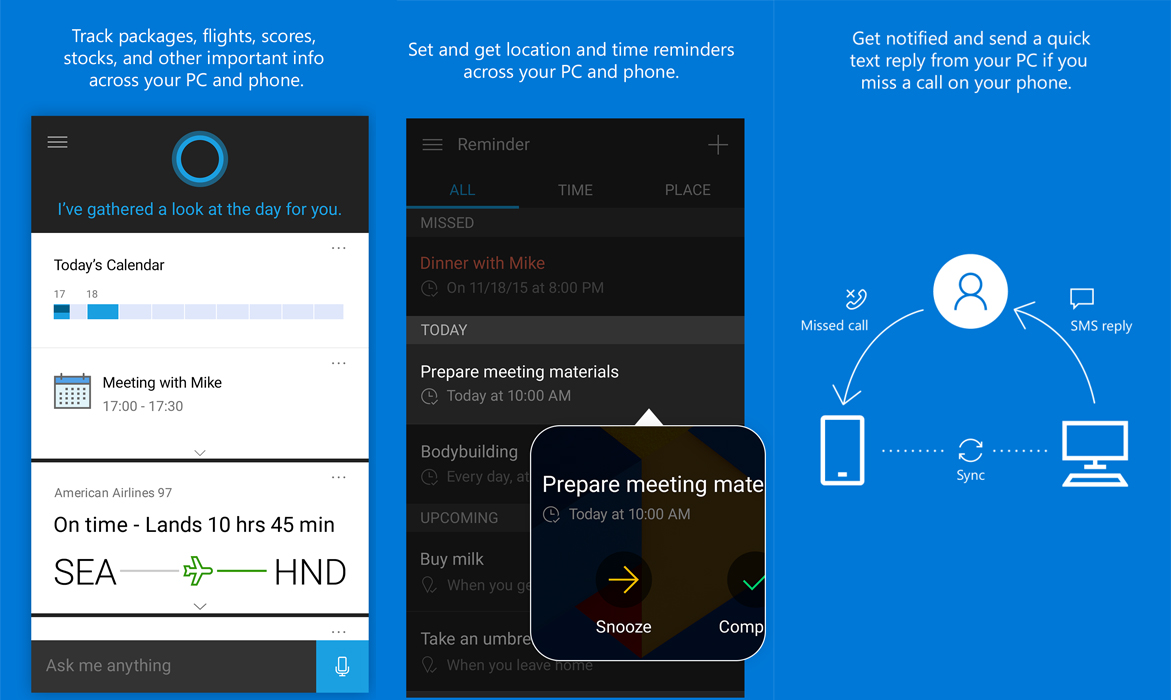
Microsoft says that Cortana will come with the same personality and features on mobile that it does on desktop. One of the main selling points of Cortana is the ability to give contextual suggestions for people, places and things that may interest you. Now the information and searches you use on one device will follow you to other devices so you’ll be able to pick up where you left off.
Even though Cortana will be fully featured on iOS and Android, due to some system limitations, it won’t be able to do some actions like toggling system settings or opening apps.
Another exciting tidbit is that on Cyanogen OS phones will now integrate Cortana much like Android Now is integrated into almost all Android Phones. You’ll now be able to say “Hey Cortana” from any screen and have the personal assistant pop up, ready to serve. With the increased integration comes more options. On Cyanogen OS phones you’ll be able to ask to have your phone powered down, enter Quiet Mode or have it toggle network modes.
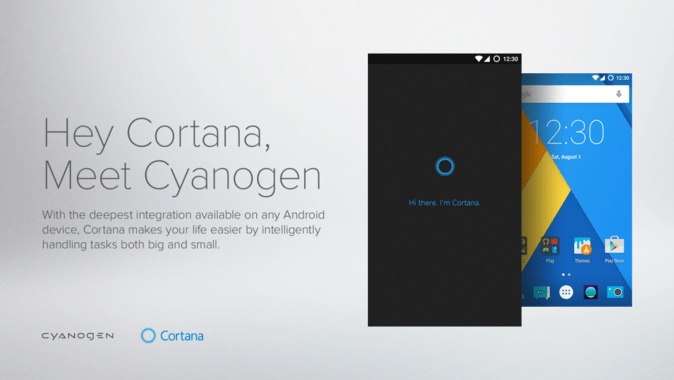
All of this is good news to those that find they like a little bit of personality in their personal assistant, but don’t want to jump over to iOS for the increasingly unreliable Siri.
Source: Microsoft
The post Cortana exits beta, gets built in to Cyanogen OS appeared first on AndroidGuys.
The new Google Play Music family plan is here for just $14.99 per month
There are way too many music streaming services and some are free while others charge monthly fees. Google has been leading the pack at offering incredible value for its standard $9.99 music plan with a huge selection of music. You can play music from your Android smartphone, tablet, TV, or even your computer while you’re at work.
If you have a family that $9.99 subscription plan can quickly add up to be quite expensive.
Google has just announced the family plan availability for households with up to five family members for the incredible price of just $14.99 per month. That’s a savings of $35 per month if all five members had an individual account. So Mom can listen to Frank Sinatra, Dad can listen to Marvin Gaye, and the kids can listen to Justin Bieber, Taylor Swift, and Pit Bull.

Benefits of Google Play Music(family plan):
- Access to over 35 million songs
- Ad-free
- Offline mode
- Access to YouTube Red ($9.99/month)
- Downloadable ad-free videos from YouTube
The family plan will be made available in the coming days to Android devices in the US, Canada, UK, Australia, France and Germany.
The post The new Google Play Music family plan is here for just $14.99 per month appeared first on AndroidGuys.
Cortana for Android officially debuts today

Cortana for Android, Microsoft’s own digital assistant, has left its public beta and is now officially available on Android. Cortana for Android will do just about anything Google Now can do, and more if you have a Windows 10-based computer.
Microsoft’s digital personal assistant will allow users to set reminders, appointments, and even dish out suggested interests. The big thing that differentiates it from Google Now is that those with a Windows 10-powered PC can send a text message reply when you miss a phone call on your smartphone.
The goal isn’t to recreate another Google Now, but to truly construct a connected and seamless digital assistant that is available to users wherever they are, whether that be on the PC or various mobile platforms like Windows Phone, Android, and iOS.
Microsoft released the public beta of Cortana for Android back in August and has been hard at work polishing it ever since. Microsoft around the same time began the public beta for iOS as well, which also came out of public beta and became official today.
Cortana for Android and iOS is also debuting in China today, allowing even more users to have a true digital assistant connection between their PC and mobile phones.
“With a Windows 10 PC in the mix we think we can do some pretty powerful things,” Marcus Ash, Microsoft’s Cortana program manager, told The Verge.
Cortana for Android and iOS won’t be everything it can be on these platforms, simply because of the developer restrictions. For instance, users won’t be able to say “Hey Cortana” to activate the digital assistant. That said, Microsoft is partnering with Cyanogen to make that possible on Cyanogen-powered smartphones.
Microsoft and Cyanogen’s partnership will also let Cortana toggle network modes, enable quiet mode, and other system features that aren’t accessible due to those aforementioned developer restrictions.
Aside from the partnership with Cyanogen, Cortana works best on Windows Phone since Microsoft is able to build it into the system on its own mobile operating system. Using Cortana on Windows Phone also opens up a much more seamless experience with Windows 10-based computers.
Despite developer restrictions, Microsoft will continue to update and polish Cortana for Android and iOS to make it the best digital assistant that it can be.


via: The Verge
Come comment on this article: Cortana for Android officially debuts today
Tim Cook Accepts 2015 Ripple of Hope Award at RFK Center for Justice and Human Rights
Apple CEO Tim Cook accepted the 2015 Ripple of Hope Award at the Robert F. Kennedy Center for Justice and Human Rights on Tuesday night, and gave a nearly twelve minute speech about the need for social change, reports Bloomberg.
 Tim Cook at the RFK Center for Justice and Human Rights (Image: Bloomberg)
Cook, who spoke after Evercore’s Roger Altman and Unesco ambassador Marianna Vardinoyannis, discussed a wide range of ongoing social issues, including the Syrian refugee crisis, climate change, Apple’s charitable work, access to quality education, privacy and discrimination.
“Today, more than half of the states in this country still don’t offer basic protections to gay or transgender people, leaving millions of people vulnerable to being fired or evicted because of who they are or who they love,” Cook said.
“Today, some in our country would turn away innocent men, women and children seeking refuge,” Cook said, “regardless of how many background checks they may submit to, simply based on where they were born. Victims of war and now victims of fear and misunderstanding.”
“Today, too many children are denied access to quality education simply because of the zip code they live in. They begin their lives facing strong headwinds and disadvantage they did nothing to deserve. We could do better, Robert Kennedy would say, and because we can do better, we must act.”
Cook offered praise for Robert F. Kennedy and said he has two photographs of him in his office that he looks at each day. “I think about his example, what it means to me as an American, but also more specifically, to my role as Apple CEO.”
Read more about Cook’s acceptance speech in the full article on Bloomberg.
Note: Due to the political nature of the discussion regarding this topic, the discussion thread is located in our Politics, Religion, Social Issues forum. All forum members and site visitors are welcome to read and follow the thread, but posting is limited to forum members with at least 100 posts.
Discuss this article in our forums
White Hat Hacker Bundle – learn to hack, pay what you want and help charity

How do you become a hacker without spending a fortune in courses and endless hours searching the web? Well, you will probably still need to do the latter to really polish your skills, but at least we can cover the fundamentals with a new offer from the AA Deals Store.
The White Hat Hacker Bundle can be yours for… however much you want to pay. Yes, you read that right. You can choose how much you want to pay for this set of 7 courses. The only trick is that beating the average will get you the full set of courses.
By the way, this bundle is valued at $765, so you are saving a lot of money here!
Courses
- The complete hacking course: go from beginner to advanced!
- Learn WiFi hacking/penetration from scratch
- Windows exploit development megaprimer
- Intensive ethical hacking series
- Ultimate WiFi hacking & security series
- Node.js security: pentesting & exploitation
- Cross site scripting (XSS) attacks for pentesters
Want in on the deal? All you have to do is click through the button below and sign up! By the way, 10% of all the profits will go to the Project HOPE, an organization that provides medical attention, medicine and supplies to those in need.
Samsung Pay transport card service launches in South Korea

If, like me, you spend a fair amount of time zipping around on public transport, then you might be interested to hear that Samsung Pay has just launched its dedicated transport payment service in South Korea.
The Samsung Pay Transportation Card Service brings both Korea’s T-Money and Cashbee pre-registered cards into a single service, which allows commuters to pay for bus travel, underground access and taxis using their mobile phone.
“Samsung Pay’s Transportation Card Service provides our customers with a much more convenient and diverse mobile payment experience. We plan to extend our partnerships so that we can move even closer to a world where we can easily and safely make payments without having to carry around a wallet.” – Samsung
Furthermore, the transport cards can be topped up with credit or debit cards that are also registered with Samsung Pay, keeping everything under one single convenient system. T-Money cards can be recharged with both Samsung and KB Kookmin cards, while mobile Cashbee transportation cards can be recharged with Lotte cards. Samsung is looking to partner up with additional credit card companies in the future.
We don’t have any official word about expansion plans yet, but hopefully Samsung will be looking to roll out a similar transport payment system to other countries and cities too. China, Spain and the UK are set to receive Samsung Pay in 2016, and I could certainly see myself using a smartphone to tap in and out of the London Underground.
Best of Android 2015 – Audio

With the smartphone having firmly replaced the iPod as the portable music player of choice, audio playback is an increasingly important factor in today’s high end mobile. Furthermore, with increasingly bold claims of HiFi and even studio quality playback being touted on some smartphones – I’m looking at the LG V10’s ludicrous sounding 32-bit playback option here – we should check to see just how well these claims hold up to some testing.
For this test we’ve also thrown in the ZTE Axon, to see how its “HiFi quality” DAC performs in a smartphone environment and how it stands up to the competition.
Audio Benchmarking
To give us an overview of how each smartphone performs, we put each headphone jack through a Focusrite 2i2 interface and ran the popular RightMark Audio Analyser, checking for frequency response, noise and distortion characteristics.
We’ll start with noise and crosstalk, which should push well through the -96dB noise floor offered by 16-bit audio if any of our high quality DACs want to come close to realising their touted 24-bit or 32-bit performance (a practical impossibility I might add).
http://live.amcharts.com/JjNzY/embed/
Crosstalk isolation is excellent across all of the models and there certainly isn’t any sign of any stereo bleed issues. However, none of our smartphones make a notable move past the -96dB target. The Xperia Z5 Premium clocks in a decent -100dB, while the ZTE Axon falls some way short at just -92dB. It’s by no means noisy, but seems to defeat the objective of offering a 24-bit codec and LG’s 32-bit DAC boasting is just outright ridiculous.
To be fair to the smartphones though, at approaching -100dB we could be starting to push up against the noise limits of our testing environment as well. So to so avoid complicating the results, we’ll simply test with 16-bit audio from here on out.
http://live.amcharts.com/TJkNT/embed/
Moving onto dynamic range, the difference between the loudest and quietest output, we should see all of our smartphones hit the full 96dB dynamic range afforded by our 16-bit test signal. While some smartphones do, three of our models fall short. The Nexus 6P, Xperia Z5 Premium and the ZTE Axon cannot reach the target, meaning that additional noise is likely making its way to the audio signal path somewhere between the DAC and the jack. This isn’t an unexpected result from a compact device with lots of potential for interference, but circuit layout in the leading phones seems to be a little better thought out.
The total harmonic distortion results are excellent across the board, with all of the handsets putting in performance well below 0.004%. The ZTE Axon is the winner by a small margin, followed by the Priv and the V10. The real test for music though is intermodulation distortion, as this shows the amount of distortion generated when playing back multiple tones.
http://live.amcharts.com/xYzU5/embed/
There is a greater disparity in this test, with the LG V10, Nexus 6P and ZTE Axon all taking a lead coming in at or below 0.01%. Here the ZTE Axon is again the winner. The Galaxy Note 5 and Xperia Z5 Premium are very close by on 0.012%, while the Priv and Moto X Force are the worst performers, although by no means are they bad and such small percentage differences are going to be very tough to tell apart.

Frequency response is as flat as you like across all the tested smartphones, at least when connected up to our interface. Interestingly, the Moto X Force, Nexus 6P, BlackBerry Priv and LG V10 seem to have a low pass filter on their DAC output with a -3dB point at just over 18 kHz. This is likely designed to remove any high frequency interference from high speed signals, such as the codec clock, without interfering with the audible spectrum, or could be something in software.

Crunching through the data, it’s definitely a tight run thing in the portable audio space these days, will all the smartphones offering up specifications that are hard to complain about. It’s a bit disappointing to see that none of the higher resolution devices offer a notable bit-depth advantage, but this just highlights the difficulties in fitting low noise audio circuits into a mobile phone, if nothing else. With that said, the “32-bit” LG V10 performs consistently well across all of the tests, followed closely by the Galaxy Note 5 and the HiFi ZTE Axon.
Listening Test

Of course, no audio test would be complete without actually having a listen to the phones in the real world. So I stuck a couple of my favourite FLAC tracks on board and had a good listen through some AKG K550s, a reasonably priced pair of “reference” headphones. Honestly, all of the smartphones performed well, as the scientific testing suggested, but there were some subtle differences between a number of the phones.
The “worst” performers, to my ears, were the 6P and the X Force, as the balance didn’t quite seem to keep up with the other phones. Although tone and detail were good across both models, the X Force seems to throw in some heavy hitting bass that verged on boomy for my tastes. The 6P has the opposite problem, lacking any real punch to kick drums and both were missing that extra sizzle on cymbals that really flesh out a track.
The Priv sounded well balanced and delivered nice tone, but seemed to produce a narrower sound than all of the other handsets. This resulted in an experience that felt a bit more sterile. The ZTE Axon suffered from a similar lack of excitement despite sounding nice and wide, but I put this down some missing punch in the lows. That being said, the ZTE Axon offered excellent detail across the spectrum.
The Galaxy Note 5 stood out the most in terms of a unique tone, as the tracks seem a little warmer here than on other phones. After listening, I took a closer look at the intermodulation distortion results and found an interesting introduction of some second harmonic distortion that can’t be seen on other phones (at least not this noticeably). Although it only appears very slight, cumulatively this might be audible when listening to a full track. The panning and high-end detail are excellent with vocals cutting through nicely, but the extra smoothness might not sit well with everyone.

There appears to be some additional 2nd harmonic content introduced somewhere in the Galaxy Note 5’s signal path, which is more typical of a classic warm valve sound.
The Xperia Z5 is one that the bass junkies will love. It really thumps on kicks but isn’t overbearing and provides excellent details in the mids that holds up well in the highs too. I really couldn’t find much to complain about here but it’s tough to call it notably ahead of the Note 5 or Axon.
This leaves the LG V10 as the stand out smartphone for me, and it was the only one to bring a smile to my face as it managed to conjure up some new sounds from tracks that I thought I knew in and out. The V10 is well balanced across the frequency spectrum and really shines when it comes to detail and spacing. It’s by far the widest sounding phone, which was actually a little disorienting at first, but this really allows for all the small details to come through. Although a 32-bit DAC may be little more than a marketing gimmick from a technical standpoint, the detail and sense of space that comes through with this codec are simply fantastic.
Rear speaker volume test
If you’re planning to take your smartphone out on the road, then the maximum volume of the smartphone’s speaker may also be of interest. We took a peak volume reading right next to the phone’s speaker to see which is the loudest. The chart below shows the result and the typical dB values for common environments.
http://live.amcharts.com/VmZTF/embed/
Given that you’ll be holding the speaker away from you and the actual media volume will be more dynamic than the peak, you want to get notably past the markers to be sure that you can make out quieter details. So if you want to watch films in the car, the Note 5, X Force, Nexus 6P and LG V10 should definitely have you covered.
Remember, decibels are a logarithmic scale and every 10dB increase results in roughly a doubling of the perceived loudness of a sound. This makes the LG V10 the loudest of the bunch by some margin, offering up double the peak volume of BlackBerry Priv, Xperia Z5 Premium and the ZTE Axon. At a whopping 100dB I honestly don’t recommend sticking your ear right up next to the speaker.
Given the decent performance of the ZTE Axon in the headphone tests, the speakers were a major disappointment. We didn’t have any complaints about the other phones, but the Axon’s speaker was horrendously tinny.
Summing up
Taking the whole picture into account, the LG V10 is a pretty clear winner. It comes out as one of the best performers in both the jack and speaker tests, and sounds incredibly good. Second place is a very close run contest, with the Galaxy Note 5, Xperia Z5 Premium, and Nexus 6P all putting in good performances.
The Galaxy Note 5 just edges out ahead in the benchmark and speakers tests, but there’s excellent headphone sound available on the Z5 Premium too. Sadly, the Axon phone’s disappointing dynamic range and speaker results hurt what was otherwise a lovely sounding phone, proving that spec sheet point scoring doesn’t always translate in the real world. Unfortunately, the Moto X Force didn’t stand out in the listening test and had the worst distortion results, so you can certainly do better if you’re looking for a top notch audio experience.
Best of Android 2015
Don’t miss:
Tomorrow we will be taking a look at the performance of our six contenders, through benchmarks and real world tests. Come back on December 10 at 10AM EST for Best of Android 2015: Performance!
Credits
Post by: Rob Triggs
Series Contributors: Rob Triggs, Gary Sims, Lanh Nguyen, Joe Hindy, Krystal Lora
Series Editors: Nirave Gondhia, Bogdan Petrovan, Andrew Grush
OnePlus X Ceramic will be available from tomorrow

Although it was unveiled all the way back in October, OnePlus has finally announced that invites for the Ceramic version of its OnePlus X smartphone will begin to appear starting from tomorrow, December 10th.
Presumably the full details will be heading our way tomorrow, but the announcement post suggests that the handset is about to go on international sale through its official website. Remember, you will need a specific OnePlux X Ceramic invite to grab this limited edition model, so expect some tough competition to get your hands on one.
The Ceramic version of the smartphone also recently went on sale in India. It was made available back at the end of November through Amazon, with a rather more expensive Rs. 22,999 ($346) price tag than the Onyx version, which runs Rs. 16,999 ($256). We should probably expect a similar price hike when tomorrow’s international invites land.
OnePlus recommends that we stay tuned for “more ways” to get a hold of a Ceramic handset, so presumable some sort of contest is on the way. If you’re unsure about whether this handset is a worthy purchase, be sure to check out our full review below.
OnePlus X in review:
.rvs_wrapper
width: 350px;
.rvs_wrapper.align_left
float: left;
.rvs_wrapper.align_right
float: right;
.rvs_wrapper.align_center,
.rvs_wrapper.align_none
width: 100%;
.rvs_wrapper.align_center
text-align: center;
.rvs_wrapper.align_center.cbc-latest-videos ul li
float: none;
display: inline-block;
vertical-align: top;
.rvs_wrapper.cbc-latest-videos:not(.align_none) ul li:nth-child(2n+1)
clear: both;
.rvs_title
font-weight: 600 !important;
margin: 0 !important;
font-size: 24px !important;
.rvs_wrapper.align_right .rvs_title
padding-left: 20px;
.rvs_title a
font-family: ‘Roboto Condensed’;
color: #3a3a3a;
.rvs_wrapper.cbc-latest-videos ul
padding-top: 10px;
.rvs_wrapper.align_left.cbc-latest-videos ul li,
.rvs_wrapper.align_none.cbc-latest-videos ul li
padding: 0 15px 0 0;
.rvs_wrapper.align_right.cbc-latest-videos ul li
padding: 0 0 0 15px;
float: right;
.rvs_wrapper.align_center.cbc-latest-videos ul li
padding: 0 7px;
.rvs_wrapper.cbc-latest-videos ul li > a
font-weight: 400;
.rvs_wrapper.cbc-latest-videos ul li > a .yt-thumbnail
margin-bottom: 0;
@media only screen and (min-width : 480px)
body #page .rvs_wrapper.cbc-latest-videos ul
width: 100% !important;
@media only screen and (max-width : 480px)
body #page .rvs_wrapper.cbc-latest-videos
width: 100%;
float: none !important;
overflow-x: auto;
overflow-y: hidden;
body #page .rvs_wrapper.cbc-latest-videos ul
overflow: auto;
max-height: none;
body .rvs_wrapper.cbc-latest-videos ul li
float: left !important;
clear: none !important;

Do you like the look of the OnePlus X Ceramic?
 AIVAnet