


Intel’s new NUC will show off AMD’s Vega GPU
We’ve called Intel’s NUC “the future of tiny desktops.” That’s truer than ever with the newest version of the device, which is powered by the company’s new 8th generation CPU with AMD RX Vega M graphics. In fact, it sports the fastest version of that chip, making it an even better desktop replacement. Intel claims it’s so powerful, the 1.3 liter NUC is the smallest VR-ready system so far. And based on its specifications, we’re inclined to believe them.
The new NUC, codenamed “Hades Canyon,” is a bit thicker and taller than the “Skull Canyon” version was saw in 2016. It comes in two versions: the most powerful includes a Core i7-8809G chip with powerful RX Vega M GH graphics, running at speeds between 3.1GHz and 4.2GHz. The other model is still pretty capable, with an i7-8705G chip, a clock speed between 3.1GHz and 4.1GHz and slightly slower RX Vega GL graphics.
Based on what we’ve seen from Intel’s benchmarks, the faster NUC should be speedy enough for most VR experiences (though complex games like Doom VFR might be a challenge). Overall, you should expect to see at least 60 FPS with modern games in 1080p. While the company tried position the last NUC as a gaming-oriented machine, this one actually has the potential to be a solid gaming PC for your living room.
Intel also packed in a bevy of ports to make this NUC much more useful to enthusiasts. Along its back panel, it sports two Thunderbolt 3 USB-C ports, two gigabit Ethernet connections, two Mini DisplayPorts, four USB 3.1 Type-A connections, HDMI and a hybrid 3.5mm/optical audio jack. Up front, it has USB-C, USB Type-A, USB Type-A for charging, HDMI, a headphone jack and an SDXC slot. That might sound exhausting, but that doesn’t even include the internal USB connections and dual M.2 SSD slots.
As usual, Intel will sell the NUC as a DIY kit. You’ll have to supply your own storage, RAM and accessories to get it up and running. Unfortunately, we don’t have pricing details yet, but Intel says they’ll be available in the spring.
Click here to catch up on the latest news from CES 2018.
Intel unveils its first chips with AMD’s Vega graphics
The fruits of Intel and AMD’s unprecedented partnership are finally here. Intel just unveiled its 8th generation Core CPUs with AMD’s RX Vega M, bringing together its fastest mobile processors with graphics capabilities that used to required a dedicated GPU. Together, they’ll lead to thinner and lighter laptops with decent gaming chops. While we got an overview of the chips back in November, we finally have more details at CES. And, simply put, gamers should be pleased.
Fittingly, Intel is plugging AMD’s RX Vega M module into the first batch of its high-powered “H-series” 8th generation Core chips. These are the processors that are typically paired with dedicated GPUs, like NVIDIA’s GTX 10-series line. Now, for the first time, Intel has a custom all-in-one solution.
Intel is offering two variants of AMD’s graphics: RX Vega M GL, which is meant for laptops, and GH, which is targeted at small desktop-like devices, such as Intel’s new NUC. Naturally, the GL variant has a lower clock speed and less graphics hardware than its more powerful sibling. It runs between 931MHz and 1,011MHz and has 20 compute units, while the GH clocks between 1,063MHz and 1,190MHz has 26 compute units. You’ll find the GL variant bundled with Intel’s new 8th generation Core i5 and i7 processors, while the GL will only come with an i7.
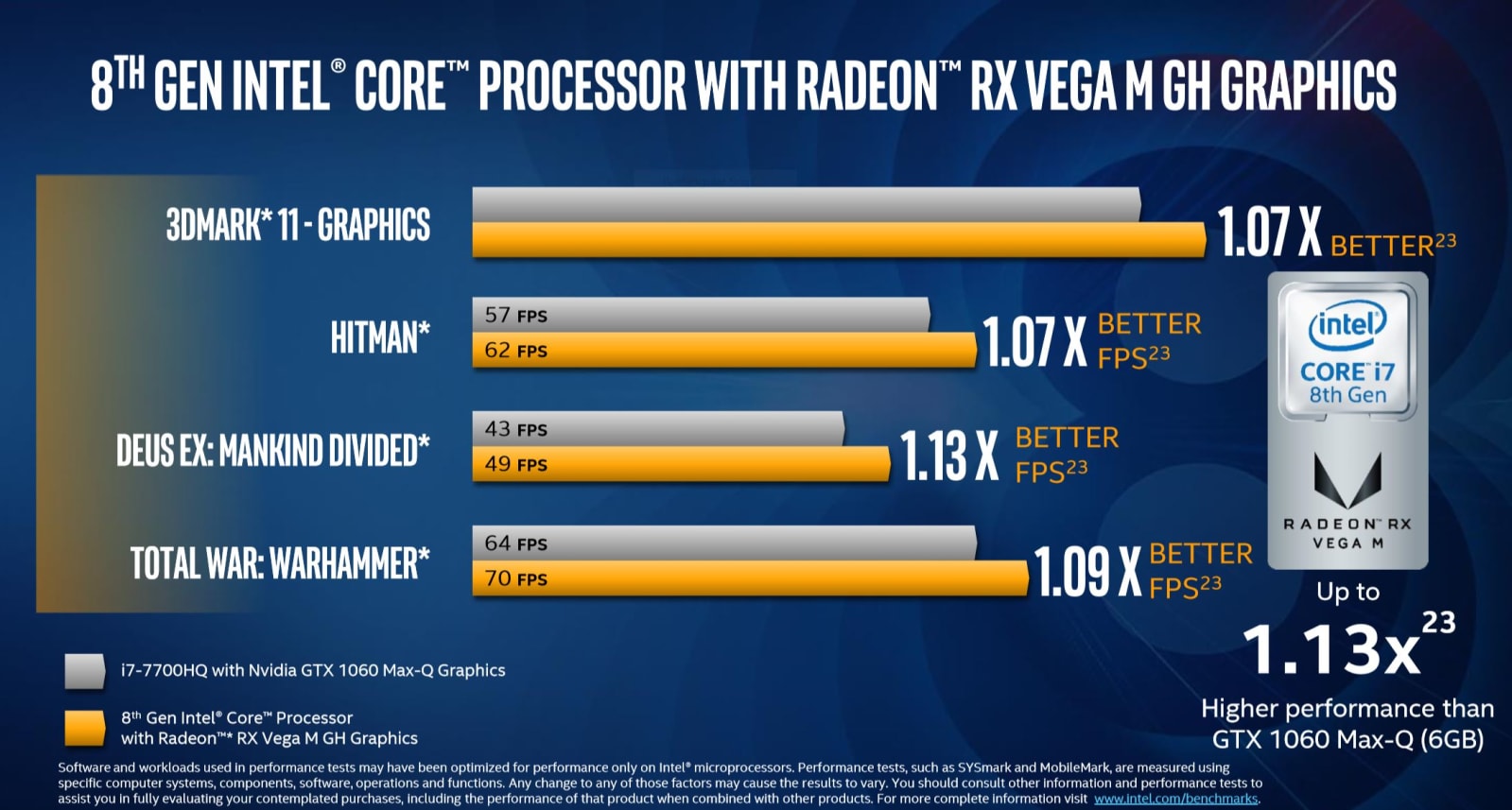
In laptops with the RX Vega M GL module, you can expect speeds around 1.4x faster than NVIDIA’s GTX 1050 while playing Hitman. And with the speedier GH graphics, you’ll see performance up to 10 percent faster than NVIDIA’s GTX 1060 running on a machine with a 7th generation Core CPU. That basically ensures that, in most modern games, you’ll see a smooth 60 frames per second in 1080p with high graphical settings. Those figures would be admirable from larger dedicated GPUs. For something bundled together with a traditional CPU, they’re honestly astonishing.

Intel
Intel crafted a unique custom chip to fit in the RX Vega M. It’s wider than the company’s typical designs, because it fits in both the 8th generation Core processor, AMD’s graphics and it makes room for 4GB of HBM2 (High Bandwidth Memory Gen 2). In particular, Intel focused heavily on the EMIB (Embedded Multi-Die Interconnected Bridge) between the memory modules and RX Vega M. It’s a high-speed method of connecting different types of chips on the same die, ensuring that there won’t be any memory bottlenecks for the GPU. Additionally, Intel is using eight lanes of PCI-Express Gen 3 to connect the GPU to its CPU.
As for the processor portion of these new chips, you’ll find them running from 2.8GHz to 3.8GHz with the i5-8305G, all the way up to a speedy range of 3.1GHz to 4.2GHz with the top of the line i7-8809G. They each offer four cores with eight computing threads. Surprisingly enough, you’ll also be able to overclock their CPUs, GPUs and memory modules. And just in case you were wondering, you’ll still find Intel’s HD 630 graphics integrated into the CPU. It’ll serve as an efficient way to drive your display when you don’t need AMD’s 3D hardware.

Intel
So what would a computer look like if it ran one of these chips? Intel says it could weigh around 4.6 pounds, measure 17mm thick and get around 9.3 hours of battery life. In comparison, a similar enthusiast-oriented notebook from there years ago would be close to six pounds, measure 33mm thick and get around 4.7 hours of battery life. As for the extra-powerful RX Vega M GH variant, Intel claims a tiny machine like its new NUC could deliver the same amount of performance as a mid-tower desktop from three years ago.
Since these chips are running AMD GPUs, they’ll also support the company’s Radeon Adrenalin Edition software and take advantage of features like FreeSync for smoothing out game performance, and ReLive for capturing your sessions. You’ll be able to use both Intel’s XTU app and Radeon WattMan to manage overclocking. Intel also promises that it’ll offer launch-day drivers for new titles at its new gaming site. You’ll be able to find Intel’s chips with RX Vega M graphics in upcoming laptops from Dell and HP, as well as the company’s new NUC when it launches this spring.
Yes, it’s still very strange that this partnership exists. It’s an admission by Intel that it needs some serious help with high-end graphics. In the short term, this is a quick fix. But it’s no surprise that Intel also stole away AMD’s former graphics head, Raja Koduri, who was responsible for the Vega GPU’s design. It’ll likely take a few years, but you can fully expect Intel to replace this “frenemy” solution with its own chip down the line. For now, though, it’s something AMD can use to market its superior graphics, while still competing with Intel in the processor market.
Click here to catch up on the latest news from CES 2018.
Source: Intel
These smart shoes alert you if your grandma falls
We’ve seen our fair share of smart shoes at CES in the past, including a pair you can “lace up” using your smartphone. And today, at CES 2018, we came across some more interesting footwear. What you see above are the “smart shoes with falling alert,” created by a French startup called E-Vone. As the name suggests, the kicks feature a system that will notify friends, family or medical services if the person wearing them happens to take a fall. The company says they’re designed for older adults (like your grandma or grandpa), as well as construction workers, hikers or anyone who feels like they may require assistance if they’re alone indoors or outdoors.
Inside E-Vone’s shoes, specifically the midsole, there are a slew of sensors: GPS, accelerometer, gyroscope and a pressure system that knows every time someone put on the shoe on and activates the alarm. According to E-Vone, they don’t need to be paired to a mobile device because the shoe processes all the information on its own, thanks to a GSM chip, GPS and LoRa antennas, which can send the bad news with “ultra-precise” geolocation details.
Unfortunately all the sample pairs here at CES aren’t working prototypes, but an E-Vone rep said we can get a demo in the next few days. The shoes are said to be available in about six months, with pricing expected to be between $100 and $150, plus $20 per month for the alarm service. We’re told there will also be an option to just pay $30 per month and nothing up front, and the goal is to launch them in the US in the near future.
Click here to catch up on the latest news from CES 2018.
Moen makes Alexa and Siri your shower concierge
Our bathrooms are about to get a lot smarter, if the latest technology being unveiled here at CES 2018 is any indication. Moen, which released its U by Moen smart shower system last year, is adding Alexa and Siri voice control capability to the series this year. With the new skills, you can tell Alexa to turn on your shower at a desired temperature or to a customized setting. Siri compatibility is coming later in the year.
The system consists of a digital valve that enables digital, to-the-digit temperature control, shower heads, handshowers, body sprays and other fixtures. You can already use the in-shower control pad or the U by Moen app to adjust your water temperature or pick a different preset, but the new integration lets you start a shower just by talking. The benefit here may not seem obvious, but it should offer an easily accessed method to pre-start your shower, which would be helpful to busy parents chasing after reluctant toddlers.
When you tell Alexa (or use the app) to turn your shower on to a certain temperature, the water will gush out until it reaches your desired level. Then, it will pause (the water will turn off) until you are ready to step in, and you can restart the flow by pressing the button on the digital controller. During my demo here on the show floor, the digital controller showed the water climbing from 86 degrees (Fahrenheit) to a toasty 98 degrees before stopping.

For now, the way to get Alexa to start your shower is still slightly clunky, as the feature is a third-party skill. You’ll have to ask Alexa to “tell Moen” to run the water, which somewhat of a mouthful. We don’t know yet what the Siri command will be. You can also ask the assistant to launch presets like “morning shower” or “post workout cooldown” for different temperature and showerheads, provided you had already specified them via the Moen app.
As a safety measure, the valve will only allow temperatures between 60 and 120 degrees, so those looking for a hotter or colder shower than that range might not like this system. Up to four shower devices can be connected at a time, so if you have a real fancy bathroom complete with showerheads, taps and body sprays, then you can use the new automation features to upgrade your setup.
Click here to catch up on the latest news from CES 2018.
Hulu’s ‘The Handmaid’s Tale’ wins best TV drama at Golden Globes
Streaming shows are no strangers to picking up Golden Globe awards, and that trend is continuing at the 2018 ceremony. To start, Hulu’s The Handmaid’s Tale has won awards for both the best TV drama and best TV actress (Elisabeth Moss). The wins weren’t completely surprising given the strength of Margaret Atwood’s story, Moss’ performance and the all-too-timely subject matter, but it’s still a significant victory.
Not that other services left the Globes empty-handed. Rachel Brosnahan won the best TV actress award for playing the namesake role in Amazon’s The Marvelous Mrs. Maisel, for example. We’re still waiting on the full list of winners as we write this, but we wouldn’t be surprised if Amazon and Netflix scooped up some of the remaining awards.
Developing…
Never let them grind you down. Congratulations to The #HandmaidsTale cast and crew on your #GoldenGlobes win for Best Drama Series. #Globes75 pic.twitter.com/hqvKtPwQec
— The Handmaid’s Tale (@HandmaidsOnHulu) January 8, 2018
The spotlight is on #MrsMaisel! Congratulations to @RachieBros and the entire @MaiselTV cast for 2 @GoldenGlobes nominations! #GoldenGlobes pic.twitter.com/0hKJwDSG1K
— Marvelous Mrs Maisel (@MaiselTV) December 11, 2017
Source: Handmaid’s Tale (Twitter), Marvelous Mrs. Maisel (Twitter)
The Enhancia ring turns your gestures into musical effects
Enhancia consists of a rubber ring that you wear while playing the keyboard, connected to a larger hub. Its purpose is to augment whatever tune you’re playing with effects that are common in modern music — often added later in the production stage — with natural gestures and in real time. “We wanted to create the shortest path between musical intention and musical creation” said Damien Le Boulaire, CEO and one of Enhancia’s four co-founders from Grenoble, France.
The “connected ring” essentially functions as a responsive MIDI controller that can function with or without a laptop. Tilting your hand up and down modulates the volume while rolling it from side to side creates pitch bend or vibrato effects. Combining gestures means the effects combine, too. The team says they’ll add more gestures in the future — which are received through nine sensors — while any number of musical effects can be programmed by a user.
Presently, the ring is connected to the hub by a tether, but the team says it will be wireless by the time Enhancia’s Kickstarter launches in March 2018. While a spokesman would not confirm exact pricing, he anticipates it will sell at around €200-€300 ($240-$360), with delivery expected by the end of the year.
Click here to catch up on the latest news from CES 2018.
Jabra’s Elite 65t are affordable wireless earbuds with great sound
Jabra may have just announced its latest totally wireless earbuds at CES, but I got a hold of a pair early and have been using them as primary headphones for about a week. While the $170 Elite 65t that I’ve been wearing isn’t a final model, they still gave me an idea of what to expect when the final version ships next month. Mostly, Jabra proves that you don’t need to spend $250 (or more) to get a pair of earbuds that won’t get tangled and still sound really good.
You won’t find any surprises in terms of design here, as the Elite 65t look similar to other totally wireless earbuds. The in-ear units themselves are small enough to sit nicely in the space just outside your ear, so they don’t stick out from your head like some others do (looking at you, Bose Soundsport Free). The Elite 65t also has controls on both earbuds that make adjustments easy and don’t require pulling your phone out of your pocket. On the left side are the volume controls while a short press on the right side will play/pause and a long press will summon your virtual assistant of choice. In my case, that was alerting Siri on my iPhone.
Those controls are handy, but you’re still pushing the earbuds into your ear any time you employ them. It’s not super uncomfortable, but it did take me a few tries to find the best way to make volume or other tweaks while putting the least amount of pressure on my ears. Of course, the alternative is no on-board controls at all, so I’ll take what I can get.

Jabra says both software and sound quality are still being tweaked ahead of the official launch, so I won’t go into too much detail there. Based on a few days with the Elite 65t though, the final product will sound really good based on the current audio quality. There’s not quite the depth of sound I heard on the Soundsport Free currently, but again, that could change. However, the current current audio profile is still very nice. Highs, mids and lows are all well-represented across a range of genres, including bluegrass, hip-hop, metal, electronic and more. These earbuds, even in an unfinished state, sound good when you consider they cost at least $80 less than some of Jabra’s main competition, like Bose or B&O.
Due to their small stature, the Elite 65t earbuds are comfy to wear — even for long periods of time. They aren’t too heavy and sit comfortably in your ears. Even at the gym, both units stayed in place despite the lack of any fin or other design element that would help them stay put. As you might expect, the Elite 65t comes with a charging case that provides two addition full charges. That means you can expect up to 15 hours of playback when you use the case’s extra power — up from the 5-hour battery life Jabra says you can expect with the earbuds alone. I didn’t put those figures to the test though, as I put the in-ears back in the case each time I was finished listening so I wouldn’t lose them. I did, however, have to plug the case in to recharge the whole thing about every third day.
Even with a beta unit, Jabra has a compelling totally wireless option with the Elite 65t. Sure, there are more affordable options than this $170 pair, but there are also more expensive ones that aren’t so impressive they justify the higher price. The combination of good sound and comfort is definitely on display here, and let’s be honest, those are the two things that matter most when it comes to selecting new headphones or earbuds.
Click here to catch up on the latest news from CES 2018.
CES 2018: Belkin Adds HomeKit Compatibility to Wemo Lineup With Launch of New Bridge
Belkin today announced that it is officially adding HomeKit support to its popular Wemo lineup of smart connected accessories with the launch of the new Wemo Bridge.
Customers who own Wemo home automation products have been eagerly awaiting the debut of the Wemo Bridge, which Belkin first unveiled earlier this year. It was meant to launch in the fall of 2017, a target that was missed, but it will be available for purchase starting tomorrow.
Details about the bridge have already been added into the Wemo app, so some customers may have already noticed its imminent availability.
The Wemo Bridge is designed to connect to any home Wi-Fi router via an Ethernet cable to add HomeKit connectivity to current Wemo Smart Plugs and Light Switches. With the addition of the bridge, selected Wemo accessories can be controlled via the dedicated Home app or through Siri, and they can interact with other HomeKit products using Scenes, Schedules, and Timers.
Belkin’s Bridge-compatible Wemo devices include the Dimmer, Mini Smart Plug, Insight Smart Plug, Motion Sensor, and Light Switch.
“We’ve had an overwhelming positive response from customers when we announced last spring that we would make the Wemo Bridge compatible with HomeKit support, said Kara Alexander, Wemo senior product manager. “We have made it a top priority working with Apple to ensure an incredible experience for both Wemo and HomeKit users. Bringing together two of the most influential Smart Home platforms will enable millions of current and future Wemo users to experience the benefits of HomeKit, including the Apple Home app, Siri integration and interoperability with other HomeKit devices.”
The HomeKit-connected Wemo Bridge will be available for purchase starting on Monday, January 8 from Belkin, Amazon, Apple, and Best Buy for $39.99.
Tags: HomeKit, Belkin, WeMo, CES 2018
Discuss this article in our forums
CES 2018: Speck Announces New Presidio Mount iPhone Case Designed to Work With Scosche Mounts
Speck today announced that it has teamed up with Scosche to create a new Presidio Mount iPhone case that is designed to work with Scosche’s lineup of MagicMount magnetic mounts.
Scosche’s magnetic mounts typically require iPhone users to attach metal mounting plates to their iPhones or iPhone cases using adhesive, but the Presidio Mount includes two steel plates that are embedded between the layers of the case.
Speck says the metal plates are invisible because they’re mounted inside the case, and they’ve been positioned so they won’t interfere with wireless charging.
Like Speck’s other Presidio cases, the Presidio Mount includes two-layer protection that can keep an iPhone from getting damaged from drops up to 10 feet high. The inner layer is made from an impact absorbing rubber Speck calls Impactium, while the outer layer is made from a polycarbonate designed to disperse shock.

The Presidio Mount is compatible with all cradle-free Scosche MagicMounts and it will be available for the iPhone 6, iPhone 6 Plus, and later, including the iPhone X. Speck plans to make the Presidio Mount available for purchasein February of 2018 and it will be priced starting at $44.95.
Tags: Speck, CES 2018
Discuss this article in our forums
Intel wants to bring you faster Wi-Fi in the next couple of years
We’ve got more and more devices these days that rely on Wi-Fi, whether they’re cellphones, laptops, or something in between. With the increase of all these new technological tools, the need for more reliable and faster wireless networks has become very important. But a solution to this problem does appear to be coming down the pipeline. Intel recently made an announcement that it is readying new chips for what will be the next generation of Wi-Fi.
In 2018, Intel is going to make its home Wi-Fi portfolio larger with its new 802.11ax chips. With these new chips comes a whole host of upgrades and improvements from the predecessor, 802.11ac. The 802.11ax chips should be able to offer up to 40 percent higher peak data rates for an individual device, which means a change from 433Mbps to 600Mbps. On more dense or congested networks, the average throughput per user should improve by at least four times. This is accomplished, in part, by sending the data out to designated devices, as opposed to covering an entire area with an abundance of signals.
In addition to that, the battery life of client devices is going to be extended with these new 802.11ax chips, while at the same time increasing network efficiency. These improvements are going to be very useful for households with an increasing number of connected devices. Intel says it will begin shipping 802.11ax chips sometime this year. It will be some time before we’re connecting to the internet on much faster Wi-Fi, however.
The Wi-Fi Alliance told The Verge that they don’t expect to see mass adoption of the new chips until next year in 2019. This is mainly because product certification does not begin until next year, and according to a spokesperson, certification “is typically an inflection point toward broader industry adoption.”
Even when certification for 802.11ax arrives in 2019, it will still be a little while before we will be able to take advantage of it. It will take some time before certified products are on the shelves. You’ll also probably have to replace some of your devices for ones that will support the new Wi-Fi standard.
Editors’ Recommendations
- Hide your kids, hide your Wi-Fi! Vulnerability found in WPA2 encryption
- Wi-Fi wherever you go: Here’s how to set up a hot spot on Android and iOS
- RCA enters the smart home space with a new smart camera and doorbell camera
- Intel’s Cannonlake processor is still scheduled to fire off by the end of 2017
- Asus NovaGo, the first gigabit LTE-capable laptop, promises fast download speeds

