


Skully plans to ship its Fenix AR motorcycle helmet by summer
It’s been a rollercoaster year for Skully. After failing to deliver on its IndieGoGo crowdfunding promises, the company appeared all but dead in August of 2016 when LeEco passed on acquiring the firm. However Skully has since found new owners, resumed development of its AI-guided, AR-enabled Fenix motorcycle helmet and announced plans to begin shipping by this summer.
Skully showed off the latest prototype of its helmet at CES Unveiled on Sunday night. It boasts a rear-facing camera, a visor with heads up display, and smartphone integration which will enable GPS navigation and audio turn-by-turn directions.
The Fenix AR has long been promised but also has repeatedly met with production delays and missed shipping deadlines, however the company’s new owners appear confident that the helmet will ship in the summer of 2018. To make up for the IndieGoGo debacle, Skully has launched its “Make It Right” campaign, which promises one Fenix to anybody who ordered one through the crowdfunding site.
Click here to catch up on the latest news from CES 2018.
Xenoma builds smart clothing for dementia patients
Smart fabric company Xenoma is looking for ways to integrate its technology into our lives, and is looking to do so in the medical space. The Japanese outfit is showing off a set of smart pajamas that can be worn by patients in hospital, with a specific focus on dementia patients. It’s thought that, rather than confining people to rooms or keeping them under observation, the clothing can do the job automatically.
Embedded in both the shirt and pants are cloth sensors that are customized to pick up on specific inputs tailored to each item of clothing. The circuits running along the hips and legs are designed to detect motion, so professionals know when the wearer is moving. The technology in the shirt, meanwhile, is designed to monitor vital signs such as breathing, while an additional pair of ports on the sternum can be connected to an ECG, should it be required.
One of the most interesting innovations is the fabric sensors themselves, which don’t require gel or liquid contact to maintain conductivity with the skin. Even more importantly, the company claims that the cloth can be washed more than 100 times before showing signs of wear — making it as hardy as regular clothes.
At the top of the chest is an Iron Man-style plastic disc that holds the battery, Bluetooth LE unit and an accelerometer and gyroscope. The two-inch-diameter device should last for up to eight hours on a charge, although it’ll need to run for far longer than that in clinical scenarios. Speaking of which, Xenoma is conducting a limited clinical trial of the clothing with an as-yet unnamed German hospital in the near future.
It’s hoped that the hardware will be ready for medical use by 2020, at which point the cost per garment will be less than $100. Of course, that’s still a couple of years away, but it bodes well for a future where hospitals are far friendlier.
Click here to catch up on the latest news from CES 2018.
Source: Xenoma
Nuheara’s wireless earbuds can also help you hear better
Now that the totally wireless earbuds craze is here, companies are looking to find ways to stand out from the crowd. Thanks to the Over-the Counter Hearing Aid Act of 2017, the US government freed up access to certain assisted hearing devices in a move that should also make them more affordable. At CES 2018, a number of companies are showing the tiny audio devices that can help people hear better, announcing products or plans for gadgets that will offer assistive listening. One of those is Nuheara.
The company is showing off its IQBuds Boost here in Las Vegas, a set of wireless earbuds that create a custom listening profile by evaluating the user’s hearing. The device uses an app called Ear ID to do just that, calibrating the earbuds automatically to tailor them to each person. Nuheara says the app offers a hearing test you’d usually have to visit an audiologist to get.
Of course, that personalization will also help users who can hear just fine but want a more custom sound from their earbuds. The customization extended to the touch controls on the outside of the earbuds as well. You can set specific controls (volume, play/pause) for a tap, double tap and long press. You can expect five hours of listening time or 20 hours of Bluetooth audio and 40 hours of sound amplification when you factor in the extra charges the case offers. There’s no word on price just yet, but the IQBuds Boost are slated to arrive by April.
If active noise cancellation is a deal breaker when it comes to headphones, Nuheara’s LiveIQ offers that feature in a set of wireless earbuds. The company says the model is “one of the first intelligent truly wireless earbuds” to pack in ANC, pairing it with “unique hearing intelligence software.” What’s more, they’ll offer four hours of audio (up to 16 hours total with the charging case) and cost under $200 when they arrive this summer. Pre-orders will begin soon.
Nuheara has also extended the battery life for its IQBuds that have been on sale since January 2017. With the updated model, you can expect up to 20 hours of Bluetooth streaming and up to 40 hours of speech amplification. Not too shabby.
Click here to catch up on the latest news from CES 2018.
Samsung adds Bixby voice control to its Family Hub smart fridge
Samsung is fulfilling its promise of spreading Bixby beyond mobile devices — it just unveiled a Family Hub 3.0 refrigerator whose star attraction is (you guessed it) Bixby voice control. The company hasn’t said exactly what its in-house voice assistant allows, but it will personalize responses to individual voices: you can ask what’s new and get your personal calendar and news updates.
The fridge also better lives up to the “Hub” side of its name. It now integrates into Samsung’s SmartThings ecosystem, letting you control the lights, tweak the temperature or monitor a security camera. This might also be the first fridge good enough to replace a dedicated speaker in the kitchen: the Family Hub has a built-in AKG speaker that promises richer bass and midrange sounds. You can stream music directly from your phone, if you’d like.
There are a few practical software updates to boot, including a Meal Planner that personalizes recipes based on preferences, restrictions and even when your food expires. You can add bargains directly to your shopping list, and customized sharing of everything from calendars to notes. Samsung is promising a wider array of content thanks to partnerships with the likes of HomeAdvisor, Pinterest, Tasty and The Weather Company.
Samsung hasn’t mentioned pricing yet, but the new fridge should reach shops this spring.
Click here to catch up on the latest news from CES 2018.
Source: Samsung Newsroom
Samsung’s Notebook 9 Pen is a super-light Galaxy Note/laptop mashup
Samsung announced a handful of laptops before CES even started, but only one of the was really new: the Notebook 9 Pen. It isn’t Samsung’s first attempt at blending a laptop and a Galaxy Note, but after a little hands-on time, it’s shaping up to be one of the most pleasant.
As you might expect from Samsung, the Notebook 9 Pen is pretty understated in terms of design. Some may prefer the adjective “boring,” and I can’t really argue with that — its a nondescript silver machine with rounded edges and very little in the way of personality. As far as Samsung was concerned though, building an incredibly light machine was more important than impactful design. Thanks to the use of a magnesium alloy called Metal-12, the Notebook 9 Pen weighs in at a paltry 2.2 pounds — that’s a little more than half of what the MacBook Pro I’m lugging around Las Vegas and my back is already wishing I brought a different machine.
Of course, the devices name really says it all — there’s no point in picking up a Notebook 9 Pen unless you want to live that S Pen life. This isn’t the first Samsung to use that trademark stylus, but it’s still a remarkably handy thing to have around. Samsung is positioning the Notebook 9 Pen as a took for artists, and the S Pen — with its 4,096 pressure levels and its 0.7mm nib — is certainly quite good for sketching, especially when you have the screen folded back into tablet mode.
After using the thing for a while, though, the Notebook 9 Pen seems like a better tool for students: you’ll be able to jot down lecture notes in either OneNote or Samsung’s included Notes app, and invoking Air Command (as you would on a Galaxy Note) reveals shortcuts for marking up whatever you happen to be looking at? A new Voice Note feature uses a far-field microphone to capture conversations and lectures as they unfold around you, and you have to option to jot down written notes as the app records audio. And what better way to while away those precious moments between classes than using the S Pen to make GIFs by capturing snippets of video on-screen. (Pro tip: if you happen lose the laptop’s included S Pen, using one from a Galaxy Note works just fine.) As someone who fell harder for the Galaxy Note 8 than expected, being able to pull off some of the same tricks on an ultraportable notebook is highly gratifying.
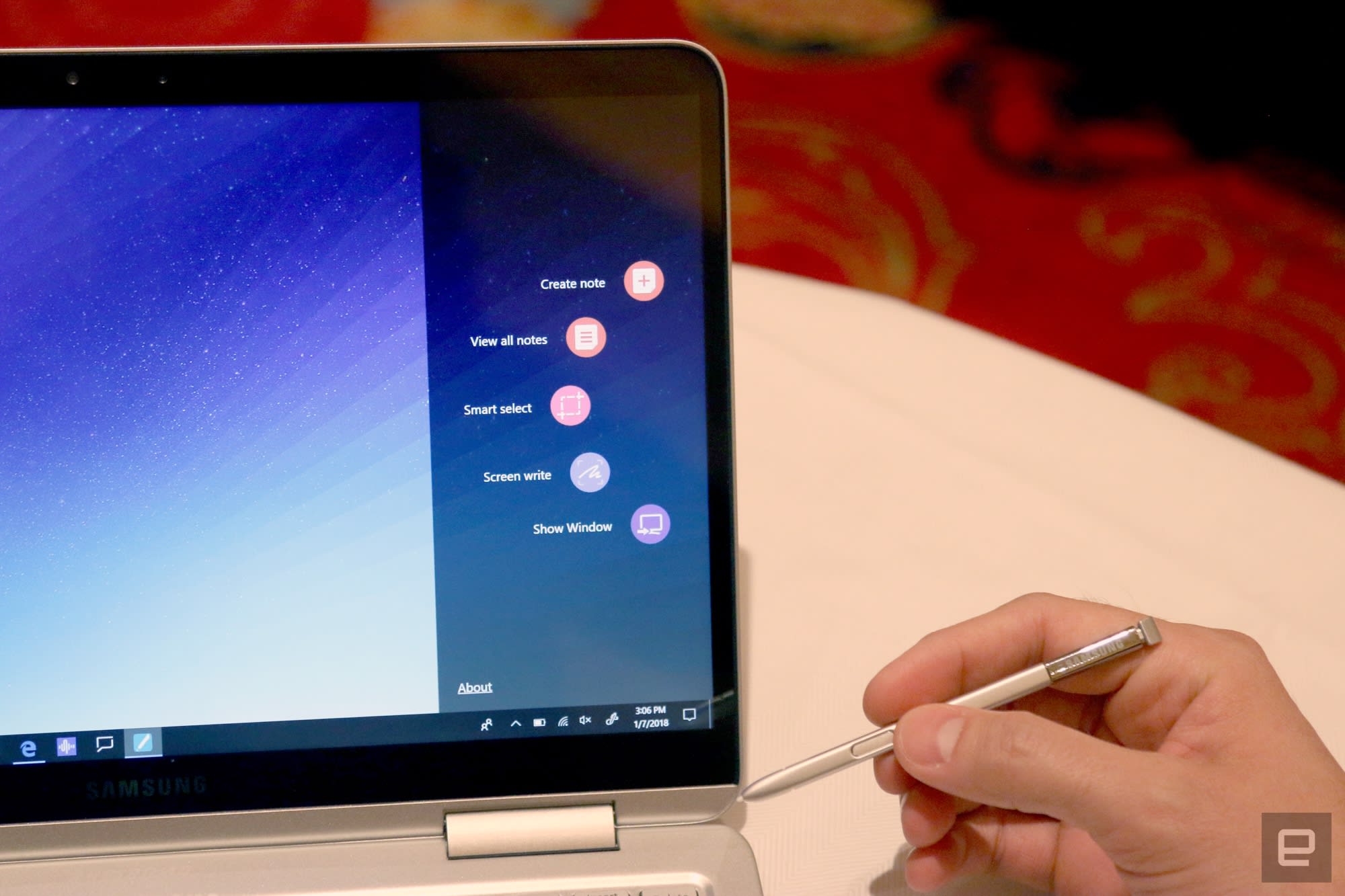
Beyond the S Pen angle, the Notebook 9 Pen is a pretty standard machine. There’s an 8th-generation Intel Core i7 chipset thrumming away inside, and you’ll be able to pick up models with up to 16GB of DDR4 RAM and a 512GB SSD, though Samsung is still keeping quiet on pricing. The moments I spent with the Notebook 9 Pen were perfectly snappy and indicated that it would slot into my daily workflow without issue, but this since this still non-final hardware, you’ll have to wait for a more complete verdict. Similarly, I had no real issues with the 13.3-inch 1080p display — my only real concern is that at max brightness, it’s not quite as bright as either of the other Notebook 9 models Samsung talked up ahead of the show. I also would’ve preferred a more robust selection of ports — there’s one USB-C port, one USB 3.0 port, a microSD slot and an HDMI-out — but here’s hoping the final price tag reflects this.
The Notebook 9 Pen might be lacking in style, but so far it seems like a solid blend of power and pen-based productivity tools. Whether it fulfills a need that actually exists is another story, and it shouldn’t be too long before we get the final hardware and find out for ourselves.
Click here to catch up on the latest news from CES 2018.
Whill’s new electric wheelchair is light, portable and fast
Whill’s electric wheelchair picked up the award for Best Accessibility Tech in last year’s Best of CES, and now it’s back with a newer, lighter and more portable version of that vehicle. The Model Ci uses a lithium-ion battery and can travel 10 miles on one charge, with a top speed of 5 miles per hour. (We took the Model Ci for a brief spin and we’re happy to confirm 5 MPH is plenty fast for everyday navigation — it’s a light jogging speed). That battery makes it lightweight, too; the entire thing weighs 115 pounds.
But the coolest part? The Model Ci is available today. It costs $4,000.
Another new feature in the Model Ci is its ability to break into three parts for easy packing. Whill’s wheels are specially designed, each one containing 24 separate rollers that allow the chair to move smoothly in any direction. All of this is controlled via a joystick on the right armrest, though the chair also connects to an app, which allows users to control it remotely via a smartphone.
Whill is continuing its award streak — it’s already won a CES 2018 Innovation award for the Model Ci.
Click here to catch up on the latest news from CES 2018.
Samsung’s 8K TV uses AI that ‘learns’ to upscale low-res video
In 2013 Samsung introduced a $40,000 85-inch 4K TV with an easel-like design, before showing off an 8K demo unit in 2014. Now at CES 2018 Samsung is showing off this 8K-resolution Q9S that continues the same design strategy, just with more pixels and AI inside. Combine that with LG’s 88-inch 8K OLED, and it looks like 2016’s LG vs. Samsung battle is ready to resume.
We don’t have details like a price or release date for the Q9S, but the 85-inch monster features a “proprietary algorithm” to upscale lower-res video for its Super Hi-Vision screen. The artificial intelligence comes in with its ability to “learn from itself” to improve over time — which could be interesting if it works well, and could also lead to some incredible self-created artifacts if something goes wrong.
Click here to catch up on the latest news from CES 2018.
Samsung’s 2018 4K TVs add Bixby AI
Even if you can’t spring for an 85-inch 8K TV or a screen large enough to be called The Wall, Samsung still has something new for your next TV. Its 2018 Smart TV platform is getting an upgrade with the addition of its Bixby AI voice control platform, as well as integrated SmartThings technology. That home automation hub support will “offer easier sharing, connectivity, and an overall simplified way to control the television and sync with other devices.” Finally, a new universal guide will keep up with the likes of Apple, Roku and TiVo by searching for content within apps and suggesting new things you to watch.
Click here to catch up on the latest news from CES 2018.
Samsung is ready to build a 146-inch TV wall in your house
Last year Samsung announced a 34-foot 4K LED TV that could challenge movie theater screens, and now it’s ready to sell a version for home use. The Wall by Samsung uses similar MicroLED tech that works without a backlight and can be assembled in extremely large sizes thanks to its modular design. We don’t have much information to go on yet, but the 146-inch 4K screen promises “outstanding brightness, contrast, and close-to- perfect viewing from any angle.” Just something to think about, if an 85-inch 8K TV isn’t big enough and projector screens aren’t bright enough.

Click here to catch up on the latest news from CES 2018.
Jabra’s newest wireless earbuds promise better sound and voice control
Apple’s AirPods aren’t the only truly wireless earbuds out there. In fact, Jabra is releasing the third generation of its own take on the technology: the Elite 65t and Elite Active 65t wireless earbuds. In addition to these two new models, Jabra is showing off a wired pair of Bluetooth earbuds, the Elite 45e, at CES this year as well.
The Elite 65t includes one-touch access to Siri, Google Now, and Amazon Alexa, and promises up to five hours of listening time. That figure bumps to 15 hours total thanks to the included charging cradle. There’s a built-in microphone for calls and voice commands with the Jabra Sound+ app handling any EQ tweaks. They’ll come in three color combos: Titanium Black, Copper Black and Gold Beige.
The Elite Active 65t model has all of the same features, but adds a special coating to keep them in your ears while you’re working out, an integrated accelerometer for use with the Jabra fitness app and an IP56 sweat, water and dust resistance. They’ll only come in Copper Blue and Copper Red color combinations.
The Elite and Active models will both be available for pre-order at Best Buy starting tomorrow (January 8th). Elite is priced at $170 while the Active version is $190 and both will ship next month. Jabra also has new Elite 45e wired Bluetooth headphones that will retail for $100, too. They come with a soft neckband with a memory wire and pack in a microphone for use in voice calls, however there’s no word on when those will arrive just yet.

