


The TVs that mattered at CES
As usual, CES 2018 provided a bonanza of big screens, loaded up with every piece of tech you can create a buzzword for. But figuring out which TVs will matter to you next year is about a little more than just pixels and apps. While there could be only one “best” winner, the decision of what to buy is about more than just picture quality, which is why these screens are the ones that stuck out.

LG 65E8 OLED
Richard Lawler / Engadget
It’s obvious why LG’s OLED tech stretched its run as Best of CES TV champ into a fourth straight year — despite all challengers, we think this one was the most outstanding. Up and down its line of televisions, the picture quality is undeniable, thanks to its self-illuminating pixels, which provide a true black. This year, LG’s upgrades focused on enhanced processing, added voice controls and, in some models, support for 120-frames-per-second video. We’re still waiting to find out if these will be more affordable in 2018, but so far the premium price has been worth it.

Samsung chose to go in a few different directions this year, and it’s less clear how well they’ll turn out. Its immense MicroLED wall and consumer 8K TV looked amazing, but it’s hard to imagine when we’ll see them for sale, and at what price. When it comes to the TVs most of us might actually afford, the emphasis is on the newly added Bixby AI, as well as its SmartThings app, which is supposed to streamline the setup process and makes the TV a hub for any home automation hardware you have.
The company isn’t giving up on the picture-quality war, though, and in no-pictures-allowed demos, Samsung tried to prove that its quantum-dot LCD tech could match and even outpace OLED for high-quality 4K. It’s also dug in its heels against Dolby Vision, opting instead to push HDR10+ as a competing standard, adding Warner Bros. as an ally. There’s a lot going on here, but it could give Samsung a chance to push its TVs as smarter, cheaper options — if people appreciate the experience.

If you absolutely must have the highest resolution available, there is one company ready to sell one. While Sharp’s 8K panel isn’t brand-new, this was the first time I saw the production version in action, and it was as stunning as ever. Sure, there isn’t any 8K content to watch; if you have some, it requires plugging in four synchronized HDMI cables; and it’s available only in Japan so far — but why worry about small details? Real early adopters are preparing for the Tokyo Olympic Games in 2020.

Can a projector count as a TV? Hisense hasn’t stopped to worry about the nomenclature, and is determined to press forward with its “Laser TV.” The 100-inch model that launched last year is already eating up a significant part of the market for screens 75 inches and larger, and it’s easy to see why. In a demonstration, the just-announced 150-inch version used its laser light engine and dual color wheels to throw a bright, beautiful image without taking up too much space or requiring additional hardware. With speakers, apps and tethered subwoofer included, just plug in two cables and find a screen — your home theater is set. That’s a tough claim to match for any other “TV.”
Pushing a wave of affordable 4K TVs, TCL’s P-Series put the company on the map last year, and in 2018 it’s again choosing a direction apart from the TV competition. While Alexa and Assistant are inside nearly every device on the CES show floor, the 5 and 6 Series are sticking with Roku’s burgeoning voice control platform. We’re still waiting to see if it competes with the rest, but if you’re unwilling to give Amazon and Assistant a peek into your living room, then maybe it can emerge as a viable alternative.

This is hardly a comprehensive list of the TVs that popped up at CES (NVIDIA’s giant gaming displays are an interesting new wrinkle), but it should provide a good start if you’re thinking about upgrading this year. Last year’s show ushered in the age of cheap-and-good 4K TV. This year, we’re seeing the evolution of HDR and the emergence of voice-controlled AI assistants as the top stories, but that could all change by the time any of these TVs go on sale.
Click here to catch up on the latest news from CES 2018.
Facebook goes back to basics: People
Over the past couple of years, Facebook has frequently tweaked its News Feed algorithms to deliver stories that are relevant and of interest to you. It was a strategy that, up until now, seemed to be the way forward for the site. But that’s all about to change, as Facebook has announced that there are big adjustments coming to its News Feed. In the months ahead, the platform will start to prioritize posts from people you care about, like friends and family, over stories or videos from publishers. Users may react positively, but publications that rely on Facebook to drive traffic won’t be happy.
In a blog post, Facebook CEO and Founder Mark Zuckerberg said the goal is to ensure that users feel happy when they’re on the site, something that’s easier to accomplish if you’re seeing baby pictures rather than news articles about Russia investigations. During the early days of Facebook, the focus was simply on communication between friends, but over the past couple of years it began to actively promote and push content from media companies into users’ feeds. It’s something Facebook had to do in order to keep people on the site for longer period of times and, of course, gave the social network a solid source of revenue in the process.

For better or worse, the platform quickly became more of a news curator. And while that may have helped it grow as a business and become the most powerful social network, with more than 2 billion monthly active users, it also meant the company strayed away from its roots. By bringing the focus back to interactions between friends and family, Facebook is simply going back to basics. The the latest News Feed tweaks are attributed to recent user feedback, noting that people have said posts from businesses, brands and media are crowding out the “personal moments that lead us to connect more with each other.”
Facebook hopes that by eliminating some of that media noise, and creating more personal connections, people will stress less. “Research shows that strengthening our relationships,” Zuckerberg said, “improves our well-being and happiness.” He added that although he expects the amount of time people spend on Facebook will go down, he believes keeping users in a good mood will be better for the business and community in the long term — but he didn’t say how, exactly, that’s going to happen. It seems the fear is that, while users may spend more time on the site now, the negative atmosphere could eventually drive them away.
Though news articles or videos will still show up on your feed every now and then, Facebook is making it clear that from now on the priority is going to be to content from friends, family and groups you’re part of. That’s a punch in the gut for publishers who have built their strategy around Facebook.

Of course, it’s no secret that Facebook is still under scrutiny for its role in Russia’s meddling in the 2016 US presidential election. Facebook became the preferred platform for Kremlin-sponsored trolls to spread misinformation (aka fake news) and dubious ads, as part of a vicious (and successful) campaign designed to undermine our democracy and encourage hostility between the American people. Last year, the company revealed to Congress that over 126 million users were exposed to that content in the lead-up to the election, in what was a major blow to Facebook’s reputation.
Although Facebook doesn’t say this is the reason for the change, it’s not hard to imagine that what happened in 2016 helped shape the upcoming News Feed. Less negative articles and more positive, personal posts could create a healthier community. It remains to be seen if the changes will actually help prevent another major headache for Facebook, but at the very least it will make it feel like less of a media company — something it keeps claiming not to be, despite overwhelming evidence to the contrary.
“Some news helps start conversations on important issues,” Zuckerberg said. “But too often today, watching video, reading news or getting a page update is just a passive experience.” The problem he highlights isn’t exclusive to Facebook, either: Similarly Twitter has become exhausting and toxic, thanks to non-stop political bickering and harassment. If you’re Facebook or Twitter, that’s definitely not what you want to hear.

Zuckerberg also said his team has found that users interact more with live videos, as opposed to regular ones, perhaps suggesting that publishers should focus more on that type of content going forward. A different byproduct of this is that Facebook can now make a bigger push for Watch, its original video content platform, where it has more control over the kind of stuff its users are viewing. Coincidentally, there have been reports that the company is prepared to invest $1 billion on TV programming, hoping to rival the likes of Amazon and Netflix in developing original shows.
Ultimately, Facebook claims it wants users to be happy, even if that happiness comes at the expense of its bottom line. “We’re losing hope,” an undisclosed Facebook media partner told Digiday about the overhaul coming to the News Feed. For years, it’s felt as if Facebook had prioritized publishers and brands over its users, but now it’s seems like it’s changing tactics. As usual, there will always be someone unhappy with change. This time around it was done with users in mind. But knowing Facebook, don’t be surprised if in a few years the tables are flipped. Again.
Learn how to use AirDrop on an iPhone or iPad
Like many features native to iOS and MacOS, AirDrop is both quick and easy. Similar to sending files via text and email, you can use the cross-platform utility to send photos, videos, songs, and even robust PDF files. This is particularly handy when you are in close proximity to the person you’d like to send your file to, as AirDrop only works when users are near one another.
Moreover, from a security standpoint, AirDrop is safer to use than both email and text. The feature uses a Bluetooth connection to create a peer-to-peer Wi-Fi network between your iOS and MacOS devices, and creates a firewall which allows for added encryption.
Another benefit of AirDrop is that several native iOS apps support it. You can access the feature from directly within Photos, Notes, Safari, Contacts, and Maps, without having to navigate to a different screen or copy and paste the information. Well, that is, assuming you know how to use AirDrop in the first place. If you don’t, the tutorial below will provide you with everything you need to know.
Accessing AirDrop
Apple reconfigured the Control Center in iOS 11, making AirDrop less accessible than it once was. Thankfully, the feature is still easy to access.
- Step 1: Swipe up from the bottom of your iPhone, iPad, or iPod Touch to reveal the Control Center. If using an iPhone X, swipe down from the upper-right corner of the display.
- Step 2: Locate the upper-left box, which contains Airplane Mode, Bluetooth, and other connectivity controls.
- Step 3: Perform a 3D Touch or hold down on any of the aforementioned icons. This will expand the box, and reveal additional controls like AirDrop.
- Step 4: Tap the AirDrop button to open the quick settings menu. Here, you will be able to set your ability to send and receive files via AirDrop.
Note: If you see “Receiving Off” and can’t seem to change it, go to Settings >General > Restrictions and ensure the AirDrop feature is toggled on.
Making sense of AirDrop’s quick settings
Once you’ve access the quick settings menu, you’ll be presented with three options:
- Receiving Off: This blocks your device from receiving any and all AirDrop requests.
- Contacts Only: This makes it so only your contacts can see your device.
- Everyone: This allows all nearby iOS users who are using AirDrop to share files with you.
Sharing files via AirDrop
Now that AirDrop is turned on, follow these steps below to share files, photos, and other content:
- Step 1: Go to the file, photo, or other piece of content you’d like to share.
- Step 2: Tap the Share button in the bottom-left corner of your device’s display. The feature’s icon will depict a box with an arrow pointing upward.
- Step 3: Directly below the image or piece of content, you should see a list of available devices. Tap the name of the device with which you wish to share.
- Step 4: Once accepted, “sent” will appear under the device name.
Accepting or declining an AirDrop transfer
Sending a piece of content via AirDrop is easy, as is accepting or declining an AirDrop transfer. If someone sends a file or photo to you using AirDrop, an alert will appear on your screen with a preview of said content.
Tapping Accept will open the app that corresponds with the file (Photos, for instance), whereas tapping Decline will cancel the transfer. Keep in mind that if you’re sharing content with yourself via AirDrop, you won’t see an option to accept or decline an AirDrop transfer; the content will automatically transfer between your devices, assuming both are signed in using the same Apple ID.
Troubleshooting
If you’re having trouble transferring content between devices, make sure both Bluetooth and Wi-Fi are turned on. This applies to each device, as AirDrop only works when both Wi-Fi and Bluetooth are enabled.
If that doesn’t solve the issue, ensure you’re not using your iPhone or iPad as a personal hotspot. To do so, go to Settings > Cellular > Personal Hotspot, and ensure the slider beside the feature is toggled off.
If none of the above solve the issue, make sure the two devices are within range of one another. AirDrop will not work if either user is out of Bluetooth and Wi-Fi range. Also, if the person you’re attempting to share your content with has AirDrop set to Contacts Only, and your information is not saved in their contacts, make sure they toggle their AirDrop configuration to receive AirDrop content from Everyone.
Editors’ Recommendations
- Apple adds more indoor maps for select airports and malls to iOS 11
- Free up storage and keep your media organized with Google’s Files Go app
- How to transfer files from Android to your PC — the easy way
- Common iOS 11 problems and advice on how to handle them
- Apple iOS 11.2.2 update offers a fix to the Spectre security vulnerability
George Clooney will star in and direct Hulu’s ‘Catch-22’
Netflix isn’t the only streaming service getting some George Clooney-produced goodness. The popular actor/producer is also bringing Joseph Heller’s satirical novel Catch-22 to the small screen, this time via Hulu. According to Deadline, the six-episode series will be written by Luke Davies (Lion) and David Michôd (War Machine) and star Clooney, who will also direct along with frequent collaborator Grant Heslov (Argo).
According to Deadline, Clooney will take on the role of antagonist Colonel Cathcart in the show, who keeps raising the number of missions men like protagonist Captain John Yossarian must go on in order to finish their tour of duty and go home: the un-winnable situation the title has become synonymous with. Deadline notes that Clooney and Heslov’s Smokehouse Pictures will executive produce, as well, along with Anonymous Content. This will be the first full television series based on the novel, which had a 1970 movie starring Alan Arkin and a television pilot starring Richard Dreyfuss in 1973 that never went to series.
Source: Deadline
Retro tech, accessibility and the latest in the TV wars
There’s so much news at CES, it can be hard to filter out the noise and find what matters. Thankfully, Engadget is here to help. A collection of your favorite editors got together toward the end of the show to have a conversation about the big trends and the announcements that excited them most. And, of course, Richard Lawler talked about TVs.
Click here to catch up on the latest news from CES 2018.
False alarm: Emergency alert in Hawaii claims ‘missile inbound’
A few minutes ago, phones across Hawaii received the above emergency alert about a “ballistic missile threat inbound,” but according to state officials it isn’t true. US Rep. Tulsi Gabbard, Hawaii’s governer David Ige and the state’s Hawaii Emergency Management Agency all chimed in one Twitter to confirm the alert is false. Honolulu police confirmed in a post that “State Warning Point has issued a Missile Alert in ERROR!,” while Buzzfeed reporter Amber Jamieson tweets that one EMA employee said it was a part of a drill.
Developing..
NO missile threat to Hawaii.
— Hawaii EMA (@Hawaii_EMA) January 13, 2018
HAWAII – THIS IS A FALSE ALARM. THERE IS NO INCOMING MISSILE TO HAWAII. I HAVE CONFIRMED WITH OFFICIALS THERE IS NO INCOMING MISSILE. pic.twitter.com/DxfTXIDOQs
— Tulsi Gabbard (@TulsiGabbard) January 13, 2018
There is NO missile threat. https://t.co/qR2MlYAYxL
— Governor David Ige (@GovHawaii) January 13, 2018
Source: Hawaii Emergency Management Agency (Twitter), David Ige (Twitter)
Taking Arcimoto’s three-wheeled EV for a spin
The rise of the electric car promises a cleaner future. Arcimoto CEO Mark Frohnmayer believes that we can do more to reduce our footprint by not just removing trash from our air but also using smaller vehicles built using fewer materials. The $11,900 Arcimoto three-wheeled EV is the result of his desire to lower his CO2 emissions and cut down on the space a daily driver takes in the world.
At CES, I had the opportunity to get behind the… well, it’s not a wheel. I sat behind the handlebars and whipped the tiny EV around a Las Vegas parking lot. Meant for quick jaunts around town, the two-seater Arcimoto won’t be much help on a trip to Costco. But for the majority of the single-person trips around a neighborhood, for the truly adventurous, it could replace a second car.
Arcimoto calls its car the FUV (fun utility vehicle). On the road, the Arcimoto, even at slow speeds, is exactly that. Its peppy acceleration and quasi motorcycle feel, without the worry of tipping over, create an experience you don’t get from your typical electric car. I caught myself leaning like I did as a kid on my three-wheel ATC, even though it wasn’t needed. Your childhood memories may vary.

It’s set up like a scooter with a twist-and-go accelerator. The front brake is a hand lever, and the rear brake is positioned on the floor. A single passenger can sit directly behind the driver, and both are strapped in with two seatbelts that criss-cross your body. That felt a bit like overkill, but safety first, I guess. I could only spend about 30 minutes, but apparently I could have spent hours doing circles, thanks to the range of the vehicle.
The base-level 13kWh battery has a range of 70 miles. A larger 20kWh battery pack will keep the Arcimoto FUV on the road for up to 130 miles. It can be charged via the regular 110V wall outlet at the rate of 10 miles’ worth of charge after one hour, and a level 2 charger will juice up the vehicle at the rate of 40 miles in one hour. Normally I’d be bummed about a vehicle with a 70-mile range, but let’s be honest: No one should be using the Arcimoto for road trips of any consequence.
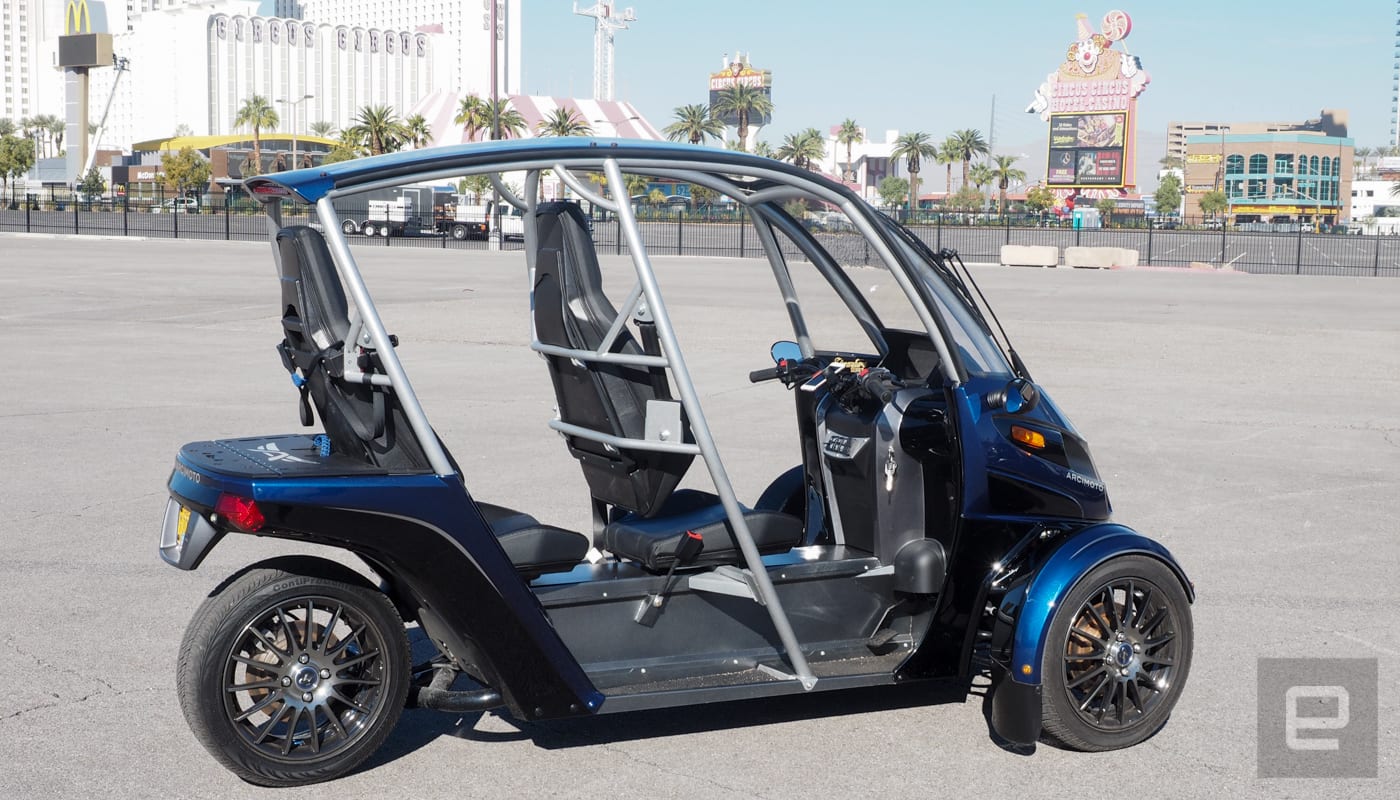
I drove the Signature series FUV, a limited-edition vehicle built for 10 customers. Arcimoto says it’ll spin up production of the consumer version this summer. It’s not for everyone. The center dash consists of a lever for the single wiper, two USB ports, a parking brake, defroster, handlebar grip heater and seat heaters. That’s it. The display is equally sparse, with a speedometer and a huge battery gauge.
And yet, if you’re low on space, want an EV with more than enough range to get around town and enjoy the open-air excitement of riding (or driving, I’m really not sure) a not-really-a-motorcycle-but-not-quite-a-car, the Arcimoto FUV is worth checking out.
Click here to catch up on the latest news from CES 2018.
Windows 10 adds ‘Do Not Disturb’ feature
If you’re part of the Windows Insiders Fast Ring (or have opted to skip ahead), you’ll find the Windows 10 Insider Preview Build 17074 available to download. Of note is the addition of Quiet Hours, which functions similarly to the Mac Do Not Disturb feature. You can set your own schedule, during which you will only receive notifications from people and apps in your priority list. The feature will also automatically switch on when you’re playing full screen DirectX game and when you’re duplicating your display.
There are quite a few other improvements included in this build; many focus on the reading experience within Windows 10. There are new grammar tools for both EPUB books and Reading View on websites. Additionally, Microsoft Edge has a new look for reading across EPUBs, PDFs and other documents, as well as syncing reading progress and notes across devices. The build also includes support for custom audio in EPUB.
The build adds an option to never save passwords for a domain, which was highly requested feature among Windows Insiders. It also allows for autofilling passwords and using extensions when using InPrivate mode. Additionally, fixes were put in place to make Near Share more reliable. You can see the full list of improvement at the Windows 10 blog.
Source: Windows 10 Blog
Zap your brain for a better you
Squirt some conductive gel on your skin, place a lightweight headset on your noggin and, according to a number of companies at CES, there’s barely a limit to the types of self-improvement you can achieve. You can improve your sleep or your athletic performance, or lose weight. You might relieve nausea or even aid depression. And with almost no effort on your part.
Many of these gadgets use tDCS — transcranial direct current stimulation — to mildly stimulate or suppress neurons firing in certain areas of the brain. It’s a straightforward mechanism that has been heavily studied in connection with everything from math skills to post-stroke rehabilitation. There is much we still don’t know about how the brain functions, and tDCS research is not conclusive — it merely correlates electric shocks with improvements in conditions without our understanding why. Yet when it works, it’s a noninvasive, relatively cheap clinical treatment that’s fairly safe, beyond potential burns and mild discomfort.
Off-the-shelf devices that tap into this research, mostly to help users focus or relax, have been around for a while. Yet, increasingly, startups are allowing you to administer your own electric zaps, to achieve a host of goals.
Modius, for instance, is designed for weight loss. It doesn’t use tDCS, because its currents don’t hit the brain directly. Instead it targets your vestibular nerve, which affects the hypothalamus.
As CEO Jason McKeown explained, the hypothalamus controls fat storage, appetite and metabolic rate. By stimulating it, Modius essentially tricks your brain into thinking the body is in motion, which jacks up your metabolism. “It feels like you’re moving,” he said. “It’s a pleasant floaty feeling.”
To me, it was more of a lightheadedness, like a dizzying rush of blood to the head. McKeown claimed that, of the 650 people using Modius, 80 percent lost weight, with an average decrease of six pounds after six weeks. After an Indiegogo campaign last summer, the device went on sale this month for $499.
Meanwhile, Danish company Platoscience’s headset, called Platowork, is designed to help you be creative or focused, depending on the setting. (Another product still in development is called Platoplay; the company says it will boost eSports players’ performance.) The company says that 15 minutes with the headset shortly before you want to work gives you a brain boost for about an hour.
Research indeed shows a link between tDCS and creativity, and the company pitches its product as a way to stop procrastination or break through a mental block. “We don’t help you be better at creativity or focus; we help you get into that mind-set,” said Morten Lindhardt Madsen, the company’s UX designer.

Then there’s Ybrain, a startup from Seoul, South Korea, that claims to treat depression. In South Korea, depression rates are comparatively high for a developed country, but the condition still carries a public stigma. The company says it wants to provide private relief to users. “We found that many patients who have depression are not coming to hospital,” said a spokesman. A number of papers have shown that tDCS can decrease depression, and a recent review claims that depression is one of the most responsive conditions to mild electric pulses, along with addiction and fibromyalgia.
In an unpublished study by Ybrain, 56 percent of patients with major depressive disorder responded to their device. In these patients, the treatment by headset was comparable to selective serotonin reuptake inhibitors (SSRIs), which are a common form of antidepressant. The study consisted of 12 tDCS treatments in six weeks, involving 96 patients in Korea — a relatively large sample size compared with similar studies.
The clinical model is called MINDD and is approved by Korea’s Ministry of Food and Drug Safety (the FDA equivalent) for treating depression and post-stroke rehabilitation. It is being used in more than 30 hospitals, according to the spokesman. The company also showcased a consumer model, which they hope to launch in 2019.
Together with more established neurostimulation companies at CES, like NuCalm (which is about to sell its consumer model, ReNu, with a catalog of potential emotional outcomes) and Halo (which primes your brain for workouts), this sector of devices is filling up.
Yet, although there’s more than a decade of tDCS research, some experts in the area are reluctant to prescribe it for conditions like clinical depression. The issue is that when consumers see treatments on the shelves, they have every right to assume they’re safe and effective.
In the unsupervised hands of consumers, there’s a risk that a one-size-fits-all dosage may not fit the patient. For instance, tDCS treatment on depression patients in a Taiwan psychiatric facility resulted in outbursts of rage in two instances last year — episodes that could have been missed if they had taken place at home. While Ybrain’s consumer model will not allow users to change the dosage, the company acknowledges that patients with epilepsy or undiagnosed bipolar disorder could be harmed by the treatment — and they cannot say why 44 percent of patients showed no improvement in their study. Modius, meanwhile, can be used only once a day for 60 minutes, after which users will be locked out. Both companies say they will educate customers on holistic treatment for depression and weight loss, respectively. But ultimately, they can’t make people listen.
We are forever chasing self-improvement, and neurostimulation promises immediate results. Yet without solid science, a doctor’s guidance or specific regulations, these consumer products simply might not work. Then again, if the technologies emerging at CES take off, they’ll raise a host of new questions too: Will users rely on them to the detriment of their long-term health? Could they become addicted to mini electric shocks to the head? If mishandled, this technology could turn out to be ineffective at best, and dangerous at worst. And of course, the allure of a quick fix might be too strong for its own good.
Click here to catch up on the latest news from CES 2018.
iMac Pro is $1,000 Off at Micro Center Stores, Now $3,999 While Supplies Last
Micro Center stores are currently offering the base model iMac Pro for $3,999, a significant $1,000 discount off Apple’s regular price, and by far the lowest price we’ve ever seen for the powerful desktop workstation since it was released a month ago.
Micro Center says the deal is available at its retail stores only and not online. The official Apple Authorized Reseller has 25 locations across the United States, many of which appear to be open this Saturday and Sunday.
The best deal we had previously seen on the base model iMac Pro, which starts at $4,999 from Apple, was a $250 discount from Best Buy that dropped the price to $4,749.99 earlier this week, so this is an impressive sale.

Micro Center says the deal is limited to one per household, and supplies are likely extremely limited, so we recommend calling ahead if you are planning on visiting one of their stores. There’s no indication when the sale ends, so act fast.
The base model iMac Pro is equipped with a 27-inch 5K display, 3.2GHz 8-core Intel Xeon W processor, 32GB of ECC RAM, 1TB SSD storage, Radeon Pro Vega 56 graphics with 8GB HBM2 memory, 10Gb Ethernet, and four Thunderbolt 3 ports.
Related Roundup: iMac ProTag: Micro CenterBuyer’s Guide: iMac Pro (Buy Now)
Discuss this article in our forums
 AIVAnet