


Android 5.0 Lollipop gets ported to the HTC HD2
 If you were expecting the headline to read something like “Lollipop gets ported to HTC Butterfly S” or some other relatively new HTC device then sorry for the confusion! Yes, the HTC HD2 is ahead of the game again, this time with a port of Lollipop by XDA Senior Member macs18max.
For those of you unfamiliar with the HD2, it was HTC’s Windows Phone 6.5 device, released in 2009. It has a 4.3 inch, 800 x 480 display, 448MB of usable RAM and is powered by a 1 GHz single-core Qualcomm Scorpion processor. The perfect candidate for Android 5.0 Lollipop!
The Hd2 has a become a legend in the custom ROM community for its ability to run different operating systems. It probably has the world record for the number of different mobile operating systems that can run on a single device.
The HD2 has been seen booting Android 2.2 Froyo right up to Android 5.0 Lollipop, as well as Ubuntu, MeeGo, Sailfish, Windows RT and Firefox OS.
It started out as a Window Phone 6.5 device, but when it was abandoned by Microsoft and didn’t get any more upgrades, the hacker community took the phone to heart and started porting. In its long and illustrious history the HD2 has been seen booting Android 2.2 Froyo right up to Android 5.0 Lollipop, as well as Ubuntu, MeeGo, Sailfish, Windows RT and Firefox OS.
Android 5.0 Lollipop was successfully booted on the HD2 using the 3.0.101 kernel, however the ROM is in its very early stages, and only the display and audio are working at the moment. However macs18max has pledged to continue working on the port.
If you want to find out more and even try out this custom firmware then head over to XDA’s HTC HD2 Lollipop 5.0.2 thread!
Do you, or did you own a HTC HD2? Any thoughts?
CES 2015: ‘Schlage Sense’ Smart Lock Allows Siri Voice Commands to Unlock Doors
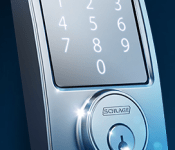
 Schlage, a division of technology-focused safety and security company Allegion, has announced at CES this year the Schlage Sense, a touch-pad enabled smart lock for homeowners that most notably allows users to command Siri to unlock their doors thanks to integration with Apple’s HomeKit.
The company’s first Bluetooth-enabled lock, the Schlage Sense allows users to simply enter a code to gain access to their house using the back-lit touchpad or a smartphone with a free-to-download app. HomeKit integration also brings added security and end-to-end encryption and authentication when the Schlage Sense lock interacts with a user’s smartphone via the app.
The Schlage Sense system has the ability to manage and schedule up to 30 codes at the same time through a dedicated, easy-to-use app, which offers an additional layer of key-free convenience. The Schlage Sense app allows individuals to create and delete access codes, check on lock status and view activity, as well as update settings and check battery life without requiring residents to connect to an existing home automation system or pay a monthly subscription charge.
The company also promises that, thanks to Built-in-Alarm Technology that sends out alerts any time it senses potential door attacks, the new lock provides the highest rating of security certified by the Builders Hardware Manufacturers Association.
Schlage Sense will become the latest in the brand’s growing portfolio of keyless door locks, which also includes the Schlage Touch and Schlage Connect. The new lock will come in two styles – Camelot and Century – and a variety of finishes – Matte Black, Satin Nickel and Aged Bronze – that the company claims will match any home’s aesthetic. Schlage Sense will be made available nationwide in select stores and online retailers “later in 2015.”
Samsung CEO says everything company produces to be IoT capable within 5 years

Yesterday during CES 2015 Samsung joined several other companies in announcing major expansions in their efforts to turn home automation initiatives into full blown Internet of Things (IoT) ecosystems. Samsung’s announcement primarily focused on their SmartThings platform which the company is showing off during CES 2015. During his keynote address last night, Samsung CEO BK Yoon claimed IoT “has already started” and that “it’s not science fiction anymore — it is science fact.” Despite the claims of Yoon and others regarding the maturity of IoT, only 2% of consumers have invested in IoT devices according to Samsung’s research. That is not stopping Yoon who says Samsung is on a path to having everything the company produces IoT capable within five years.
According to Yoon, Samsung will have reached the point where 90% of their products are IoT devices by 2017 and within 5 years they will be at 100%. This includes items from ovens to air purifiers and all of the other goods that Samsung produces for the home market. Samsung is not stopping there though. They see IoT as having a huge impact on the enterprise market where business will have a need for connected devices whether it is phones, tablets, other wearable devices, digital displays, or even industry specific items like medical diagnostic equipment in the healthcare field.
Samsung will be joining other companies in what is becoming an increasingly crowded field to supply everything with electronics in your home or business. Samsung says they intend to help the industry establish standards and promote interoperability. This could be achieved as Samsung shifts their business model to focus more on collaborations.
With all of this attention on IoT during CES 2015 this year, are you taking a second look at how it may be used in your home or business? Let us know in the comments and then check back here at TalkAndroid for more news from CES 2015.
source: USA Today
Come comment on this article: Samsung CEO says everything company produces to be IoT capable within 5 years
Samsung to launch two budget Android tablets in 3rd week of January: Report

Rumour has it that that Samsung is preparing a couple of budget Android tablets to be released this year. Codenamed Project Goya, the tablets are currently known as numbers SM-T116 and SM-T113. While it is nearly impossible to make detailed presumptions about a device by looking at its model number, the tablets appears to be a successors to the Galaxy Tab 3 Lite. It is quite possible that Samsung is aiming entry-level market with its new tablets.
If sources are to be believed, the upcoming tablets are going to have similar specification as the Galaxy Grand Max and the Galaxy J1. The tablet with model number SM-T113 first surfaced on the Indian import record keeping website Zauba, and initial reports suggest that the device might be intended for the European market. Reports say that the SM-T113 could be priced around $549, but nothing can be confirmed before its actual release.
As far as the latter model SM-T116 is concerned, it reportedly will feature a 7-inch display, Android 4.4 KitKat, a 1.2GHz quad-core Spreatrum SC8830 processor and 1GB RAM.
If you are planning to buy a budget tablet, you might want to wait till the third week of January, when these devices are likely to be launched.
Are you excited about the new Samsung tablets? Tell us your views by commenting.
Via: SamMobile

The post Samsung to launch two budget Android tablets in 3rd week of January: Report appeared first on AndroidGuys.
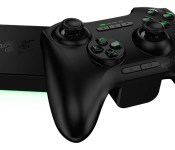
Razer’s Android TV box targets gamers with PC streaming

Razer has joined other recent comers in the Android TV arena with Forge TV, but unlike the others, its box is aimed squarely at gamers, not cord-cutters. As such, it’s suitably powerful with a quad-core Snapdragon 805 CPU, Adreno 420 GPU, 802.11ac WiFi, Bluetooth 4.1, 2GB RAM and 16GB of storage. Yes, that’ll let it handle garden-variety Google Play games for up to four players and beam them onto a big-screen TV. But the Forge TV’s main powers have little to do with weak-sauce Android gaming, and more to do with Razer Bluetooth peripherals and the piece de resistance, Cortex: Stream. That tech uses WiFi to give you low-latency streaming from a source far more suitable to gaming than a dinky Android box — namely, your PC.
Razer says its Cortex: Stream tech dodges the laggy PC streaming of other systems and works at up to 1080p resolution with a WiFi or ethernet connection. It’s also hardware agnostic and works with DirectX9 and higher games. To further aid game play, Razer added two optional Bluetooth accessories: the Serval gaming controller and the Razer Turret gaming mouse and lapboard. The controller can play any Android TV or smartphone game (using the phone clip), and memorize up to four device pairings.

Oh yeah, and Forge TV also works as an Android TV entertainment center. It’ll power apps like Netflix, Hulu and Spotify, giving you remote control via an Android or iOS device. It also supports Google Cast in case you want to broadcast shows through a Chromecast dongle, and you can save shows and gaming progress via a cloud save feature. What price gaming power? The Forge TV box alone is $100, or $150 bundled with the Serval controller (we’ve reached out for pricing for the Turrent gaming mouse). Availability is targeted for Q1 2015.
Filed under: Gaming, Home Entertainment, HD
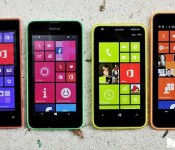
New report shows slight spike in Windows Phone app installs on Christmas

A new report says that Windows Phone app downloads got a slight spike of 10 percent during the Christmas 2014 period of December 25-26, compared to December 24, indicating an increase in new activations for Windows Phone devices.

Fitbit Now Shipping Charge HR and Surge Fitness Bands [iOS Blog]
Fitbit today announced it has started selling the Surge and Charge HR, the company’s latest activity trackers. Unveiled in October, the two wearables join the Charge and Flex in Fitbit’s popular fitness band lineup.
 Fitbit Surge
Advertised as a Fitness “Super Watch”, the Surge includes a continuous heart rate monitor and an onboard GPS module for distance, route, and elevation tracking. Similar to other Fitbit wearables, the Surge also offers sleep monitoring, silent alarms, and all-day multi-sport activity tracking. Besides activity tracking, the Surge displays iOS notifications and provides music playback control via the touchscreen LCD display.
 Fitbit Charge HR
Alongside the Surge, Fitbit is also shipping the Charge HR, a version of the Charge fitness band that adds a continuous heart rate monitor. The Charge HR supports the standard all-day activity and sleep tracking available in Fitbit’s line of fitness bands. It also supports Caller ID on its monochrome OLED display.
Both the Surge and the Charge HR are available to order today on Fitbit’s online storefront for $249 and $149, respectively. Fitbit has so far opted not to support Apple’s Health ecosystem introduced with iOS 8, but there are several intermediary solutions to allow users to move Fitbit data into the Health app.
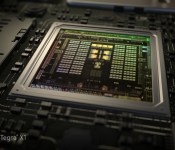
Tegra X1 – a closer look at Nvidia’s “superchip”

One of the first announcements out of CES 2015 was Nvidia’s new Tegra X1 SoC, the graphics giant’s successor to its rather good Tegra K1. Featuring the latest powerhouse ARM Cortex-A57 and A53 CPU combo and Nvidia’s Maxwell GPU technology, the company’s first 20nm SoC looks to be as energy efficient as it is powerful. Let’s delve a little deeper into what the Nvidia Tegra X1 has to offer.
CPU
The first thing you’ll probably have noticed about the Tegra X1 is that Nvidia appears to have ditched its customized 64-bit Denver CPU architecture, as found in the Nexus 9’s Tegra K1, and has gone back to a more standard 64-bit ARM configuration. That is not to say this chip isn’t interesting, Nvidia will be among the first to bring an octa-core Cortex A57 and A53 SoC, arranged in two groups of four, to market. This design is similar to Qualcomm’s upcoming Snapdragon 810 and Samsung’s existing Exynos 5433.

There are a couple of reasons why Nvidia may have chosen to go back to ARM’s designs. Nvidia itself stated that time-to-market is the leading reason, suggesting that shrinking its Denver CPU design down to 20nm was more time consuming than picking up and tweaking an ARM design. Alternatively, perhaps Nvidia wasn’t convinced by the performance results of its custom CPU, although it has hinted that Denver may reappear in a future SoC. Regardless, let’s take a look at what Nvidia has done with ARM’s reference designs.

The high-end A57 CPU cluster has 2MB of L2 cache shared across the four cores, along with 48KB L1 instruction and 32KB L1 data caches. The four energy efficient A53 CPUs share 512KB of L2 cache and have two 32KB L1 caches for instructions and data.
As the multiple CPU core design suggests, Nvidia’s chip operates as a big.LITTLE design in order to more efficiently share workloads across the most appropriate CPU cores. However, Nvidia has opted for its own custom interconnect, rather than ARM’s CCI-400, and cluster migration, rather than global task scheduling, to open up all eight cores for use at once.
Nvidia touts that its interconnect design significantly outperforms Samsung’s System LSI used in the Exynos 5433, boasting 1.4 times more performance for the same amount of power or half the power required to produce the same level of performance. This is partially down to cache coherence, which reduces the power/performance penalties usually associated with cluster migration. Nvidia has also decided to use its own System Electrical Design Point power management system to throttle and gate clock speeds, rather than ARM’s in-house Intelligent Power Allocation feature.
Although the Tegra X1 has gone back to an ARM CPU design, Nvidia clearly believes that its own customizations can improve on the standard ARM formula.
GPU
New technology also makes its way into the GPU aspect of Nvidia’s latest SoC. The Tegra X1 again features Nvidia’s proprietary graphics architecture, although this time the SoC is packing the company’s latest Maxwell architecture, which powers the high-end GTX 980 range of graphics cards, as well as the incredibly power efficient GTX 750Ti.

Take Nvidia’s own benchmarks with a pinch of salt, but the X1 appears to offer at least an additional 50 percent boost over the K1.

Nvidia claims to have doubled the GPU performance and halved the chip’s power requirements compared with the Tegra K1. Nvidia’s benchmarks suggest that this energy efficiency has been ploughed straight back into increasing performance, meaning that the X1’s GPU is still likely to be quite power hungry. Just like the Tegra K1, the X1 is probably destined for tablet products, where manufacturers can squeeze in some extra battery capacity.
The GPU design has changed a little compared with last generation, featuring two Maxwell SMMs (Streaming Multiprocessors) for a total of 256 CUDA cores, compared with a single Kelper SMX and 192 CUDA cores in the Tegra K1. Although the number of CUDA cores may not have doubled up, Nvidia states that a Maxwell SMM is up to 40 percent more efficient than an older Kepler SMX. Furthermore, the move to two complete SMMs means that important geometry and textures units have been doubled.
Nvidia has also quadrupled the number of ROPs to 16 and has added a 256KB L2 cache between the ROPs and the 64-bit memory interface, which should help the GPU drive those higher resolution displays. General memory improvements will also play a big part in the Tegra X1’s performance leaps at higher resolutions, as this is generally an area in which mobile devices suffer from bottlenecks.
Speaking of memory, Nvidia has also implemented a new and improved memory compression features in the Tegra X1, to further alleviate DRAM bandwidth demands on the chip’s 64-bit memory bus. The GPU continues to support a range of OpenGL 4.x and DirectX 11.x features, including Tessellation, Tiled Resources and Voxel Global Illumination, ensuring that Nvidia mobile customers can make the most of the latest gaming effects and efficiencies.

One final important feature added to the Tegra X1 is support for “double speed FP16” (16-bit floating point operations) in the GPU’s CUDA cores. Typically Maxwell only features FP32 and FP64 cores, but Nvidia has altered FP16 operation handling in the X1, whereby a limited set of FP16 operations can be packed together and computed over a single FP32 core. This is not ideal, but will allow Nvidia to compete with its rivals in situations where FP16 operations are important. Overall, these changes add up to 1024 GFLOPs (1 TFLOP) FP16 performance and 512 GFLOPs for FP32 operations.
Feature Set
Nvidia hasn’t just gone all-out with its CPU and GPU design. Tying the whole SoC together is a 64-bit wide LPDDR4 memory interface that supports up to 4GB of RAM. Peak memory bandwidth has been boosted up to 25.6 GB/s, up from 14.9GB/s and energy efficiency has improved by around 40 percent. The Tegra X1 now supports eMMC 5.1 memory for faster reading and writing of high speed storage cards.

Video and display support has also been bumped up this generation. The Tegra X1 supports 60fps 4K H.265, H.264, VP9 and VP8 video encode and decode, improving on the 30fps 4K limit of the Tegra K1. External displays are now also supported at 60fps for 4K video content via HDMI 2.0 and HDCP 2.2 connections. JPEG encode and decode has also received a fivefold speed boost, up from 120 MP/s to 600 MP/s, although the other ISP features appear the same as the Tegra K1. The Dual ISP supports 4096 focus points, 100 MP sensors and up to 6 camera inputs.
Sum-up
The Tegra X1 is a clear improvement over its predecessor and should provide a considerable jump in GPU performance. As Qualcomm, Samsung and MediaTek all move over to new ARM Cortex CPU designs this year, Nvidia is banking on its graphics prowess to set it apart from the competition. We will have to wait to get our hands on the chip to know for sure if the Tegra X1 has what it takes to challenge the mobile market’s biggest players, but Nvidia’s latest effort certainly looks like a strong contender this year.
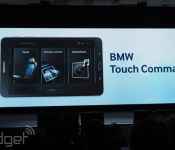
BMW teams up with Samsung, slaves your Beamer to your Samsung tablet

Riddle me this, dear reader: when is a car no longer a 1.5-ton machine? When it becomes an accessory to a 1-lb tablet, perhaps?
The common motif at CES 2015 this year is the highlighting of the Internet of Things (IoT) and how all of our physical possessions can be controlled by one another with the user at the helm. Talk Android reported yesterday about Viber’s new Android Wear app that will allow consumers to start their vehicles, lock and unlock the doors, and track their automobiles via GPS from their smart watch (of course, so long as the car has Viber’s SmartStart 4.0 installed).
So what will BMW’s Touch Command bring to the masses? Keep reading after the break for more information.
Samsung and BMW are wanting to step it up a notch and bring your Beamer totally under the purview of your Samsung tablet. The partnership will bring features like those mentioned above, as well as the ability to control many aspects of your vehicle’s comfort systems. Climate control, music volume, panini press, and seat adjustments are all discussed as controllable features from BMW’s Touch Command app on your Sammy tablet.
Personally, I find myself a little bit concerned on the matter of driver distraction with this product. Perhaps they’ll address that issue between now and when BMW and Samsung release Touch Command? So far, they’ve both been silent about when it would arrive to the market.
Click here for more of Talk Android’s continuing coverage of CES 2015.
Source: Engadget
Come comment on this article: BMW teams up with Samsung, slaves your Beamer to your Samsung tablet

Sony announces lollipop update for Xperia Z3

Sony promised to update the Xperia Z3 to Android 5.0 (Lollipop) and it looks like they will keep their word. In their CES 2015 press conference, Sony announced that the rollout should start sometime in the next month. COO of Sony Electronics Michael Fasulo, didn’t get into specifics about the date or schedule, just promised the rollout would begin in the next month. This is definitely great news for those out there that own the Sony Xperia Z3.
Source CES 2015 and Android Central
The post Sony announces lollipop update for Xperia Z3 appeared first on AndroidGuys.

