


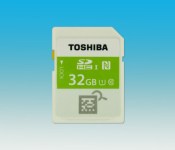
Toshiba’s NFC SD card lets you preview pictures with just a tap

Toshiba has just launched two new products that will help photographers out greatly during photoshoots. The Japanese technology company has just announced two new SD cards, including the world’s first NFC-enabled SD memory card, as well as a new Wifi-capable SD card.
The NFC-capable card comes in 8/16/32GB variants and can be used alongside any NFC-compatible Android device. If you’d like to use the NFC capabilities with this card, simply download the Memory Card Preview App on your device, tap it to your camera, and up to 16 image previews will appear on your phone, along with available storage space on the card. If you’d like to download or really do anything with the photos beyond looking at the previews, unfortunately the SD card doesn’t support those features quite yet.
Toshiba has also announced a new Flash Air III, the seemingly more useful device out of the two. This one is Wifi-enabled, meaning you can access all of your stored pictures and quickly share them with your computer as long as it’s connected to a WiFi network. This newer version of the SD card provides enhanced photo sharing and management features from the previous model, and should be able to transfer photos and videos faster than previous iterations. You can pick up the Wifi-enabled SD card beginning in March. The 16GB model will run you $79.99, while the 32GB model will cost $99.99. If you’d like to pick up an NFC-enabled SD card, they’ll be available sometime in February, though no pricing information has been mentioned yet.

Uber’s newest service helps users move house, but only in Hong Kong

Uber already offers several options in the US, including quirky seasonal ones like ice cream-on-demand. But the company’s Hong Kong division has something not available anywhere else: an experimental service (like UberFresh in California) that transports big items, bulk goods, or even huge pets. That option, called UberCargo, has been in beta for a while, but it’s now open to anyone in Hong Kong. It provides customers with big vans they can fill with their clothes, produce, merchandise, furniture or whatever they want — they can even ride with their goods or track the van via the app.
Since loading cargo usually takes time, customers are charged HK$1.60 (20 cents) per minute while the van isn’t moving on top of the HK$20 ($2.60) base fare. It then shifts to HK$4.50 (60 cents) per kilometer once the vehicle’s on its way. It’s not entirely surprising that the company has launched its cargo service in Hong Kong, seeing as it announced in December that the $1.2 billion it raised from the latest funding round will be used for its Asian expasion. The company didn’t mention whether it will make UberCargo available outside Hong Kong, so for now, you’ll have to call up Two Men and a Truck for your moving needs.

Filed under: Misc
Source: Uber

Divoom announces the stylish and durable Voombox-Party speaker

Divoom, the company behind various audio products built around functionality, has a speaker product that brings together style and durability. The Voombox-Party is a weather-resistant speaker that has a built-in subwoofer, dual radiators, and five drivers. Although it is not gigantic, the speaker is able to fill a room with deep sound. The Voombox-Party pairs with devices via the Near Field Communication (NFC) technology. Devices just have to be tapped with the speaker and it automatically connects. Then, the entire experience is wireless. The device features more than eight hours of battery life and charges with micro-USB.
The Voombox-Party will cost $119 when it is available online at the end of January. Color options are black and silver.
Hit the break for the press release. Click here for our full CES 2015 coverage.
Divoom Introduces Weatherized, Party-Approved, Powerhouse Speaker at CES 2015
Experience the Voombox-Party-s monstrous sounds and design at CES in the North Hall, booth 6336
LAS VEGAS — Jan. 7, 2015 – Divoom, a leading provider of innovative audio products with superior aesthetic design and audio performance, has released the Voombox-Party speaker at CES. Divoom’s Voombox-Party is fearless by nature, rugged by design, and powerful by sound.
Packed with an audio punch, this little powerhouse includes a built-in subwoofer with dual passive radiators, creating a spectacular bass for musical enjoyment. The speaker boasts sound from five mind-blowing drivers that feature high-performance 2″ full-range drivers, one 3″ subwoofer and dual passive radiators, prepped and ready to deliver 20 Watts of room-filling, thrilling sounds.
Created with the latest Near Field Communication (NFC), the speaker effortlessly pairs with NFC-enabled devicese by lightly tapping the devices together. Additionally, the speaker doubles as a speakerphone, allowing users to take make and take calls.
The Voombox-Party is also weather-resistant, making it ready to withstand the harshest conditions to ensure its users keep the party whether they are at the beach, a park or in a backyard. The speaker’s rechargeable battery lasts up to ten hours, ensuring the party doesn’t stop. The speaker delivers up to eight hours of battery life and conveniently charges via micro-USB.
The Voombox-Party will be available in black or silver toward the end of January for $199 MSRP at divoom.com.
For More information on the Voombox-Party as well as all of Divoom’s critically-acclaimed products, please visit http://www.divoom.com/.
About Divoom:
Divoom provides innovative audio products with aesethic design and audio performance for music lovers. The company offers a full line of stylish and colorful Bluetooth speakers, mobile/tablet speakers, docking and MP3 speakers for music anytime/anywhere. Divoom products are available around the world through their network of retailers and distributors. For more information, see http://www.divoom.com.
Come comment on this article: Divoom announces the stylish and durable Voombox-Party speaker
CES Day 3 round up


The later you get into CES, the weirder it gets, and CES 2015 has been no exception to that rule. After the surprise revelation that Audi had an LG webOS smartwatch we had to wonder what else there could possibly be. Turns out there was still plenty of weird to be found at CES.
CES Day 3 round up

The later you get into CES, the weirder it gets, and CES 2015 has been no exception to that rule. After the surprise revelation that Audi had an LG webOS smartwatch we had to wonder what else there could possibly be. Turns out there was still plenty of weird to be found at CES.

Apple’s Online Store in U.S. Now Listing All iPhone 6 and 6 Plus Models as In Stock
Apple’s Online Store in the U.S. is now listing all capacities and colors of iPhone 6 and the iPhone 6 Plus from all carriers as in stock, with the company now appearing to have now achieved supply and demand balance. The SIM-free iPhone 6 and iPhone 6 Plus are also showing an avaliability of 1 business day.

Last month, shipping estimates for the 16/64GB iPhone 6 and iPhone 6 Plus improved drastically, with estimates improving to 3 to 5 days in early December and jumping to 1 to 3 day and 1 day estimates later in the month. The larger-capacity 128GB devices were somewhat constrained throughout the month, with estimates remaining at 7 to 10 days and jumping to 3 to 5 days in December.
Apple’s Online Store in the United Kingdom, France, and Germany are also listing both devices as in stock. Meanwhile, the company’s other stores in Australia, New Zealand, Canada, Mexico are showing a shipping estimate of 1 business day.
The iPhone 6 and iPhone 6 Plus have experienced severely constrained supplies since their launch in September, with Apple working to improve available supply. Apple was even said to be delaying mass production on its larger-screen iPad Pro to puts its efforts towards the iPhone 6 Plus.
Ecovent named as the Automation Device of the Year by CEA

The Consumer Electronics Assocation (CEA) announced that Ecovent, maker of wireless vents and sensors for home climate control, will be receiving the Automation Device of the Year award. CEA is the group behind the International Consumer Electronics Show (CES), which has been running all week in Las Vegas, NV.
Ecovent is a DIY upgrade to existing home heating and cooling systems and falls under that hot new category of smart devices in the Internet of Things (IoT). Founder and CEO Dipul Patel, had some gracious words when accepting the award: “To have the industry authority in consumer electronics recognize our product, and the technology and design that goes into it, is particularly gratifying because there is no other organization that has the deep knowledge and insight on the best products and services for the home and ultimately, the consumer.”
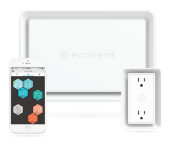
So, how does it work? Well, there are two devices needed for one room. The first device is a plug-in power outlet that will monitor the temperature in the room it’s based. The next device is a replacement air vent that has a screen built into it that can be controlled by the power outlet. The power outlet, of course, being controlled by the Ecovent app on your smartphone or tablet. The app will be available for both Android and iOS.
Like many homes, no matter how great the location is for your thermostat, you end up with some rooms being hotter or colder than the others. Ecovent is capable of redirecting your home’s airflow to maximize temperature and energy efficiency. In some tests Ecovent ran, it found that it was able to run your climate controls 30% less, and depending on where you live, that could translate into some huge energy savings.
Click here to view the embedded video.
Ecovent is slated to hit the markets in August of 2015. It will retail for approximately $200 USD per room.
For more reading of on CES 2015 happenings, continue to follow Talk Android by clicking here.
Source: Ecovent Press Release via Business Wire
Come comment on this article: Ecovent named as the Automation Device of the Year by CEA
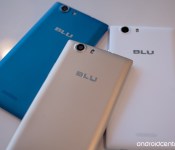
BLU’s new phones are inexpensive and colorful, plus one that’s really thin

So many phones that we need more hands
 At CES 2015, Miami-based manufacturer BLU announced a handful of new phones that come in a variety of sizes, shapes, and specs. While BLU does not have any of their devices in the major carriers, the company does sell them for a very reasonable price unlocked on Amazon. We stopped by by BLU to get a quick feel of the new devices and see if the low priced devices were worth your hard earned money.

AT&T claims FTC has no jurisdiction over data throttling, identifies itself as a common carrier

AT&T CEO Randall Stephenson
In a bit of legal tap-dancing, AT&T has filed a motion to dismiss the U.S. Federal Trade Commission’s (FTC) lawsuit against AT&T over data throttling on the grounds that the regulatory body lacks authority to do so. The legal grounds AT&T is basing this on is Section 5 of the FTC Act, in which a portion of that section helps draw distinction between the FTC’s jurisdiction and the U.S. Federal Communication Commission’s (FCC) jurisdiction.
AT&T argues that because of its company’s status as a common carrier in mobile voice communication, then its data service should as well. Mobile data has not traditionally fallen under the purview of the FCC, but AT&T is claiming that data should be under FCC authority.
Additionally, AT&T states that, currently, there is litigation in the works by the FCC’s Enforcement Bureau taking aim against AT&T’s data throttling. The FCC is claiming that AT&T failed to be fully transparent in its throttling practices and is actively planning to issue a Notice of Apparent Liability, which could bring statutory forfeitures. Both the FTC and FCC claim that AT&T promised customers unlimited data then throttled their speeds up to 90%.
This is an interesting position AT&T is taking with regard to claiming that its data service should be given common carrier status. Not long ago, AT&T lobbied against such a classification because then its data service could fall under the FCC’s net neutrality regulations. AT&T asking for common carrier status for its mobile data in this motion to dismiss could wind up providing the FCC with the ammo necessary in the future should AT&T attempt to fight net neutrality.
FCC Chairman Tom Wheeler has stated that he is planning to classify internet service providers (ISP), both static and mobile, as common carriers so they must follow net neutrality rules. The FCC will be voting on the matter in February.
Source: Ars Technica
Come comment on this article: AT&T claims FTC has no jurisdiction over data throttling, identifies itself as a common carrier

President Obama uses Facebook and Vine to preview his free college plan

President Barack Obama is previewing parts of his State of the Union address in a bid to drum up support ahead of the big speech, and his latest effort is breaking some ground — both in the policy and how he’s presenting it. The head of state took to Facebook, Twitter and Vine to unveil a proposal that would give Americans two free years of community college so long as they maintain good grades and graduate. It’s a rare move for discussing politics online. While the president regularly makes announcements on social networks, it’s not often that you get a peek at the State of the Union while you’re catching up on friends’ status updates and looping cat videos.
The proposal itself is potentially significant for tech as well. If you meet the criteria, you either get two years of academic credit (which you can transfer to a public college or university) or a training program that gives you the skills to work in a given field. The move could lead to more locally-sourced tech workers, not to mention more incentives for companies to open US factories. There’s no telling whether or not the idea would work as well as planned, and it’s bound to face stiff opposition from Congress, but it’s certainly a bold concept.
BREAKING: Watch President Obama announce his #FreeCommunityCollege proposal http://t.co/8YTKdPKa7U https://t.co/vtM3wGwEUd
– The White House (@WhiteHouse) January 8, 2015
Filed under: Internet, Facebook
Source: White House (Twitter), (Facebook), White House Blog

