


Theme engine added to CM12 nightly builds

Much to the delight of the modding community, the CyanogenMod team announced on January 5th that they would begin rolling out nightlies for the Lollipop powered CM12. Although the team mentioned that the early builds should be stable enough to use as a functional daily driver, they did mention that a few specific CM specialties weren’t up and running yet, one of which included the popular theme engine. Fortunately for CM12 users, the team has now announced that the theme engine is up and running, and will appear in nightly builds from here on out.
The news came via the Google+account of Cyanogen Inc employee Clark Scheff, who commented that 13,000+ lines of changes were merged in order to implement the theming engine. The announcement was just made today, meaning that all nightly builds from here on out should have a working theme engine.
Clark went on to explain that are a few things to consider when using it. Due to the Material Design in Android 5.0, a large majority of the CM11 themes won’t look “too great” when being applied to CM12 if the app isn’t currently using a holo style. There are also themes that have bad .9.png images that will not function, meaning that if you developed a theme that isn’t showing up, you’ll need to check the logcat in order to find what the issue is. It is also (at this point anyway) not possible to have a working theme for both CM11 and Cm12, which is an issue that could possibly be patched at some point. He also pointed out that anyone making themes for CM12 will need to make the appropriate directs to the targetSdkVersion=”21″ in the<uses-sdk> tag in order for the system to know that your theme applies to CM12 and not CM11.
By my count there are 50 devices on the download page that currently have available CM12 nightly builds, which can be viewed and downloaded via this link. Although CM nightly builds are generally stable enough to use as daily drivers, remember that these are not stable releases, so their will be features missing and possible bugs throughout the OS. The team has stated that they are 85% close to an M release (which is in essence a stable release candidate), so any bugs you may find should be ironed out rather quickly.
It’s also worth mentioning that if you decide to update from CM11 to CM12 or vice versa, that a full wipe will be needed in order to ensure compatibility due to the many changes that came with Android 5.0.
If you decide to give it a go (I will give it a go with my Note 3 and Nexus 7 soon and report back, as builds are available for both), be sure to let us know your first impressions in the comments below.

Virgin Mobile debuts inexpensive no-contract shared data plans

Virgin Mobile has just announced their new no-contract shared data plans starting at only $65. The plans are called Data Done Right, and offer 4G LTE speeds and support up to four lines at a time. The new plans debut tomorrow, January 17th exclusively at Walmart. The Data Done Right plans feature a Virgin Mobile app that allows users to manage data and buy more with just the click of a button, no additional monthly line fees, international plan options as well as parental control and curfew features. The new plans will be available right away on four Android devices, including the HTC Desire 510, LG Volt, LG Tribute and the Samsung Galaxy Core Prime. Virgin says they plan to have more Data Done Right-compatible devices available by the end of February. Virgin Mobile is also allowing Data Done Right users to use unlimited Facebook, Instagram, Twitter and Pandora for an additional fee of $5, without counting against the user’s pool of data.
Here are the three prepaid shared data plans the company has just announced:
- $65/month (2 lines) – Unlimited talk, text and 4GB of 3G/4G LTE data
- $90/month (3 lines) – Unlimited talk, text and 8GB of 3G/4G LTE data
- $115/month (4 lines) – Unlimited talk, text and 12GB of 3G/4G LTE data
Additionally, the carrier is rolling out new single-line unlimited plans, exclusively to Walmart customers. For $35/month, users can get 300 minutes of talk, unlimited text and 2.5GB of high-speed data. For $45/month, users get unlimited talk, text and 2.5GB of high-speed data. Both plans come with unlimited data after the 2.5GB of high-speed data is used up, but data will be throttled to 2G speeds for the remainder of the time you have your plan.
Beginning Saturday, Jan. 17, the new plans are available on four specific 4G LTE1 smartphones pre-loaded with the Virgin Mobile data-sharing application, which provides data buy-ups and international add-ons with one touch, directly from the device. Every multi-line plan will also come with a free Mobile Hotspot feature, making it even easier to share data across Wi-Fi enabled devices.
“At Virgin Mobile we are committed to offering prepaid customers innovative new wireless options,” said Angela Rittgers, vice president-Sprint Prepaid. “We were the first prepaid carrier to offer texting keyboards and texting-only plans, first to help customers pay less for talk they weren’t using, the first to feature a totally customized plan, and now the first data sharing plans. The new data sharing plans bring some of the most aggressive shared-line plans ever launched to Walmart.”
Virgin Mobile’s Data Done Right data share plans feature:
- Preloaded Virgin Mobile app that enables customers to manage data sharing directly from their device
- No additional monthly line fees
- One-touch data buy-up options starting at just $10/month for 1GB
- Popular social media and music streaming apps without data charges, such as Facebook, Twitter, Instagram and Pandora – unlimited usage without counting against the customer’s data allotment for just $5 per month2
- Flexible international plan options
- Parental control features with device curfew and app restrictions
“At Walmart, we know our no-contract wireless customers are looking for some of the same experiences as contract wireless users – including high performing smart phones available on great plans at great prices,” said Mehrdad Akbar, vice president of Wireless, Connected Home, Wearables and Tablets, Walmart. “We are always seeking ways to innovate for our customers, which is why we’ve worked closely with Virgin Mobile to offer exclusive new plans such as data sharing.”
|
Virgin Mobile Data Done Right Plans starting as low as $30 per line |
||||||||
| Options | $65/month (2 lines) | $90/month (3 lines) | $115/month (4 lines) | |||||
| Talk | Unlimited | Unlimited | Unlimited | |||||
| Text | Unlimited | Unlimited | Unlimited | |||||
|
Data3 |
4GB 3G/4G LTE | 8GB 3G/4G LTE | 12GB 3G/4G LTE | |||||
In addition to the new data plans, Virgin Mobile is also delivering a new set of single-line, unlimited plans to Walmart customers:
|
|
||||||||||
| Options | $35/month | $45/month | ||||||||
| Talk | 300 minutes | Unlimited | ||||||||
| Text | Unlimited | Unlimited | ||||||||
| Data3 | Unlimited (2.5GB high-speed data) | Unlimited (2.5GB high-speed data) | ||||||||
Virgin Mobile Unlimited and Data Share will be immediately available on updated editions of the HTC Desire® 510 [$99.88], LG Tribute™ [$79.88] and LG Volt™[$149.88]. Data Share service will also make its debut on the Samsung Galaxy Core Prime™ [$129.88]4 , also available starting Jan. 17. The Galaxy Core Prime features a4.5-inch display, 1.2GHz quad core processor, Android 4.4 KitKat® and a 5-megapixel rear-facing camera.
More devices are expected to be introduced by the end of February.
A $20 starter kit is required to activate each new line of service and includes two months of unlimited music streaming without counting against the customer’s data allotment5.

Virgin Mobile announces new no-contract data sharing plans

Virgin Mobile announced today that they are introducing the first no-contract data sharing plans to the industry. Customers will have a choice of two to four lines to have on their account and will have access to a special data-sharing app that can help with data buy-ups, adding on international service, and monitoring usage. In addition to the normal charges for service, Virgin Mobile is also giving users an option to pay a flat $5 per month fee to avoid having data charges for Facebook, Twitter, Instagram or Pandora, and other social media and music streaming apps, from counting against their data cap.
The plans are each based on the number of lines desired and come with unlimited talk and text. Each line gets a 4 GB allotment of data which can be shared between the lines. The plans will run $65 per month for 2 lines, $90 per month for 3 lines, and $115 per month for 4 lines. Consumers will have a choice of four different devices initially that can be purchased with the data sharing plans, including the HTC Desire 510, the LG Tribute, the LG Volt, and the Samsung Galaxy Core Prime. Buyers will have to pay for the devices which range in price from $79.88 up to $149.88 as well as a $20 starter kit for each new line of service.
For buyers who only need one line, Virgin Mobile is also offering new single-line unlimited data plans. A new $35 per month plan provides 300 minutes of talk and unlimited text while a $45 per month plan removes the talk limit. Both plans have unlimited data, although high-speed data is only accessible up to 2.5 GB of use. After that, speeds fall back to 2G speeds. Virgin Mobile also notes that video streaming may be limited to 3G speeds at all times.
The new phones and data sharing plan options will be available exclusively at Walmart stores starting this Saturday, January 17th. For those not familiar with Virgin Mobile, they operate on the Sprint network. According to Angela Rittgers with Sprint Prepaid, “At Virgin Mobile we are committed to offering prepaid customers innovative new wireless options…the new data sharing plans bring some of the most aggressive shared-line plans ever launched…”
source: Virgin Mobile (PR)
Come comment on this article: Virgin Mobile announces new no-contract data sharing plans
myTuner Radio brings thousands of radio stations to Windows and Windows Phone

Radio app myTuner Radio is now available for Windows Phone 8.1 and Windows 8.1. myTuner lets you listen to radio stations from around the world, with 30,000 stations from 120 countries available.

Bloc & Roc Galvanize headphones review

As a college student, I see a lot people who use earphones and headphones. Of those that use headphones, a good majority of them use Beats by Dr. Dre. This irritates me immensely, as it goes to show that most people these days will buy something because it’s a brand name they know and they “look cool” as opposed to doing research to look for the best product. Also, having been to Thailand and bringing back faux Beats headphones (cost me $20), most people don’t hear the difference between those and real Beats headphones. Bloc & Roc hopes to bring not only a great looking headphones, but headphones that sound great and are comfortable to wear and use, and are durable enough to last. Note: I reviewed the Galvanize S1 headphones, however the S2 are exactly the same except for the design on the outside of the earpieces.
Bloc & Roc Galvanize S1

Build Quality
The first thing that strikes you about the Galvanize S1 are their design. There is no loud branding, but just a sleek, minimalist design that I think is largely absent from headphones these days, and something that I appreciate greatly. The outside of the earpieces have a circular, almost spin metal, design that are premium looking, but still minimalist. The insides of the earpieces are padded with a comfortable protein leather that I could wear for long periods of time without getting the painful feeling on my ears that I normally get with other headphones I have used (and that has led me to usually use earphones instead). The padding on the top has a nice high-grade faux leather that is comfortable while wearing. They are light, but feel solidly built. Whether on my head or around my neck, I would hardly notice they were there except for when music was playing.

The headphones just feel premium and well made, as they should be. Each set of headphones are hand-built in Britain with all of the core materials coming from Britain. Here’s the process from their website:
The Galvanize series consists of two distinct designs; S1 and S2. Each speaker chamber has been crafted from a single piece of British 6082 aerospace-grade aluminium. Once machined, these are hand prepared and then anodised in either black, red, grey or plated in 24-carat gold. All models come with soft protein leather ear pads and the 24-carat gold Deluxe Editions also feature supple British-sourced lambskin leather headbands.
So each set you know have been examined closely by someone before being sent to the consumer. Much like how a Ferrari is built.

The case the headphones come in is really nice, and immediately makes you feel as though you’re dealing with a premium product. Along with the case is a canvas travel bag (below) that are just big enough to fit the headphones in to keep your headphones protected while being stowed in a bag.

The auxiliary cable (below) is covered in a fabric that keeps it tangle-free, which is a nice touch. It is also only plugged into the left earpiece, not only making it less likely for you to get tangled, but also makes it easy to differentiate between the left and right earpiece (though that is labeled on the inside of the band).

Performance
Bloc & Roc says that the 40mm dynamic drivers took over a year to develop, and boy does that show. I happened to have these while I was home for the holidays, and had my family all check these out. Each person that listened said they had a very pleasant experience, and not just heard but felt the music well. My uncle even said these were better than his Bose earphones!
My experience was much the same. I have found myself reaching for these headphones as opposed to my previous favorites even while not reviewing them. Whenever I’m listening to a song, I can clearly hear the highs, mids, and lows, and while the bass is present and felt, it is not over-bearing so that it takes over the sound, but rather complements it (another thing that irritates me about Beats-loving audiophiles).
Voices are crisp and clear, and I can hear them through any music and sound. While watching movie trailers and other non-music videos, I can hear the multi-directional sounds working well for as close to a “surround sound” experience you can get with headphones.
To be honest, there isn’t much to say about the sound performance of these headphones, but that’s a good thing. They work really well and they are a pleasure to use, and there has not been a time where I have felt disappointed because I didn’t hear something from these.
The only other thing to note is the in-line mic and button on the cord. I actually received a call before going to test it myself, and the person on the other end heard me clearly and well. The button also works, allowing you to pause your music and play it again without having to reach for your phone (this is on a 2013 Moto X using Google Play Music).
Price
One of the best parts about these headphones is its price. Most well-built, good sounding headphones that are durable and comfortable run over $250. On blocandroc.com, these will go for $180 (includes S2, but excludes the 24k gold headphones, which are $360). For the entire package, that’s a great deal. Considering you’re getting headphones that are hand-built Ferrari style, great sound, and will last awhile, this is one heck of a deal.
The post Bloc & Roc Galvanize headphones review appeared first on AndroidGuys.
Virgin Mobile USA announces data sharing pre-paid plans exclusively through Wal-Mart January 17th
Shared data isn’t a new concept, it has been around for quite some time on multiple carriers from AT&T to Verizon. However, shared data plans have traditionally always been for post paid, or contracted, consumer accounts, not for pre-paid non-contract users. Today Virgin Mobile USA has announced that they are bringing that shared data option […]
The post Virgin Mobile USA announces data sharing pre-paid plans exclusively through Wal-Mart January 17th appeared first on AndroidSPIN.

5 Android apps you shouldn’t miss this week – Google Play Weekly
<!–
By use of this code snippet, I agree to the Brightcove Publisher T and C
found at https://accounts.brightcove.com/en/terms-and-conditions/.
–>
<!–
This script tag will cause the Brightcove Players defined above it to be created as soon
as the line is read by the browser. If you wish to have the player instantiated only after
the rest of the HTML is processed and the page load is complete, remove the line.
–>
brightcove.createExperiences();
Welcome back to Google Play Weekly! Here are your headlines for this week:
- Samsung has announced that Android apps will run on Tizen using OpenMobile ACL.
- New stats reveal that Google Play grew faster than the App Store and Amazon Appstore in 2014.
- Google Classroom is now available in the Google Play Store and Apple App Store.
- An update to Google Maps finally allows for navigation sharing.
- Facebook at Work is now a thing that exists.
And now here are five Android apps you shouldn’t miss this week!
 Google Translate
[Price: Free]
Google Translate got a huge update this last week. Included is a new word lens feature that lets you point your camera at something and have it translated in real time for you. The other big feature is instant voice translation where, much like word lens, translations happen on the fly. If you need translation, Google Translate proves again that it is king on Android.

 AcDisplay
[Price: Free with in app purchases]
AcDisplay is a popular lock screen replacement app that recently updated to version 3.0. The new update brings support for Lollipop, a new Material Design inspired interface, and a host of bug fixes and performance improvements. It’s one of the better apps that emulates the Moto Active Display with the notifications and clean look. It’s free to try if you’re interested.
 Google Now Launcher
[Price: Free]
Google Now Launcher was updated this last week. The update includes some Material Design elements to those running Android 4.1 through 4.4 and that includes animations, button changes, and other minor aesthetic changes. It’s not a huge update but those who want a more Lollipop style experience that don’t already run Lollipop should appreciate it. It’s rolling out right now.
 Falcon Pro 3
[Price: Free with in app purchases]
Falcon Pro 3 was released this last week. It improves on prior iterations of the app by including boat loads of Material Design, improved performance, easier navigation, and more. It is a brand new release and that means there are bugs so if you try it out, do keep that in mind. If you don’t want buggy software, give the developer a couple of weeks to fix up the problems and give it a try then.
 Adobe Lightroom mobile
[Price: Free to download but requires Creative Cloud subscription]
Adobe released Adobe Lightroom mobile for Android and pretty much any major name-brand release from Adobe is good news. It has a pretty decent set of features including desktop syncing and considering it’s an early release, it works pretty well. The bad news is that you’ll need a Creative Cloud account once the trial expires and that sucks for those who bought the software.

Wrap up
If we missed any great Android apps and games news, let us know in the comments!
Designers Envision Concepts for Apple Watch Apps Like Uber and Instagram [iOS Blog]
Digital agency Huge yesterday released a set of renderings showing off their concepts for how existing popular apps like Fandango, Foursquare, Chase Bank, and others could take advantage of the Apple Watch when the smartwatch launches in the coming months.
Breaking down the major new features of the Watch, including the Taptic Engine, Voice command, and the Digital Crown, Huge reminds readers that none of the renderings are based off any confirmed apps from the companies or Apple itself, but they do offer an interesting look at the possibilities.

Huge also smartly points out that the success or failure of apps on the platform lies in developers embracing its smaller-scale and not just shoehorning existing iOS user interfaces and features into the Watch but making something new and unique. Interaction between the Apple Watch and the iPhone will of course be key, however.
Features such as native voice control, haptic feedback, and a digital crown that can be used to magnify, scroll or zoom within apps crack open a whole new world of design requirements and opportunities. The smartest companies will do more than offer facsimiles of their existing apps; they’ll create custom experiences that exploit the watch’s unique interface.
Tackled first are “existing apps” that the company reimagines for the wearable platform, namely Uber. Pointing out Uber’s dependency on tracking a car, Huge thinks possible voice control, a quick messaging system between the user and driver, and easy peeks at real-time car tracking would push the app to be even more popular on the wrist.
On the banking side, the company takes a look at the possibilities for an app like Chase, thinking the transfer of money, checking balances, and alerts for bills due and deposits made could provide even more ease-of-mind for customers banking on the go.

On the more social side, Huge mocks up an idea for movie-going app Fandango consisting of electronic ticketing, alerts for movie times, and, of course, theater time listings for movies nearby.
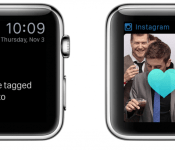
Perhaps most questionable, but also one of the most interesting, are Huge’s ideas for Instagram on the Apple Watch. Though most users probably wouldn’t mind taking out their iPhone to check the service, Huge envisions the Watch version of the app as more of a companion piece: alerting users to photo comments, tags, and likes, with possible photo browsing relegated to the digital crown. The company also points out the significant gain any news outlet, like The New York Times, could receive from having alerts and breaking news sent right to their readers’ wrists.

Next, the company looks at “new use cases” the Apple Watch will enable, thanks to the release of WatchKit to developers a few months ago. Though iBeacons have been the source of some questionable developments about the possibility of location-based advertisements hitting the Apple Watch, Huge points to a few clever alternatives, like the watch notifying a user passing a grocery store that they have milk or bread on their shopping list, for example. More broadly, Huge envisions a native to-do list app in the vein of Apple’s Reminders but which could easily best its iPhone counterpart due to its easier-to-access location on the Watch.
The Apple Watch launch is rapidly approaching, although a rumored March release date has yet to be confirmed by Apple. Apple has promised it will share more information on the Watch as its launch nears, and third-party developers have been hard at work on their Apple Watch projects for some time now. But for the time being, readers can see the possibilities outlined above, as well as others including a kitchen assistant, haptic feedback-fueled navigation, and a sports-focused news app, in Huge’s feature published at Fast Company.
Facebook, people, and arguing: my social network experiment

I refuse to “unfriend” people on Facebook.
Well, okay, that’s kind of false. I will unfriend you if we’re not actual, real life friends, and I eventually forget how we knew each other. But that’s not the point. The point is that my Facebook friends list is made up of people I know, or knew, in real life. They may not be people I speak to every day, or people I see in person with frequency, but they are or were a tangible part of my life: part of what makes me me. To put that more eloquently:
“I see it as my network: a digital representation of my network. An archive of the people I’ve encountered and come across. If I want to understand my story, my history, all of the ways that I’ve come about, this is one of those vehicles. It’s almost like this weird digital therapy space where you can get to the heart of where you are via the people you’ve interacted with.”
That’s WNYC contributor Ibrahim Abdul-Matin in a December episode of the radio show/podcast “New Tech City“. I fully agree with that sentiment: for me, Facebook is the one bastion of personal space left online. I’m only friends with people I actually know (unlike Twitter — shoutout to my man Mike Isaac for the hilarious tweets despite us never having met).
I’ve carefully curated my Facebook friends list (431 strong) from real life: It’s a virtual directory of my actual life since sophomore year of college (2006!). That is intentional. I’ve lived in a variety of places, worked a variety of different jobs, and gone to several different schools, so it’s a pretty broad mix of people. I lived in Barcelona for a year in college, so there are a handful of folks who live in and around Barcelona. I lived in Philadelphia and attended Temple University, so there are a few dozen folks from Philly and many of them attended school with me. I grew up in Connecticut and worked in a Tower Records for several years, etc. You get the idea.

Most of the time, at worst, Facebook is boring — a time-wasting dalliance of “I’m eating this fancy thing!” or “look at my baby!” or “Which Sex & the City character are you?” (I’m such a Samantha). The occasional friend I haven’t seen in 10 years might post a link to the National Report with accidental outrage, or maybe someone gets heated about guns; nothing that elicits anything beyond an eye roll.
Sometimes I add a comment, maybe even argue a bit. But always — always — it’s a discussion. These are real life friends after all.
2014 changed Facebook dramatically for me.

In early August, when an 18-year-old black man named Michael Brown was shot dead by a 28-year-old white policeman named Darren Wilson in Ferguson, Missouri, months of protest ensued. While the majority of the protests were non-violent, some involved looting.
This drove a wedge into my normal feed, as was assuredly the case with many other Facebook users. Instead of occasionally posting something I disagreed with, friends were suddenly posting things I found outright concerning. People I know to be not jerks — people who have shaped my life and the person I am — were saying all variety of ignorant nonsense. Not just any kind of ignorant nonsense, but the kind of base level, overtly racist junk that makes you ask what century you live in. Were these the same people I knew in real life?
I had a decision to make: whether to cut folks from my Facebook feed solely because I disagreed with them, or to engage folks I consider friends on contentious topics.
Given my stance on Facebook — of curating a list of people I know in real life — I felt obligated to respond. These are people I respect, who respect me. Perhaps more importantly, I don’t want to surround myself with an echo chamber. Studies have repeatedly shown that people who surround themselves with other people who share similar political views will become galvanized in those views (read: less likely to consider other points of view).
As the abstract of a 2006 study on political polarization puts it (the emphasis is mine):
“This essay reports the results of a kind of Deliberation Day, involving sixty-three citizens in Colorado. Groups from Boulder, a predominantly liberal city, met and discussed global warming, affirmative action, and civil unions for same-sex couples; groups from Colorado Springs, a predominately conservative city, met to discuss the same issues. The major effect of deliberation was to make group members more extreme than they were when they started to talk. Liberals became more liberal on all three issues; conservatives became more conservative. As a result, the division between the citizens of Boulder and the citizens of Colorado Springs were significantly increased as a result of intragroup deliberation. Deliberation also increased consensus, and dampened diversity, within the groups.”
I’m happy to report that the results have been largely positive. The vast majority of Facebook discussions I have which involve “contentious topics” (read: equality, racism, gun rights, abortion, etc.) turn out well — or at least amicably — with both people having learned something.
But few people take this approach. Facebook provides two different options for making your news feed experience more comfortable. These tools aren’t a bad idea, but they’re easily used (by accident, I’d guess) to virtually isolate yourself from different perspectives.

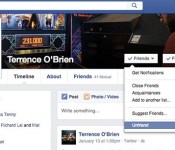
The first option is “I don’t want to see this,” which limits the number of posts you see from the user in question; the second is “Unfollow,” which is reserved for people you’re friends with (rather than, say, publications you follow). You remain Facebook friends, which removes any potential impact from a real life friend thinking you’ve unfriended them, but you stop seeing their posts in your news feed. It’s one step below the nuclear option (unfriending). Both options are just two clicks away.
I asked my Twitter followers (which pushes to my Facebook feed) how they handle “inflammatory stuff from real life friends” on social media. Of the twenty or so responses I received between Twitter and Facebook, less than a quarter said they engage friends when they find statements offensive or wrong in some way. Most answered like this (warning that the example status below the response text is racist / awful):

This was December 3rd, 2014, just over one week after the announcement that a Missouri grand jury chose not to indict Darren Wilson in the death of Michael Brown; The New York Times reported that “hundreds” were protesting outside the Ferguson Police Department that night. December 3rd was also the day that a grand jury in Staten Island, New York chose not to indict NYPD officer Daniel Pantaleo, a 29-year-old white man, in the death of Eric Garner, an unarmed 43-year-old black man.
In other words, it was peak timing for engaging with friends and discussing societal issues we often eschew in conversation — especially social media conversation — in favor of discussions about Kim Kardashian’s provocative magazine cover, or John Travolta’s hilarious mispronunciation of Idina Menzel’s name. Sadly, though understandable, many folks instead used Facebook’s built in tools to make their online lives a bit more digestible.
So, where am I going with all of this? Nowhere in particular — there’s no grand point — I’m just fascinated to hear how you handle these issues. Maybe I’m unique in how I use Facebook, but I doubt it! I’ve set up a poll to get a better idea of how you folks deal with similar issues, and I’d love to talk about it in the comments (or on Twitter, of course). Consider this one of those rare times that I’ll end a piece with, “Head into the comments below and tell us what you think!” At least it’s for a good reason!
How do you respond to inflammatory/offensive content from friends on social media?
Unfriend/unfollow/block/muteEngage in conversationTry to ignore itMessage that friend privatelyTalk about it in personOtherVote
Cyanogenmod 12 nightly builds now including the CM Theme Engine
 One of the coolest features that Cyanogenmod offers is a fully fleshed out theme engine built directly into the OS for your Android device. There are tons of available themes on the Play Store and the internet that can completely change the look of your phone on the fly, and it’s one of the biggest things that’s been missing from Cyanogenmod 12.
Fortunately, looks like most of the hard work is over, as CM 12 nightly builds now have the theme engine baked in. The drawback here is that many, but not all, older themes have issues running on the newer theme engine, and some of them don’t actually work at all. As it stands, a theme won’t be able to have cross-compatibility between CM 11 and CM 12, so it’s going to be one or the other. T-Mobile’s older theme engine support is completely gone as well.
The theme engine should make its way into the next stable build of Cyanogenmod, but if you flash nightlies, you can go ahead and get a taste of applying some themes to your Lollipop device.
source: Clark Scheff
Come comment on this article: Cyanogenmod 12 nightly builds now including the CM Theme Engine
 AIVAnet