


3 million Motorola smartphones sold in India last year

Early reports last year suggested that Motorola’s re-launch in India was going rather well, as the company shifted 1 million smartphones in only 5 months. Almost one year on from the brand’s regional reappearance, The Economic Times states that Motorola has now sold more than 3 million smartphones in India, proving that the company can compete with the cut-throat local competition.
According to the report, around half of Motorola’s sales in India came from its affordable Moto G and Moto E handsets, which offer reasonable specifications in a market with plenty of competitively priced options.
In the third quarter of 2014, Motorola claimed fifth spot in India, behind Samsung, Micromax, Lava and Karbonn. Previously, Motorola had not even ranked in the global top 10, so is clearly performing above expectations in India. However, since its acquisition by Lenovo, the two now make up the third largest manufacturer in the world, according to Counterpoint Research.
“We will be doubling up our efforts in India, which is a very critical market for us,” – Amit Boni, head of Motorola’s India operations
Motorola shows no signs up letting up in India and will be focusing more heavily on the country this year. As parts of its plans, Motorola is set to open its own experience stores across India, beginning in Bangalore. There are also rumors circulating that Morotola may release some of its future handsets in the country first and that its Moto Maker service may also be making its way to India.
With India expected to be one of the world’s fastest growing smartphone markets in 2015, the country could turn out to be a big earner for Motorola.

Don’t take those Spigen Galaxy S6 cases too seriously
Here we go again. Spigen, the well-known case manufacturer, is trying to squeeze out some early SEO juice by putting up cases for a highly anticipated device that is still weeks away. It happened with the One (M8), Nexus 5, and a few other devices, and it’s now happening with the Galaxy S6.
The images below are from Spigen’s Amazon listing and allegedly show Samsung’s eagerly awaited new entry in the Galaxy S series.

This clear case in particular appears to be giving us a good look at the Galaxy S6, which, if the render is correct, looks a lot like the Galaxy S5, save for the different placement of the flash and sensor module.

Is this it? After Samsung promised us new materials and innovative designs, will it deliver a Galaxy S5 look alike? Probably not.
Last year, Spigen put up its Galaxy S5 cases before the device was announced, and while their render of the device was close to the real thing, it wasn’t accurate. In Spigen’s Galaxy S5 rendition, the device had a two-tone flash, but no heart rate scanner, and – rather amusingly – no home button.

Spigen and other case makers may know in advance the size of upcoming devices and the placement of design elements like the camera, buttons, and ports. It’s widely assumed that Samsung itself gives out these dimensions, so accessory makers can launch their products in time for the phone release.
But that’s it – Samsung has no reason to share more details than it needs to, especially to a partner like Spigen that is prone to leaking them out.
At this point, it looks safe to assume that Samsung has relocated the flash/HRM module to the side of the camera. That’s the same layout that can be seen in another set of cases that hit the web, this time coming from a Chinese wholesale case seller on Alibaba.

But everything else is up in the air – the dimpled texture on the back, the materials, the colors, other design elements, those are elements that Spigen’s designers likely just made up based on the Galaxy S5.
For the real deal, whatever it ends up looking like, we’ll have to wait, probably until MWC. There’s still no official confirmation that the Galaxy S6 is coming at the Barcelona show, but all signs point to it. For more on the Galaxy S6, check out our rumor roundup.
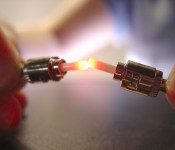
BT says faster broadband is coming, but it could take 10 years

Everyone in the UK wants super-fast broadband in their home. The most reliable and effective solution right now is fibre, which every internet provider uses as the backbone for their network nationwide. But there’s a problem — the fibre often stops at the street cabinet, and many customers are limited by the slower copper cables running up their driveways. While fibre can be installed for the final leg, it’s expensive, so companies such as BT are looking for new ways to give their traditional copper a speed boost. One approach is “G.fast,” a technology that uses a wider frequency band to increase performance. It works best over shorter distances, although rural homes can still be supported via remote nodes and distribution points, which bring the fibre connection closer to the property.
BT has been trialling this method for some time in its research labs, but today the company announced it’ll soon be ready for the mass market. Two pilots are set to kick off in Huntington (Cambridgeshire) and Gosforth (Newcastle) this summer, connecting roughly 4,000 homes and businesses. So what can locals expect? Faster speeds, but nothing unprecedented. BT is promising “a few hundred megabits per second” to begin with, which sounds roughly the same as its 330 Mbps fibre-to-the-property (FTTP) connections. However, the firms says it’ll be increased to 500 Mbps over time, and expects to deliver these speeds to most of the UK within the next decade. Any improvements will, of course, be welcomed by the British public, but it’s hard not to see G.fast as a stop-gap measure. It might improve copper cables in the short-term, but it doesn’t solve the long-term need for full-blown fibre broadband connections. Notably, BT has also promised “premium” fibre services of up to 1Gbps, but that’s likely to come from FTTP installations, not G.fast.
[Image Credit: Barta IV, Flickr]
Filed under: Internet
Source: BT
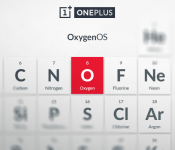
OnePlus announces name of their new ROM, OxygenOS

With all of the issues that OnePlus has been having due to their partnership with Cyanogen Inc., we heard a while back that the flagship killing company was building their own ROM, which they have now officially given a name. Introducing OxygenOS.
What’s in a name? Well, that is about all there is to the announcement on the OnePlus forums, a name. OxygenOS is but a theory at this point, with further info promised to be announced on February 12th.
This new OS may have been at least partially spawned by a need to part ways with Cyanogen, but it is a great way for the company with the motto ‘Never Settle’ to take control of their OS as they have their hardware. OnePlus says they are starting from the ground up on this one, putting only what they want in the OS, taking into consideration everything that users have been asking for.

The name of the ROM was decided based on user entries as well. OnePlus goes on about how oxygen, the stuff in the air, is a part of our world and necessary to live and all that. Marketing aside, we assume that forum member midfire from Belgium will get a nice treat in the mail as a thank you for the name suggestion.
Head on over to the OnePlus forums to get all their details, and stay tuned, we are excited to see what OxygenOS has to offer. February 12th will be a good day.
What do you think, is OnePlus on the right track in building their own Android OS, or should they source out to another established Android developer?
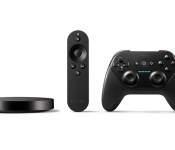
Nexus Player to hit Japan by the end of February

Google’s Nexus Player may be viewed by some as the second coming of the Nexus Q, the ill-fated orb that sought to bridge the gap between television and mobiles some years back. Fortunately, unlike the Magic 8-Ball gone awry, it’s making it to stores, safe and sound. Having released already in the USA, Google has now indicated the second territory to receive the Nexus Player is Japan, where it will retail for 12,800 Yen, which at the current exchange rate is about $108, though the value of the dollar/yen has been changing on an almost daily basis, so it could wind up cheaper than the $99 US retail price by the time its late-February release date hits.
We announced Android TV at Google I/O in 2014 as a new platform that puts Android inside televisions and set-top boxes. Just by speaking to the remote, you can find live TV shows, a new movie release on Google Play, or a cooking video on YouTube and watch them all on the biggest screen in your house. You can also use the remote, and the separate game controller, to turn your TV and Android games into a gaming console. (And pick up the game on your smartphone where you left off). Nexus Player, a collaboration with Asus, can also stream movies, music and videos and allows you to cast entertainment from almost any Chromebook, Android device or iOS device to your TV
It will be interesting to see how the Nexus Player fares in the Land of the Rising Sun, given how its only true rival is Apple TV. The Chromecast, while a bit different in nature from the device in question here, has been sighted frequently in used electronics stores which raises the question of its acceptance in the market. While the Chromecast is available both online and in stores here, there is no indication as of yet where the Nexus Player will be sold.
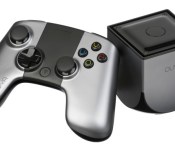
Alibaba Makes Heavy Investment in Ouya
 Ouya, the game-console maker made famous by its kickstarter campaign, has recently received $10 million from online shopping titan Alibaba. There have been discussions about incorporating Ouya’s software and 1,000 game library into Alibaba’s set-top box.
The primary location where Ouya can flourish is in China, which is poised to be the next battleground for video game competition now that the 15 year-long ban on videogame consoles has been lifted. Although Ouya seemed to be off to a great start in 2012 with an explosion of funding, the results are less than expected, mostly due to the powerful hold on the market that Sony and Microsoft have and the recent emergence of the Nexus Player and Fire TV, which both allow for similar cheap gaming. However, a struggling company and a burgeoning market can be perfect for each other if there is a way for them to connect. Enter Alibaba. If there is any place that Alibaba knows, it’s China. Alibaba can be extremely helpful to Ouya as it tries to move into China’s market.
Ouya is no stranger to deals with other companies, and has also been working out some mutually beneficial agreements with Xiaomi as well.
Source: WSJ
Come comment on this article: Alibaba Makes Heavy Investment in Ouya

Microsoft Office open to Android Tablet Users
It is official. Microsoft is opening their Office products to Android tablet users. For a couple of months, Microsoft had allowed select Android tablet users to preview and offer feedback so they could refine and improve what they needed to. There were 3,000 Android devices of over 500 models with different sizes and hardware capabilitiesSo far, there have been at least more than 80 million downloads of Office on the iPhone and iPad worldwide. That number is expected to increase now that Android users will be able to download Microsoft Office.
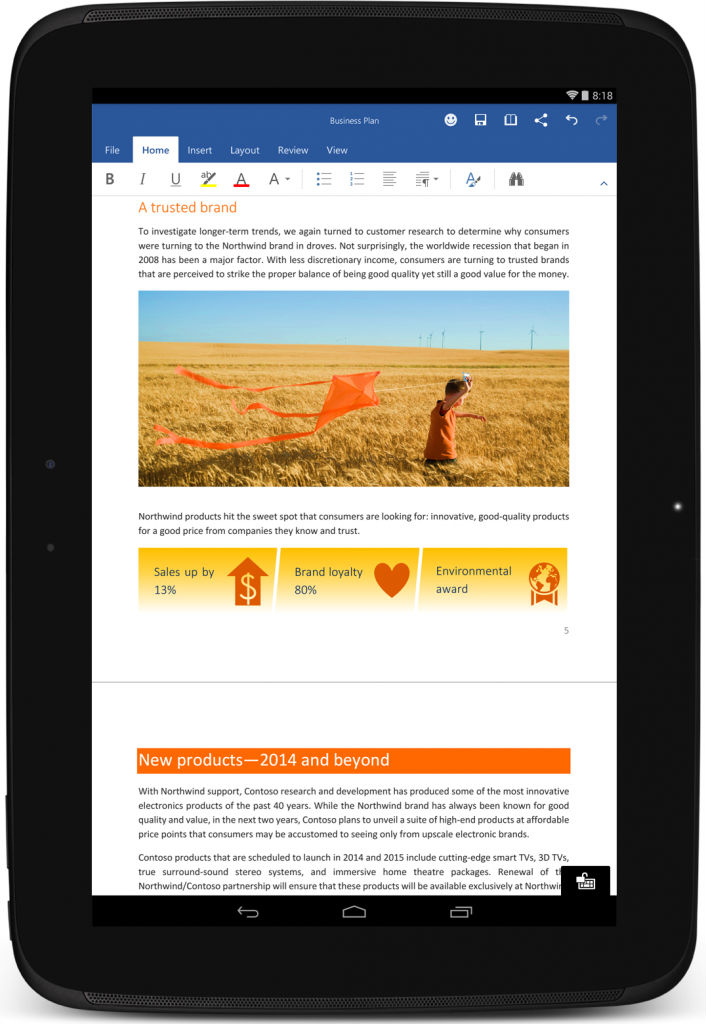
Simply download the free apps from the Google Play Store. However, there are a few requirements one should keep in mind. Office for Android works on tablets running Android KitKat 4.4 and must have 7 inch screens or larger. For tablets running on Lollipop, keep in mind that Microsoft is not officially supporting the upgrade just yet. It will somewhere down the line though.
As of right now, the Android versions of Word, Powerpoint, and Excel let you browse and open documents from your OneDrive or Dropbox accounts. Of course one must have a Microsoft account, but if you don’t have one, then one can sign up for an account using the app. Basic features such as creating files, printing, and performing other day-to-day jobs is free. However, to access premium features, one must sign up for a qualifying Office 365 subscription.
For those of you that downloaded Microsoft Office for Android, be sure and leave a comment below and let us know how it is working for you.
The post Microsoft Office open to Android Tablet Users appeared first on AndroidGuys.
The next ‘Toshiba’ TV you see will be made by a different company

Toshiba has undertaken many attempts to reshape its TV segment over the years with “Cloud Portal” and Cell TV, but none have hit the mark and now it’s getting out of the business entirely in North America. Following other Japanese manufacturers that have axed (Pioneer), scaled back (Panasonic), or reorganized (Sony) their TV operations, Toshiba will license its name to Taiwan’s Compal. New TVs from the venture will be on shelves in March, so don’t be surprised if they’re a bit different. It already switched to more outsourcing after axing jobs in 2013, so the shift may turn out to be subtle. Toshiba has always been willing to bring some unique — if not always appreciated — aspects to the game, and we’ll be sad to see them go. The plan now is to “develop new technologies and services” while it works on securing a stable profit.
Filed under: Home Entertainment, HD
Source: Toshiba (PDF)
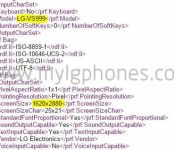
Could the LG G4 sport a 3K display?

The LG G4 (LG-VS999) was spotted in a leaked document. That in itself is no big deal, but what is interesting is the display resolution, which is 2880 x 1620.
It’s believed that this device is headed to Verizon since the Verizon G3 had a model number of LG-VS985. Now interestingly enough the AT&T version (LG-H810) was spotted in a UA profile a few days ago with an expected resolution of 2560 x 1440.
So one of two things is going on here. Either Verizon is going to get a better version than AT&T or the leaked document is fake.
We probably won’t see the G4 until May, so it’s certainly not out of the question that LG could offer a 3K display, but I need a little more evidence.
source: MyLGPhones
Come comment on this article: Could the LG G4 sport a 3K display?

Google Finishes Short of Q4 Expectations, Grows 19%

Google just released its Q4 earnings report today, and some investors may be a little less than pleased. The tech giant finished with less growth than originally predicted, but still managed to bring in a revenue of $18.1 billion and earnings per share of $6.88. The net income was $4.76 billion, which is also an improvement over $3.38 billion from Q4 last year. The full year brought in $66 billion for Google, up 19% from 2013; this includes the sale of Motorola to Lenovo.
Just how much did Google underperform in Q4 when compared to predictions, you may ask? Wall Street expected a revenue of $18.5 billion, so about 2% under. A worse stat was the earnings per share of $6.88 instead of the predicted $7.13—under by 3.5%.
While there could be many explanations to the results (Google frequently underperforms when compared to estimates), we won’t know anything more conclusive until Google releases more info about the specifics.
Do you own Google stock? Let us know what you think about everyone’s favorite tech company’s latest results in the comment section to get the conversation going.
Source: Google
Come comment on this article: Google Finishes Short of Q4 Expectations, Grows 19%
 AIVAnet