


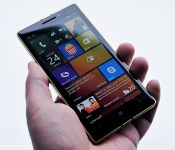
This is the special golden edition Nokia Lumia 930

In early January, Microsoft officially announced special golden editions of its Lumia 830 and Lumia 930 smartphones for various markets, including Europe, Asia Pacific and China, and India, the Middle East and Africa. Coming in either matte black or glossy white, the gold-framed versions of the latest Lumias add a little sophistication to the previously colorful devices.
I managed to get my hands on the matte black gold Lumia 930, which can be found unlocked for around $430, including on eBay. Here are some photos and a video to show you what it is all about.

Watch us play Saints Row IV: Re-Elected on Twitch tonight

Every weekend, Windows Central streams an Xbox One game or two on Twitch for 1-2 hours, showing you some of the wide variety of games available on Microsoft’s latest console. Last week, we streamed Sniper Elite III and dished out codes to 23 lucky viewers.
Tonight, we’ll be playing Saints Row IV: Re-Elected from High Voltage Software and Deep Silver. We want you guys there, chatting along. So we’re giving out a variety of codes as prizes – mostly for Steam this time.
Just follow me on Twitch.tv/Eastxtwitch, watch along, and participate in chat for your chance to win. You can also watch the event right here live or after the fact.
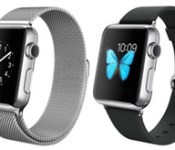
Apple Reported to Begin Shipping Apple Watch in March, 12-Inch MacBook Air in Early 2015
Apple will begin shipping the Apple Watch in March and will also look to launch its new 12-inch MacBook Air during this quarter, according to a new report by KGI Securities analyst Ming Chi Kuo. The analyst also predicted that iPhone shipments would beat expectations for Q1 2015 with over 61 million units shipped, while iPad shipments are expected to total to 10 million units.

Kuo notes that Apple may reveal more details about the Apple Watch before its official launch, revealing specifics on battery life and the start of pre-orders. Most components of the Apple Watch will see high shipments during the quarter, but other key components are expected to see low production yields which may cause a constrained supply. Kuo predicts that Apple will ship 2.8 million Apple Watch units in Q1 2015, and his estimate for a March launch falls in line with previous reports.
 Rendering of 12-inch MacBook Air done by Martin Hajek
Kuo’s estimate for a Q1 2015 launch of the new 12-inch MacBook Air falls in line with a report earlier this month which stated that Apple supplier Quanta Computer was ramping up production of the notebook for a release this quarter. The 12-inch MacBook Air is expected to feature a new ultra-thin, fan-less design with a high resolution Retina display and a low-power Intel Core M processor. The notebook is also said to be one of the first to take advantage of the new reversible USB Type C connector, which may also be used for charging.

Apple’s TestFlight winning over devs and testers

Last year Apple bought TestFlight, the popular beta distribution app, and relaunched it WWDC 2014 in a more focused, integrated form, but one that also required App Store approval for major feature changes. Since then developers and testers alike have been trying it out. The verdict so far? Supertop really likesit:
None of these issues come close to negating the benefits of TestFlight for us as we work on updates Castro and Unread. We’ll be excited to beta test Castro 2 this way as well. App developers should take the time to try it. The availability of a much larger test audience, far better install rates and simplified IAP testing should help you release higher quality apps on the store.
Federico Vittici of MacStories does too:
In the past few months, I’ve been testing about 50 apps with TestFlight, and, as a user, I think the system is way better than the old days of beta testing with Hockey and the original TestFlight. I don’t need to give developers my device UDIDs; all my betas are in the TestFlight app; I get notifications for updates; and, I can easily unlock In-App Purchases in beta builds with my Apple ID. Apple has built the new TestFlight with simplicity in mind, and I appreciate the time it has saved me so far.
I’m apparently not testing anywhere nearly as many betas as Ticci — hey, devs! — but the ones I have been testing have worked really well, and for exactly the reasons he states.
Hopefully crash reporting and other useful features are in the pipeline.

Ask AC: What’s that star in my notification area?

Welcome to the wonderful, confusing world of Android 5.0 notifications
This question still hits our inbox from time to time, and it’s worth a quick reminder. Android 5.0 Lollipop — at least in its current, unadulterated form — changes the way notifications work. Or, more specifically, there are now three ways they’ll be presented to you. The firehose is simply called “All.” That is, you’ll see every notification there is to see in your notification area. You’ll get a buzz, or hear the notification tone.
Then there’s “Priority,” which brings us back to the question at hand. You can designate specific apps as being “Priority,” and then you’ll get only “Priority” notifications.
So what’s a “Priority” notification? And what’s it have to do with that start up there? Glad you asked.
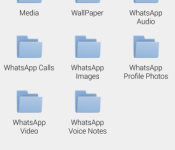
WhatsApp Calls folder appears, could voice calling launch soon?

A user of WhatsApp downloaded and installed an update from the app’s official site only to notice that something new has been added behind the scenes. Reddit user /u/akhilman78 posted the image above showing the WhatsApp Calls folder. The folder could belong to the highly-anticipated voice calling feature that WhatsApp promised almost one year ago. Being that the folder appeared via an update pushed directly from the site, a launch could be right around the corner.
Do you use WhatsApp? If so, let us know in the comments whether or not you are eager for voice calling.
Source: /r/Android
Come comment on this article: WhatsApp Calls folder appears, could voice calling launch soon?
Extend your Nexus 6 battery life with these tips
The Nexus 6 has a huge 3,220mAh battery and combined with Android 5.0 Lollipop’s battery optimisation thanks to Google’s Project Volta, provides pretty decent battery life, but there’s always room for improvement, especially when compared to the battery life of the Xperia Z3 or OnePlus One for example.
That’s why we’ve compiled a few tips you can use on your Nexus 6, and pretty much most Android smartphones, to stretch the battery life just a little bit further. These may be common knowledge to the technically gifted of us who know our devices inside-out, but will perhaps prove useful for someone who is not necessarily familiar with such techniques.
Turn off Ambient Display
To benefit from a longer standby time, head on into Settings -> Display -> Ambient Display to turn it off. Ambient display allows you to see notifications without having to fully wake the device, but at the cost of battery life.
Optimise Location Settings
Google allows for different location modes when it comes to the accuracy and method of obtaining your location for various apps. Often certain apps, especially social network apps, can request a GPS location quite frequently putting a strain on your battery.
If you’re not running the Maps application and can cope with a less refined location, then it’s worth setting your location to only be requested by using your geo-location through WiFi or Cellular network. Alternatively, to fully save battery, you can turn location services off completely.
Enable automatic brightness
It should come of no surprise that usually the biggest culprit of battery drain is the screen itself, and with the huge 6-inch qHD display on the Nexus 6, having the wrong brightness settings can significantly affect battery life.
Android 5.0 Lollipop has a feature called adaptive brightness, which automatically adjusts the brightness of your screen to suit the environment. This means that firstly you don’t have to manually adjust the brightness and also ensures permanent maximum brightness isn’t killing your battery. You can check adaptive brightness is still enabled in Settings -> Brightness.
Check what is using your battery
Even having every battery optimisation under the sun turned on, all it takes is one erroneous app to be maxing out your processor to absolutely kill your battery life, so be sure to check what is using the most battery under Settings -> Battery.
You should notice the usual culprits like ‘screen’ and ‘Android OS’, but if you see an app that you haven’t used in a while clocking up the %’s then chances are it’s doing something funky in the background and needs to be force closed or uninstalled.
Do you have any other tricks that you’ve found gives you the few extra hours of battery life on the Nexus 6, or any other Android device? Let us know in the comments below.
The post Extend your Nexus 6 battery life with these tips appeared first on AndroidGuys.
Cyanogen to attempt a Google free Android
The Information, an online subscription based news site, recently had an event in San Francisco on the “Next Phase of Android.” According to Android Authority, Cyanogen had a lot to say when it came to their future as well as the industry’s.
With an opening statement that hid nothing back, Kirt McMaster introduced himself as, “…the CEO of Cyanogen. We’re attempting to take Android away from Google.” As the interview continued, McMaster clarified by expressing that Android is currently limited in how apps can interact on a base system level, so his company would create their own version of Android to rectify this, with more possibilities for app developers and less Google influence. The bold statements didn’t stop there however, with another statement saying that Cyanogen will have their own version of the Google Play Store within 18 months. Until then, they will encourage alternative app stores on the Android platform.
These are massive goals for any company to set for themselves, let alone achieve, and whether or not they are actually viable remains to be seen. There are many challenges facing Cyanogen in the future, such as achievement of enough of a loyal fans to switch from Google to Cyanogen apps, creating their own ecosystem and dealing with the imminent security threats that could arise with allowing applications deeper system integrations.
The post Cyanogen to attempt a Google free Android appeared first on AndroidGuys.
The Godmother of Virtual Reality: Nonny de la Peña

“Print stuff didn’t scratch the itch. Documentary didn’t scratch the itch. TV drama didn’t scratch the itch. It wasn’t until I started building this stuff. There was no way I could do anything else. I just couldn’t do anything else. I don’t know even how to explain that. And I think sometimes I wanna shoot myself in the head that I can’t do anything else because it just motivates me. [VR] drives me. This is such a visceral empathy generator. It can make people feel in a way that nothing, no other platform I’ve ever worked in can successfully do in this way.”
Let that stand as your introduction to Nonny de la Peña, the woman pioneering a new form of journalism that aims to place viewers within news stories via virtual reality. That vision has culminated in Emblematic Group, her content- and VR hardware-focused company that she runs along with her brother in Los Angeles.

VR visionary Nonny de la Peña speaking on a panel at Tribeca Film Festival in 2014.
De la Peña’s resume runs the gamut, including work on documentary films, television dramas and a longtime stint as a correspondent for Newsweek. But her name almost always surfaces in connection with the boy billionaire, Oculus VR founder Palmer Luckey, who served as her intern and provided a prototype Oculus Rift when she debuted Hunger in LA at the Sundance Film Festival in 2012. That first VR piece was displayed at New Frontier, an exhibit within the festival that focuses on works that meld technology, art and filmmaking. Hunger served as an entry point to De la Peña’s brand of immersive journalism as it dealt with the true story of a diabetic’s collapse due to starvation while waiting in line at a food bank in Los Angeles.
“I was really kind of a nightmare because I was so nervous, right?” De la Peña admits, speaking of her VR debut. “It was the first one. I was so scared to go in the world. And then the opening night, when the first people to take off the goggles started crying, I think it blew all of our minds. … And then nine months later came the Kickstarter for Oculus. And last spring when Palmer … when they sold the company to Facebook, I texted him, “Thank you so much.” Because look. [gesturing to the New Frontier exhibit around her] Look at this place now. Look at what’s happening here. It’s so fabulous!”
De la Peña’s right to be so giddy, to take a certain pride in the explosion of VR projects (11 in total) dominating New Frontier. Many of the artists exhibiting this year, like Chris Milk with Evolution of Verse, Rose Troche with Perspective and Danfung Dennis’ Zero Point, drew inspiration from seeing her original work and linked up with other like-minded creatives to begin exploring the VR space.
“This is such a visceral empathy generator. It can make people feel in a way that nothing, no other platform I’ve ever worked in can.”
But the fanfare and accolades flowing De la Peña’s way are only a recent development. It wasn’t always like this. The warm embrace was once a stiff, cold shoulder. “Back in 2012 when I launched Hunger in LA, I was still considered such a weirdo,” she explains. “I had colleagues literally pointing their finger at me and saying, ‘You can’t do that. That doesn’t work. It’s not ethical. It’s too subjective.’ And I got so much criticism. It was really difficult.”
De la Peña chalks up much of that early anxiety and resistance to the medium’s newness, as well as the transformations surrounding traditional notions of journalism. She concedes it was a scary time for old-guard journos that felt like “their lives were being threatened by digital technologies.” The introduction of an additional technological layer, virtual reality, certainly didn’t ease those fears either.

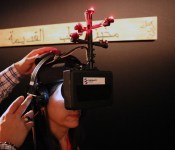
Nonny de la Peña exploring the virtual world of Project Syria in custom VR gear.
The tides have turned for De la Peña who was once jobless when she spent $700 of her own money to fund Hunger. Now, her work is being funded by the likes of the University of Southern California (where she’s studying for her doctorate), Tribeca Film Institute, Google, Associated Press and the World Economic forum, which commissioned this year’s exhibit Project Syria.
A fully immersive sociopolitical work that utilizes computer-generated graphics, as opposed to live action with human actors, Syria places Sundance attendees within the aforementioned Arab country where the experience moves through three distinct moments: a calm street scene, a sudden bombing and a camp for refugee children. It’s a testament to the alternate hardware approach De la Peña’s taken with her VR hardware that Syria really allows the viewer to feel transported into another reality.
“Last spring when Palmer… when they sold [Oculus] to Facebook, I texted him, ‘Thank you so much.’ Because look. Look at this place now. Look at what’s happening here. It’s so fabulous!”
Where Oculus’ dev kits continue to focus on a standalone headset experience with inbuilt audio and inward and outward-facing camera-based tracking, De la Peña’s custom hardware opts for a higher-end, albeit more cumbersome, setup. That approach incorporates facial-tracking, separate headphones and an external, body worn pouch housing crucial processing circuitry.
“I love Oculus, but it’s a sit down experience. They don’t really want you walking around,” says De la Peña. “And I can spend $3,000 on my goggles instead of $300 right now. Right? I can get higher-end components to make it crisper and get a wider field of view. And I can set up my own tracking system. This is a face-based tracking system which I have to tell you is still one of the best in the world. You know what? It’s really good.”

Oculus shows off its new Crescent Bay prototype headset at CES 2015.
That boast is not without merit, either. Motion sickness is one of the most persistent hurdles to making VR a mass-market consumer technology. It’s why Facebook’s acquisition of Oculus makes sense — billions of dollars in research are required to overcome the medium’s Achilles’ heel and make the experience a seamless one for all users.
It’s also the one major con to VR that I consistently encounter. Unlike my other colleagues that regularly cover the VR space, I seem to be part of that small, but nonetheless important minority that’s prone to motion sickness. Indeed, when I experienced Perspective, another VR work at New Frontier, I had to close my eyes and take several deep breaths to keep from throwing up. That did not happen with Project Syria and De la Peña’s gear.
“I had colleagues literally pointing their finger at me and saying, ‘You can’t do that. That doesn’t work. It’s not ethical. It’s too subjective.’”
“In general, I think we report less levels of nausea. I know we do, because I collect data. … I collect data also beyond my anecdotal, my observations. I actually collect information data to inform how to make better pieces,” says De la Peña.
That’s not to say De la Peña’s being dismissive of the Oculus approach. She likens the two companies’ differing solutions as being akin to “TV vs movie theatre.” She also concedes that it likely won’t be her company Emblematic Group that delivers the VR industry’s coup de grâce when it comes to tracking tech and a motion sickness solution. “Honestly, I presume somebody else is going to solve the headgear problem before we are. I mean, that’s not what my number one goal has been because there’s so many billions of dollars [thrown] at this and huge people.”

An early 3D-printed prototype of Emblematic Group’s Zig Zag, a low-cost VR viewer.
There is a bigger picture in mind for Emblematic Group, though. De la Peña’s vision for the fledgling startup company she’s founded with her brother (the man responsible for creating the vast majority of her hardware is nothing if not ambitious. With a steep background in media, she’s confident Emblematic can become a content juggernaut covering everything from entertainment stories to tech stories to general news and human rights pieces. At present, she’s even deep in development with a major Hollywood director on an unspecified fiction project, in addition to working with The Guardian, BBC and Al-Jazeera.
“People keep saying, ‘Are you a content maker? Are you a hardware maker?’ And I keep saying we’re a content business, but… when there’s a hardware problem we just solve it for now.”
In a sense, it’s almost as if De la Peña envisions Emblematic becoming a sort of virtual reality news network — think the CNN of VR. When I asked if she had any interest in hiring on and training journalists in this new form of immersive journalism, De la Peña eyes sparkled with that glint visionaries often have. “That would be a dream come true. It would be a dream come true to do that.”
“We understand content here. But the crazy thing is we’ve turned out to understand a bit of hardware too,” says De la Peña. She is, of course, referring to the VR headset that she and her brother specced up and 3D printed out of their Mother’s garage. The end-goal being that, with the proper deep-pocketed funding, Emblematic can tackle the higher-end consumer VR market. “Oculus is wonderful for everybody,” she says. “And maybe we’d be the high-end folks. Because I think that’s what we do best.
In the near-term, however, Emblematic is gearing up to release an affordable VR viewer. Think of it as Emblematic’s competitor to Google Cardboard. Zig Zag, as she and her brother have deemed it, is a collapsible VR viewer that, when closed, resembles a hard plastic eyeglass case. De la Peña showed it off to me during our interview and admitted that it was “hot off the 3D printer this week.”

Nonny de la Peña demos her company’s collapsible Zig Zag virtual reality viewer.
Zig Zag works much like Gear VR and Cardboard in that it requires the use of an Android phone to power the experience. The actual “hardware,” however, apart from its lenses which she independently sources, contains no moving parts or processor; it relies entirely on the smartphone to power the experience. And, unlike Google’s flimsy Cardboard, it’s durable. “It’s not going to break or bend,” she says.
Ultimately, De la Peña would like to distrbute Zig Zag through Emblematic’s site, but she’s also considering a Kickstarter campaign and is in talks with an unnamed partner that’s interested in ordering 10,000 units. She’s confident that Emblematic can offer Zig Zag for a relatively inexpensive price.
“It’s really nice not to feel vulnerable anymore. I think Keri Putnam, the head of the festival here, put it best when she said to me, ‘You don’t have to justify yourself anymore.’”
While De la Peña is focused on the high-end, she sees opportunities for devices like Zig Zag to work in conjunction with the 3D imaging tech in Google’s Project Tango. That technology is where De la Peña sees VR inevitably headed on the consumer end. “Right now we’re looking at 360 [degree] video as very realistic stuff and I’m still doing a lot of CGI stuff,” De la Peña says. “They’re gonna merge. And we’re already merging it now. You’re going to use your Project Tango on your phone and you’re gonna just res-up a scene you just [scanned]. And it’s gonna turn into a 3D model right away that people can see. That is for sure the future.”
#fivemin-widget-blogsmith-image-738757display:none; .cke_show_borders #fivemin-widget-blogsmith-image-738757, #postcontentcontainer #fivemin-widget-blogsmith-image-738757width:570px;display:block;
 trydocument.getElementById(“fivemin-widget-blogsmith-image-738757″).style.display=”none”;catch(e)
Google ATAP’s Johnny Lee talks about the new Project Tango tablet built for developers.
The novelty of the medium may have initially aroused disdain from her peers, but De la Peña doesn’t think the world-at-large will throw up the same level of resistance to VR. She points to her young children as examples of digital natives that don’t fear technology. They’ve already become accustomed to living in virtual gaming worlds like that of Minecraft. And, besides, she insists the technology’s already matured enough to the point where it’s no longer considered a moonshot; it’s already practical for consumer use.
“I don’t know why people get so terrified by technology. … Look, I’m the one that could tell you. I would know. I would know. I took so many hits,” she says. “The criticism I’ve gotten over the years, you have no idea. It’s really nice not to feel vulnerable anymore. I think Keri Putnam, the head of the festival here, put it best when she said to me, ‘You don’t have to justify yourself anymore.’ And that is the truth. That’s why being at this moment with everybody here… it’s so gorgeous. So again, thank you Palmer Luckey.”
 AIVAnet