



Google Inks Deal With Sprint, T-Mobile to Become Wireless Carrier
Google has signed deals with Sprint and T-Mobile that will allow it to sell wireless service directly to consumers, reports The Wall Street Journal, adding to a report released by The Information earlier today. The publication’s sources suggest that Google’s entry into the wireless service industry may be part of an effort to persuade carriers to bolster speeds and cut down on pricing. Positioning itself as a wireless carrier is also part of Google’s larger effort to provide better Internet coverage across the United States.

Currently, there are four major carriers in the United States: T-Mobile, Sprint, AT&T, and Verizon, and while T-Mobile has made efforts to shake up the wireless industry with its Un-Carrier initiatives, wireless service in the United States remains much pricier than in other countries, with subscribers getting less data for more money.
Details on how Google will offer wireless service, its cost, or when it will launch are not known, but like the rollout of its Google Fiber broadband internet service, Google-branded wireless service could launch in a limited number of cities to begin with.
Sprint, of Overland Park, Kan., is the third-largest wireless carrier, while T-Mobile, of Bellevue, Wash., ranks fourth. Under separate agreements with each carrier, Google will resell service on the Sprint and T-Mobile networks, according to people familiar with the plans. Such wholesale agreements are common, essentially allowing sellers such as Google to pitch wireless service under their own brand names.
As it will operate as an MVNO, or mobile virtual network operator, Google will not need to build out the infrastructure for its own wireless network, instead providing T-Mobile or Sprint service that’s controlled by and sold through Google. Other well-known MVNO’s include Boost Mobile, FreedomPop, and Straight Talk.
In the past, there have been rumors and speculation suggesting that Apple too would take on the role of a mobile carrier, selling service directly to consumers, but Apple has not made any moves in that direction. In fact, in 2012, Apple CEO Tim Cook said that Apple did not need to own a carrier or provide its own wireless service, stating that the company would be better off focusing its efforts on making great devices than attempting to get into a market out of its area of expertise.
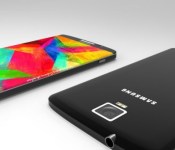
Details galore about the upcoming Samsung Galaxy S6

Tech blog BGR released an article today claiming that a reliable insider has sent them some fantastic information with regard to Samsung’s upcoming flagship, the Galaxy S6.
The source gives some incredible facts about the guts running the smartphone leader’s Project Zero device. Hit the “Read More” link below to wet your whistle.
To quote BGR and its source, we can expect the following from the Galaxy S6:
- 64-bit eight-core 14nm CPU which is 50% faster
- 5.1-inch Quad HD Super AMOLED display with a 577ppi density, stunning outdoor visibility, super dim mode for late night.
- A huge 20 megapixel OIS camera sensor and a 5 megapixel f/1.8 front-facing camera with real-time HDR
- 32 / 64 / 128GB of storage
- 2550mAh battery
- Built-in wireless charging
- Four hours of usage on a 10 minute charge
- Quick connect charging
- Samsung Pay: works with 90% of existing magnetic stripe payment terminals, and NFC payment terminals
- Metal and glass body
- Gorilla Glass 4
- Cat 6 LTE
The question is, will it be enough to turn around Samsung‘s downward spiral? Robert Nazarian reported earlier that 2015 will be a crucial year for Samsung, so if these specs turn out to be true for the S6, maybe it’ll clot that financial hemorrhaging plaguing the Korean powerhouse.
Source: BGR
Come comment on this article: Details galore about the upcoming Samsung Galaxy S6
And then there were none, HTC One M8 GPE leaves the Play Store
It was fun while it lasted, but the tryst that was Google Play Edition versions of hot flagship devices appears to be over. For now. It would appear that the final device that carried the GPE branding, the HTC One M8, has slipped quietly off into the night to join its brothers in arms. The […]
The post And then there were none, HTC One M8 GPE leaves the Play Store appeared first on AndroidSPIN.
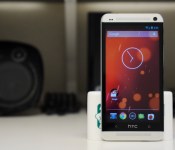
Goodbye Google Play Experience: One M8 GPe leaves the building

While the Nexus line has always been the defacto “go to” choice for OS enthusiasts, purists, and developers alike — much like Apple’s iPhone — it’s a very one-size fits all affair. In the case of the Nexus 6, ironically, that size might actually be a bit too large for some, but that’s another story. For those who lusted after the top-tier flagships by Samsung, HTC, Sony, or even LG but wanted a pure Google software experience, Google Play Edition devices provided users another route for pure stock goodness.
At its height, the GPe line-up included a number of different products: the HTC M7 and Galaxy S4 (the first two to be released), the Sony Xperia Z Ultra, the LG G Pad 8.2 tablet, and the HTC M8. Motorola also release the Moto G as a GPe option, though it didn’t differ much from the already lightly skinned Moto G. These products all ran the same exact software that was present on the Nexus devices, however with the duo camera present on the M8 there was a slight software modification. There’s also one other important difference: all of these devices were updated to Android Lollipop weeks ago, whereas the non-GPe versions of these devices are still all running Kitkat (with the exception of the Moto G).
2014 proved to be a disappointing year for those who wanted more GPe hardware
Unfortunately, 2014 proved to be a disappointing year for those who wanted more GPe hardware, for the M8 was the last device offered and since then we’ve seen a number of Google Play Edition devices leave the Google Play store. Now with today’s disappearance of the Google Play Edition One M8, it seems that the GPe program has finally ended. So what gives here, is the GPe program done for good? If it is gone, what exactly happened?
Some 8 months ago, we covered a report that Google was going to introduce Android Silver, effectively spelling the end of the Nexus program (a rumor that, itself, is now an entire year old). The basic idea was that the Google Play Experience and Nexus line would essentially merge into a more comprehensive, marketing-heavy approach to sales. This would allow for more than one device running the stock Android experience, in short giving us a number of Nexus-like offerings in a way that expanded upon the GPe program. Carriers would sell the devices directly, there would be money spent on advertising, and despite the near-stock software approach, anything OEMs installed via bloat would be removable without root access. Of course Google itself never confirmed any of this, much less officially acknowledged the existence of Silver. After the departure of a key staff member allegedly involved with the program, things more-or-less cooled off.

The Nexus many thought we’d never see.
As we all know, this vision of the future never came to pass. Some say it was never going to happen, others say that all the negative talk about the rumored program caused Google to shift course. Regardless, the Nexus 6 and Nexus 9 are now the future of the Nexus lineup. As for Android Silver and GPe programs? In many ways, the Nexus 6’s sale philosophy is a bit like the vision behind Android Silver, in that Google is focusing harder on marketing and carrier support. Still, it’s a limited approach since there’s only one Nexus phone.
As far as ‘pure’ Android hardware goes, especially that sold directly from Google, the future is more-or-less up in the air.
We can’t say why, but it seems Google is content to push the Nexus 6 as the only “Google-backed pure Android experience”, at least for the time being. Instead, Google has expressed a major interest in expanding Android to cars and televisions (the latter more of a re-start) and Android Wear is slowly but surely gaining more support. At the same time, Google Glass is seemingly on a temporary hiatus, and the modular Project Ara isn’t set to launch in a major market for the time being.
As far as “pure” hardware goes, especially that sold directly from Google, the future is more-or-less up in the air. While it’s probable that Mountain View will unleash a pair of new Nexus devices this year (a phone and tablet), it’s difficult to say what will become of the GPe program, or why there was no Galaxy S5 GPe or similar tablet last year. Given that even the Nexus smartphones can’t earn mainstream success – at least based on one report- it is highly likely the GPe products were simply deemed too expensive for the masses, or just flew off the radar entirely.
This is, of course, exactly where Android Silver was supposed to come in play, with its in-store presence. Google’s one-size-fits-all approach to the Nexus hardware can be a major detractor for those who are looking for a product in anything but the available size, and Silver would have given such options.
// <![CDATA[
(function () ());
// ]]>
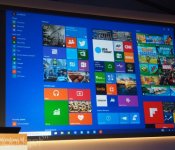
Here’s a closer look at the latest build of Windows 10 (video)

Shortly after Microsoft wrapped its epic Windows 10 keynote today, we had a chance to see the latest version of the next-gen OS running on some honest-to-goodness hardware. Using a Dell Venue Pro 11 tablet on display here at Microsoft’s Redmond headquarters, we got to experience the software in a slightly more final form than when we last saw it. New features include a button for bringing the Start Screen to full-screen, a notification center, revamped Photos and Settings apps and, most importantly, Cortana voice search built right into the desktop. In addition, we got a closer look at the so-called Continuum feature that allows the UI to change depending on what device you’re using (laptop, tablet, et cetera).
#fivemin-widget-blogsmith-image-885142display:none; .cke_show_borders #fivemin-widget-blogsmith-image-885142, #postcontentcontainer #fivemin-widget-blogsmith-image-885142width:570px;display:block;
 trydocument.getElementById(“fivemin-widget-blogsmith-image-885142″).style.display=”none”;catch(e)
Unfortunately, Microsoft’s new Spartan browser wasn’t ready to test, and neither were most of the redesigned core Windows apps. (The reason being: They won’t be included in the next build, which will roll out to testers in the Windows Insider program starting next week.) That said, this remains the most detailed look we’ve had yet of the OS. Have a peek, and stay tuned for more updates, if not today, then sometime soon; Microsoft says it plans to reveal even more about the OS at its Build developer conference in April.
Ben Gilbert and Edgar Alvarez contributed to this report.
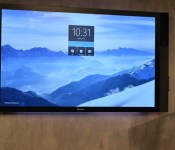
Microsoft Debuts 84-Inch Surface Hub Touch Display, HoloLens Augmented Reality Headset
Alongside officially debuting Windows 10, Microsoft today unveiled two new futuristic hardware products, the Microsoft HoloLens augmented reality headset, and the Microsoft Surface Hub, an 84-inch 4K touch screen tablet with multi-touch and multi-pen support, dual camera, and advanced sensors.
The Microsoft Surface Hub runs a version of Windows 10 that’s been adapted for the huge 84-inch display, and Microsoft showed the device being used in workplace meetings, as a hub for communication. The screen was used for making drawings and notes, and content projected to the Surface Hub was then shared to all people on a Skype conference call. The Surface Hub was also demonstrated using various Microsoft apps adapted for a larger screen.
 Microsoft Surface Hub, image via The Verge
Microsoft has not announced pricing, but the Surface Hub is aimed at enterprise users and is likely to be quite expensive.
The company’s second major product debut was the Microsoft HoloLens, which is a headset that uses holographic see-through lenses to allow its users to see and interact with holograms in an augmented reality environment. The HoloLens has spacial sound and advanced sensors to capture location information, allowing for a totally immersive holographic experience, and it has a built-in high-end CPU and GPU, as well as a “holographic processing unit” that processes information and data from the headset’s sensors. “HoloLens enables native holographical computing,” said Microsoft Kinect developer Alex Kipman.

There are no wires or external connections, and there is no need to have a phone or PC to use the HoloLens. Running a version of Windows 10 called Windows Holographic, the HoloLens knows where a user is looking, providing a virtual display that can be interacted with to launch apps.
In a video, Microsoft showed a holographic view that saw a virtual to-do list projected onto a real refrigerator, and a set of quick-launch apps portrayed on a wall for easy access. It was able to display virtual maps, reminders, and information like weather, all laid over a real view, with Microsoft promising it delivers “new ways to visualize work.”
With HoloLens, a Skype conversation could be projected on a wall, or people could play a holographic version of Minecraft. “Imagine an architect walking around their designs while clients are viewing it from a remote location,” said Kipman.
On stage, Microsoft demoed something that it calls Holo Studio, which can be used to design personalized 3D creations in just minutes, which can then be 3D printed. The Holo Studio was used to create a full-on quad copter in just a matter of minutes, which was fully functional.

Microsoft’s holographic computing was also demoed with the Mars Rover, as Microsoft has had a secret partnership with NASA developing the HoloLens. “We’ve had the great honor of partnering with one of the most innovative organizations in history,” said Kipman as an immersive image from the Mars Rover was displayed on the screen. NASA’s been using the technology to allow its scientists to walk on Mars.
According to Microsoft, the HoloLens will launch during the Windows 10 timeframe, which means that it could be available for purchase at some point later this year. Attendees at Microsoft’s event today will be able to give the HoloLens a try immediately in Microsoft’s lab. More information on the HoloLens will be available in April at Microsoft’s Build Developer Conference.
Google will soon offer wireless service through Sprint and T-Mobile

It has often been rumored that Google will eventually get into the wireless mobile game, and it looks like that dream will come true. As part of something codenamed Nova, Google won’t be starting their own service, but will instead opt to be an MVNO for Sprint and T-Mobile.
If you’re not familiar with what an MVNO is, it’s a mobile virtual network operator, or basically a re-seller of another carrier’s service. For example, Ting is a Sprint MVNO and Straight Talk is the same for both T-Mobile and AT&T. You can now add Google to the mix.
According to The Information, Google wants to not only offer lower prices, but also improve the user experience. They are also developing mobile apps to go along with the service.
Google has not commented, but the report indicates that they have been working on this project since the fall of last year, and the service could launch sometime this year.
Does this excite you? Neither Sprint nor T-Mobile excites me since their coverages are dismal in my area, but I am intrigued to see Google get into the game.
source: The Information
via: The Next Web
Come comment on this article: Google will soon offer wireless service through Sprint and T-Mobile
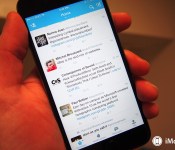
Twitter announces ‘while you were away’ recap feature

Twitter has announced a new recap feature coming to its iOS app today. If you’re a casual user of Twitter, you should start seeing recaps of tweets that Twitter thinks you’ll find interesting. The groupings will also be marked with the helpful “while you were away.”
Twitter made the announcement via a blog post, stating:
A lot can happen while you’re on the go. To fill in some of those gaps, we will surface a few of the best Tweets you probably wouldn’t have seen otherwise, determined by engagement and other factors. If you check in on Twitter now and then for a quick snapshot of what’s happening, you’ll see this recap more often; if you spend a lot of time on Twitter already, you’ll see it less.
The micro-blogging service says that the feature should be live for iOS users today, and it will come to its Android app and website at a later date.
Source: Twitter

Twitter for iOS Gains ‘While You Were Away’ Tweet Recaps [iOS Blog]
Twitter today announced plans to add new top tweet recaps to timelines within its iOS app, which display important tweets that were sent while a user was away from the app.
According to Twitter, these tweet recaps will include a “few of the best tweets” that users might not have seen otherwise, which are selected by engagement and other unspecified factors. Users who check in on only every so often may see the tweet recaps quite often, while users who continually use Twitter will see fewer recaps as they’re already up to date on what’s going on.

Our goal is to help you keep up — or catch up — with your world, no matter how much time you spend on Twitter. With a few improvements to the home timeline we think we can do a better job of delivering on that promise without compromising the real time nature of Twitter.
Missed tweet recaps will be marked with a “While you were away” heading within the iOS app, and should begin appearing for iOS users today as the update rolls out. Tweet recaps will make their way to the web “soon.”
Twitter for iOS can be downloaded from the App Store for free. [Direct Link]

Google preparing to become a MVNO carrier as part of Project Nova – report

Google is getting ready to launch its own MVNO wireless service, according to a report by The Information.
Headed by longtime Google executive Nick Fox, the project, known as Nova, is said to have been in testing since at least last fall. Google will buy wireless access – voice and data — wholesale from T-Mobile and Sprint and sell it to its customers. This model, known as a Mobile Virtual Network Operator (MVNO), is widely employed in the US and worldwide – Republic Wireless and Tracfone are some well-known examples of MVN operators.
According to The Information, which cites three people familiar with the matter, Google sees Project Nova as an experiment and as a tool for forcing wireless carriers to offer better services or lower prices. Google will sell voice and data plans through an online store, probably the Play Store. At one point, the company considered bundling wireless plans with its Nexus smartphone, though it’s not clear what came of that plan. The project is likely to launch sometime this year, says the report.
It’s not the first time we’re hearing about Google’s ambition to become a MVN operator, in order to disrupt the telecom incumbents, which Google’s leadership perceives as slow to innovate and determined to preserve the status quo. The Mountain View company is doing something similar with Fiber, and, in the handful of markets where Fiber rolled out so far, competing providers did step up their offerings. It remains to be seen whether Google will manage to meaningfully disrupt the wireless industry.
What do you think of having Google as your carrier?
 AIVAnet