


New HTC flagship coming on March 1 in Barcelona

It’s happening, folks! HTC’s newest flagship, the successor to the critically acclaimed One (M8), is coming March 1.
HTC has just fired off the first batch of media invites for a “mystery” event scheduled for Sunday, March 1. There’s no official indication that the M8’s successor (you may know it as the Hima or the M9) is coming, but, really, there’s no other HTC phone that warrants a big event during this time of the year.
The press event is set to take place on the day before MWC opens its gates, but that’s fairly typical for a company wishing to capture as much limelight as possible for its products.
The invite itself reveals no clues about what we should expect from the Hima, with just a starry background and the cryptic “utopia in progress” tagline. However, a few rumors paint the picture of a powerful Snapdragon 810-equipped device with a 5-inch screen and the sleek metallic build we’ve come to expect from HTC’s high-end devices. Read more about it in our recent M9/Hima rumor roundup.
For what is worth, HTC is promising something special for the show:
Get excited! HTC will show you something new and utterly spectacular on March 1! pic.twitter.com/joJivvVtfe
— Jeff Gordon (@urbanstrata) January 16, 2015
Regardless what the utopia ends up looking like, Android Authority will be there to bring you full coverage. Stay tuned for more.

Reasons to upgrade to Android 5.0 Lollipop
<img src="http://i0.wp.com/www.androidguys.com/wp-content/uploads/2014/07/lollipops4.jpg?resize=640%2C431" class="attachment-medium wp-post-image" alt="lollipops4" style="display: block; margin-bottom: 5px; clear:both;" data-attachment-id="73941" data-orig-file="http://i0.wp.com/www.androidguys.com/wp-content/uploads/2014/07/lollipops4.jpg?resize=640%2C431" data-orig-size="1024,690" data-comments-opened="1" data-image-meta=""aperture":"0","credit":"","camera":"","caption":"","created_timestamp":"0","copyright":"","focal_length":"0","iso":"0","shutter_speed":"0","title":"","orientation":"0"" data-image-title="lollipops4" data-image-description="<p>via https://www.flickr.com/photos/gazeronly/10071699233</p>
” data-medium-file=”http://www.androidguys.com/wp-content/uploads/2014/07/lollipops4.jpg” data-large-file=”http://www.androidguys.com/wp-content/uploads/2014/07/lollipops4.jpg” />
In the world of technological innovation, its course is often defined by the actions of leading brands. In the face of intense market competition and driven by the desire to dominate a specific market sector, companies invest heavily in the development of new technology and improvement that will redefine the consumer experience. Take the smartphone market, for example, where Android responded to the launch of Apple’s successful iOS 8 software by releasing its own upgrade in the form of the Lollipop (Android) 5.0.
Like the iOS 8, Androids’ own Lollipop update includes several targeted enhancements. The first of these is the inclusion of Android RunTime (ART), which improves application performance in terms of speed, responsiveness and consistency. It is also 64-bit compatible, and the initial tests that have been conducted through tests such as Google’s Nexus 9 underline the improved performance that they tool delivers. It is particularly beneficial for business users or freelancers, who may often be required to operate multiple applications simultaneously and in real-time.
Android have also equipped the Android Lollipop upgrade with security features, thanks at least in part to the increased prevalence of virtual retailing and responsive online slots sites. More specifically, users can now ‘pin’ specific screen or applications, locking other users out of these functions while ensuring that the handset remains active. This is great for parents who wish to protect sensitive data without disabling their devices entirely, while it also makes it far easier to maintain battery life and protect your data in the event that your phone is lost or stolen.
In terms of practical usage, the Android 5.0 upgrade also incorporates a detailed usage chart and heightened battery saver mode. This is the brainchild of Google, who are in the midst of a drive to increase processing speeds and ensure that Android applications can run simultaneously without compromising the performance of individual devices. Although this project is its infancy, there are signs of it in the recent upgrade and a clear indication of the direction that future operating system updates will take.
The post Reasons to upgrade to Android 5.0 Lollipop appeared first on AndroidGuys.

Intel CEO Responds to Rumors of ARM-Based Macs, Says Relationship With Apple Is ‘Strong’
 Intel CEO Brian Krzanich appeared today on CNBC’s Squawk Box to talk about the financial future of the technology company. Following discussions about Intel’s disappointing Q1 forecast and flat PC sales, CNBC anchor Betsy Quick questioned the executive about rumors that Apple may eventually drop Intel chips from its Mac computers in favor of its own processors.
Unfazed by the questioning, Krzanich toed the company line, revealing no new information about the future of Intel’s relationship with Apple and simply calling it a “strong” one.
I just hear the same rumors. Our relationship with Apple is strong and their products are great. Apple is always going to choose the supplier who can provide them the most amount of capability in innovation for them to build on, for them to innovate. They’re a company based on innovation. Our job is to continue to deliver parts that have that capability give them that, that are better than our competitors. And then they want to use our parts. So I wake up every morning making sure that across the board, whether it’s Apple or Lenovo or Dell or any of our customers — we have to provide the most competitive part: performance, price, reliability, all of those.
http://player.theplatform.com/p/gZWlPC/cnbc_global?playertype=synd&byGuid=3000347186&size=530_298
In his latest report, KGI Securities analyst Ming-Chi Kuo offered the prediction that Apple may launch ARM-based Macs in the next few years. In this scenario, Apple would replace the Intel chips it currently uses with custom designed A-series chip, allowing the company to better time processor upgrades with new product launches. Apple last year was forced to delay major product launches across its MacBook Air and MacBook Pro lineup, offering only minor processor bumps due to delays in Intel’s Broadwell processors.
Rumors of Apple’s interest in ARM-based Macs are not new, with earlier reports suggesting Apple has developed ARM-Based prototypes of the iMac, Mac Mini, and a 13-inch notebook model. If the rumor pans out this time, the switchover to ARM processor would initially target low-end machines that would benefit from the low battery consumption of the ARM-based architecture. Future expansion may be possible as improvements in Apple’s A-series processor begin to rival the performance of Intel’s entry-level offerings.
Sony Xperia Z4 passes through Japan’s certification authority

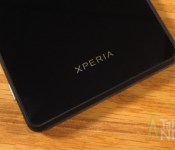
Earlier today, an unannounced Sony smartphone passed through Japan’s official certification authority — the RRA (Radio Research Agency). Information included in the brief filing documentation reveals that we could potentially be looking at the upcoming Xperia Z4 — a revamped model of the company’s flagship smartphone of 2014.
Unfortunately, the paperwork doesn’t disclose anything about the internals of the device, but we do know that the handset has been certified for NTT DoCoMo, KDDi and SoftBank. Additionally, the Z4 is set to pack a variety of different connectivity options, including support for VoLTE, Bluetooth Class 1 (Version 4.0, LE+EDR), 802.11b/802.11g/802.11n Wi-Fi, NFC and GPS.
The Xperia Z4 is expected to sport a 5.2-inch Triluminos display, a Snapdragon 810 chipset, 3GB of LPDDR3 RAM, a 16-megapixel rear-facing camera, 32GB of internal memory, a 2-megapixel front-facing shooter, hardware buttons, water/dust resistance and a 2,800 mAh removable Li-Ion battery.
If you wish to see the full RRA filing — hit the source link below.
Source: RRA
Come comment on this article: Sony Xperia Z4 passes through Japan’s certification authority
One month with the Microsoft Band – Was it worth the effort?

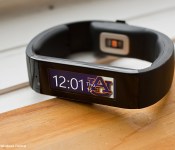
The Microsoft Band has been on the market since last November and I finally got my hands on one by driving to a Microsoft Store in a neighboring State. I’ve had the Band for a little over a month and as inventory levels start to climb, I wanted to share my impressions of the Band.
For the most part I have been very impressed with the Band, but as we often seen with first generation devices, there is always room for improvement. But was it worth calling Microsoft Stores in neighboring States and driving two hours to finally get my hands on one?

Former boss of Jony Ive-founded firm will shape Samsung’s design future

There is arguably no consumer electronics company in the world that releases as many smartphone and tablet variants as Samsung does per year. Tune out for a bit and you’re liable to miss one, or an entire series for that matter. The company is trying to shape things up in 2015 after a period of poor fiscal returns, and taken an affinity towards metal. Still, one might be hard pressed to find anyone who drools over a Samsung device like some do over an HTC phone, or Apple anything. Samsung knows this, and thus things are about to change.
In a move that can only be taken as a hard-line stance against stale concepts, Korea JoongAng Daily is reporting that Samsung has hired Lee Don-tae, a “design entrepreneur”, as team leader of the Global Design department. Don-tae is a Professor at Hongik University’s Department of Industrial Design, but, perhaps more interestingly to the tech-crowd, was also President of London-based design firm Tangerine, a position he earned after just seven years working there. Of no small trivial matter is the fact that a certain Jony Ivy founded the nectarine-named studio prior to being recruited by another fruit company.

Only time will tell if even this newest of Samsung design’s is to be replaced by something entirely new and possibly award-winning
While Lee has actually been working at Samsung since the start of the new year, the news itself indicates the company may be trying to build up some hype before the presumed launch of the Galaxy S6 and new Gear watch (rumored to have a round display) that may take place at MWC this March. Still, given that he’s only just joined the company, it would be highly unlikely he could have an influence on the S6 should it be announced in the near future: work inevitably began some time ago, and any kind of new frame or shape would be subject to possible manufacturing issues, not unlike those rumored to be occurring for the Galaxy A3 and A5.
Still, at the very least, the idea of a new Samsung device with a fresh design would definitely go a long way in making sure the company can attract new customers in the future. Then again, how much can be done with a slab? We shall just have to see.
Retina 5K iMac Models Now Available From Apple’s Online Refurbished Store
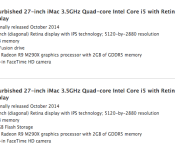
Apple recently started selling the 27-Inch iMac With Retina 5K Display in the refurbished section of its online store, as first noticed by 9to5Mac. These refurbished models offer customers the chance to save up to 15 percent off the retail price of a brand new model.

Several 27-inch Retina iMac models are available, including the entry-level model which is availablee for $2119 and includes a 3.5GHz Intel Core i5 processor, 8GB of memory and a 1TB Fusion Drive. Other available Retina iMacs include a $2,419 model with 16GB of memory and a 3TB Fusion Drive and a $2,549 unit with 16GB of memory and 512GB flash storage. All three models are in stock and available to ship today.
After months of speculation, Apple unveiled the 27-Inch iMac With Retina 5K Display during its October media event. The consumer desktop features a 5120 x 2880 pixel display with improved contrast, viewing angles, and color accuracy. Early impressions of the machine were favorable with reviewers praising the “stunning display” and noting that it is a “huge step up” from Apple’s notebook Retina displays.
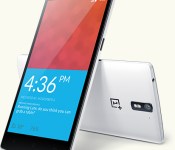
Rumors of OnePlus 2 keeping 5.5-inch screen size, increasing resolution

OnePlus rumors are already trickling in as we make our way through 2015 and near the Chinese start-up’s second flagship device’s release. This rumor comes from Andi Sykes of GizChina.com, who claims that the OnePlus 2 will keep the same screen dimensions of its predecessor, but will see a bump in the screen resolution to 2K.
As will be common throughout 2015, we can expect to see flagship devices utilizing Qualcomm’s Snapdragon 810 and better battery technology. ASUS has already introduced us to the world of 4GB RAM right at the start of the new year, so expect all other devices to have the initial rumors that they too will have 4GB.
As should be expected for our devices coming out this year, Sykes states that OnePlus 2 will be running off Android 5.0+. No reliable word on Cyanogen’s involvement with the device, though.
The OnePlus 2 will be the successor to the OnePlus 1. The first flagship device brought amazing specifications at a very affordable cost, but was mired in a terribly implemented invite system and, at times, questionable public relation snafus from its makers. To the OnePlus team’s credit, this was their first stab at being a player on the big (tech) stage so perhaps a little leeway can be given.
Source: GizChina
Come comment on this article: Rumors of OnePlus 2 keeping 5.5-inch screen size, increasing resolution

Comic: Apple is slipping lately
 Ed: Welcome to this week’s-ever-so-slightly-delayed-due-to-the-artist-being-on-a-train-for-his-birthday’s edition of The Pixel Project: a weekly comic from Diesel Sweeties‘ Rich Stevens on Apple, technology, and everything in-between. This week: Apple is sure slipping lately… or is it?


Read more comics from the Pixel Project on iMore.com.
Report: Galaxy S6 to feature improved touch-based fingerprint sensor

Fingerprint sensors have been a controversial addition to the feature set of modern smartphones, but as the technology evolves, it’s gaining acceptance as a convenient solution to the problem of securing our devices.
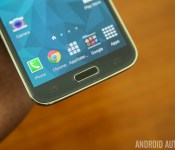
Samsung first used a swipe-based fingerprint sensor on the Galaxy S5 and continued with the Note 4. If this report from SamMobile is accurate, the fingerprint sensor on the Galaxy S6 will be larger and touch-based, which should improve accuracy and ease of use.
A little recap on the difference between touch and swipe sensors: as the name implies, the former type requires the user to simply place their finger on the sensor, while the latter requires the user to actually move their finger vertically so more of the fingerprint is scanned and registered. The difference is small, but in practice, touch-based sensors are not only faster to use, but they require fewer tries to unlock.
Apple is championing touch-based sensors with their Touch ID system embedded on the iPhone, but some Android companies have adopted it as well – for instance, the Ascend Mate 7, which I currently use, uses a touch fingerprint sensor mounted on the back that works really well and is faster and more convenient than pushing the power button and entering a code or pattern.

Samsung (as well as HTC, on the One Max) opted for a swipe-based system, that some users complained didn’t work very well. If the report is accurate, that could be a thing of the past on the next Galaxy S6, expected to launch at MWC in early March.
According to the same report, all the software features taking advantage of the fingerprint sensor will be returning to the Galaxy S6. That includes Pay with PayPal, which lets you sign in to PayPal from mobile with just a swipe. A recent report claimed that Samsung is trimming down software features, but it seems that this particular corner of TouchWiz will be spared the spring cleaning.
For an up to date roundup of Galaxy S6 rumors, check out our roundup.
What’s your experience with fingerprint sensors, both on Samsung and on other devices?
 AIVAnet

