



Facebook at Work lets business have their very own social network

FB@Work was initially revealed to be Facebook’s secret project aimed at enterprise users. And today, the social media giant has finally unveiled this new business tool called Work (or Facebook at Work).
This will be available as a standalone application on major app hubs and will also be accessible through the browser version of Facebook. Facebook at Work will adopt the theme and UI of the standard Facebook app, so it will act and work like the app normally would but with the name and logo of your choice.
Bear in mind that Facebook is only making the app available as a pilot to begin with, so not everybody will be able to access it immediately. But we can expect Facebook to subsequently fast forward the rollout of the app to everyone across the world. This could finally be your gateway to using Facebook at a workplace, where the use of social networks is usually frowned upon.
There is no word on whether Facebook will charge a fee for these services or rely on ads to monetize this project. Interestingly, this is what Facebook employees use internally to communicate with each other. So its availability in Beta is a little surprising.
What do you make of this new app from Facebook?
Via: Tech Crunch
Come comment on this article: Facebook at Work lets business have their very own social network
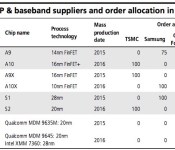
Apple Diversifies Chip Orders for iOS Device and Apple Watch Amid Predictions of ARM Macs
KGI Securities analyst Ming-Chi Kuo, who has frequently offered accurate information on Apple’s product plans based on supply chain information, has released a new report outlining his expectations for the company’s chips over the next several years. Kuo highlights a diversified supplier lineup for Apple’s A-series chips used in its iOS devices, with TSMC, Samsung, and GlobalFoundries all contributing to production.
Kuo sees the 2015 chip breakdown with the A9 chip destined for this year’s iPhones being shared by Samsung and GlobalFoundries, while TSMC handles the A9X that would be used in iPad models. That split is projected to flip in 2016, with TSMC handling the A10 iPhone chips and Samsung being responsible for A10X iPad chips.

Perhaps most enticingly, Kuo projects that Apple could begin launching ARM-based Macs in the next year or two based on its custom chip designs.
Apple may launch Mac products that use own AP in next 1-2 years. This prediction is based on the assumption that Apple’s self-developed AP performs at a level between Intel’s Atom and Core i3 and is good enough for Mac. Using self- developed AP can help Apple better control the timing of Mac launches and Mac product features.
Use of A-series chips in Macs would certainly be limited to lower-end devices at first, but Apple’s emphasis on controlling its supply chain and the improving performance of Apple’s A-series ARM chips compared to low-end Intel chips could lead to a shift in the coming years.
Kuo also looks at the Apple Watch, where Samsung has been reported to be handling the primary portion of Apple’s custom “S1″ chip for the upcoming smartwatch. He believes, however, that TSMC will take over responsibility in 2016 for the S2 in the second-generation Apple Watch.
Kuo certainly does not have a perfect track record with his claims over the years, but he is reliable enough that his predictions are followed closely. Given muddled rumors of Apple’s chip partnerships for future devices, it will be interesting to watch how these supplier deals play out over time.

Ambient Display on the Nexus 6

The display is the notification indicator — for better or worse
You may have heard folks talk about “Ambient Display” on the Nexus 6, with comparisons to Motorola’s “Moto Display” that debuted on their 2013 product line. That’s fine and dandy, because the two are pretty comparable (and Motorola built the Nexus 6). But I’m betting a good many of us have never used either, and aren’t quite sure what all the hoopla is about.
We’re going to break it down a bit so we all are on the same page and know a little more about it.

Samsung in Talks to Buy BlackBerry for $7.5 Billion
Samsung has recently been in talks with BlackBerry about a potential takeover, reports Reuters. The South Korean company has reportedly offered to buy BlackBerry for $7.5 billion, in the hopes of acquiring BlackBerry’s extensive patent portfolio. Executives from both companies are said to have met last week in order to discuss the potential deal.
South Korea’s Samsung proposed an initial price range of $13.35 to $15.49 per share, which represents a premium of 38 percent to 60 percent over BlackBerry’s current trading price, the source said.
The offer price would imply an enterprise value of $6 billion to $7.5 billion for BlackBerry, assuming conversion of $1.25 billion of convertible debt, according to the documents.
BlackBerry has struggled with flagging sales in recent years, and in 2013, the company received a takeover bid worth $4.7 billion from Fairfax Financial, but the deal ultimately fell apart. BlackBerry went on to receive interest from both Apple and Microsoft, among others, but was uninterested in breaking up the company to sell it piecemeal.
Ultimately, the company accepted investments and aimed to re-establish itself in the smartphone market, which led to the launch of the Passport, a large square-shaped phone, and the Classic, a throwback to original BlackBerry designs.
BlackBerry holds quite a few valuable patents, which are estimated to be worth $1 billion to $3 billion. In 2012 alone, its patent portfolio grew by 986 patents, many of which are relevant to competing smartphone companies like Samsung.
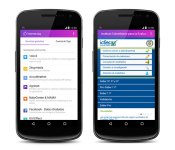
Facebook takes its Internet.org app to Colombia

Facebook took it’s Internet.org app to Zambia back in July, and now it’s heading to Latin America. The social network announced today that folks in Colombia would now be able to use a handful of connected tools free of charge. Tigo customers can access Instituto Colombiano para la Evaluación de la Educación (an education service) and Agronet (agriculture and rural development info) at no cost, as well as things like Facebook, Messenger, UNICEF, Wikipedia, AccuWeather and more. In addition to the initial 16 services, more will be added in the future as Internet.org continues to expand its reach to other parts of the world. While a load of useful tools have been a part of the free app for a while, the version that’s launching in Colombia is the first to offer access to government services.
During a Q&A in Bogotá, CEO Mark Zuckerberg said that due to the infrastructure required to do so, giving folks in developing areas access to the entire internet for free may never happen. However, through the Internet.org project, handy apps for searching job listings, speaking with a doctor and getting local news will help give users info they usually wouldn’t have access to. Zuckerberg also noted that by removing the data plan requirement, only the cost of a phone is the barrier to access, and the one-time cost of the device itself is much cheaper. What’s more, once Internet.org reaches more locales, further reducing the cost of those handsets is a goal for the future.
Filed under: Cellphones, Internet, Software, Mobile
Source: Facebook
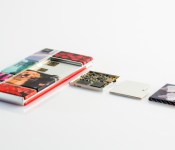
Google wants to help you customize your Project Ara device with the Ara Configurator app

Earlier today, Google held their second developer conference for Project Ara. During the keynote, the company made available the Modular Developer’s Kit v.2 which includes update framework, software and firmware for the Spiral 2 prototype device. Over the past few months, we’ve heard that Ara will be sold in an online marketplace where users will go to assemble their own Ara smartphones. During the tail end of the conference today, Google’s Jason Chua demoed the Ara Configurator app which will allow users to customize their modules, much like we’ve seen with Moto Maker.
The marketplace will make three components available: the endoskeleton, modules and external shells. Users will be eventually be able to find modules they’re fond of, and save them to their online ‘Stashes’. If you want Google to customize your phone for you, there’s an option called ‘simple phone maker’, that will one day create a device specifically tailored to your likes. Chua explains that we may be able to eventually connect the app to social networks, which will allow the Ara Configurator to analyze your social network feeds and recommend different modules to you based on your interests. And yes, you’ll also be able to customize the looks of modules themselves by adding custom images or colors to them. I think we can all agree that a Moto Maker-style website is the best way to sell modules for Ara.
If those updates weren’t enough for the Project so far, Google has also released a new promotional video showing what the final product may look like. Take a look below:
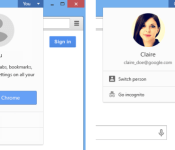
Google Chrome update now enables Guest Browsing and easy switching of accounts

Google appears to have updated the Chrome browser for desktops with the ability to switch profiles right from the top right corner of your window. This feature was originally announced on Chrome Beta back in August, but has now made its way to the standard Chrome as well.
There’s also a new Guest Mode feature, which will open a new browser window with no access to history, which is ideal if you don’t want guests to snoop on your browsing history. This can be easily turned on from the Switch Person option which appears when you click on your name (located on the top right corner).
To add or remove people from Chrome, you can head over to the browser settings and make the necessary changes under the People section. It is important to note that Chrome will not use the browsing history of one user when browsing from another account, which is a very handy security feature.
So if you have two accounts on the browser, your browsing history will not be visible to the other person and vice versa. The browsing history and bookmarks available on your account will be accessible on connected devices as usual.
Overall, it’s a very neat addition to Chrome on desktops. Chromebooks are yet to receive the update apparently, but we’re certain that an update is on the horizon. Make sure you give this feature a try if you happen to use the Chrome browser on your computer.
Via: Unofficial Google OS Blog
Come comment on this article: Google Chrome update now enables Guest Browsing and easy switching of accounts
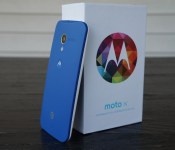
Original Moto X will get new Moto X Moto Voice features

Motorola has made themselves known in the last year or so to update their devices quickly and as fully as possible. When the new Moto X was announced, one of the many questions that owners of the original Moto X had been whether or not the device would get the new Moto Voice features, like being able to change the hotword to start voice control. Well, in a post regarding Lollipop update details for the original Moto X, Luciano Carvalho also confirmed the answers to these questions in the comments.
In the comments on Carvalho’s post on Google+ about the Lollipop updates for other devices, another Google+ user asked if he could confirm whether or not features from the 2014 Moto X would come to the 2013 Moto X. His answer is as follows:
The original Moto X will get all features from 2nd gen that are not dependent on hardware. This excludes Best Photo feature from Camera/Gallery and a couple Moto Actions dependent on the new IR sensors)… Yes, the Moto app with new Moto Voice app will be there.
The Best Photo feature he later explains is semi-dependent on the new camera in the 2014 Moto X, which is why it is not included. However, it would seem the features from the new Moto Voice is not hardware dependent, so owners of the original Moto X have that to look forward to.
Which non-hardware dependent feature are you looking forward to on your older Moto X?
The post Original Moto X will get new Moto X Moto Voice features appeared first on AndroidGuys.
Bring tech to class; Google releases Classroom mobile apps for Android and iOS
I distinctively remember constantly getting my little flip taken away in class all the time for playing snake and attempting to text. Now kids are encouraged to bring their phones, tablets and laptops to class as an extension of the learning environment. I for one am rather happy to see it really. Today Google announced […]
The post Bring tech to class; Google releases Classroom mobile apps for Android and iOS appeared first on AndroidSPIN.

Wireless Charging Looks to Go Mainstream in 2015
As the largest consumer electronics show in the world, CES often gives us a hint of the technologies we can look forward to in the near future, based on the products that are shown off at the show. In 2013 and 2014, there was a heavy focus on wearables, and this year’s emphasis on home automation suggests 2015 will be a big year for connected home products.
There’s one other important emerging technology that we may see explode over the course of the next few years — wireless charging. Several companies, including Energous and WiTricity, demoed upcoming wireless charging solutions, and the Alliance for Wireless Power had a booth showing off how wireless charging will work in the Home of the Future.
MacRumors had a chance to sit down with Alex Gruzen, the CEO of WiTricity, who walked us through the company’s technology, its existing partnerships, and gave us details on when we might see the debut of the first products using WiTricity’s technology, which uses the Rezence specification agreed upon by the Alliance for Wireless Power. WiTricity’s wireless charging solutions, which we have covered multiple times in the past, works using magnetic resonance, which is able to transfer power over distances using the magnetic near-field.
In the past, wireless charging solutions like the Powermat (which uses a competing technology from the Power Matters Alliance) have required the electronic device being charged to rest directly on the power source, but WiTricity’s wireless charging technology is unique because it does not require direct contact. The magnetic field used for charging is able to wrap around barriers, letting WiTricity charging pads be placed in unassuming locations like under desks, rugs, tables, and more.
In our time at the WiTricity booth, we saw charging pads that were placed under concrete, under desks, and more, hidden out of sight but still capable of delivering a full charge to a device (or multiple devices at once) equipped with WiTricity’s technology. This type of hidden charging technology is what we can expect in the future, and Energous, previously mentioned, also debuted a similar “WattUp” technology that uses radio frequencies to charge devices, replacing a charging pad with a transmitter that can provide power up to 15 feet away. Read more 
 AIVAnet