


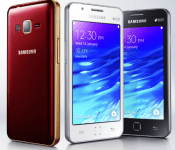
Samsung launches sub $95 Tizen phone for India

Samsung has launched its first Tizen powered smartphone for India, the Samsung Z1. The 4 inch device is very low-end, presumably to hit the target price point. At its heart is a 1.2GHz dual-core processor, it has 768MB of RAM and 4GB of internal storage. There is also a 1500mAh battery, which although it sounds small, is probably reasonable for a device with a 800×480 resolution display. In terms of cameras the Z1 comes with a 3.1 megapixel rear camera, and a VGA front camera with an auto face detect feature.
Besides the underwhelming specs, the big thing here is that the phone runs Tizen 2.3 and not Android. To make a Tizen based phone more attractive Samsung has gone to great lengths to bring some value-add to the Z1.
Users of the Z1 will get access to “a wide range of free entertainment content spanning across categories such as music, movies, videos, mobile TV and radio.” Samsung will also launch a free entertainment package called ‘Joy Box’, that gives Z1 users access to music, TV and movies. Samsung has also partnered with Hungama.com to deliver a wide selection of music available for streaming and downloading.

The Z1 also includes a SOS alert feature. If you press the power button four times, the handset will send out a ‘Help’ message to the user’s primary contacts and track the device’s location to provide necessary assistance.
As Mr. Hyun Chil Hong, President and CEO, Samsung India Electronics put it, “We have customized the Samsung Z1 to meet these unique, entertainment-focused needs of local Indian consumers for a personal and reliable mobile experience.”
The Z1 is a 3G device and works with India’s Reliance Communications and Aircel networks. The Samsung Z1 costs INR 5,700/- (just under $95) and will be available in India from January 14th in White, Black and Wine Red.
Since Samsung has similarly priced Android phones, what do you think is Samsung’s strategy with Tizen?
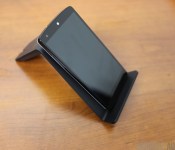
Wireless charging technology in 2015: what you need to know

Wireless charging is a technology with plenty of potential, ranging from promises of cordless charging at your desk to boosting your battery as soon as you walk through the door. However, most Android OEMs only appear to be making a token effort to push this technology into the mainstream and many consumers are still waiting for a truly convincing implementation.
As is currently stands, there are three big groups each promoting their vision for the de-facto future standard of wireless charging: the Wireless Power Consortium, Alliance for Wireless Power, and Power Matters Alliance. Recent merger intentions between two of the industry’s largest groups may signal a big push into products later this year. In which case, we should probably know a little bit more about each of the big names.
Qi
Qi (pronounced chee) is probably the most well-known of the various wireless standards, having made an appearance in the popular Nexus 4 and 5 smartphones, Nokia’s (Microsoft’s) Lumia range, and a handful of flagship smartphones, such as the LG G3 and Galaxy S5. The Qi standard was developed by the Wireless Power Consortium, which was established back in 2008 and currently boasts 206 companies in its membership program, including big tech names like Microsoft, MediaTek, Qualcomm, Samsung, and Sony, among others.

Despite missing from the spec sheets, both the Nexus 6 and Galaxy Note 4 support Qi wireless charging. Although, you will require a compatible cover for the Note 4.
Despite early adoption, this generation has seen Qi wireless charging move from a standard feature in some models, to optional smartphone cases sold separately at additional cost. Many Qi phones no longer come with a charger by default either, see the Nexus 6 or Droid Turbo, turning it an option that many consumers aren’t even aware of.
Qi may have taken a backseat this generation for a number of reasons. Qi cases are slightly more expensive to produce than ones without a coil, which could be the first cut to make as price competition increases. Alternatively, the questionable practically of Qi may be hindering its popularity, but more on that in a minute.

Coils of wire create magnetic fields, which can be used to generate a current flow in a separate, insulated coil. This is the basis of transformer technology.
Qi has been around for quite a while and is based on the core principle of electromagnetic inductance. Essentially, this technology is powered by two coils of wire. The charging station contains one coil which produces an oscillating magnetic field, which induces an alternating current in the receiving coil located on the device being charged. Communication between the base station and receiving unit controls the output power of the transceiver if it is to be used with multiple devices.
The latest Qi specification states a transfer of around 5W of power when using the appropriate secondary coil, which is typical of older smartphone chargers connected to the mains supply.
An important point for later is that Qi uses tightly coupled coils for high transfer efficiency, but this necessitates that the coils are tuned slightly “off-resonance” frequency, as, oddly, two close tightly coupled coils don’t work very well with a matched resonance. This results in the most efficient transfer of power but at the cost of high sensitivity to coil misalignment.

Tightly coupled coils ensure maximum power transfer (left), while smaller loosely coupled coils operate at greater distances with reduced power (right). Source: WPC
The close nature of this connection ensures a good level of transferable power without the need for wires, but it does have its compromises. These drawbacks mainly boil down to the limited distance allowed between coils, which means that devices have to be lined up quite accurately in order to achieve a good connection and power can only be transmitted to one device at a time per transmitting coil. Even though the Qi standard ensures compatibility across all certified devices, different sized smartphones and docking stations sometimes fail to play nicely with each other.
Often it ends up being just as easy to keep a USB cable or standard dock at your desk than it is to buy a compatible, more expensive Qi docking station. The lack of any major benefit over normal charging is a probably cause as to why Qi has not become a more mainstream technology.
Rezence

Highly tuned, high Q resonance circuits create a higher power transfer at the base, allowing for larger coverage distances. Source: Hyperphysics
The Alliance for Wireless Power may not have established products like the Wireless Power Consortium, but its technology is just as promising. Just like Qi, you will find a wide selection of big tech names among A4WP’s members list, including Qualcomm, Samsung, and Intel. All of which are interested in its wireless charging standard known as Rezence.
Rezence, as the name implies, makes use of resonant inductive coupling, which is an ever so slightly different take on the technology used by Qi. The principle still uses coils of wire to create a usable magnetic field, but also tunes the frequency of the oscillation to precisely match between receiver and transmitter. This increases the maximum transfer distance before power diminishes, but looser coupling between the coils results in suboptimal power transfer.
Well coupled (similarly sized) coils allow for an excellent capture of the magnetic field at close range, but quickly fall off at a distance. A loose (smaller), on-resonance receiving coil can continue to make use of the magnetic field at greater distances and can also operate almost anywhere within the magnetic field, albeit with a decreased level of power.

Tight coupled, off-resonance coils (left) allow for maximum power transfer, while loose, resonant coils (right) can be placed anywhere in the field.
Rezence’s latest specification states a maximum power transfer of 5W at greater than 80 percent transfer efficiency, again quite typical of older smartphone chargers, with a maximum of eight devices charging at one. However, this power will decrease with the number of connected devices and distance. 5cm has been stated as a typical operating distance, although no measurement is declared in the specification.
What Rezence may lose in maximum power transfer it makes up for in product flexibility. Rather than producing single use transmitter docks or complex and expensive multi-coil transmitters, Rezence circuits can charge multiple devices, without having to worry about alignment. It’s worth noting that Qi has its own resonant prototypes in the works and chargers can be built to simulate the effects of resonance coupling with existing Qi products, which will appear in the upcoming 1.2 specification. Guided Positioning and Free Position modes for devices are already in the latest Qi specification, suggesting that Qi is also interested in this approach.
Personally, I find the idea of being able to place multiple devices on a charging mat or desk far more useful than requiring a dedicated docking station for each device. That said, Qi may be the better solution if you want the fastest possible wireless charging, although mains charging via Quick Charge 2.0 is faster still. WiTricity is also a member of the A4WP and bases its technology on the same magnetic resonance principle, which it says can work up to several metres in specific scenarios.
The additional distance of a resonance based technology means that charging mats can be placed under tables and other surfaces to create discreet charging stations. Rezence charging accessories and compatible mobile devices will be rolling out throughout 2015.
Power Matters Alliance
The Power Matters Alliance is the last of the big three groups involved in wireless power standards and is overseeing a couple of interesting technologies. The PMA and A4WP are the big two that recently agreed to merge, in order to help promote their standards as an alternative to the more established Qi brand.
Until recently, the PMA was promoting its own inductive charging standard, which is very similar to Qi. In fact, some smartphone vendors had chosen to adopt PMA instead of or alongside the Qi standard in the US, and some chip makers have begun proving dual solutions for both technologies at little extra cost. Last year, Starbucks announced plans to adopt PMA chargers in its stores. In addition to this, the group also manages an extended layer of digital monitoring and policy APIs for wireless power.
However, following the agreement with A4WP, the PMA will now be shifting its focus to include resonance based charging alongside its tightly coupled inductive standard. Both groups will be adopting and supporting each other’s standards for future design specifications, meaning that wireless charging is likely heading for dual-mode operation, offering the benefits of inductive and resonance solutions. Qi also looks to be heading in this direction with its latest prototypes, but it remains to be seen if this more complicated solution is economically viable.
The Power Matters Alliance is also working with a new company named Energous, which own the unique WattUp technology. This is quite a bit different from the magnetic field based technologies of Rezence and Qi. Instead, WattUp uses a radio frequency system to transmit power up to 15 feet from the charging station. Using the 900MHz (5.7-5.8GHz) RF spectrum, WattUp targets your device’s receiving antenna with lots of small signals that add up to a decent current with which to charge your device. Power levels, charging times and schedules can all be managed with the company’s software and up to 12 devices can be charged at a single time.
However, Energous’ WattUp only delivers 1W of charging power at 15 feet, increasing to 4W nearer the charging station, which isn’t as fast or reliable as the competition, especially when you consider that Quick Charge 2.0 mains power typically operates at around 10 watts and can reach 36 watts on supported devices. On the plus side, WattUp can power your devices constantly without having to leave them on a dedicated pad, so your smartphone can start charging as soon as you walk in the door. Bringing WattUp to market is more challenging, as the expensive hub is clearly a bigger investment than a small docking station, but home and business use are both on the cards.
What to expect in 2015
You can now probably see why the industry has been so indecisive about making a commitment to any one standard. There is no perfect solution to wireless power yet. Rather, there’s an assortment of workable ideas to choose from, each with their own pros and cons. Not to mention that better technologies are still being worked on and some ideas haven’t even been presented to consumers yet.

With competition over standards expected to pick up this year, we may see a wider range of smartphone accessories to ensure compatibility with various technologies.
Qi hasn’t taken off in its current form, instead resonance or dual-mode charging is likely to be the next stop
As for where things are heading, Qi clearly hasn’t taken off in its current form, instead resonance and/or dual-mode charging is likely to be the next stop. This should overcome most of the practical and performance issues associated with the early first generation technologies. Ideas like Energous are also promising, especially in the business space where entire offices could be built to operate on wireless power. But this is likely further away and requiring substantially more investment and time to perfect than smaller gadget accessories.
The big question still to be confronted by wireless power is: why should the majority of consumers choose it over the convenience of a bedside USB cable? The first group to solve this issue both simplistically and economically could unlock a market with hundreds of millions of potential customers. Wireless charging still has a lot to prove, but the technology is right around the corner.

Google Play grew much faster than Apple’s App Store in 2014 – report

According to a recent report from appFigures, Google Play has grown more than Apple has in both the number of apps and developers in the year 2014. Google has also grown faster than Apple in the total number of apps available, total number of developers creating apps for the platform, and for the first time in 2014, the Play Store has released more new apps than App Store released in a given year.
Taking a look at the charts below, we’re seeing major growth in the number of apps and developers in the Google Play Store, iOS App Store, as well as the Amazon Appstore from 2010 to 2014. Google ended the year 2014 with over 1.43 million published apps, compared to Apple’s 1.21 million. Amazon is still very far behind, finishing the year with only 293,000 apps in all. We can also see the total number of developer growth for each platform. Google finished the year with almost 400k developers, while Apple nearly made it to 300k. Amazon is nearing the 50k mark to finish out 2014. As you can see, Google Play’s developer community has grown faster than Apple’s for the third year in a row.

Moving forward, we can also see that app development is on the rise. Google Play grew in the number of apps by more than a 100% increase, while Amazon grew a bit more than 80%, and Apple growing by under 60% in 2014. Additionally, more developers joined Google Play in 2014 than Amazon and Apple combined. The Google Play Store now has 388k developers on the Android platform, compared to Apple’s 282k and Amazon’s 48k.

The report also took a look at the fastest growing categories in each app store. Google Play’s Games and Photography apps increased tremendously, while Apple’s Business and Food & Drink categories rose the most. There’s not much jarring information here, but the charts below still show some interesting results.

So, why is Google Play growing so much faster than Apple’s App Store? It’s mainly because Android is so much more popular than iOS globally, and its developer base is simply larger. Also, the difference may have a lot to do with the way Google and Apple publish apps in their respective stores. Apple has a more rigorous app approval process before anything can get published, while Google is a tad more lenient up front, then fixes problems and violations after the app is published. Due to these opposing publishing processes, we’re unsure if these charts account for the removal of apps after they’ve already been published.
Either way, we’re still seeing major growth out of both Google and Apple, so it will be interesting to see who surpasses who in the coming years.

Melt undead with cool new plants in the latest update for Plants vs. Zombies 2

Plants vs. Zombies 2 has today received an update, introducing 16 exciting new levels for players to enjoy. Titled Frostbite Caves Part 1, EA has brought freezing winds and hot new plants – a perfect recipe for melting frigid zombies.

Melt undead with cool new plants in the latest update for Plants vs. Zombies 2

Plants vs. Zombies 2 has today received an update, introducing 16 exciting new levels for players to enjoy. Titled Frostbite Caves Part 1, EA has brought freezing winds and hot new plants – a perfect recipe for melting frigid zombies.
Here’s a quick run through of what’s new in the latest release:
- 4 fiery plants, like Pepper-pult
- 8 primitive zombies, including Dodo Rider
- Zombie Hug-a-thon celebrating Valenbrainz (February 3 – 14)
- The Sap-fling Reforestation Bundle
This update marks the beginning of a chilled adventure for the title, which is set to receive more content after Part 1.
- Free – Download Now
Samsung Galaxy S6 could have a toned down TouchWiz UI, almost “Nexus-like”
One of the biggest criticisms about Samsung devices is its TouchWiz user interface (UI). That’s not to say that there aren’t people that like it, but on a scale from stock Nexus to heavily controlled and themed, the TouchWiz UI is next to almost nothing else. Having seen TouchWiz on almost every Samsung device for […]
The post Samsung Galaxy S6 could have a toned down TouchWiz UI, almost “Nexus-like” appeared first on AndroidSPIN.


Google Translate just got smarter: Word Lens and instant voice translations in latest update

When Google acquired Word Lens in May 2014, it was clear that it was only a matter of time until the startup’s impressive visual translation technology would be folded into Translate. That moment is coming today – Word Lens integration and improved voice translations are coming in the latest Google Translate update.
Word Lens lets you point your smartphone to a foreign language text and have it instantly replaced with your language of choice, right on the screen. Until this update, you could scan text with your device and have it translated and displayed into a text box, a clunky experience in most cases. Word Lens removes that friction, and everything happens in real time. Street signs, restaurant menus, product labels, there are tons of situations you could find it useful.
This genuinely amazing capability will be available in English, coupled with French, German, Italian, Portuguese, Russian, or Spanish. That means you will be able to translate from English to French, and the other way, but not from French to Russian, for instance. Google says more languages are coming.
The second big feature in this update is instant voice translation. Before the update, translating speech required tapping the mic button each time someone said something, as well as switching between languages in order to accommodate the other speaker. Now that all happens on the fly, because Translate understands different languages without requiring your input.
This feature should make for much more natural conversations, akin to having a human interpreter on your side, translating the back and forth in real time.
The new Google Translate should start rolling from today – we’ll keep an eye out for other features potentially present in the update and for an APK file.
What do you think of these new features?
The future landscape of mobile devices

Editor’s Note – In many ways the mobile revolution has only just started. As devices become smarter, as seemingly insignificant objects get connected, and as wireless technologies advance, there will be significant changes in how technology impacts are lives. One researcher who is taking a longer term view of mobile technology is Professor Cristian Borcea of the New Jersey Institute of Technology.
Borcea is an Associate Professor and the Associate Chair of the Department of Computer Science at NJIT, and holds a Visiting Associate Professor appointment at the National Institute of Informatics in Tokyo, Japan. Holding a Ph.D. from Rutgers University, Borcea studies mobile computing and sensing, ad hoc and vehicular networks, and cloud and distributed systems.
Here’s Cristian Borcea talking about his research interests in this April 2014 video:
Professor Borcea and his colleagues have recently been awarded a National Science Foundation Grant to research a novel mobile cloud computing platform that would “support collaborative applications in areas such as healthcare, safety, and social interaction, potentially benefiting millions of users.”
“Our goal is to make smartphones smarter,” said Borcea, who is the grant’s principal investigator. We caught with Professor Borcea and asked him to explain his work and vision to us. In the following guest post, Professor Borcea lays out his vision of cloud-augmented mobile computing and the potential impact his research could have on fields.

The Future Landscape of Mobile Devices
By Cristian Borcea
In the next 10 to 15 years, the mobile landscape will experience a seismic shift that will completely alter the way our devices interact with the physical world. The market will be saturated with intelligent wireless sensors that will impact healthcare, transportation, energy and water distribution networks, etc. For example, body-worn health monitoring sensors will communicate wirelessly with smartphones or smartwatches, which will be integrated with the cloud. The applications of this technology are seemingly endless – from finding a doctor nearby to assist someone who is having a heart attack, to monitoring and potentially stopping the spread of epidemic diseases. In addition to sensors, we will see autonomous devices, vehicles and robots in a multitude of forms (self-driving cars, drones, household robots).
These devices will stream large amounts of data from the physical environment (video, audio, and other types), and this data has to be quickly processed to provide useful real-time assistance to users. However, in order for this vision to become a reality, several problems need to be overcome to ensure that these novel mobile apps work efficiently and protect the users’ privacy. Researchers and computer scientists will have to integrate mobile and cloud computing in order to allow automation and interaction between devices.
At the New Jersey Institute of Technology, my colleagues and I are trying to answer a key question necessary for the shifting mobile landscape: How can we provide fast, scalable, reliable, and energy efficient, distributed computing over mobile devices?
Avatar
Our proposed solution is called Avatar, and it is a mobile-cloud system that enables effective and efficient collaborative apps for mobile users. In Avatar, a mobile user owns one or more mobile devices and has an “avatar” hosted in the cloud. Our version of an avatar is a per-user software entity that acts as a surrogate for the user’s devices, which will reduce the workload and demand for storage and bandwidth. Avatars run the same operating system as the mobiles and can run unmodified mobile apps or app components. Implicitly, they save energy on the mobiles and improve the response time for many apps by executing certain tasks on behalf of the users. The avatars are always available, even when their mobile devices are offline.
Potential application: finding people in a crowd
Currently we see a wide range of applications for this research. For example, through Avatar, a parent could find a lost child by using the child’s photo to search through recent images taken by nearby mobile users. Similarly, law enforcement agencies may search for a person of interest. Being able to efficiently and automatically run such an operation on thousands of mobile devices, selected according to their current location and other properties such as social connections, while preserving the users’ privacy, has been the holy grail of mobile computing for a long time.
The “find person” app could run on either the avatars or the mobile phones, depending upon where the photos are currently located and the trade-offs between computation and communication. Our architecture improves the response time by using avatars to process the photos already uploaded to the cloud, and by deciding how to deal best with the photos residing on mobiles.
In addition to impacting the way parents and law enforcement can find persons of interest, our research will improve healthcare and wellbeing. Users may have health body sensors that report health-related data to smart phones and then on to the avatars; additionally, the phones may record the user location and co-location with other users. A simple example app is one that would allow users or health agencies to monitor and stop, in early stages, the spread of epidemic diseases, by seeing spikes in the data and alerting the CDC to help control the outbreak. These types of applications would have perhaps helped limit the spread of Ebola. When natural disasters strike, such as an earthquake or a blizzard, the mobiles/avatars of users can be queried in real-time to alert emergency teams of the locations of injured citizens. The avatars may share the users’ data even after the mobiles have run out of battery power, thus improving availability.
Privacy in the cloud
The above applications can work efficiently by storing and processing an unprecedented amount of data in the cloud. At the same time, our goal is to also protect the user’s privacy and data confidentiality from the cloud providers. We propose to use a variant of multi-party computation, which is tailored for the Avatar system and cloud:
- Split and store the users’ data between two different cloud providers in such a way that each individual cloud provider cannot access the original data (this is achieved through cryptographic functions);
- Execute the desired program on the data split between the two cloud providers such that the providers cannot see the final result – the requester will get partial results from each cloud provider and use cryptographic functions to merge them into a final result.
The privacy of the users’ data is preserved as long as the cloud providers do not collude with each other. This assumption is supported by the current real-world settings in which the cloud providers are competitors (e.g., Amazon and Microsoft).
Programmability and scalability challenges
In addition to privacy issues, there are substantial technical challenges to Avatar, including programmability and scalability issues. Many current apps are interactive or heavy on communication instead of computation. Therefore, new cloud architectures and protocols are needed to maximize scalability and find a good balance between cost and efficiency. For this reason, we propose to work on re-designing the cloud architecture and protocols to support billions of mobile users and mobile apps with very different characteristics from the current cloud workloads.
Some of our current recommendations include the following techniques: Virtual machine clustering to localize communication; distributed storage and data layout to localize data accesses; deducing data and computation redundancy; and schedule VMs and requests carefully to further reduce computing resource consumption.
Avatar apps execute over distributed and synchronized (mobile device, avatar) pairs to achieve a global goal. Therefore, app components have multiple options about where to place execution to achieve different global performance objectives. However, the programming abstractions should shield the programmers from all these complexities and provide a simple, high-level API. In addition to the app code, the programmer should issue policy and performance objectives that will be translated into an execution plan by the Avatar middleware. For this reason, we propose to work on creating a high-level programming model and a middleware that enable effective execution of distributed applications on a combination of mobile devices and avatars.
Overall, computer scientists have a major task ahead of them in order to integrate mobile and cloud computing, but the impact to the way society manages healthcare, transportation, energy, and safety are immense.
Through our research at NJIT, we’re hoping to find ways to create a new mobile cloud architecture that allows for many of the future mobile apps to happen efficiently and without privacy intrusion. The future landscape of mobile devices over the next 10 to 15 years is exciting, and it’s almost impossible to imagine how far we can improve the fundamental building blocks of the way we interact with our physical and digital landscapes.
Google Translate with Word Lens is now official, rolling out over the next few days
It was about a month ago when we first got wind of a possible Google Translate with Word Lens union, and now Google has made that marriage official. On their blog today, Google has detailed just what Google Translate with Word Lens on Android and iOS is going to be capable of, and it looks like it’s […]
The post Google Translate with Word Lens is now official, rolling out over the next few days appeared first on AndroidSPIN.
 AIVAnet