


Google details Ara Manager app for wrangling all your modules

We’ve known that there’ll be an Ara Manager app to help Android users grok their shiny, new modular toys, but we’ve just gotten a better sense of how it’ll actually work when Ara devices trickle into the wild later this year. At its most basic, the app — which should come pre-loaded on Ara phones — allows users to lock and unlock the modules currently slotted into the phone by using a bit of current to disengage the electro-permanent magnets holding them in place. We knew that already, though: What’s new?
Well, what about when you’ve got multiple, similar modules slotted into a phone’s endo, like a regular camera and a thermal camera? You’ll be able to use the app to determine which one you want to use at any given time, though it’s not exactly clear how the interface will let you do that. Oh, and seeing as how there’s firmware specific to each module, the app will also let you manage the updates and “support packages” that’ll assuredly become available as developers refine their modules. Beyond the mechanics of managing an Ara phone, the app will provide users will status information (think battery levels, vendor details and the like), but maybe the app’s most important role is a sherpa of sorts, a guide to help people figure out their devices by flagging potential issues and offering suggestions for optimal module spots. Linaro CEO George Grey hinted that slipping hardware into certain slots would lead to less-than-ideal performance, but sadly, he didn’t dive into what exactly that meant.
Filed under: Mobile

Apple and Ericsson sue each other over wireless patent licensing

Apple has gotten involved in yet another lawsuit. This time, its with Ericsson, which the company claims is demanding “excessive royalties” for the patents it holds for LTE wireless technology.
According to Reuters, Apple says that Ericsson is trying to gain royalties based on the price of an entire smartphone or tablet, but Apple thinks it should only pay based on the price of the processor inside. It quotes a company spokesperson as saying:
We’ve always been willing to pay a fair price to secure the rights to standards essential patents covering technology in our products. Unfortunately, we have not been able to agree with Ericsson on a fair rate for their patents so, as a last resort, we are asking the courts for help.
Today, Ericsson filed its own lawsuit against Apple, claiming it has tried and failed to work out a new license agreement with Apple for two years. Reuters quotes an Ericsson spokesperson as saying:
We have been trying to negotiate a new agreement. We came to the conclusion we needed the help of a third party.
If a court does make a decision in this case in favor of Ericsson, Apple could be forced to pay as much as $750 million a year to continue to use its wireless patents.
Google’s Play Store eclipses Apple’s App Store in number of apps and developers for first time

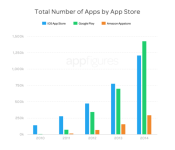
Given the differing business models being employed by Google and Apple in getting their mobile operating systems into the hands of consumers, it should be no surprise that despite a jump start by Apple, Google is ahead in many measures. Even in areas where Apple has a lead, Google is steadily marching toward dominance. An example of this occurred in 2014 according to app metrics tracking firm AppFigures whose latest numbers show Google’s Play Store has surpassed Apple’s store in terms of both number of apps and developers.
According to AppFigures, the Google Play Store now boasts 1.43 million apps compared to 1.21 million available in Apple’s App Store. There are some who may counter that Apple is much more strict about what gets into their store, which keeps the numbers down. Nevertheless, there will be many Android fans who will point to this change in app figures as a major milestone for Google’s business.
Meanwhile, the number of developers who are working on apps for each store continued to grow faster for the Play Store than it did for the App Store. In terms of actual numbers, Google has been in the lead for a few years now and has now reached 388,000 developers compared to Apple’s 282,000 developers.
As a whole, app development continues to grow at a very strong clip. All three major app stores – Google’s Play Store, Apple’s App Store and Amazon’s Appstore – all saw at least 50% growth during 2014. This kind of expansion should continue during 2015 as manufacturers work to expand their ecosystems to a whole variety of new platforms, especially wearables, that will push developers to consider new ways to support interaction with apps.

source: 9to5Google
Come comment on this article: Google’s Play Store eclipses Apple’s App Store in number of apps and developers for first time
Google will launch Project Ara market pilot in Puerto Rico later this year

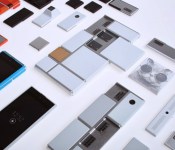
Google has just announced that Project Ara is making its way to Puerto Rico for its first market pilot later this year. Earlier today in Google’s second Project Ara developer conference, the company laid out its plans on how exactly they plan to proceed in getting the modular smartphones into consumer’s hands. In the second half of the year, Project Ara will be launched in the United States territory on both OpenMobile and Claro.

Google chose Puerto Rico for a few different reasons. Firstly, the mobile phone market is largely diverse with a broad number of users on smartphones and feature phones, all spread out in a wide variety of US carriers, Puerto Rican carriers, as well as local mobile carriers. Puerto Rico also has a 1:1 ratio in terms of sales with high-end flagships to entry-level devices. Puerto Rico also abides by FCC regulations, so Google won’t need to sidestep any regulations while still in the planning process.
Google’s ATAP venture will be opening up a number of “food truck-style” vehicles on the streets of Puerto Rico in order to sell Project Ara devices and extra modules. At the time of launch, Google says they’ll have 20-30 Ara modules available across multiple different categories. In order to expand their reach, the search giant has partnered with 11 different schools in the University of Puerto Rico system to invite developers on board if they’re interested.

We also saw an updated version of the “Spiral 2″ hardware, which is the current device being tested. The newest model boasts a NVIDIA Tegra K1 processor, a 720p display, 5MP rear-facing camera and much more. The Spiral 3 skeleton is the device Google plans to launch when the market pilot comes to Puerto Rico. The company plans to release an updated and improved version of the Sprial 3 when the device hits the mainstream. So we’re still far away from seeing anything come to market, but at least we have a more updated vision on what’s to come in the second half of the year.
We’ll be sure to fill you in once more details surface about the upcoming Project Ara launch.
European App Store Price Increase Turns Off Auto-Renewing Subscriptions [iOS Blog]
Apple last week implemented price increases for App Store content throughout the European Union and in several other countries, rebalancing the company’s pricing as exchange rates have shifted and new taxes have gone into effect in some countries.
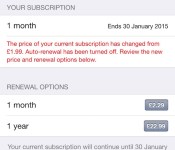
One side effect of that change, however, is that auto-renewing subscriptions for app content have been automatically turned off for any pricing tiers that saw increases due to Apple’s changes. The issue was noticed by a MacRumors reader and also highlighted by Popular Science UK editor Tom Royal today.

Users have so far apparently not been notified that auto-renewals have been turned off following the price increases, although in the examples we’ve seen the renewal dates are still several weeks into the future.
It is understandable that Apple may want or need to receive consent from customers before automatically raising recurring subscription fees, but so far neither publishers nor users have been notified of this issue and they are only discovering it for themselves when digging into the subscription settings for their apps.
Apple was proactive about notifying app developers of impending price increases roughly a day and a half of time, but additional information on the effect those changes are having on recurring subscriptions was not included. As a result, some users may suddenly find themselves losing access to their content while publishers may lose out from users who simply elect not to follow up on the issue and resubscribe, regardless of whether the new rates themselves would be a determining factor.
Users in affected countries should check their settings for any recurring in-app subscriptions and ensure that they turn auto-renew back on should they wish to continue receiving their content.
(Thanks, Richard!)
How AT&T will deliver TV (and more) over crowded LTE

During the first-ever College Football Playoff National Championship, AT&T showed off a working demo of a new version of its Long-Term Evolution network: LTE Broadcast. With this, the wireless carrier is hoping to alleviate the congestion problems consumers face when they are in highly crowded places — such as professional sports stadiums. AT&T’s been working on LTE Broadcast for years, but until now has shared few details about it. In 2013, AT&T CEO Randall Stephenson said that the company was “all about architecting networks to deliver video,” pointing out that the technology would be “mature in scale within the three-year time horizon.” We’re not quite there yet, but what I saw on Monday leaves me hopeful for the future of smooth, buffer-free television over LTE.
#fivemin-widget-blogsmith-image-23786display:none; .cke_show_borders #fivemin-widget-blogsmith-image-23786, #postcontentcontainer #fivemin-widget-blogsmith-image-23786width:570px;display:block;
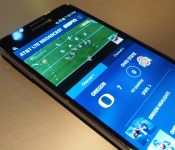
For this particular demo, AT&T decided to build a mobile application that streamed two different live feeds related to the College Football Playoff championship game. Channel 1 consisted of the Spidercam angle, which gave you an overhead view at the action, while Channel 2 let you watch and listen to experts and analysts who were on an ESPN set. The video looked great and there were no buffering or stuttering issues to speak of — AT&T says the demo was sending the connection at a 1 Mbps rate, allowing the stream to be relatively sharp, similar to what you would see over WiFi. In general, LTE Broadcast can deliver data in the same speed range as LTE, since the service uses that same network to fulfill its purpose. The idea here, though, is to maintain a quality consistency regardless of how many people are watching at the same time.
On LTE Broadcast, AT&T says it allocates a portion of its spectrum resources to deliver specific content to users, without any compromises (read: crappy video quality). And it can do that by sending the same stream of content to multiple devices all at once, rather than on a one-to-one basis, which is how the current LTE network works. Simply put, you’re not sending any data back to AT&T’s servers, only receiving it; since LTE Broadcast is designed to push out clear-cut content, AT&T doesn’t have to worry about tailoring the experience for every single user. At a place like AT&T Stadium, home of the Dallas Cowboys, this also helps by taking the load off the major network, since those who decide to use LTE Broadcast would be connected to a different cell site. When there are more than 80,000 people with smartphones in one place, that’s even better.
#fivemin-widget-blogsmith-image-23786display:none; .cke_show_borders #fivemin-widget-blogsmith-image-23786, #postcontentcontainer #fivemin-widget-blogsmith-image-23786width:570px;display:block;
 trydocument.getElementById(“fivemin-widget-blogsmith-image-23786″).style.display=”none”;catch(e)
AT&T partnered with Ericsson, ESPN, MobiTV, Samsung and Qualcomm during the College Football Playoff demo of LTE Broadcast. The streaming app, created by MobiTV, was running on a Samsung Galaxy Note 3, which the carrier built specifically for this purpose. Qualcomm supplied the chip inside the handset; Ericsson brought the infrastructure; and, finally, ESPN provided the content. On that note, it’s worth mentioning that LTE Broadcast isn’t compatible with any device currently out on the market, and AT&T says it doesn’t know what the plans for OEMS are.
The company adds that it has been exploring LTE Broadcast technology, which is compatible with all spectrum bands, as an add-on for LTE since the very beginning of its Long-Term Evolution efforts, but it’s just now ready to display its progress. Naturally, AT&T is hoping to create buzz around LTE Broadcast, and it needs support from other firms to get its shiny new network beyond the trial stages. AT&T’s president of network operations, Bill Smith, said, “Part of the reason for us showcasing it here is to get other potential partners interested.” Now, whether it actually achieved that goal is too early to tell. At the very least, the carrier can feel confident that it managed to get ESPN, Samsung and Qualcomm on board for the very first public demonstration.

AT&T says there’s more where that came from too. According to the company, the streaming app built to be shown inside a jam-packed stadium is only the beginning. “The stadium is only one use case; we wanted to show what our network can do,” an AT&T spokesperson at the event said. “The market will dictate what it’s used for.
In the future, LTE Broadcast could be used to deliver plenty of high-demand content, including software updates for smartphones and tablets. “We stagger updates because of so many people downloading at once,” AT&T’s representative said. “With Broadcast, you can take the load off and deliver specific payloads for those huge files.” As for what kind of damage LTE Broadcast does to your device’s battery life, AT&T wasn’t willing to answer — though it did say that, during the demo, it had been performing “especially well.”
LTE Broadcast is, without a doubt, a great example of what AT&T’s network can do. Unfortunately, at the moment there’s not much subscribers can do with it. For now, you’ll just have to deal with the fact that it exists, and maybe one day you’ll have access to it. Let’s hope so.
Filed under: Cellphones, Wireless, Networking, Mobile, AT&T
Google to bring Project Ara devices to Puerto Rico first

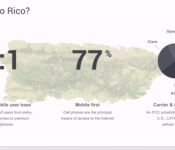
At the second Project Ara Developer Conference, Google has announced that Puerto Rico will be one of the regions to get a ‘market pilot’ of the device. This essentially means that Puerto Rico will be the first region to get Project Ara based handsets.
Google mentions that this decision was taken considering the country’s reliance on mobile networks. Since it is part of a mobile-first ecosystem, it’s feasible to try out something like Project Ara over at Puerto Rico.
Google mentions that test devices should be available sometime in Q2 2015, so there’s still some waiting to do. By then, Project Ara will reach functional status, so the timing of the launch has been scheduled based on that.

Paul Eremenko of Google’s Advanced Technology and Projects (ATAP) group stated the reasons for choosing Puerto Rico as one of the first launch markets – “First, Puerto Rico has an incredibly diverse mobile user base, that ranges all the way from a large number of feature phone users all the way up to premium smartphone users. We need to be able to reach both with the Ara platform, and so we should have both included in the market pilot. As it happens, the ratio in Puerto Rico is about 50/50 between feature phone users and smartphone users.”

Google further mentions that since Puerto Rico is a free trade zone, it would make it easier for manufacturers to send components from around the globe. Also, since Puerto Rico is technically under FCC’s jurisdiction, it will act as a decent test market for the subsequent American launch of Project Ara based devices.
Come comment on this article: Google to bring Project Ara devices to Puerto Rico first
You can now save your Outlook web email attachments right into OneDrive

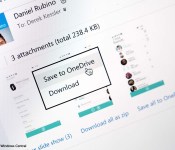
Outlook.com email users now have the option to easily and quickly save attachments right into OneDrive cloud storage. The update to the web email service adds a “Save to OneDrive” that, well, lets you save attachments to OneDrive.
Samsung’s TouchWiz is going on a diet

Samsung may have an announcement at the 2015 Mobile World Conference (MWC) regarding TouchWiz, the proprietary user interface prominently featured in the Galaxy line of Android devices. The Samsung Galaxy S6 is rumored to feature a slimmed down version of TouchWiz that showcases a look and feel closer to stock Android. This comes from a statemt made by a source close to BusinessKorea.co: “We are aiming to get rid of unnecessary functions and simply our UI at the level of the Nexus 6.” The release of the Nexus 6 and Android 5.0 lollipop shows Google’s attempt to unify and beautify its mobile device OS on devices with flagship specs. Along with expanding vendor relationships, the crew in Mountain View is getting closer to giving companies like Samsung little reason to install a bloated software stack on top of Android.
In the past vendor supplied UIs like TouchWiz were meant to differentiate brands in the emerging mobile device space. Custom software takes up valuable storage real estate and could cause a device to become slow and unresponsive. In other words, bloat is bad. A recent sampling of users at phonearnea.com showed that close to 45% of those polled felt that TouchWiz made their devices slower. Samsung seems to be moving in the right direction by addressing some issues in one of the most popular lines of Android based devices.
The post Samsung’s TouchWiz is going on a diet appeared first on AndroidGuys.
Facebook debuts Facebook at Work, allows businesses to communicate internally

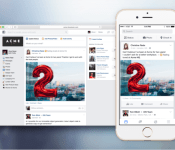
Facebook has just taken the wraps off of their new project, Facebook at Work. The new business-centric social network aims to let companies communicate as well as share items and announcements internally. The app is set up to look exactly like the Facebook we’re all familiar with, but will likely require separate business log in credentials to sign on. The app is going live in the Google Play Store and iOS App Store today, though it will only be available for a handful of select businesses.
Facebook at Work has been in development for roughly ten years, and is actually what the folks at Facebook HQ use to communicate within the business. Lars Rasmussen, engineering director at Facebook, tells TechCrunch that “when Mark (Zuckerberg) makes an announcement he just posts it on Facebook at Work.” The company is unsure whether or not this will be a paid service. For now, Facebook Platform is disabled on the beta app, meaning there are no ads quite yet. Even so, the idea of ads coming to the platform isn’t too farfetched, seeing as how most other rival business communication apps require a paid subscription.
It’s obvious why Facebook wants to create this separate social networking platform: to compete with other rivals in the field. Slack, Yammer, Convo and Socialcast are some of the more popular apps in the space. However, many people are unaware that those apps even exist. But everyone knows about Facebook. If your business uses Facebook at Work you can expect to have two Facebook apps on your mobile device. Information between the two apps will never crossover between Work and personal Facebook accounts, so there’s no need to worry about accidentally sharing the wrong item to the wrong app.
Once the app comes out of beta status, be on the lookout for more Facebook at Work developments in the near future.
 AIVAnet