



TouchWiz to Become Less … Wizzy, More Nexus-Like?

Perhaps bowing to immense pressure and boatloads of frustrated user reviews, Samsung appears to be stripping down its TouchWiz overlay of Android for the upcoming Galaxy S6, bringing it closer in line with stock Android. As one industry source stated, “We are aiming to get rid of unnecessary functions and simplify our UI at the level of Google’s Nexus 6.”
TouchWiz has its adherents, and few can argue that Samsung doesn’t load their phones with features unseen in competitors’ devices. Indeed, Samsung phones are among the most robust, feature-rich devices on the market. But TouchWiz is also big and sucks up system resources, resulting in some of that now-trademark Samsung sluggishness. Slow UIs have no place on phones in 2015.
Bringing TouchWiz in line with the Nexus 6 hints at a greatly stripped-down user experience, and we can safely assume that in the S6′s case, this means ditching superfluous features and focusing on the core ones that Samsung’s market research has identified as vital to the user experience. Coupled with improved memory optimization and smaller software files, hopefully the S6 stays nimble and functional well into the end of its life cycle.
The Galaxy S6 is rumored to be unveiled at Mobile World Congress (MWC) in March. MWC is held every year in Barcelona, Catalonia, Spain. Visca Catalunya.
Source: Business Korea
Come comment on this article: TouchWiz to Become Less … Wizzy, More Nexus-Like?

Desay announces $160 sapphire screen phone in China

Although there has been lots of hype about sapphire screens, there has been little in the way of actual products. There are a few phones out there with sapphire screens, like a sapphire version of the Huawei Ascend P7, but that is about it. However sapphire screens could be poised to gain in popularity as China Mobile, China’s largest mobile carrier by subscribers, has started taking pre-orders for the Desay Magical Mirror X5.
The Magical Mirror X5 is a 5 inch device with a 720p HD display protected by sapphire glass. At its heart is a quad-core MediaTek processor, 1GB of RAM and 16GB of internal storage. It has a 13MP rear facing camera, a 5MP front facing camera, and a 2050mAh battery. The phone supports 4G LTE, runs Android (probably 4.4 KitKat) and costs just ¥ 999, around $160. So the specs aren’t very high, but a 4G phone with a sapphire screen for $160 is quite an amazing price.
Using sapphire instead of glass to protect smartphones has been an idea that has been around for a number of years now. Android Authority has been writing about its potential since at least 2013. We have tackled such issues as, is sapphire better than Corning Gorilla Glass or are sapphire screens worth the hype when it comes to scratch resistance? Could we be seeing the beginning of a new era for sapphire coated displays, not on high-end devices as was predicted, but on low- and mid-range devices as an alternative to Corning Gorilla Glass or other lesser glasses.

Limited Edition 24K gold-plated Lumia 930 now available in Vietnam

If the color gold for a smartphone simply wasn’t enough, a special version of the Lumia 930 is available in Vietnam. The Windows Phone has been coated in 24K gold by Vietnamese luxury brand Karalux, offering an expensive and premium look for those who enjoy showing off some wealth.

Report: Samsung aiming to optimize TouchWiz to “Nexus 6 level”

Under pressure to improve its flagging smartphone business, Samsung needs the Galaxy S6 to be a hit. Expected to launch at MWC in early March, the Galaxy S6 will likely feature a metallic design, a first for the series, but major changes could be coming on the software side as well.
According to Business Korea, Samsung aims to par down and simplify the software features of the Galaxy S6, after customers and analysts have criticized the clunky TouchWiz for years.
Business Korea cites “industry sources” claiming Samsung is working to “optimize” TouchWiz for the release of Galaxy S6.
We are aiming to get rid of unnecessary functions and simplify our UI at the level of Google’s Nexus 6 – source
“We are aiming to get rid of unnecessary functions and simplify our UI at the level of Google’s Nexus 6,” one source said, suggesting a drastic change is coming to user experience. Reportedly, the aim is to reduce the weight the OS puts on the system, so the Galaxy S6 feels and runs smoother.
This sort of software optimization could infuse some much needed nimbleness into TouchWiz, after years of gaining weight. There’s no denying that Samsung devices are among the most feature-rich on the market, but even with top hardware, the Samsung user experience is widely perceived as slower and clunkier than the competition.
In spite of the alleged insider’s statement about Nexus-level optimization, it’s hard to believe that Samsung would ever tone down TouchWiz to be so close to stock Android. Software was a big focus for the company in 2012-2014, and massive resources were invested in developing in-house apps and services.
Samsung is painfully aware that it needs to change something radically in order to invert its sliding market share
With that said, the company has already decided to cut down on its product range by up to a third, so a similarly dramatic shift in the software department cannot be ruled out.
Over the past month, Samsung has moved some of its mobile software engineers to other units, though we don’t really know the effects of the shuffle. We do know, however, that Samsung is closing down some of its services, like ChatOn and WatchOn.
Almost a year ago to the date, Re/code reported that Google successfully coaxed Samsung to scale down its software customization in what one source called “a huge change, a sea change.” We haven’t seen that massive change in 2014, but any such agreement would probably require many months of planning and product development. Is the new TouchWiz the result of that “sea change” agreement?
A word of caution – this isn’t the first time we’re hearing that Samsung is working on an extreme makeover for TouchWiz. There were rumors of a revamped design coming to the Galaxy S5, but the phone did not match those expectations.
All things considered, Samsung is clearly, painfully aware that it needs to change something radically in order to invert its sliding market share. A big software shakeup, coupled with the adoption of a metallic build, could make the Galaxy S6 the growth engine that Samsung needs right now.
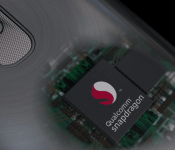
Snapdragon 810 vs 805: what to expect from Qualcomm’s next high-end SoC

Qualcomm’s new Snapdragon 810 is already powering LG’s high-end G Flex 2 and will be the brains behind many a flagship smartphone this coming year. The Snapdragon 805 already sets a rather high benchmark for performance and features, so let’s examine how Qualcomm intends to improve its popular 800 series of mobile processors as it moves into the 64-bit generation.
Processing Power
| Snapdragon 810 | Snapdragon 805 | Snapdragon 801 | |
|---|---|---|---|
| Cores | 8 | 4 | 4 |
| CPU | 4x Cortex-A57 + 4x Cortex-A53 | Krait 450 | Krait 400 |
| Arch | ARMv8-A (32 / 64-bit) | ARMv7-A (32-bit) | ARMv7-A (32-bit) |
| GPU | Adreno 430 | Adreno 420 | Adreno 330 |
| Memory | LPDDR4 1600MHz 64-bit | LPDDR3 800MHz 64-bit | LPDDR3 933MHz 32-bit |
| DSP | Hexagon V56 | Hexagon V50 | Hexagon V50 |
| Process | 20nm | 28nm | 28nm |
The Snapdragon 810 marks the first 800 series chip to depart from Qualcomm’s customized Krait CPU core design and is also the first Qualcomm mobile SoC to reach 20nm. The reasons for the change in CPU cores is that Qualcomm is making the move over to the latest 64-bit ARMv8 architecture, which requires a new CPU design.
The customized 32-bit Krait 450 quad-core makes way for two sets of 64-bit quad-core chips. Four high-performance ARM Cortex-A57s nestle alongside four low-power ARM Cortex-A53s, arranged in a reference big.LITTLE configuration, similar to Samsung big.LITTLE Exynos line-up. Unlike early Samsung chips, all eight cores in the Snapdragon 810 can be active at once, as the chip makes use of Global Task Scheduling.

The Cortex-A57 offers around a 20 to 50 percent boost over the older Cotex-A15 design that Qualcomm’s Krait CPU cores are based on, depending on the scenario. However, this comes at the expense of 20 percent more power consumption. Fortunately, the Cortex-A53 is a more efficient replacement for the low-power Cortex-A7, which, combined with the smaller 20nm manufacturing process, should help offset the battery sapping A57 cores. By efficiently managing workloads across all eight cores, the octa-core big.LITTLE design should result in a higher level of peak performance when needed but a lower level of background and idle power consumption.

When we compared the Snapdragon 805 to the slightly older 801 we were mostly looking at improvements to Qualcomm’s Adreno GPU technology. This time around, the CPU is the biggest change between generations, as the Adreno GPU is simply swapped out from an Adreno 420 in the Snapdragon 805 to a 430 in the 810. That being said, the Adreno 430 supposedly boosts performance by up to 30 percent compared with the Adreno 420, making it around 80 percent faster than the last generation Adreno 330. With gaming on Android becoming a bigger deal each year, the Snapdragon 810 will make sure that frame rate is not an issue.
Performance is expected to improve across the board between the Snapdragon 810 and 805. The new CPU designed should finally see some general performance gains compared to the tried and tested Krait cores in the 32-bit 800 series and the new high-end Adreno GPU should offer a top of the line experience for video content consumers and gamers.
SoC Features
As well as increasing the raw processing power of its latest Snapdragon, Qualcomm has also implemented improved LPDDR4 memory support and a faster Hexagon V56 DSP chip in the 810. The fast 3200MHz RAM data rate and 25.6GB/s memory bandwidth should see applications open and transition that bit smoother on the 810 and the improved DSP chip will help further offset the CPU load for music and high-quality video processing.
 Looking at the rest of the SoC features, we find that the Snapdragon 810 and 805 are rather similar. Both chipsets support dual image sensors up to 55 Megapixels, and are capable of 4K capture and playback with H.264 (AVC) and H.265 (HEVC) formats.
The Snapdragon 810’s ISP has received a modest improvement, moving up to a 14-bit dual-ISP design with a 1.2GPixels/s throughput, improving performance by around 20 percent compared with the 805. NFC, 802.11n/ac WiFi, GPS, and Bluetooth 4.1 support is also identical between the two. Quick Charge 2.0 technology is also supported, with a current draw of up to 3A.

When it comes to displays, both SoCs are suitable for use with up to 4K on-device and can support 1080p and 4K external displays as well. Qualcomm has also been eager to tout its improved LTE data speeds, with both chipsets supporting CAT6 speeds of up to 300 Mbps. Although the 810 now support up to 3×20 MHz carrier aggregation, up from 2x. The modem supports LTE FDD, LTE TDD, WCDMA (DC-HSPA+, DC-HSUPA), CDMA1x, EV-DO Rev. B, TD-SCDMA and GSM/EDGE networks.
What does it mean for me?
Enough of the tech terms, the really important issue is what Qualcomm’s latest chip brings to the consumer experience.
Performance wise, we should expect a modest step up from the Snapdragon 805 and gamers will definitely want to make use of the newer Adreno 430. General app/CPU performance will look something like the Exynos 5433 Galaxy Note 4, which features an octo-core Cortex-A57 and A53 set-up. Battery life is still an issue these days and a big.LITTLE Qualcomm chip should be able to squeeze out a few more hours of life when performing simple tasks. However, battery life when gaming or running more intensive apps is unlikely to change much, as the 20nm energy efficiency gains will likely be offset by increased performance.
Feature wise, those in areas with a fast 4G/LTE network won’t see much of a data speed boost between the Snapdragon 805 and 810, as they both top out at 300Mbps. Average speeds and connection quality may improve in a few areas, as the Snapdragon 810’s modem can connect to three bands at once, rather than two. Phones powered by either SoCs will suite those looking to playback or record high resolution video and image content, as ISP, DSP, camera, and display features and support are virtually identical between the two.
The final major difference between the 810 and 805 comes from the CPU architecture. The Snapdragon 810 is a 64-bit chip, while the 805 is only 32-bit compatible. At the moment, this doesn’t make any major practical difference because 64-bit applications are not widespread. However, as Android Lollipop continues to roll-out and more 64-bit capable smartphones hit the market, the Snapdragon 810 may benefit from slight performance improvements down the line, at least when running certain applications. That said, this might be worth considering if you want the most future-proof smartphone right now.
The Snapdragon 805 was clearly a feature stepping stone between the 64-bit Snapdragon 810 and the Snapdragon 801 found in many of last year’s flagships. We may have seen some features of the 810 already, but the performance gains and more efficient 20nm manufacturing node are the real talking points anyway. Qualcomm’s latest SoC certainly seems to have the performance and features demanded by today’s smartphones and tablets.

ReadItNow! updated to bring Hub Browser support, new themes and more

For those who use ReadItNow! this is for you. The app has received another update. An update with quite a lot of new features too, as well as fixes, which are always welcome. I really love to see developers constantly update and improve their apps and taking on user feedback. ReadItNow! is one of my most used apps and so I am very thankful to see it constantly updated.
If you don’t know already, ReadItNow! is a third party Pocket client for BlackBerry 10. It is a read it later service that I make use of daily. This version brings a handful of new features including better control over font size and line height, so you can customize things the way you want. The ReadItNow! has also partnered with the developer of Hub Browser which means you can open articles via the Hub Browser app. You can change this back via the Settings within the ReadItNow! app.

Xiaomi phone teaser leaves much to the imagination, save for its lack of girth
CES may be old news already, but that doesn’t mean January’s new tech train has slowed to a stop. In fact, given the increasingly large significance of key Chinese OEMs like Xiaomi, Huawei, OnePlus, and Oppo, it may not be too long before the world starts to pay closer attention to trade shows that will take place inside the world’s largest populated country. Xiaomi may have been off-the-radar for CES, but that hasn’t stopped it from teasing a tantalizing new product this week. Take a look:

Quite literally nothing is officially known about what this product might be, but Xiaomi clearly wants everyone to know what it isn’t: thick, heavy, or mediocre. The key use of the word flagship in the text indicates something potentially big is in-hand, at least significance-wise.
As far as unofficial word goes, rumor has it this product could be the Mi 5 or Mi 4s, and is said to contain an all-aluminum chassis. French-language site, Nowhereelse has alleged pics of the chassis, along with some rumored specs:

The device is said to be 5.1mm thin, possibly have a 5.2 inch 2560X1440 QHD display, a rear camera ranging between 16-20 megapixels, and a front facing one allegedly boasting a whopping 8 megapixels. CPU rumors can’t decide between a Snapdragon 805 or 810, however, suffice to say whichever is included the device will be packing some major power.
Assuming the display specs actually pan out, one might begin to wonder just how good battery life could be given the thin size. While it’s certainly possible Xiaomi will have done some software optimization to make things work, it would certainly be nice to see some major advancements in battery technology to go along with the announcement.
Another theory claims Xiaomi will introduce two devices tomorrow, and this second teaser image seems to support this prediction:

While all eyes have been on a potential successor to the Mi 4, Xiaomi could also unveil tomorrow a second generation of the Redmi Note. Regardless of who will end up being the star of the show, everything will become official tomorrow at 1AM EST, at Xiaomi’s Beijing event.
Xiaomi’s new hardware comes amid a major push among Chinese OEMs to release impossibly thin phones. It seems like just a short while ago Oppo had taken the cake for the world’s record, only for it to immediately be dethroned by the Vivo X5 Max. While nothing is yet official, it looks like the world’s third largest OEM may be making some big headlines of its own soon, for something scandalously slim.

Lollipop for HTC One (M8) getting close, leaked video shows it off

If you needed a reminder that the HTC One (M8) does not yet have Android Lollipop, an unofficial video leak has popped up, showing off what the Android 5.0.1 Lollipop release and Sense 6 look like on the HTC One (M8).
The leak comes out of Vietnam and appears to be pre-release software, but things look fairly similar to the leaked screenshots we had a few weeks back. For all it is worth, we can say that this is what you should expect to see when the official OTA hits your One, soon.
Things are looking fairly snappy, which should be no surprise as the One packs the Snapdragon 801 SoC and 2GB of RAM. Also evident in the video is how fast you can fill up the new Recents interface. With the option to turn each open web browser tab into an individual tile in the Recents list, things can build up quickly. Don’t forget also that your Recents list will now survive a device reboot, like it or not.

You are obviously wondering when exactly the OTA of Android Lollipop will hit for the One (M8), and we can only again reference HTC’s original promise to push out to your device by the end of January. As we are coming up on half way through the month, that really could mean you’ll see the update any day now. Be sure to hit HTC’s update page to keep track, or just hang out with us, we’ll let you know the moment we have confirmed news.
HTC is on track to do fairly well in getting the Android Lollipop update to users. Not to say that they’ve kept up with manufacturers. Motorola, for example, has already had Lollipop on their major release phones for several weeks now, and aim to have the release out to all of their 2013 and 2014 phones “very soon”. Still, HTC pushing out within 90 days from the official code release is fairly good, at least their transparency on the process is appreciated.
We asked this last time, but again, are you liking what you are seeing of Android Lollipop and Sense 6 for your HTC One (M8)?

Delsey’s new luggage weighs itself, charges phones, forecasts the weather

CES was flooded with a bunch of “internet of things” for the home, but frequent travelers will likely appreciate this connected luggage better. Leading luggage maker Delsey has been working on a connected suitcase called Pluggage for the past two years and has recently tested a working prototype, as you can see in the video below the fold. Before Pluggage hits the market, though, the company wants your help in choosing which high-tech features it should give the suitcase. Your choices are:
- * Auto-weight: The accompanying app tells you how much your luggage weighs using the suitcase’s integrate scale to avoid paying extra fees.
- * Instant battery reload: This lets you charge a phone in the absence of outlets at the airport or wherever you are.
- * Onboard detection: The app lets you know once your suitcase is on board and takes the guesswork out of whether the airline has lost your luggage… again.
- * Inside lighting system: Interior lighting switches on when the suitcase is opened.
- * Flight info: Entering your flight details into the app shows you the latest updates.
- * Fingerprint ID: You can choose to add a fingerprint lock as an extra layer of protection when launching the app or opening Pluggage.
- * Check lock: The app can tell you if the suitcase has been opened by someone else.
- * Weather forecast: If you’ve entered your flight info, the app can tell you the kind of weather to expect at your destination.
- * Inside speaker: You can pull out Pluggage’s hidden speaker to play your music.
- * Trip info: Lets you create departure or must-see checklists during your trip.
It’s unclear why Delsey can’t just include all these features, many of which are pretty cool and useful, we must say. You can make your choices on Pluggage’s official website, though, and just hope that your favorite features get picked in the end. If all these sound like deja vu, it’s because another connected suitcase called Bluesmart was also announced last year. That one was an Indiegogo project from a startup that managed to raise more than a million dollars, so with Delsey’s considerable brand cachet behind this project, it’s safe to say the Pluggage has a market just waiting for it to become available.
Filed under: Misc
Source: Delsey Pluggage

GoodReader adds VoiceOver compatibility, other accessibility features in update

One of the most versatile document editors for the iPhone and iPad, GoodReader, has picked up accessibility features in a new update that makes it more convenient for users with visual or reading disabilities access documents on the go. Included in the update to version 4.8.1 is compatibility with Apple’s VoiceOver, which along with GoodReader’s own text-to-speech utility, called Speak, allows users to listen to documents in their preferred language.
Users also have the ability to select how fast the text is read aloud. GoodReader mentions that its own text-to-speech service is different from the functionality offered by VoiceOver:
The difference between VoiceOver and the “Speak” option in GoodReader is a text-to-speech feature simply reads out highlighted text, while VoiceOver is specifically designed for visually impaired users and reads aloud anything they need, including window names and menu details. With VoiceOver, a user can move their finger across the screen and the app will audibly read what is supposed to be seen there – the names of the buttons, the items in the menus, and the names of the files and folders.
Using “Speak,” users press on a blank section of a document and are presented with options for reading the document to them – including volume, language and speed controls.
In addition to the accessibility features, GoodReader offers a robust set of tools for editing and managing large documents that include:
- PDF Page Management – add, rearrange, delete, rotate, extract and email individual pages, split and merge files
- PDF Page Slider now shows page previews
- icon view for file browser, with larger previews
- collapsible tool area on the main screen
- true Auto Sync – background and scheduled execution
The app is also universal, meaning that you buy it once, and use across all your iOS devices. GoodReader 4.8.1 is available from the link below.
- Download Now ($4.99)
 AIVAnet