


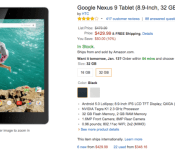
Amazon is currently offering the Nexus 9 for $50 off

Many users tend to think that Google’s Nexus 9 is too expensive. If you’ve been waiting for the next promotion to arise so you can get your hands on one, now may be your chance. Amazon has the Nexus 9 in both storage options and both colors at a $50 discount. That means the 16GB model is only $349.99, and the 32GB model is $429.99. Both colors and both storage options are currently available, so you may want to act fast before they sell out. Additionally, the Nexus 9 is eligible for free shipping, sweetening the deal a bit more.
If you’re in the market for a new Android tablet, this may be the one for you. The Nexus 9 is fast, has a nice sharp screen, loud front-facing speakers and has a battery that can get you through multiple days on a single charge. If you’d like some more information on the tablet, head to our full Nexus 9 review.
We’re not quite sure how long this deal will last, but you better hurry before the deal is over!
Buy now on Amazon
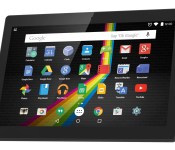
Polaroid L series tablets to run as low as $100

Polaroid last week announced its upcoming budget-friendly “L” line of tablets set for launch this spring. Slated to sell in 7-inch (L7) and 10-inch (L10) sizes, the duo run Android 5.0 Lollipop and feature quad-core processors. The full set of specifications is not yet clear though we can expect Wi-Fi connectivity, front-facing and rear cameras, front facing speakers, and “extended battery life”. Pricing is listed at $99 for the 7-inch model and $149 for the 10-inch model. Look for more details to surface in the coming weeks or months.


The post Polaroid L series tablets to run as low as $100 appeared first on AndroidGuys.

Apple Maintains Mac Sales Momentum in Holiday Quarter
Apple saw an increase in its U.S. PC shipments during the recent holiday quarter, according to PC shipping estimates from Gartner. Apple shipped over 2.1 million Macs in 4Q14, up from 1.9 million Macs in 4Q13, marking an 11.5 percent increase. Though the company’s shipments were up, its growth rate slightly trailed the overall market, resulting in a share of 11.7 percent down from 11.9 percent in the year ago quarter.
With its 11.7 percent share of the market, Apple is the third largest PC vendor in the United States, behind HP and Dell, which captured 29.2 and 22.6 percent of the market, respectively. Lenovo and ASUS came in behind Apple, with 10.2 and 6.8 percent of the market, respectively.
 Gartner’s Preliminary U.S. PC Vendor Unit Shipment Estimates for 4Q14 (Thousands of Units)
Overall, U.S PC shipments totaled 18.1 million units in the fourth quarter of 2014, a 13.1 percent increase from the year ago quarter. HP saw the largest amount of growth in the U.S. at 26.2 percent, followed by Lenovo’s 21.6 percent growth, Dell’s 13.5 percent growth, and Apple’s aforementioned 11.5 percent growth.
 Apple’s U.S. Market Share Trend: 1Q06-4Q14 (Gartner)
IDC has also released its own estimates of Apple’s U.S. PC shipments during the holiday quarter, which are quite different from Gartner’s estimates. According to IDC, overall U.S. PC shipments totaled 17.6 million, with Apple responsible for 2.2 million of those with a growth rate of 18.1 percent.
In IDC’s estimations, Apple’s share of the market grew from 11.3 percent in Q413 to 12.7 percent in Q414, rather than declining slightly as in Gartner’s estimate.
Apple does not rank as one of the top five worldwide vendors in Gartner’s data, which ranks ASUS above Apple, but in IDC’s data, Apple ranks higher than ASUS and is counted as the number five worldwide PC vendor. IDC’s data suggests that Apple’s worldwide PC marketshare climbed to 7.1 percent in the fourth quarter of 2014 with a record breaking 5.7 million shipments, while Gartner’s data suggests ASUS was the number five worldwide PC vendor with 6.2 million shipments.
It is important to note that data from Gartner and IDC is preliminary and that the numbers can shift. Last year, for example, Gartner predicted shipments of 2.2 million for Apple in Q4213, later revising that number to 1.9 million.

Despite artist tension, Spotify subscriptions are growing quickly

At the end of 2014, artists like Taylor Swift pulled their music from Spotify citing inadequate compensation and music being made available to non-subscribers free of charge. Those vocal lashings didn’t stymie growth though, as the streaming service has added 2.5 million paying users since November, bringing its paid tally to 15 million. During that time, the total user count grew to 60 million — up from 50 million in two months. What’s more, the growth is accelerating: It took about 17 months for Spotify to move from 5 to 10 million, but roughly half that time to hit 15 million. This means that only a quarter of the company’s active users are paying customers, a percentage that’s remained consistent for a while now.
During December, Spotify offered three months for just 99 cents — a move that certainly helped the Swedish company pad its numbers at the end of the year. Family plans were announced in October too, making it cheaper to hop on your sibling’s membership rather than pay full price for your own. With the former promo set to expire this quarter, it’ll be interesting to see how many folks stick around at $10/month.
Unfortunately, Rdio doesn’t release its numbers, and the only concrete update on Beats Music came from Jimmy Iovine last May when he revealed the young service had 250,000 subscribers in its first four months. Back in July, Rhapsody revealed that it had hit the 2 million mark, claiming to be the clear “number two.” Deezer, on the other hand, says it currently has 6 million paid accounts, and it’ll add a couple million more in the US after nabbing Cricket Wireless’ Muve Music last week. Of course, Deezer hasn’t fully launched here in the States just yet. With Beats Music becoming a bigger part of Apple’s plans and Deezer’s widespread launch, Spotify will face some stiffer competition in the near future.
Filed under: Internet, Software
Source: Spotify

Facebook and Xiaomi explored investment opportunities without yielding any results

Facebook has tried on multiple occasions to branch out in the mobile world, moving past a simple mobile application. Over three years ago, we saw the social network try to make its way into the mobile scene by partnering with HTC for the HTC Status, which gave users a Blackberry-like experience that offered a simple status update button that was only one touch away. Then in 2013, Facebook came out with the HTC First, which ran the new Facebook Home application that not many users were fond of. After AT&T sold off their remaining stock of the HTC handset because of poor sales, one could assume that Facebook would give up trying to breach the mobile device world.
However, in a new report from Reuters, Facebook discussed investment opportunities in Xiaomi in October 2014. When Mark Zuckerberg visited China late last year, he met up with Xiaomi CEO Lei Jun for dinner. The two met to discuss Facebook investing in Xiaomi, the Chinese-based smartphone manufacturer, which is currently estimated to be worth 45 billion dollars. During the discussion, the two CEOs talked about the political and commercial ramifications that go along with partnering with the social networking giant. Facebook has been banned in China since 2009, so if the deal had warranted any results, the entire situation would have been extremely controversial. Xiaomi has been on the rise in the Chinese market for quite some time, and given the manufacturer’s good relations with Google and China, the company decided to pass on the investment opportunity.
Though the deal fell through, we now know that Facebook is actively trying to break into the Chinese market to expand their social networking site around the world. Xiaomi has been trying to expand their global marketshare for quite some time, and Facebook obviously wants to expand to China. It’s clear that both companies would benefit from working with one another, though in the end, the potential political issues outweighed expanding global marketshare for Xiaomi.

Chrome Remote Desktop finally makes its way to iOS

After seeing an initial release on Android last year, Google has finally brought its Chrome Remote Desktop app to the iOS masses. When paired with the corresponding Chrome web app, Chrome Remote Desktop for iOS will allow users to access their computers from an iPhone or iPad.
The app will work for accessing both Macs and PCs. If you want to get in on the action, here’s a quick run-down from the app description on how to set things up:
- On each of your computers, set up remote access using the Chrome Remote Desktop app from Chrome Web Store.
- On your iOS device, open the app and tap on any of your online computers to connect.
Finally, below you’ll find the download links for both the iOS app and the corresponding Chrome Web App.
Via: 9to5Mac

Facebook and Xiaomi explored investment opportunities without yielding any results
Facebook has tried on multiple occasions to branch out in the mobile world, moving past a simple mobile application. Over three years ago, we saw the social network try to make its way into the mobile scene by partnering with HTC for the HTC Status, which gave users a Blackberry-like experience that offered a simple status update button that was only one touch away. Then in 2013, Facebook came out with the HTC First, which ran the new Facebook Home application that not many users were fond of. After AT&T sold off their remaining stock of the HTC handset because of poor sales, one could assume that Facebook would give up trying to breach the mobile device world.
However, in a new report from Reuters, Facebook discussed investment opportunities in Xiaomi in October 2014. When Mark Zuckerberg visited China late last year, he met up with Xiaomi CEO Lei Jun for dinner. The two met to discuss Facebook investing in Xiaomi, the Chinese-based smartphone manufacturer, which is currently estimated to be worth 45 billion dollars. During the discussion, the two CEOs talked about the political and commercial ramifications that go along with partnering with the social networking giant. Facebook has been banned in China since 2009, so if the deal had warranted any results, the entire situation would have been extremely controversial. Xiaomi has been on the rise in the Chinese market for quite some time, and given the manufacturer’s good relations with Google and China, the company decided to pass on the investment opportunity.
Though the deal fell through, we now know that Facebook is actively trying to break into the Chinese market to expand their social networking site around the world. Xiaomi has been trying to expand their global marketshare for quite some time, and Facebook obviously wants to expand to China. It’s clear that both companies would benefit from working with one another, though in the end, the potential political issues outweighed expanding global marketshare for Xiaomi.
 AIVAnet