



First Sons of Anarchy game trailer shows first-person smoking
In December, it was announced that the acclaimed TV crime drama Sons of Anarchy would be adapted into a upcoming game for mobile devices called Sons of Anarchy: The Prospect. Now the first trailer showing gameplay footage has been released, and it looks like it will contain some scenes of first person smoking.
That sequence is perhaps the oddest thing about the brief trailer, which also shows some first person shooting and motorcycle riding in a cel-shaded art style. The game’s developer Orpheous Interactive hasn’t offer much in the way of details, saying only that the episodic game will give “fans a chance to experience the treachery, graphic action, intrigue and life and death decision making they have come to anticipate from the show.” A specific release date for the game has yet to be announced.
Source: Orpheus Interactive (YouTube)

First Sons of Anarchy game trailer shows first-person smoking
In December, it was announced that the acclaimed TV crime drama Sons of Anarchy would be adapted into a upcoming game for mobile devices called Sons of Anarchy: The Prospect. Now the first trailer showing gameplay footage has been released, and it looks like it will contain some scenes of first person smoking.

First Sons of Anarchy game trailer shows first-person smoking
In December, it was announced that the acclaimed TV crime drama Sons of Anarchy would be adapted into a upcoming game for mobile devices called Sons of Anarchy: The Prospect. Now the first trailer showing gameplay footage has been released, and it looks like it will contain some scenes of first person smoking.
That sequence is perhaps the oddest thing about the brief trailer, which also shows some first person shooting and motorcycle riding in a cel-shaded art style. The game’s developer Orpheous Interactive hasn’t offer much in the way of details, saying only that the episodic game will give “fans a chance to experience the treachery, graphic action, intrigue and life and death decision making they have come to anticipate from the show.” A specific release date for the game has yet to be announced.
Source: Orpheus Interactive (YouTube)

Brazil’s enormous taxes chase Nintendo out of the country

After this month, Nintendo will halt all direct sales in Brazil. According to UOL Jogos, the company’s leaving the country due to the exorbitant taxes it has to pay to continue its operations. Bill van Zyll, the company’s general manager in Latin America, said in a statement that “Brazil is an important market for Nintendo,” but the company had to make this decision, as its “current distribution model [is] unsustainable in the country.” Chances are, some unauthorized sources are already selling imported consoles and games in Brazil. But if you’d rather buy a 3DS or a Wii U from stores that get its supplies from Nintendo’s local partner, Juegos de Video Latinoamérica, you may want to do so soon.
Brazil is known for imposing high tariffs on international companies in order to protect local ones, forcing corporations to pull out, like what HTC and Durham did in 2012. Another reason is to beef up local employment, because one way to avoid paying those taxes is to build factories in the country — something Apple did in 2011, so it can continue selling iDevices. Nintendo probably thinks that’s not a financially viable route, though Van Zyll swore the company will monitor the Brazilian market and evaluate how best to serve its fans.
Via: Venture Beat
Source: UOL Jogos
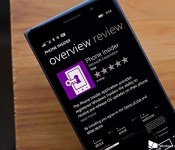
New Microsoft Phone Insider app may be a prelude to a Windows 10 preview for phones

A Windows Phone app from Microsoft called Phone Insider has been discovered today. The app could possibly signal that the company is preparing to launch its rumored preview version of Windows 10 for smartphones.

Samsung’s Nook tablets weren’t big sellers Holiday 2014

When Barnes & Noble announced that it had partnered with Samsung to try and salvage its endangered Nook line of e-book readers, things seemed mildly interesting. Samsung has an untold number of tablets available for purchase, so the prospect of a dedicated book reader seemed like it had some potential promise.
After the dust settled however, it was clear the results weren’t quite what some had hoped: the Galaxy Tab Nook was simply a standard Galaxy Tab 4 pre-loaded with B&N Nook software and the Nook UI replacing TouchWiz. The price was set at $199, significantly higher than the various offerings by Bezos and Friends. The duo then paired for yet another offering, this time a modified Galaxy Tab 4 10.1, but priced higher than the smaller Tab Nook.
It is perhaps unsurprising that a new report by the Wall Street Journal indicates Tab Nooks had a less than stellar sales situation this most recent holiday shopping season.

Specifically, the WSJ reported that revenue from Nook hardware and content (i.e. e-books) was only $56 million, a decrease of a whopping 55% compared with the same 9 week holiday performance measurement last year (ending January 3rd). More specifically however, it was the hardware that did most of the damage: both the readers and accessories saw sales drop by 65% to $28.5 million compared with Q4 2013. Digital content, interestingly enough, only fell by 25% to $27.4 million, a much more modest drop to be sure, but a significant one nonetheless.
Suffice to say this is a trend that doesn’t seem likely to stabilize as e-book readers approach commodity status and even higher end tablets are starting to slide under the $200 mark. Likewise, Barnes & Noble has been contemplating establishing its Nook brand as a separate spin-off company (related to the digital retail of college textbooks), something that may become increasingly difficult with these disappointing results. According to the WSJ, James McQuivery, an analyst at Forrester Research, believes users are “abandoning” the Nook, “Otherwise, you’d have seen stabilizing digital content sales” and then suggested B&N would be better off combining the Nook business with its online store, bn.com.

With such sour sales this past holiday season, it’s unlikely 2015 will see another such invitation.
Assuming that B&N wants to continue making use of the Nook brand for future products and/or services, something drastic needs to be done, and quickly at that. Meanwhile Samsung can’t be too happy either, given that its own situation is sliding and the failure of this once-possibly powerful partnership is no doubt on rocky ground at the moment, if not all but terminated.

We flew over the Nevada desert with Avegant’s ‘Jellyfish’ video glasses

Avegant’s video headsets are like buses. You wait all year for one, and then two suddenly turn up at once. That thing you see above might look a million miles away from the headphone-inspired Glyph, but it is in fact a very close relative. Codenamed “Jellyfish” the video headset/wearable display has a wider field of view than the Glyph (65 degrees compared to 45), which makes it better for things like simulators, VR and (as seen here) point-of-view drone flying. The Jellyfish is something of a side project right now, Avegant’s priority remains with the Glyph. But, the company told us that devices with a wider field of view are something on its developmental roadmap, just don’t expect to see a consumer-ready product any time soon.

I was lucky enough to get my head inside the Jellyfish out in the Nevada desert. I used it while flying a drone, experiencing its point of view. The results were pretty incredible. I’ve flown drones with FPV (first person view) goggles before, but this was much more immersive than anything I’ve used so far. Of course, it helps that the drone I was flying has a 4K camera attached, but the larger image in front of your eyes, and its sharpness, are a huge step up from most of the units currently on the market. I could make out individual blades of grass with the drone hundreds of feet in the air. The stony, arid surface of the desert leaping out in sharp clarity. After my short time with it, I was pretty unhappy about having to take it off.
Using the Jellyfish alongside DJI’s Inspire 1 (and its 4K camera) gives you a tantalising taste of what’s around the corner for immersive or remote-video experiences. As drone use continues to grow, demand for such products will surely follow. The whole experience reminded me of watching those first few bits of HD content after upgrading your SD TV, the leap is significant, you just want more opportunities to enjoy it. Avegant’s current product, the Glyph, was primarily designed for mobile media consumption, but I think the wider field of view on the Jellyfish really does show off the company’s micro-mirror technology to its full potential. For now though, we’re left wanting more.

C Spire intros rolling data for 10GB+ plans

U.S. mobile provider C Spire will soon be debuting a new feature for customers for its big data customers, shared rolling data, which it says is an industry first.
C Spire, which said it was the first to introduce rolling data plans last November, will be expanding these shared rolling data benefits to 10, 15 and 30 GB shared data plans beginning Jan. 19. Customers on these plans will automatically be converted to the updated version with rolling shared data at no additional cost, plus customers on other plans may switch to a rolling shared data plan also at no cost.
It’s simple enough to understand, but C Spire explained further in a media release, stating that the way it works is any unused data from the previous month will be rolled over to the next month for sharing among all users up to the plan’s included monthly data amount. C Spire does not force consumers to use plan data first or eliminate any unused rollover data at the end of each month, instead, rolled over data can be accumulated, shared and used among all individuals up to the plan’s included monthly data amount.
If C Spire isn’t your current provider, it’s nice to know that the provider lets customers use their data as they please, with tethering included in the smartphone plans, plus it includes unlimited talk, text and photos along with data overage protection and optional top-up data passes on the company’s nationwide 4G+ LTE mobile broadband network.
VIA C Spire

The post C Spire intros rolling data for 10GB+ plans appeared first on AndroidGuys.

Microsoft Studios allows ‘Let’s Play’ video creators to make money with its titles

Microsoft Studios now has a formal policy for YouTube and Twitch “Let’s Play” video creators to use when they want to feature the company’s titles in their streaming or video clips. In very basic terms, the new rules do allow those creators to make money off of videos based on Microsoft Studios titles, such as the upcoming Halo 5: Guardians for the Xbox One, but with some restrictions.
CES takeaway: wearables

As CES 2015 is coming to a close, we thought we’d take this time to go through the week’s top stories and roundup the biggest wearable announcements we saw at the trade show. Wearables have been absolutely growing in popularity over the past year, and they’ve arguably been one of the most important parts of CES. There’s a lot to recap here, so let’s jump right in.
Starting your car with Android Wear
Android Wear got a lot cooler throughout this year’s CES, largely thanks to car companies new integrations. Hyundai and Viper both announced Android Wear integration, allowing users to start, stop, unlock and lock their cars, all using an Android-Wear powered smartwatch. While Viper has only announced their compatibility with the platform so far, Hyundai showed off the technology to us at the trade show. Take a look at the video above to see how exactly it works.
Read more:
- Hyundai Blue Link for Android Wear hands-on at CES 2015
- Hyundai announces Android Wear app that can start your car remotely
- Viper SmartStart 4.0 allows you to lock or start your car with Android Wear
The future of wearable technology

Sometimes CES isn’t all about the products being shown off, but about new technology that’s used to power them. Intel recently announced their new “Curie” module, which will one day most likely run your smartwatch or smart ring. The draw to the Curie chip is its compatibility with Bluetooth Low Energy and its small-as-a-button design, allowing wearables to shrink in size.
MediaTek also announced a chip recently, specifically tailored to the Android Wear platform. The chip is called the MT2601 and its a small powerhouse of a processor. It packs in a 1.2GHz dual-core ARM Cortex-A7 CPU accompanied by an ARM Mali-400 MP GPU. The chip can be connected to up to the usual array of external sensors and wireless modems, such as MediaTek’s own MT6630 five-in-one wireless SoC, and supports a qHD display resolution. While it’s not as powerful as the Snapdragon 400 found in other Wear devices, MedaTek is confident that the combination of high power and low cost will be able to put this chip inside your next wearable.
Read more:
- Intel hopes to power your next wearable with the tiny Curie module
- MediaTek introduces its MT2601 SoC, designed for Android Wear
A prettier Sony Smartwatch 3
We’ve already reviewed Sony’s Smartwatch 3, but one of our main gripes with the device was the fact that it just didn’t really look premium. The company is finally trying to fix that with their new stainless steel watchband. Overall, this band is really nice. It’s a tad heavy, but it feels like a truly premium product. The way the Smartwatch 3 works with other bands is a little clunky, since you basically just pop out the watch module from the band, and attach it to a new one. It might be easier to switch bands on the fly, but it makes the watch clunkier than it has to be.
All in all, this is nothing groundbreaking, but we’re sure happy Sony is giving us more band options with their first Android Wear device.
Read more:
A hint of webOS wearables

Okay, so this isn’t a product that was announced, but it’s still definitely worth mentioning. For awhile now, we’ve heard many reports of LG resurrecting webOS in the form of a wearable, but we’ve all been wondering when it will actually surface. During Audi’s keynote at CES, The Verge spotted a unique LG-made watch, used to summon a self-driving car up to the stage. The folks over at Android Central tracked the watch down and confirmed it was, in fact, running Open webOS. The watch itself is beautifully crafted, offering a stainless steel chassis and a nice leather watch strap. Unfortunately, this watch was crafted specifically for Audi to show off their car prototype, so we don’t think a consumer-friendly model will arrive anytime soon. But we do know, however, that the rumors are true and that webOS is on it’s way to our wrists.
Read more:
- LG reportedly working on WebOS and SIM-enabled smartwatches
- Mystery LG smartwatch reportedly spotted at CES [updated]
Lenovo’s new fitness band
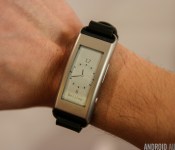
Lenovo was pretty busy this week, announcing two new phones (P90 and VIBE X2 Pro), and launching a selfie flash accessory along with arguably their most exciting product, the Vibe Band VB10. The VB10 is a fitness tracker/smartwatch hybrid that connects to any Bluetooth-enabled device running Android 4.4 KitKat and above. It’s lightweight, durable and is IPx7 approved, so you can get it wet without having to worry about it. It also notifies you of all phone notifications, as well as tracks your steps, sleep, distance traveled, and much more. The display is E Ink, similar to what we see on the Pebble. Thanks to this low-power technology, the battery will likely last up to 7 days on a single charge. The chassis is made of metal and the strap is rubber, offering a both premium and sporty feel to the device.
I think Pebble is a great example that E Ink just works on wearables. At least with the horrible battery life we see on Android Wear devices, E Ink is the way to go for the time being. Even though it’s not the most attractive watch out there, the VB10 is succeeding in all the right places.
Read more:
Garmin’s new sporty smartwatches

Garmin was one of the first companies to announce a product for CES this year with the unveiling of three new smartwatches. Well, these watches should be considered more fitness tracker than smartwatch. They tell the time and give you notifications on your Android device, but other than that, their main use is to track workouts, sleeping habits and much more. Garmin’s new Epix, Vivoactive and Fenix 3 smartwatches aren’t the cheapest wearables ever, but they boast some of the newest fitness tracking technology you can get on a smartwatch, and that has to be worth something.
The watches will be available sometime in Q1 2015 ranging from $250-$600.
Read more:
BBM coming to Android Wear

Last but not least, Blackberry Messenger is gaining Android Wear support. As much as you don’t want to admit it, BBM is one of the best, most fluid and feature-rich messaging platforms out there, and a ton of people use it. BBM on Android Wear works exactly how you think it would. You can reply and dismiss messages, and even send canned responses if you don’t want to respond via voice control.
This certainly isn’t groundbreaking technology, but it’s nice to see more services integrating with Android Wear.
Read more:
I think it’s safe to say that wearables played a huge role at CES this year. The advancements we’re seeing with car integration is particularly fascinating, and it just seems like something we would only see in the future. Five years ago, long before the smartwatch craze came about, if someone told me that I would be able to start, stop, lock, unlock and even track my car with my watch, I wouldn’t have believed a word of it. It’s finally happening, and I couldn’t be more excited. Now, this technology isn’t particularly innovative, especially since car companies have had the ability to do all of these actions from a smartphone, but I just can’t help but think I’m living in a future-esque world of technology.
As for smartwatches in general, we didn’t really see a whole lot. Garmin announced a few nice smartwatch/fitness tracker devices, but they’re very expensive and only directed toward a very niche market. The wearable I’m most excited for that was announced at CES was Lenovo’s VB10. I’m a firm believer that we need more wearables with E Ink displays, thanks to the awesome battery life they provide. The Pebble is a great example of how E Ink technology can succeed on a wearable. Especially with the 1-2 day battery life we’re seeing on Android Wear devices so far, this type of technology needs to be utilized more often in the wearable world.
Of course, we might end up seeing better battery life coming to wearables in the near future or at least by the end of 2015. Intel’s new Curie module has me very excited, providing support for Bluetooth Low Power while only being about the size of a small button. Smartwatches so far are pretty bulky, so anything to reduce the size of the devices is a great idea in my book.
Overall, I’m extremely excited for what’s to come in the wearable space. A ton of new technological advancements have come out of this year’s CES trade show, and I think wearable devices will progress at a very fast rate throughout this next year. What are your thoughts on wearable technology? Did you have a favorite or least favorite wearable announcement at CES 2015? Let us know your thoughts in the comment section!
 AIVAnet