



Samsung’s rumored round smartwatch will reportedly run Tizen

Round smartwatches are seemingly all the rage as of late. First, everyone drooled over Motorola’s Moto 360, followed by LG’s G Watch R. We even got a glimpse of an LG-made webOS smartwatch at CES this year. For quite some time, we’ve heard rumors of Samsung developing a round smartwatch, dating back almost a year ago. Now in a new report from SamMobile, a few more details are surfacing regarding the rounded wearable. According to the report, the device will be known as “SM-R720,” and is referred to by the codename “Orbis.” What’s more, the device will run Samsung’s own Tizen OS.
Up until now, the operating system running on the round watch has been a mystery. Samsung has put out both Android Wear and Tizen watches in the past, so this wearable could have gone either way. Now that the device will reportedly run Tizen, it makes sense from Samsung’s standpoint. Since rounded wearables are “in” right now, this is a great way for the company to get their own OS on as many wrists as they can.
There is one thing to note, though: the ring-operated rumors we’ve seen in the past aren’t exactly connected to the Orbis codename. We do know that there is an upcoming Tizen watch with the codename ‘Orbis’ and the model number SM-R720. It would make sense that a wearable with a name like ‘Orbis’ would be a rounded smartwatch with a ring-like design, but so far, the fact that the two rumors are connected is still just assumption.
The report also hints at a projected release for MWC this year, though it’s likely much too early to tell when we’ll actually see this watch. So, how do you feel about a Samsung-made ring-operated watch running Tizen? If rumors are true, is this something you’d be interested in?

Upcoming Plex Update to Add One-Click iTunes Library Import, New Music Features [Mac Blog]
Plex this week announced changes to its media software that will move the service beyond its video roots. Following updates that added online movie trailers and a recommendation engine, the next version of Plex will bring several new music features that Plex Chief Product Officer Scott Olechowski says will challenge iTunes in the music department.

As reported by Gigaom and PCMag, Plex users will be able to import their existing iTunes libraries, including playlists, ratings, and smart playlists, into the Plex app using a new one-click import feature. Plex is partnering with music database company Gracenote to add music file recognition and tagging to simplify the organization of this newly imported media.
One a user’s music is imported, the service will leverage Gracenote’s extensive database to provide Genius-like music recommendations based on a user’s personal music collection. Users also will be able to create station-based playlists from a song’s selected characteristics such as genre, tempo, or mood.
Plex also is working with Vevo to roll out a premium feature that will match music videos with the songs that are in a user’s music library. These Vevo videos will be available to watch without advertisements by Plex Pass subscribers. Plex hopes this new music video option will drive additional users to sign up for its subscription service, which generates about 80 percent of the company’s revenue.
The next version of Plex is expected to debut in the coming weeks. Beyond this version, other possible future music features may include music downloads and integration with a music subscription streaming service.

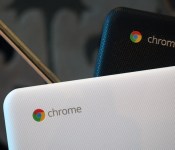
Acer has a 15-inch Chromebook, but it’s unclear why you’d want one

I initially wasn’t going to bother writing a longer piece about Acer’s new 15-inch Chromebook. I figured the last thing you wanted from me during the busiest week in tech news were hands-on photos of yet another laptop, especially when we already review so many same-y Chrome OS devices. Then it occurred to me: Although this is the first-ever 15-inch Chromebook, not to mention the largest, Acer never actually made a case for why it should exist, and it’s a question that many of my peers at other tech publications don’t seem to be asking. Does anyone need a notebook this big that basically just runs the Chrome browser? I belatedly spent some time with one to try and find out.

It might go without saying, but if you were to buy a 15-inch Chromebook, you’d do it for the screen real estate. Extra inches means you can read that much more email on one screen. It makes an even nicer canvas for streaming Netflix. If you spend a lot of time working in Google Docs — and many people do — it could be nice to not be limited to a smaller 11- or even 13-inch screen. Same argument behind having an external display, really. So far, so good: I get it.
Though the base model will be offered with 1,366 x 768 resolution, I strongly suggest you find the extra cash to get one of the higher-end versions with a 1080p display. During my hands-on testing, I could tell immediately I was looking at the full HD model; everything like app icons and text was sharper than it would have been otherwise, though not to the point where it was ludicrously tiny. All told, Acer will actually have two 1,920 x 1,080 versions, one with a regular ol’ TN screen and one with an IPS panel for wider viewing angles. Considering how many tradeoffs you might be making in terms of weight and overall heft (more on that in a second), you may as well go with the IPS and make the most out of that screen as you can. If not, what’s the point, really?

Speaking of the sort, this isn’t a heavy machine, all things considered; there are clunkier 15-inch laptops out there. Still, at 4.85 pounds, it’s impossible to ignore how much bigger and heavier it is compared to a smaller-screened Chromebook. If you were willing to put up with that weight, you could also get a Windows laptop that runs desktop programs, in addition to just the Chrome browser. All that said, the build quality is solid for a $250 machine, and the design is pleasing, if a little basic. The all-plastic laptop comes in both white and black, with a textured lid that both looks nice and probably does a good job of masking fingerprints. I’m not privy to Acer’s future plans, but they’d be smart to consider using a similar design on their low-end Windows laptops too.
As you take a tour of the machine, one of the first things you’ll notice are the two big speaker grilles, which sit on either side of the keyboard, kind of like a 2007-era MacBook Pro. I think in general it’s reasonable to expect more robust sound on a larger machine, but particularly when the speakers start eating into the keyboard space, they’d better be worth it, ya know? And eat into the keyboard deck they do. Despite the fact that this 15-inch Chromebook has a wider footprint than any of its competitors, it still suffers from some shrunken buttons, especially around the arrow keys. If I’m going to carry a larger machine, I expect the keys to be the cushiest, the most spacious, the most pleasant to type on. That doesn’t appear to be the case here, but I’m of course willing to revisit that in a full review.

The last unknown seems to be performance: I’m worried it won’t be enough for some people. And I’m talking from experience here. I remember years ago, when netbooks were a thing, and companies started introducing slightly larger models — ones that had 11- or 12-inch screens, as opposed to the usual 10.1. What ended up happening was, people saw these bigger machines, and expected bigger performance. While poky performance may have been acceptable on a 10-inch system, it was hard to believe a larger system, something closer in size to a “real” laptop, could be quite that slow.
I’m concerned the same is true of 15-inch Chromebooks. The model Acer is showing off today has Intel’s Broadwell-series processors, with your choice of Celeron or Core i3. I’ve yet to benchmark a Broadwell CPU, but so far, Celeron in Chromebooks has been… okay. Good enough for basic use, but not what I’d call powerful. Interestingly, Core i3 hasn’t fared much better, at least not on Chrome OS machines. What’s more the battery life might take a hit too. Speaking of which, Acer is rating this for up to eight hours of runtime — about what you can expect on Acer’s own 11-inch C720 Chromebook. If you thought you might get longer battery life in exchange for a heftier machine, you’re going to be disappointed.

All of this is to say: I think Acer has created some big expectations here. When you agree to buy a heavier machine, you expect stronger performance, better audio, a bigger battery and the comfiest of keyboards. After spending some time with the Chromebook 15 in person, I’m not sure these are promises Acer can keep.

Watch CES Today, find out about what’s happening at CES… today
#fivemin-widget-blogsmith-image-328766display:none; .cke_show_borders #fivemin-widget-blogsmith-image-328766, #postcontentcontainer #fivemin-widget-blogsmith-image-328766width:570px;display:block;
 trydocument.getElementById(“fivemin-widget-blogsmith-image-328766″).style.display=”none”;catch(e)
It’s another beautiful, sunny day in Las Vegas, and CES 2015 is still going strong. Can’t be bothered to read all of Engadget’s coverage of the show? We’ve got you covered with highlights, humor and some wisdom from Will.i.am. If you didn’t see us live, here’s your chance to catch up on what you missed.
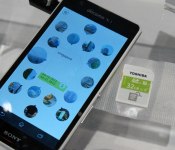
Toshiba’s TransferJet SD cards get NFC previews

Toshiba’s been hawking its Eye-Fi-troubling TransferJet technology for years now, letting you push data from your SD card to your PC without removing it from your camera. Now, however, the company has cooked up a way for users to see what’s on the card without even picking it up off the table. Simply pick up an Android smartphone, activate the company’s companion app, and the built-in NFC will show you up to 16 random thumbnails of the images included therein.
Of course, you’d only really need that sort of feature if you had thousands of SD cards that, for some reason, you hadn’t archived to your computer. That clearly hasn’t deterred the company in gearing this up for retail, and it’s expected to hit stores in the US at some point in February, with other territories given the option of joining in as they see fit. There’s no word on pricing yet, but the company expects it to cost a little more than your average SD card for obvious reasons.

Verizon will offer nearly 30 channels to its mobile subscribers this year

The CEO of Verizon Lowell McAdam has mentioned that the carrier will offer a special bundle of 30 television channels for its mobile subscribers sometime this year. He clarifies that this will be a mobile only service at first, with further expansion not discussed as of yet.
According to McAdam, customers’ hesitance to pay for hundreds of channels when they only need a bunch will work in Verizon’s favor. Given the licensing restrictions usually observed with such streaming services, Verizon is forced to make this a mobile only offering for the time being. The carrier is strictly targeting its 4G LTE customers who can watch all their favorite shows from practically anywhere, as long as they’re in the coverage area.
In preparation for the launch of this service, Verizon has already acquired Intel Media’s OnCue and EdgeCast from upLynk, although these acquisitions won’t mean anything unless Verizon gets broadcasters on board.
Would you be interested in a service like this? Let us know below.
Source: Multi Channel
Via: Android Authority
Come comment on this article: Verizon will offer nearly 30 channels to its mobile subscribers this year

Android Central 217: Live from CES 2015!

height=”480″ src=”http://www.youtube.com/embed/GLmivdqzRVY?wmode=opaque”
frameborder=”0″ allowfullscreen>
 We’re coming at you this like live from the Mobile Nations/GeekBeat/Purch stage in South Hall at the Las Vegas Convention Center. Which we mentioned because that’s why it’s crazy and loud and awesome and really just a heck of a lot of fun this week.
We wrap up the best of what we’ve seen here at CES 2015, brining along Phil, Alex, Andrew, Myriam Joire and Russell Holly.
For our complete CES coverage, hit up this monster live page!

Sprint gained almost 1 million customers in Q3 of 2014

In an preliminary customer report released earlier today, Sprint announced that the company gained roughly 967,000 new customers in Q3 of 2014. Specifically, those numbers break down to 30,000 postpaid additions, 410,000 prepaid and 527,000 wholesale net additions. Sprint also boasts that the postpaid growth in Q3 was driven by the highest number of postpaid growth additions in three years. Though the carrier was recently dubbed by some as “the lowest rated carrier of the year,” much of this business was likely driven by the success of Sprint’s Cut your bill in half deal. Sprint will release their official Q3 2014 results in February.
Sprint and T-Mobile have been neck-and-neck for quite some time now, trying to hold down the spot of the third largest carrier in the US. Though Sprint had a very good Q3 last year, T-Mobile more than doubled Sprint’s growth in Q4. If you can recall back to yesterday, T-Mobile just posted their preliminary results for the entire year of 2014. T-Mobile reported that they gained 2.1 million new customers in Q4 alone, putting them (temporarily) ahead of Sprint in total number of customers. This all might change when Sprint posts their Q4 earnings, so we’ll just have to wait and see who comes out on top.
All in all, though, Sprint has had a very successful third quarter, and things are looking very positive for the company for the year 2015.
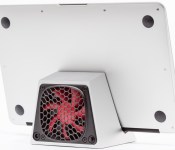
CES 2015: SVALT Launches Stylish Cooling Dock for Apple MacBooks [Mac Blog]
SVALT today announced the launch of a new cooling dock designed for Apple MacBooks and select PC laptops, which the company promises offers a 12x improvement in cooling, 129 percent improvement in CPU power, and 53 percent improvement in CPU Turbo Boost by eliminating CPU throttling due to heat issues.
Created from solid aluminum and designed to match up with the style of Apple’s MacBooks, the two-pound SVALT D is compact and holds a closed MacBook vertically in a dedicated ledge. A 12-volt fan sends air through the laptop’s closed screen to reduce system temperatures while allowing GPU resources to be used for an external display.

Transform your laptop with a level of performance and functionality previously limited to the highest-end desktop computers. Heat buildup in the laptop negatively impacts performance and long term durability. Anchored by the passive cooling capacity of a highly engineered 2 pounds of aluminum, SVALT D enhances cooling with a 12-volt 80x25mm fan to drive airflow through the laptop’s closed screen position air vent. Airflow is directed over the internal electronic components and bottom panel, feeding cool air into one or more of the laptop’s fans and driving waste exhaust air out vents, flushing out heat.
The company says that real world results using the SVALT D will depend on the laptop used, the workload, and ambient temperatures, but it detailed testing on a 2012 11-inch MacBook Air:
– Fan: Red 1600-1700RPM
– Environment: 21 Celsius +/-1 and 50dB +/-5 office standards
– Cooling: 13C increase without SVALTTM D verses 1C increase with SVALTTM D
– Power: 0.748W increase with SVALTTM D verses -2.616W reduction without SVALTTM D
– Turbo Boost: 1.000GHz increase and sustained max Turbo Boost with SVALTTM D verses a throttled 0.653GHz increase without SVALTTM D
– Noise observation: slightly louder than background noise at 2ft from front
 The dock ships with a power supply and it can be used with the fan on or off. There are two fan options — a higher-powered red fan that runs at 1700RPM/15 dBA and a quieter Yellow fan that runs at 1200RPM/12 dBA.
The SVALT D works with current-generation MacBook Air and Retina MacBook Pro computers, including 11, 13, and 15-inch models. The SVALT D is currently in production, and the company plans to begin taking orders in February. The dock will be priced between $130 and $150.
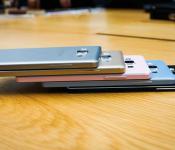
Samsung Galaxy A5 and Galaxy A3 launching in Europe

For those of us in Europe who are looking for a more premium looking Samsung device then you’ll be able to pick up the Galaxy A5 and Galaxy A3 soon.
Whilst Samsung haven’t actually confirmed the release of the devices, the European firmware for the two handsets managed to find its way online, clearly indicating their impending release.

The post Samsung Galaxy A5 and Galaxy A3 launching in Europe appeared first on AndroidGuys.
 AIVAnet