


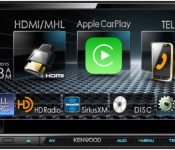
Kenwood DDX9902S multimedia receiver supports Android Auto

When it was announced at Google I/O 2014, Android Auto created opportunities for many companies. The aftermarket sector is really taking notice to the platform. The Parrot RNB 6 was already introduced at CES 2015 and now Kenwood is showcasing its own multimedia receiver. The DDX9902S supports both Google’s Android Auto and Apple’s CarPlay in addition to built-in services such as Pandora, iHeartRadio, and SiriusXM. The Android Auto support allows users to connect their devices with vehicles for a user interface that is useful and safe while in transit.
Hit the break for the full press release. Click here for our full CES 2015 coverage.
Kenwood Debuts Multimedia Receiver With Apple® CarPlay® and Android Auto™ in One
DDX9902S accommodates new smartphone-centric integrations for safer operation using touch and voice
LAS VEGAS – January 6, 2015 (SDG MEDIAWIRE) – At the 2015 International CES in Las Vegas, Kenwood will display the DDX9902S, the first receiver in its lineup that includes Apple® CarPlay, the smarter, safer way to use iPhone® in the vehicle. The multimedia receiver will also include Android Auto, which leverages features of an Android phone through a driver-friendly interface.
“We understand that consumers are loyal to the brand or platform of smartphone they use,” said Tony Mercado, marketing manager for Kenwood. “To that end, we wanted to create a multimedia receiver that doesn’t force the customer to choose based on his or her preferred smartphone. The DDX9902S allows customers to enjoy a safe, integrated experience with the phone they love.”
The DDX9902S features a high-sensitivity touch screen that allows the user to reliably make selections and interact with screen content. With CarPlay, familiar apps are within easy reach and display just the right amount of information. At the heart of the interaction is Siri, which enables users to control, read and reply to messages and more by simply speaking. Siri also provides access to music, podcasts and other third-party apps, and augments Apple Maps for full-featured, voice-controlled navigation.
With Android Auto, the menu bar makes it easy for drivers to select sources, including navigation, phone and music. Deep integration with Google Now shows informative cards to provide users with location- and preference-aware information at the right time, and robust voice recognition and playback deliver information safely to the driver.
Aside from the smartphone interfaces, the DDX9902S is a premium Kenwood multimedia center. Bluetooth integration enables safe phone calls and wireless music from a paired smartphone. An MHL-supported HDMI input connects to iPhone 5 and 6 models, as well as select Android-based smartphones, to charge the device, control compatible on-device apps and play its audio and video content on the receiver. Built-in control of Pandora® and iHeartRadio™ expand music choices when using a smartphone’s broadband connection, and HD Radio™ doubles or triples local programming options in CD quality.
The DDX-9902S is also SiriusXM-Ready™ and connects to the latest SiriusXMSXV300 Connect Vehicle Tuner (sold separately, subscription required), to access commercial-free music, plus premier sports talk and live events, comedy, news, exclusive talk and entertainment, and the most comprehensive Latin music, sports and talk programming in radio delivered via satellite.
Additional safety and convenience options include the ability to add a rear-view camera and maneuver safely with on-screen parking guide lines, and compatibility with factory steering wheel audio controls.
The MSRP and ship date of the DDX9902S will be announced soon. It can be seen at the Kenwood booth—No. 1702 in the North Hall of the Las Vegas Convention Center—during CES.
Sirius, XM, SiriusXM and all related marks and logos are trademarks of Sirius XM Radio Inc. and its subsidiaries.
About JVCKENWOOD USA Corporation
JVCKENWOOD USA Corporation is a wholly-owned subsidiary of JVCKENWOOD Corporation and is a leading developer of imaging, home and car entertainment, and navigation products for the consumer market, two-way radio communications systems for public safety, private industry and amateur users, and video equipment for the broadcast and professional markets. For detailed information, call JVCKENWOOD USA at 1-800-950-5005 or visit us at http://us.jvckenwood.com, www.kenwood.com/usa and www.jvc.com.
Come comment on this article: Kenwood DDX9902S multimedia receiver supports Android Auto

HTC posts bigger revenue growth for Q4 2014

With large help from their impressive group of mid-ranged devices, HTC is seeing its largest revenue growth in three years, according to Bloomberg. Sales have climbed to NT$47.9 billion ($1.5 billion US dollars) for the fourth quarter last year, NT$5 billion more than last year.
HTC’s Nexus 9, which is its premier tablet marking its devotion to the tablet industry in the future, One M8 and quality mid-range devices have differentiated itself from the strong competition from Apple, Samsung and the rising Xiaomi dominance in China.
The company posted an operating profit of NT$180 million for the quarter, much better than predictions of a NT$30.4 million loss. While quarterly sales have rose, the annual revenue is still short of what is was four years ago.
A few days ago, HTC executive Jeff Gordon promised “huge surprises” are coming in 2015 that will “blow you away”.
Typical corporate investing hype? Or does HTC have something very special planned for us this year. Time will tell as the company is expected to unveil its One M9 flagship phone, as well as a certain type of wearable later this year.

The post HTC posts bigger revenue growth for Q4 2014 appeared first on AndroidGuys.

Color-changing E Ink lets walls come alive

Do you think that the walls at your school or office just aren’t sprightly enough? E Ink may have a way to liven things up. Its new Prism material lets buildings subtly change colors and patterns on the spot, without having to rely on banks of expensive digital displays that stick out like a sore thumb. It’s more than just animated wallpaper, though. It can respond to input, such as a person walking by, and even works for furniture — imagine a bench that changes its look every day. Prism sips only a tiny amount of power, too, so you don’t need to keep things plugged in.
The main catch, at least right now, is that you can’t buy Prism yourself. E Ink mostly intends Prism for building owners that can afford to buy big, made-to-order installations for stores and lobbies. With that said, it’s easy to see the technology showing up in decorations and other parts of your home where it wouldn’t hurt to spruce things up. Don’t be surprised if you can one day change the art on your living room wall at a moment’s notice.
http://www.engadget.com/embed-5min/?sid=577&playList=518586059&responsive=false
Filed under: Displays, Household
Source: E Ink
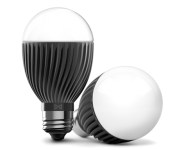
CES 2015: Misfit Introduces Connected, Color-Changing ‘Bolt’ Light Bulb [iOS Blog]
As a followup to its Swarovski Shine fitness tracker, Misfit today announced its new Bolt wirelessly-connected light bulb. Similar to Philips Hue, the $50 Bolt light bulb allows users adjust the light intensity and color of the bulb using an iOS device.

The Bolt light bulb is powered by CREE LED technology, providing the equivalent of a standard 60-watt light bulb. It connects directly to a smartphone via the Misfit and Misfit Home app or even a Misfit Flash activity tracker without the need for a hub or additional configuration. It also integrates with the Shine fitness wearable and Beddit sleep tracker to provide a simulated sunrise automatically during the morning wake-up hours.
The Bolt connected light bulb is available for pre-order from Misfit’s website, with pricing set at $50 for a single bulb or $130 for a three-pack. Shipping is expected in mid-February.

MediaTek processor at heart of world’s first Ultra HD Android TV
 MediaTek has been working with Google to port Android TV onto its MT5595 processor. The result is Sony’s latest generation of Bravia TVs, the world’s first Ultra HD TV platform running Android TV.
MediaTek’s MT5595 is a quad-core big.LITTLE SoC which includes two ARM Cortex-A17 cores and two ARM Cortex-A7 cores. The SoC also supports Google’s VP9 codec and the HEVC (H.265) codec, both of which are designed for 4K2K content streaming at 60 frames per second.
Consumers can watch movies from Google Play or cast their favorite entertainment from a mobile device to the Sony Ultra HD TV. The MT5595 also supports up to 4K2K streaming content.
We are very proud to stand alongside Sony in introducing the new Android TV device. The experience of Sony’s Android TV will set the standard for future smart televisions. This is a momentous occasion for MediaTek to be changing the way people watch TV with our strong partner, Sony.
Ching-Jiang Hsieh, President of MediaTek.
The MT5595 is a TV SoC and not only does it support 4K HEVC/VP9 at 60 frames per second, it also supports 4 x 2K HEVC/H.264 60 fps simultaneous decoding, as well as MediaTek’s ClearMotion technology for up-conversion of low-frame-rate videos. In terms of broadcasting it supports a large range of worldwide broadcasting standards including ATSC/DTMB/DVB/ISDB and HbbTV broadband.
Consumers can expect MediaTek-powered Sony Android TV devices to be commercially available by March 2015.

Samsung says all its products will be IoT enabled within 5 years

B. K. Yoon, Samsung’s co-CEO took to the stage at CES 2015 on Monday to declare that all Samsung’s products will be Internet-of-Things (IoT) enabled within five years. Five years in technology is a long time, just look back to 2009/2010 and see what smartphones existed then, or take a look at Android 1.5 Cupcake. So in one sense Yoon’s vision isn’t impossible. However what is more interesting is that he said that 90% of Samsung products would be able to connect to the web by 2017. Now that is only 2 or 3 years away (depending if he meant by the end of, or the beginning of 2017). That is a bigger challenge.
Samsung makes a huge range of products. OK, its smartphones are already connected devices, as are its Smart TVs. But what about its washing machines, air conditioning units, and microwave ovens? Yoon said in his speech, “five years from now, every single piece of Samsung hardware will be an IoT device, whether it is an air purifier or an oven.”

This means that Samsung is serious about IoT. However before we look how Samsung plans to promote this technology, we need to ask two questions. First, what is the benefit of an IoT enabled microwave oven? Second, will Samsung make a mess of this?
In answer to the first question, I am a bit of a pessimist (or maybe realist). Although I can see the advantages of Smart Homes and Home Automation, and I understand the benefits of monitoring our household appliances in terms of energy consumption, I must say I can’t really see the benefit of an IoT enabled microwave oven or of a web connected vacuum cleaner. In our family we use our microwave oven scarcely, and other than how much electricity it has consumed, I can’t really see any benefit in being able to interrogate it about how many minutes it has been active this month, how many times the door has been opened, or how often we used the defrost setting. Seriously, I can’t.

Which leads me to my second question, if Samsung has committed to making all of its products IoT enabled within five years that means it will add IoT just for the sake of adding it, rather than because an appliance needs it. This could mean that we end up with devices that are IoT enabled but yet pump out worthless information. Also, the cost of such products will be higher as they are now more complex, and they pose a security risk.
There is also the question of how an Internet enabled fridge is going to help a family living below the poverty line in a war zone. If Samsung can’t make the cheapest possible fridge then it is performing a disservice to those people. Adding IoT tech will increase the cost of that fridge. We can only hope that the IoT chips and circuits needed to web enabled these fridges will only cost pennies within 5 years from now.
Open Standards
Our IoT components and devices will be open. We will ensure that others can easily connect to our devices.
But leaving behind the questions of why? and should we? Samsung is right about one thing, in this new IoT utopia, for everything to work there needs to be high levels of interoperability. All these different sensors, devices, IoT hubs, and IoT gateways need to be able to work together. “We have to create an open IoT ecosystem,” said Yoon. “The IoT experience needs to be seamless.” To that end Yoon promised that all of Samsung’s products would be built on open platforms. “Our IoT components and devices will be open. We will ensure that others can easily connect to our devices,” Yoon said during his keynote. “Without this kind of openness, there won’t be an Internet-of-Things.”
And Samsung is in a good position to drive these open platforms and to use them on their products. Last year Samsung sold over 665,000,000 devices, that is over 20 devices per second.
If IoT features become a selling point for more than just mobile devices than it is guaranteed that other large consumer electronic manufacturers like Sony, Phillips, and LG will follow. However an IoT standards war is probably on the horizon. This is because to make something “open” just means you need to publish it, and maybe throw in a little source code. However that doesn’t mean that every appliance will speak the same lingo. In the bizarre world of technology you can have several open platform standards that aren’t compatible, but yet everyone can claim to be open. Let’s hope that doesn’t happen.
What do you think? Do you like Samsung’s vision? Are you looking forward to IoT enabled products?

iHeartRadio announces partnership with QNX and more at CES 2015


Streaming music service iHeartRadio has announced a number of new partnerships at CES 2015. The company is teaming up with seven different brands to integrate their service into new devices, including those made by Google, Sony, TiVo, and more. iHeartRadio will be one of the first apps ready for Google’s new Cast for audio system, and the service will also find its way to in-dashboard multimedia and navigation systems by Clarion and BlackBerry’s QNX.

EA releases first Need for Speed: No Limits trailer

EA has just published the first teaser for its latest racing game, Need for Speed: No Limits, on its official YouTube channel. The short video shows some pretty amazing graphics, whilst street racing and customizing rides. The footage also highlights some of the work the developers have put into the games visuals and to be completely honest; it looks awesome.
If you’re into racing games, Need for Speed: No Limits is definitely worth your attention.
Hit the break below to view the trailer.
Click here to view the embedded video.
Come comment on this article: EA releases first Need for Speed: No Limits trailer

Lenovo announces their new, e-ink smartwatch
Lenovo is jumping into the wearable market, anyone surprised? Their new smartwatch is called the Lenovo VIBE Band VB10. Lenovo’s take on the smartwatch is really more of a fitness band with some smartwatch features included. It uses an e-ink screen to prolong battery life up to 7 days. The smartwatch/fitness band consists of a… Read more »
The post Lenovo announces their new, e-ink smartwatch appeared first on SmarterWatching.
Read the rest at SmarterWatching.com!
The post Lenovo announces their new, e-ink smartwatch appeared first on AndroidGuys.

Sleep Number’s new smart bed is for kids, can adjust as they grow

Sleep Number brought the world the smart bed at CES 2014. And now, for kids! The SleepIQ Kids bed, however, isn’t simply a smaller iteration in primary colors. While it offers the same sleep monitor nous of the SleepIQ bed for grown-ups, there’s also some simple features for parents to help gauge their kids’ sleep, can be adjusted for firmness, as well as things like a monster detector. (Aww.)
The bed connects to Sleep Number’s sleep “dashboard”, which constantly monitors use. While this would include hours slept, it can also alert parents when a kid in out of bed or there’s a lot of movement going on. As kids grow, the SleepIQ Kids bed can have its firmness adjusted, while like its predecessors, the bed can arch upwards for big picture books and bedtime stories. Parents can also turn of lights around the bed remotely, with under-bed lights also activating when a kid gets up. The future of beds doesn’t come cheap: The SleepIQ Kids Bed will launch this year, with prices starting at $1,000 at Sleep Number’s own site and its own stores.
 AIVAnet