


Xiaomi reveals Redmi 2: 64-bit, LTE, colorful designs for $110

A resurgence in colorful creativity is taking over the tech world. Just a short while ago we were bemused with the inspired Meizu M1 Note, and now Xiaomi has a new phone to be released in China, the Redmi 2, that comes in an assortment of pastel-tinted plastic parts. It is the follow-up to last year’s Redmi 1S.
The Xiaomi Redmi 2 has decent specs with a quad-core Snapdragon 410 (64-bit) 1.2GHz CPU, a 4.7 inch IPS display (1280X720), Dual-SIM LTE (TDD/FDD) support, 1GB of RAM and 8GB of on-board storage (expandable up to 32GB), Adreno 306GPU, a 2200 mAh battery (made by Samsung of all companies), and 8 megapixel rear and 2 megapixel front cameras. The LTE device is just 9.4 mm thin and weighs 133 grams. The product is listed as having MIUI 6 and 5 colors for the back cover, although it is not clear if the back cover itself is removable. The product will retail for a stunning 699RMB, which Xiaomi has converted to approximately $112, making this one of the best value-for-money mid range phones to be had.

While the phone is currently only slated to hit China on January 9, those interested will inevitably be able to find an importer selling it sooner or later. Users in India, Philippines, and other markets where Xiaomi is currently active will need to wait a bit longer for a release date.
It’s worth mentioning that this is not the “flagship device” that Xiaomi promised for this month. Rumors point to the Xiaomi Mi 5, but there’s nothing solid to report for now.

Hearthstone: Ten tips, hints, and tricks to building a killer deck

Blizzard‘s Hearthstone has quietly — or perhaps not so quietly — taken the gaming world by storm. The free-to-play title combines everything great about skill-based card games with gameplay as addicting as the company’s MMOs, and it’s been a blast to get acquainted with.
Like many of Blizzard’s other titles, to excel at Hearthstone you need good gear (in this case, cards), smart strategy, and some time on your hands to put it all together. Here are some of my favorite tips, tricks, and strategic suggestions to get you on track to battling like a pro.
1. Trust in the Mage

The Mage is the default starter class in Hearthstone for a reason: The deck’s core cards are pretty well-rounded and the class’s play mechanics are easy to get the hang of. If you’ve played a Blizzard game previously, you may be tempted to switch away from the mage as soon as you unlock your desired class, but wait. It’ll be easier to go through the first set of Normal practice challenges if you focus on one class and one deck throughout.
On that note, it’s easier when you’re first starting out to do your practice challenges in order, from top to bottom — you can theoretically unlock a Paladin, Rogue, or Warlock immediately after unlocking the Mage, but it’ll be a very tough match for you, and without the Mage’s full card deck you’ll be likely to fall.
2. Build towards a deck and class you want

After the Mage has served its purpose and helped you unlock your hero classes, it’s time to decide what class(es) you’d like to play from here on out.
Hearthstone lets you play multiple heroes and multiple decks, so you can in theory have any number of hero classes at your beck and call; unfortunately, that kind of power requires gold. Lots of gold. Or lots of real money.
Instead, I recommend choosing a single class to begin building toward, and looking online for ideas on class decks — lots of Hearthstone members are willing to share info on Battle.net and elsewhere. Stay away from decks with too many legendary cards in them — as you might have guessed from the name, legendary cards are extremely hard to find, get, or manufacture, and as such, trying to intentionally build a deck with a legendary card in it isn’t the best of ideas. Focus on finding a good mid-level deck for the class you’d like to play; worry about getting or crafting legendaries down the line. If you’re not quite sure what cards you want to play for your class, you can also experiment by building multiple decks for just that hero, varying which cards you put into it.
If you’re at a blank on which class to play, I recommend either sticking with the Mage or playing a Hunter, which offers one of the best hero powers in the game along with lots of fun beasts under its command.
When you’re starting off, it’s best to stay away from the Priest: the class has a bunch of excellent cards, but they’re all fairly rare and difficult to manufacture or find; you may have a bit of trouble off the bat consistently winning matches if you insist on a playing priest.
3. Hearthstone is free to play (but buying things will help you)

I have yet to buy a pack or Arena run with real money — I prefer to grind for in-game gold the long way around — but I have several Hearthstone-addicted friends who’ve paid $20 or $50 upfront to purchase a bunch of card packs to aid them in the building of their deck.
“I’d spend $50 on an Xbox game,” one of my friends explained, “so it felt like a good investment to do the same for Hearthstone.” They have yet to pay for anything else in game, but used those initial extra cards to help create a Legendary-card-stuffed deck that took them to 500 wins and an elusive Golden character.
Whether you prefer free-to-play or the occasional in-app-purchase card buy, when getting card packs you should consider picking from Hearthstone’s “Goblins vs Gnomes” expansion pack rather than the Classic deck. At the Legendary tier, the Goblins cards and the Classic cards are about on par, but the Goblins deck has a much deeper and more fun roster of lower-rarity cards; as a newer player, this can be a huge boon to you.
4. Use crafting to beef up your deck

Can’t seem to find that perfect card for your deck, no matter how many packs you open? You can use Hearthstone’s crafting center to get rid of (or “dust”) cards you don’t want in favor of those you do. You’ll even have the chance to craft legendary cards for your character inside Crafting Mode.
To make new cards, visit the My Collection section of the game, then tap Crafting Mode. Your normal card book expands to show all the cards for each character, greyed out if you don’t have them. If you tap on a card, it displays how much dust you’d get if you owned it and disenchanted in green, as well as how much dust you’d need to create the card (in red).

If you’re starting out and building a deck for a specific character, you can get good cards for that character much faster by disenchanting anything that’s specific to another character (Druid or Hunter cards if you’re building a Mage, for instance.)
If you want to play those characters in the future, you may be putting yourself at a slight disadvantage by doing this — cards cost more dust to craft than you’ll get from disenchanting them — but it’s generally worth doing for the deck at hand.
5. Spend your gold at the arena over buying packs

Once you’ve unlocked every hero character by defeating them, you’ll have access to the Arena, Hearthstone’s central strategy playground. The Arena costs 150GP (or $2 in real money) to enter; once you enter, you’re guaranteed to walk away with a pack of cards and generally a bit more. As such, it makes a lot more sense to spend your gold to play the Arena to earn cards and dust over buying 100GP flat packs from the Shop.
On top of that, the Arena is just plain fun: You get to draft one of three random characters, then attempt to build a deck with randomly offered cards from the entire Hearthstone cardbase. If your actual deck doesn’t have the greatest cards, that doesn’t matter here: strategy and effective deck-building is the name of the game.

You get to play until you’ve won 12 times or lost three times, which potentially means lots of enjoyable matches from other players. You get a pack of cards whatever the outcome of your arena matchups, but once you win more than 3 times, you get extras, including gold, dust, and random prizes.
If you’re struggling to get enough gold to enter the arena, you can earns some a few different ways: by completing quests, winning three games in casual or ranked play, or hitting certain achievements in-game. There are new quests available to you every day, so make sure you’re working toward those for some easy gold.

If you’re not earning gold fast enough, you can contribute some real money to playing the Arena, but that’s up to you.
6. Play Casual over Ranked mode when you’re starting out

When you’re building your deck, playing casual mode deliberately matches you up with people around your skill level; the more you win or lose, the better Hearthstone knows who to match you up with in games.
Ranked mode, in contrast, matches you up with people of your rank — and just because a player has a low rank, it doesn’t necessarily mean they have bad cards or don’t know how to play. As such, players just starting out with weaker cards may not win a lot of ranked games, and losing won’t help you earn gold to improve your deck.
Instead, play casual mode, rack up some wins, improve your deck and strategies, and once you’re feeling comfortable with the game, try a ranked match or two.
7. Build a deck that scales well

There are few things worse in Hearthstone than starting up a game only to realize that you can’t play any cards in your hand until your fourth or fifth turn.
Avoid this and build a deck that scales properly along the mana curve: Have several good low-cost cards in your deck ratio so that you’re not caught without anything to play.
8. Get your creatures out

If your deck can hit your opponent with some early damage, you can often stay on top of the match until their defeat. To do this most effectively, you’ll want to get creatures out that give you the most value for their play.
I suggest prioritizing creatures that have Taunt, a special effect (if this creature is on the board, it randomly Freezes someone, for instance), or a bonus when you play another creature.
A great example of this tactic is a deck built around Deathrattle and a card called The Undertaker. The card itself only costs one mana to play and has a tiny 1-damage, 2-health ratio, but every time you add another creature with the keyword Deathrattle, the Undertaker gets +1 to both its stats. Pretty soon, your 1/2 creature can end up with a 4/5 buff, making it harder to kill and scarier to have on the board.
9. Don’t end your turn until all your effects have finished

Lots of cards have effects that let you draw extra cards, or play cards for free — don’t accidentally end your turn before you’ve made sure there’s nothing else you can do!
My personal biggest mistake starting out was forgetting about my hero power — I’d end turns with one or two mana left, forgetting that I could use my Mage hero power to zap my opponent or an opponent’s card for a little extra damage.
10. Watch Twitch.tv streams and read the Hearthstone Subreddit — and don’t get frustrated!

When in doubt, there are lots of resources if you want to get better or need some advice. Twitch.tv broadcasts are a great way to pick up tips and tricks from some of the better Hearthstone players out there, while the Hearthstone Subreddit has deck guides, Q&A areas, suggestions for the Arena, and more.
It can be frustrating if you’re not winning a lot to start off with, but don’t give up: hopefully these tips and tricks (and suggested sites) can help you enjoy many a day of Hearthstone going forward.

Xiaomi unveils the affordable Redmi 2, launching in China on January 9

Xiaomi today announced the Redmi 2, a successor to the Redmi 1S. The smartphone features mid-range specifications and dual-SIM 4G LTE, but it’s the pricing that will really attract consumers to the Chinese brand. The Redmi 2 is set to go on sale on January 9th for 699 CNY ($110).

Intel invests in smart-glasses maker Vuzix, now owns 30% of company

On January 2nd, 2015, Intel and smart-glasses maker, Vuzix, announced that Intel had purchased 4,962,600 shares of Vuzix’ common stock. This gives Intel 30% control in the company and allows the placement of two board members to the current five. This development is interesting because earlier in December, Talk Android reported that Intel would be the chip supplier to Google’s next iteration of Google Glass.
Many market analysts made note that Intel was behind the curve in developing technology for mobile platforms, so these two announcements were perhaps related to that analysis.
Vuzix’s M100 smart-glasses did very well for themselves at CES 2013. The M100 was awarded “Best of Innovations” in the category of Design and Engineering, and were also selected as “Best Technology” in the category of Wireless Handset Accessory.

The M100′s specifications are a little dated. It’s helmed by Android Ice Cream Sandwich with an OMAP 4460, 1.2GHz chip. Memory-wise, it has 1GB of RAM and comes with 8GB of flash memory, with the ability to upgrade to 32GB via MicroSD.
Talk Android’s Jack Holt reported last year that Vuzix had entered into an agreement with an undisclosed tech giant to help make the M100 as stylish as designer glasses. Vuzix has since announced various partnerships with companies like Lenovo and Fossil, but still hasn’t mentioned if it was one of these that was the unnamed company. So with the addition of companies like Fossil, I expect that Vuzix will probably show off a new iteration of their smart-glasses at CES 2015 featuring a refreshed design.
Intel has also been busy as of late with its RealSense technology. Recently, it released a series of advertisements featuring CBS’ Big Bang Theory star Jim Parsons showcasing the gesture-control technology.
Click here to view the embedded video.
Could we see a future combination between these gesture controls and Vuzix’s M100 smart-glasses? Between commercial uses and the rise of virtual reality, it’s not out of the realm of possibility that such a combination could bring about a totally new way in in which we interact with smart devices. My 2 pennies: Intel is starting to show what cards it has in its hand and the pay-off could be huge.
Source: Vuzix via PR Newswire
Come comment on this article: Intel invests in smart-glasses maker Vuzix, now owns 30% of company

LaCie Unveils Designer Mirror Hard Drive, New Rugged RAID Thunderbolt Drive [Mac Blog]
LaCie today unveiled two new products ahead of this week’s Consumer Electronics Show, including the new LaCie Mirror, a hard drive encased entirely in Gorilla Glass, and the LaCie Rugged RAID Thunderbolt hard drive, the newest product in its Rugged collection.
The LaCie Mirror is a 1TB hard drive that’s designed to be fashionable as well as functional. Created by product designer Pauline Deltour, the LaCie Mirror features a mirrored design that comes with an accompanying ebony stand.

“You have to look twice to discover the LaCie Mirror’s true ambition,” said Deltour. “Covered by mirrored glass, it’s first an elegant and functional object, and only on second glance is it revealed to be a slim high-performance hard drive.”
Through a collaboration with Corning, the LaCie Mirror is encased entirely in Gorilla Glass 3, making it ultra durable and resistant to chips and scratches. The 1TB LaCie Mirror will be available in late January for $279.99 from the LaCie website.
LaCie’s second new product is the 4TB Rugged RAID Thunderbolt hard drive, which LaCie is calling the fastest HD available on the market with upload speeds that reach 240MB/s. Like all of LaCie’s Rugged lineup, the new bus-powered Thunderbolt drive includes an aluminum shell that’s encased in orange rubber for maximum protection and portability when used in the field. At 4TB, it includes two 2TB hard drives with RAID 0/1 options to optimize for speed or data security.

Aimed at audio/photo/video professionals and those who often travel, the Rugged RAID is the first mobile RAID hard drive with Thunderbolt and with resistance to shock, dust, and water thanks to its rubber casing. LaCie’s Rugged RAID 4TB Thunderbolt hard drive will be shipping during the first quarter of 2015 for $449.
LaCie’s parent company Seagate is also introducing several new products, including the Seagate Seven, the Seagate Personal Cloud, and the Seagate Wireless hard drive for iOS devices.

Seagate Debuts iOS-Compatible Storage Option, Personal Cloud and Ultra-Thin Portable Hard Drive
At the annual Consumer Electronics Show in Las Vegas, tech companies often take the opportunity to unveil new products. Well-known data storage company Seagate is no exception, and is introducing three impressive new products at the show.
The new 500GB Seagate Wireless portable hard drive is the company’s latest HD designed specifically for use with tablets and smartphones like Apple’s iPad and iPhone, introducing additional storage at affordable price. Available in five bright colors (lime green, cool blue, slate gray, fire-engine red, and white), the hard drive offers a nine hour battery life and the ability to store media like photos and videos, which can be streamed directly to an iOS device through the Seagate Media app.

It includes a new auto backup feature for making a secondary copy of photos and videos, and it can be used for storing documents and other file types. Because it has built-in Wi-Fi, the Seagate Wireless does not need an existing network connection. The Seagate Wireless will be available in January for $129.99 from the Seagate website and through retailers like Amazon and Best Buy.
Seagate’s second product, the Seagate Personal Cloud, is designed to offer an alternative to traditional server side cloud-based storage. The Personal Cloud allows users to backup their computers (with the Seagate Mobile Backup app) and store content securely on a dedicated hard drive that’s located within the home rather than on a server.
Content can be accessed outside of the home much like any other cloud-based storage option through the Seagate Media app, and as a home media storage option, it can stream video and play full HD content with no buffering or lag.

Seagate Personal Cloud demystifies the often frustrating process of finding, accessing and enjoying photos, videos and music on the device of your choice. Once connected to a wireless router and after a free download of the Seagate Media app, users will be treated to an intuitive, media-rich browsing experience that makes playback of content an effortless and enjoyable experience.
The Seagate Personal Cloud can be used with any device that’s supported by Seagate Media apps, including Smart TVs from Samsung and LG, many consoles, streaming media players like the Chromecast and Apple TV, and smartphones and tablets like Apple’s iPad and iPhone.
The Seagate Personal Cloud can also be set up with a secondary backup to other popular cloud services, like Amazon S3, Dropbox, Google Drive, and more for additional offsite protection. There’s also a Seagate Personal Cloud 2-Bay option available with two internal drives for duplicate storage.
Seagate’s Personal Cloud will begin shipping to retailers in January, in 3TB, 4TB, and 5TB capacities with pricing starting at $169. The Personal Cloud 2-Bay will be available in 4TB, 6TB, and 8TB capacities as well.
Seagate’s most notable product this year is the Seagate Seven, which the company is calling the world’s thinnest 500GB portable hard drive. At just 7mm thick, it uses Seagate’s latest mobile hard drive technology and is aimed at tech enthusiasts who want the thinnest devices. With a brushed aluminum finish, the hard drive is ultra portable and is, according to Seagate, the culmination of 35 years of experience.

The Seagate Seven will be available at the end of January for $99.99 from the Seagate website and from retailers like Amazon.
Seagate is also debuting several new LaCie products, including the designer LaCie Mirror hard drive and the LaCie Rugged RAID thunderbolt hard drive.
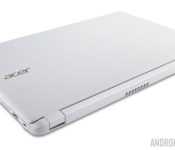
Acer unveils 1080p Chromebook 15 ahead of CES

Acer has been doing very well for themselves with their line of Chrome OS powered Chromebook devices, and they are continuing to expand their offerings with their new Chromebook 15.
The Acer Chromebook 15, as the name implies, is a 15-inch class laptop with a 15.6-inch display, making it the first Chromebook of this size to hit the market.
Chromebooks have been doing very well in the market, with most sales going to education centers. However, the web-centric computing needs of the average consumer make the Chrome browser focused Chrome OS offerings very appealing, especially when you can put a solid unit in hand for under $200.

Acer’s new Chromebook 15 is a bit of a step up for those accustomed to seeing 11 inch devices. Not that there are not larger Chromebooks out there, in-fact, this very article is being written on a 14-inch Chromebook, built by HP. Where the new Acer Chromebook 15 truly differs is in the use of an Intel Core i3 processor.
Getting down to it then, there will be multiple variants of the Acer Chromebook 15. A base model will start around $250, offering a 1366 x 768 resolution display, an Intel Celeron processor, 2GB of RAM and a 16GB SSD for storage. Prices are not given for the high end of things, but a fully decked out Chromebook 15 will score you full 1080p resolution, that Intel Core i3 processor, 4GB of RAM and a 32GB SSD for storage.

All options come with the standard set of USB 2.0 and 3.0 ports, HDMI port, SD card reader and a battery that Acer says provides “impressive” performance, whatever that is supposed to mean.
If this size of display is more than you are looking for, be sure to also check out the Tegra K1 powered 13-inch Acer offering, aptly named the Chromebook 13. Hidden in this press release, Acer says that touchscreen versions of the 13-inch Chromebook are coming soon as well.
What do you think, is a 15.6-inch Chromebook the right way to go, or does this blur the lines with normal laptops more than it should?

BlackBerry Classic now available at Selfridges

If you live in the UK and want to order yourself a BlackBerry Classic, you have a few options already such as Vodafone Business, O2, ShopBlackBerry and Clove but aside from ShopBlackBerry, few of those have actually started shipping as of yet, with most reporting mid-January delivery.

Seagate outs a fleet of cloud, wireless and super-thin hard drives

If getting your digital life better organized is tops on your list of New Year’s resolutions, Seagate has a trio of options that cover all the bases. First, the company is offering its ultra-thin 7mm drive in portable form with the appropriately named Seagate Seven. As you might expect, the company boasts that this is “the world’s slimmest” device for on-the-go storage, wielding 500GB of space and connecting to your gadgets via USB 3.0 inside a steel enclosure. The Seven certainly won’t take up much space in your pocket or backpack, and it’s set to arrive later this month for $100.

Prefer a wireless option for wrangling files? No worries: There’s something for you, too. Seagate Wireless is another 500GB portable drive, but as the moniker indicates, this one cuts the tether to play nice with mobile devices. Aiming to cure the limited-space woes on phones and tablets, this multihued model creates its own network, so there’s no need to worry about finding WiFi along the highway. Files are managed via Seagate’s Media app for iOS, Android, Kindle and Windows 8, and what’s more, stored media can be beamed to a big screen with Airplay, Chromecast or with the company’s app for smart TVs and Roku players. Expect five color schemes when the $130 Wireless hits shelves in February.

What’s that? You need a more comprehensive storage solution for all of the family’s digital clutter? Seagate is ready to sort that too, and its Personal Cloud setup makes sure that stuff is accessible both at home and on the go. Keeping downloaded media in one place to watch on tablets, TVs and media streamers? Check. Serving as a central backup for laptops and other essential gadgets? It does that as well. Heck, it can even stream your content to DLNA-based wares like a PlayStation or Xbox console. Personal Cloud also handles backups of Dropbox, Google Drive, Amazon and other cloud repositories, and there’s a two-bay model that’s configured to copy all data to the second drive for folks looking to be extra careful. And yes, you can turn it into one big storage space if you prefer. There’s no word on pricing just yet, but Seagate Personal Cloud will wrangle 3TB, 4TB and 5TB capacities while the two-bay version will handle 4TB, 6TB and 8TB, with both scheduled to ship before the month’s end.
Filed under: Misc, Peripherals, Storage

Xiaomi announces Redmi 2S, launches in China

Xiaomi is keeping its momentum going as it just launched the Redmi 2S in China earlier today. The device is a budget-class smartphone and will cost a mere $113. The Redmi 2S is the successor to the Redmi 1S (also sometimes called the Hongmi 1S), which was launched in May 2014.
The specs for the Redmi 2S aren’t anything spectacular, but it also won’t break your wallet. The display is 4.7-inches with 720p IPS. The cameras are 8MP and 2MP, back and front respectively. The main feature of this phone is the addition of a 4G LTE antenna, which supports GSM, WCDMA, TD LTE and LTE FDD networks.
So, what’s under the hood in terms of processors? Keep reading after the break.
The processor that is shipping with this phone is the 64-bit Snapdragon 410. It’ll be running with 1GB of RAM and have 8GB of storage capacity, all powered by a 2200mAh battery.
The Redmi 2S is shipping with Android KitKat 4.4, and not Lollipop. The reason I bring this up is that, along with the 1GB of RAM, the inclusion of a 64-bit processor is fluff.
Firstly, the Play Store still mainly features apps that are created for 32-bit processors. Unless those apps were created in Java, it’s still going to take some time to make the shift to 64-bit. Secondly, Android 5.0 really sets the stage for 64-bit processing and without it an average user may never really notice any speed differences between 32-bit and 64-bit. Finally, it is only coming with 1GB of RAM. There are many perks to 64-bit processors outside of that >4GB of RAM argument, but the Redmi 2S doesn’t appear to be taking advantage of anything with the addition of a 64-bit CPU.
In closing, I would not recommend this device unless you just have to have 4G LTE because you’re not around WiFi often enough, or you just have an extra $100 laying around burning a hole through your wallet. Alternatively, if your smartphone just broke and all you have is a $100 for a new device, you could consider the Redmi 2S.
Source: GizmoChina
Come comment on this article: Xiaomi announces Redmi 2S, launches in China
 AIVAnet