


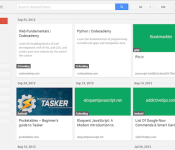
Google Stars bookmarking app makes brief appearance on Chrome Web Store

Google’s Stars bookmarking app showed up ever so briefly on the Chrome Web Store, and then disappeared again. The app, which was leaked early this month, seems to allow you to “star” web pages from Chrome’s address bar. You’d then be able to organize them by folder and search them for content, with the results displayed in an “image-rich grid” as seen in the screencap above. Indeed, the app description in the store read: “Google Stars is the platform where everything you’re already indicating interest in is saved. Initially, these will include your Chrome bookmarks, More integrations to come!” However, this particular release seems to be an accidental leak of the internal version, as it says “Thanks for dogfooding Google Stars” when we installed it. At this time, it looks as if the app has been pulled from the store. We’ve reached out to Google to find out more about what happened here, but it does seem like Stars could be close enough to final release if it’s getting leaked out to the public.
Source: Chrome, Florian Kiersch (G+)

iTunes Radio eyes local reach with broadcast content and focused ads

The Beats Music purchase may help Apple compete with Spotify, but iTunes Radio remains focused squarely on Pandora. According to a report from The Information, Apple is said to be working on local advertising while serving up content beyond the scope of musical selections with a hand from broadcast stations. iTunes Radio has yet to take off, and adding items like talk radio and more could give the platform a major boost. Items like ESPN’s daily slate and your favorite team’s hometown coverage are but a couple of examples that could make for a compelling station menu. There’s also the ads. They make money. If the folks in Cupertino can get local — or even regional — content, advertisers in those markets may be more apt to spend promotional dollars there. iHeartRadio has shown the interest in streaming broadcast programming with its apps available on mobile platforms and preinstalled in a number of automobiles. With CarPlay on the way, an expansion of iTunes Radio makes the upcoming in-car offering a much more enticing addition.
Filed under: Internet, Software, Apple
Source: The Information

HTC One Wear smartwatch due this fall, report says

The second half of the year will be a fun one to watch if you’re into smartwatches. New reports surfacing online tell us that HTC’s planned smartwatch will be called the “One Wear” and it should debut in August or September. Details, although sparse at the moment, tell us we should look for a rounded face a la the Moto 360; the watch may include polycarbonate and metal materials.
Sources have provided more than rumors but a actual demo of the HTC smart watch. I did ask for a name. Tentatively it’s called the One Wear, slated to launch late august early September of this year.
The name is said to be tentative for now but we think it fits nicely with their smartphone lineup.
The post HTC One Wear smartwatch due this fall, report says appeared first on SmarterWatching.
Read the rest at the source, SmarterWatching.com
The post HTC One Wear smartwatch due this fall, report says appeared first on AndroidGuys.
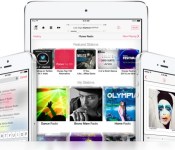
Apple to Bolster iTunes Radio With Localized Ads, Content
Apple has plans to add both targeted local advertisements and broadcast radio stations to its iTunes Radio music service in the coming months, according to a report from The Information. The move will boost its advertising efforts and introduce new content on iTunes Radio, better positioning it to compete with market leader Pandora. Apple is also expected to begin advertising its own iTunes content through the iAd network.
In a move that strikes at the heart of Pandora’s advertising business, iTunes Radio is expected to enable locally targeted advertising later this year, according to ad buyers who have spoken to Apple. Apple may begin promoting iTunes with “house ads” on its iAd mobile advertising network, an unusual move for the company.
Apple has reportedly contacted broadcasters like Cumulus Media, the second largest operator of radio stations in America. Cumulus serves approximately 150 million listeners in 110 metropolitan areas and could potentially bring multiple local stations to iTunes Radio. Apple made its first moves towards introducing local content on iTunes Radio earlier this year with the launch of the National Public Radio (NPR) channel, which will eventually include local stations offering a mix of live and taped news.

Since the launch of iTunes Radio, Apple has had a renewed focus on advertising, redirecting its iAd team to monetize iTunes Radio through advertising sales. While the company has signed deals on a national level with several high profile companies like McDonald’s, Nissan, Pepsi, and Procter & Gamble, local ads are new territory.
The addition of local ads could significantly boost the revenue iTunes Radio pulls in, which is a major threat to Pandora. Pandora currently focuses heavily on local ads with sales teams located in more than 35 markets around the United States.
In April, Apple moved towards expanding into Pandora’s local advertising territory by making it easier to create and buy iAds on its network. While a developer account was previously required to create an ad campaign, that restriction has now been removed, making it simpler for advertisers large and small to create ads for the platform.
Apple’s efforts to bolster its iTunes Radio revenue through local content come as the company works to acquire Beats Music, a paid streaming music service that delivers content on demand. With both iTunes Radio and Beats Music, Apple is hoping to boost its overall music sales, which have waned in recent years.

First iOS 8 Banner Appears at Moscone Ahead of WWDC
Apple is beginning to decorate the inside of the Moscone Center ahead of WWDC, adding banners for OS X 10.10 and iOS 8. A photo of the iOS 8 banner has been supplied by BusinessInsider‘s Jay Yarow, depicting a simple “8″ on what appears to be a watery background.

Apple’s iOS 8 is expected to retain the same general look as iOS 7, offering polish along with several new features including a health-aggregating “Healthbook” app, new TextEdit and Preview apps, and possible improvements to both Siri and Maps.
We will get our first glimpse of iOS 8 on Monday during Apple’s WWDC keynote, which kicks off at 10 AM Pacific Time. Apple will be live streaming the event and MacRumors will also provide a live blog, live tweets via the MacRumorsLive Twitter account, and a spoiler free page for those who want to watch the full keynote at a later time.
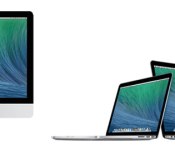
Buyer’s Guide: iMac and 13-Inch Retina MacBook Pro Discounts Ahead of WWDC [Mac Blog]
Apple’s Worldwide Developer’s Conference (WWDC) kicks off on Monday, but a few retailers have some larger than normal discounts on some current Mac models.

The 21.5″ 2.7GHz current generation iMac is seeing a $149 discount at Adorama and Best Buy. The iMac, however, is near the end of its refresh cycle and while we probably won’t see the new low-cost iMac debuted at WWDC, it does seem imminent. So, we recommend you wait on buying any new iMacs.
The 13″ Retina MacBook Pro with 512GB SSD, however, is seeing a $199 discount at both Amazon and B&H Photo, bringing the price from $1799 to $1599.99. That’s the lowest price we’ve seen. The buy recommendation for the Retina MacBook Pro is more complicated.
The Retina MacBook Pros were last updated in October 2013, according to our Buyer’s Guide and receives a “Caution” rating. Current MacBook Pro rumors place the next update in between Q3 and Q4, so approximately 4 months from now. That is enough time that if you are on the market specifically for the 13″ Retina MacBook Pro, a $199 discount may be enough to pull the trigger.
B&H Photo and Adorama only charge sales tax in NY and NY/NJ, respectively.
MacRumors is an affiliate partner with some of these vendors.

GO Launcher EX moves to v5 with Complete Overhaul and Prime for Free
 GO Launcher EX has been around for quite a while. While the apps saturation is pretty heavy, 200 million plus users, there are plenty out there that have never seen it, used it or heard of it. Today is your lucky day as the GO Launcher Dev Team has released a substantial update to the home launcher replacement that brings it to version 5.0.
 In 5.0 they have started from scratch and built the app from the ground up all over again. That is a great approach when it comes time to bring a whole new version, look and feel to a long standing app. The updated app offers up a new flat style UI, full screen folders with smart card, GO panels, menu redesign and sub-menu modules, simplified app drawer and enhanced accuracy of the auto-folders. That is just what they have listed on the Play Store for what’s new.


 It certainly looks like a great new design to me. To celebrate the launch the GO Launcher Dev Team is kicking out the Prime version of the launcher for free from now through June 1st. Prime is normally $5.99, so this is a deal you might want to take advantage of really quickly. With Prime the ads are removed, you get 6+ more transitions, more gestures and a few other things that make the purchase a good idea. To pick up prime you just need to install the free version of GO Launcher EX. Once installed, head to the Menu > Preferences > About GO launcher EX > Enter Activation Code. You will have two code words to choose from. It doesn’t seem to matter which one you use as they both work. The activation codes are “appsales” and “appszoom“, without the quotation marks of course. hit the link below to go grab the new and improved GO Launcher EX and grab the Prime version while you are at it. Let us know what you think of their update.
//<![CDATA[
ord = window.ord || Math.floor(Math.random()*1E16);
document.write('’);
//]]>

Samsung’s latest smartphone-camera hybrid launches in the UK tomorrow

Samsung appears intent on single-handedly bringing back the word “cameraphone,” if the Galaxy S4 Zoom and recently announced Galaxy K Zoom are anything to go by. The newer of the two does a much better job of hiding its hybrid bloodline, and tomorrow (May 31st) it arrives in the UK at various online and bricks-and-mortar outlets, including at Carphone Warehouse and Samsung’s own Experience stores. If the official K Zoom product page is any indication, you’ll be looking at around £400 all-in, and we doubt they’ll be a wealth of carrier-subsidised deals on offer for the niche device. The K Zoom doesn’t quite rival the Galaxy S5 in terms of raw power, but it’s the 20.7-megapixel camera with 10x optical zoom you’ll be buying it for; and, how can you resist something with a Selfie Alarm mode?
Filed under: Cellphones, Cameras, Samsung
Source: Samsung

Motorola to close its Moto X plant in Texas by the end of the year

Motorola became part of a growing trend when it opened a plant in Texas to build its flagship Moto X, but just a year on, its now decided to shut down its US manufacturing operations. According to The Wall Street Journal, employee numbers have plummeted from nearly 4,000 when it was in full swing to only 700, and the plan is to close the factory by the end of the year. Motorola’s intention was to offset the inherently higher cost of manufacturing in the US, compared with places like China, by being able to get handsets to customers quicker, and manage the Moto Maker customization process on home turf. But, despite churning out 100,000 Moto Xs a week at one point and progressively making the handset cheaper, the ‘born in the USA’ vision hasn’t paid dividends.
Motorola’s in ownership limbo at the moment, as Google has essentially sold the smartphone-maker to Chinese company Lenovo, but the deal is yet to be fully executed. Motorola President Rick Osterloh told the WSJ “the decision to close the plant was independent of the planned sale,” which isn’t hard to believe given Lenovo is one of the champions of stateside manufacturing. It has a PC plant in North Carolina, and like Motorola, believes there’s a competitive edge in being close to your customers and able to customize and ship computers quicker. Perhaps, then, there’s scope for Motorola to return to the US under Lenovo’s leadership. The Moto X will continue to be made elsewhere, and with Moto Maker being one of the main attractions of the handset, we imagine this’ll still be available on the next edition of the X due this summer, even if it takes much longer to ship.
Beyond what it means for Motorola as a company, the fact it’s had to pull the plug on its US plant after such a short time raises much bigger questions about the viability of manufacturing electronics in the US. Last year, the company convinced us it was going to make it work, so how long before others begin changing their tune as well?
Filed under: Cellphones, Mobile, Google, Lenovo
Source: The Wall Street Journal
What’s on tap for Apple at WWDC 2014

It’s that time again, folks — geeks from around the globe (us included) are getting ready to descend on San Francisco’s Moscone Center for WWDC 2014. Once those doors open and the keynote starts, we’ll get to peek at the future of computing the folks in Cupertino have cooked up… though what exactly we’ll see remains veiled in secrecy. You can bet the show will be heavy on the software (like new versions of iOS and OS X), but if we’re lucky, a few hardware announcements should keep us all on our toes. Here’s a quick look at what we think Apple will (and might!) show off during its June 2nd address.
iOS 8

Those of you expecting a dramatic redesign like last year’s leap to iOS 7 will be disappointed. From what we’ve seen and heard, expect iOS 8 to be a refinement of the software already running on your phone, a sanding down of rough edges paired with a smattering of new features. Right now, the biggest of those additions might be meant to get you in better shape. 9to5Mac published images of Healthbook in March, and they depict a Passbook-esque interface dedicated to tracking and displaying your vital stats, from heart rate to blood pressure to activity. It’s not exactly clear where Apple is going to pull all this data from — an iPhone could give you a decent guess at your activity levels, but it’s not going to track your oxygen saturation or blood sugar without some additional hardware. Is Apple hinting at what its new iPhones will be capable of tracking? Maybe, but it may also signal a platform play where Apple draws on information collected by gadgets like the Fitbit or the Withings Pulse.

With any luck, Siri is going to get smarter too. It used to be that Siri could only peer into your apps and fire them up if Apple inked a deal with the companies that made them, but a report from The Information claims Apple is working on getting its virtual assistant to “understand” what those apps do so it can respond to your requests more substantially. A mobile payments system may be in the cards too if the Wall Street Journal is to be believed — Apple SVP Eddy Cue has apparently been taking meetings with tech industry bigwigs and talking about the company’s “interest in handling payments for physical goods and services on its devices.”
And then there are the slightly less consequential bits. Apple Maps may finally get a shot in the arm with improved support for walking and transit directions. Split-screen multitasking is reportedly in the cards for the iPad (though it may not be ready in time for the show), and iOS 8 will probably come with new TextEdit and Preview apps. Facebook just started bringing TV and music audio recognition to iOS and Android, but Apple’s reportedly teaming up with Shazam to bring similar audio smarts to iTunes.
OS X “Syrah”

After all that, you’d expect the changelog for the new OS X (codenamed “Syrah”) to be equally lengthy. It probably will be, but the only thing that seems like a lock right now is the facelift Apple has given it. Don’t give in to the hysteria: the next OS X update probably won’t look too much like iOS, though 9to5Mac reports that Apple has indeed worked to unify some of the design language across Apple’s devices. (Chill, the image above is just a mock-up by artist Danny Giebe.) That means we should be in for a flatter, more open-feeling OS X with plenty of white space replete with all the desktop niceties (the Finder, Mission Control) we’ve grown so used to. For a company whose products get outed by sources and supply chain trolls on the regular, it’s a welcome surprise to see that OS X’s new look will be a, well, surprise. For now, anyway.
Where’s all the hardware?
Despite what the name sort of implies, WWDC isn’t just about the software. Apple always trots out a few new gewgaws at the show each year — last time we saw the introduction of the dramatically redesigned Mac Pro, along with a batch of refreshed MacBook Airs… which were tweaked again just a few weeks back. Rumors abound of a much-anticipated Retina MacBook Air that’ll finally bring eye-searing screen resolution to all of Apple’s portables, but take that with a grain of salt.

A bit of poking around in the latest OS X Mavericks beta software revealed references to three new iMac models — a juicy tidbit that only seems juicier when you consider the slipping ship dates for iMacs on Apple’s online store. All signs seemed to point to new iMacs at the show, but über-connected Apple pundit Jim Dalrymple quickly shot down rumors of a low-cost model taking the stage. Sorry, folks.
There’s just a flicker of hope that some fresh Macs will appear, but how about some new iDevices to go with them? Don’t hold your breath. There’s just about no way Apple is going to pull back the curtain on a next-generation iPhone with the 5s (unveiled eight months ago) still so visible in the rearview mirror. That said, some analysts are foretelling the announcement of an even cheaper 8GB iPhone 5s meant for developing markets — we’ll soon see how good their crystal balls (err, supply chain analyses) are. Our hunch? Not good. At this point, there’s a half-decent chance that Apple won’t show off any hardware at all — TechCrunch is betting that’s the case exactly.
A home invasion?
Yeah, this one came out of the blue, didn’t it? A recent report from the Financial Times purports that Apple is preparing to trot out a connected-home system… or at least a set of guidelines that it wants some manufacturers to stick to. In short (and as Gigaom reported), Apple may just want home gadget makers to commit to Bluetooth-enabled voice control and connecting devices over a WiFi network. In exchange, those manufacturers would get an Apple certification, and everyone goes home happy.
It’s unclear whether or not Apple even plans to craft any of its own home-friendly hardware, but it’s hardly a surprise to see the company trying to wrangle players in the space. After all, Apple Stores already stock their fair share of internet-of-things goodies and analysts only expect the demand for devices that enable that sort of connected life to grow. We’re hoping against hope that Apple is pulling a pump fake to draw attention away from a meatier announcement, but our inner pragmatists are expecting to be vindicated.
 AIVAnet