



Review: Häns Swipe-Clean screen cleaner

While phones, tablets, phablets, and other everyday devices are always updated, re-invented, and tweaked, the world of accessories remains a fairly stale landscape. Chargers, mounting systems, cases, and the like haven’t offered a new way of doing things in quite a while.
We have received an accessory product that actually does offer a different way to approach an age-old problem; that is, the one of the grubby and finger-smeared screen. A common solution we find is the disposable wipe that resemble the ones you get with your order of ribs at the local BBQ joint. You have probably seen the spray & dry wipe combo you might use for eyeglasses. One company has come up with a new portable and longer-lasting product. That product is the Häns Swipe-Clean multi-use screen cleaner and below is a review of its performance on AG-staffers’ devices.
This reusable cleaning system comes in a form factor that should immediately remind you of a short deodorant stick, but with caps at each end. Under the top cap is a non-removable cleaning block soaked in a proprietary cleaning solution. As-purchased, the cleaning solution should last up to 500 swipes. While the solution is stated to be “eco-friendly” their press release does emphasize to not let the cleaning solution remain on exposed device ports (micro-USB and the like). Refill bottles of the solution are available, and provide up to 6,000 additional swipes to be had. This cleaning end is sealed by way of the cap and rubber o-ring (pictured above-right).
Under the bottom cap is the polishing block, which consists of a long “five-layer antimicrobial-treated microfiber polishing” sheet, rolled around a block for structure. This sheet & block can be removed and re-rolled to get a cleaner portion of the sheet exposed for polishing purposes (pictured below). Both ends are infused with nano-silver ions for the antimicrobial properties.


Using the Swipe-Clean is easy enough, and pretty self-explanatory. You take a dirty device of your choosing, remove the top cap, and swipe around your screen to remove all the grease, grime, fingerprints, and peanut butter (that’s in my house; your screen debris may vary). Once done, you then cap the cleaning end, uncap the polishing (bottom) end, and then make like a window washer and effectively squeegee up and down over the screen surface. Repeat as needed. Though repeating isn’t likely, unless you simply miss a spot. We have to say that this product works extremely well. I purposely smudged my Moto X with fingerprints and smears of my morning-snack banana. Bringing the screen back to a perfect sheen took just a few swipes each of the cleaning and polishing ends of the Swipe-Clean.
I also encouraged others in my household to try it out, with the only instruction being the difference between the cleaning and polishing ends. Everyone came back rather amazed. Our usual method is the disposable screen wipes; these almost always create frustration in not ever getting that “like-new” gloss to a screen. Not so with the Swipe-Clean; we posted a 100% satisfaction rate! I personally love this thing, though being we live in a disposable society, I wonder if folks will keep up with changing the polishing pad position and refilling over time…. The Swipe-Clean’s suggested retail price will be $15, with a refill bottle going for $7. You can also pick up a Häns bundle, which includes (2) Swipe-Cleans and (1) Clean refill bottle for $32. These products are available at hans-swipe.com and amazon.com.

Before.

After.
The post Review: Häns Swipe-Clean screen cleaner appeared first on AndroidGuys.

Intel will let you build your own 3D-printed robot later this year

Intel CEO brought a robotic companion named Jimmy with him on stage at Code Conference today. Jimmy is a 3D-printed robot capable of walking, moving his arms, dancing and even tweeting, and it’s the key to Intel’s vision of the future of robotics. Starting later this year, the company will make an open source 3D-printable robot kit available to consumers for $1,600, with a research version for $16,000. The former will run on Intel Edison, the company’s computer-on-a-chip, while the latter will be powered by a Core i5 processor.
Developing…

AT&T Finally Announces the ASUS PadFone X; Coming June 6th for $199
 The ASUS PadFone has always been a device that many of here in states have been eyeballing. not just for its unique phone/tablet ability, but because it never officially made its way stateside. We knew the PadFone X would be coming when they announced it back in January at CES. Finally we can put the when and how much speculations to rest. AT&T has announced in their newsroom this morning that the ASUS PadFone X will be making its way to the carrier on June 6th with the usual two purchasing options. You can pay $22.92 a month on AT&T Next for 18 months, or $29.80 a month on the Next 12. If you prefer those silly contracts you can grab it for $199.
“We are proud to add the innovative ASUS PadFone X to AT&T’s leading device portfolio,” said Jeff Bradley, senior vice president – Devices, AT&T. “PadFone X provides tremendous value and flexibility to consumers. It combines a powerful smartphone with a 9-inch PadFone station and runs on the network that covers more than 99 percent of all Americans4.”
The standalone phone is a 5-inch Android 4.4 toting device with a 13MP camera.It sports a Snapdragon 800 processor, 2GB of RAM and 16GB onboard storage.
It is the PadFones ability to dock inside a 9-inch tablet that resizes the phones display on screen. Giving you a unique phone/tablet hybrid device all wrapped into one device and one service provider.
While the over all specs might not put it into he high-end category anymore, it is still a unique device that should pack plenty of punch and value for many people.
Via AT&T
//<![CDATA[
ord = window.ord || Math.floor(Math.random()*1E16);
document.write('’);
//]]>

Square dips into banking with quick loans for small businesses

Square has so far focused on helping businesses take payments; now, it’s ready to make payments to get those businesses off the ground. The company has launched Square Capital, a quick loan service that uses card transactions for repayment. Every time someone makes a purchase, a small cut of that sale (on top of the usual card fee) goes toward covering the advance. Square is purposefully keeping things as simple as that. There’s no application process, and there’s no due date — if business gets slow, it just takes a bit longer to pay off the loan.
Capital is new territory for Square, which is diving into the banking world in earnest after testing its service for a year. However, it has an edge over conventional institutions. As it’s already tracking payments in some cases, it has a better sense of how much a business can afford to pay; it may be more comfortable with lending money to young shops if it knows they’re already thriving. The new program may not help struggling outfits looking for rescue money, then, but it could help up-and-comers that just need a small financial boost to keep growing.
Filed under: Internet
Via: Financial Times
Source: Square

ASUS’ modular PadFone X is finally coming to AT&T for $199

AT&T promised back in January that it would launch ASUS’ PadFone X hybrid, but the device has been stuck in limbo ever since — the carrier hasn’t given out much more than specs for the phone-and-tablet combo. Today, though, there’s finally a date to mark on your calendar. The PadFone X should be available on June 6th for $199 on a two-year contract, or $23 per month if you buy it on an 18-month Next payment plan.
The hardware hasn’t changed in the space of half a year, although it’s still reasonably current. The core phone is a 5-inch Android device with a speedy Snapdragon 800 processor, 16GB of expandable storage and a 13-megapixel rear camera; the 9-inch tablet shell provides a bigger screen for the docked phone as well as an extra battery and wireless charging. You can’t exactly call this a timely launch, but it’s still big news for Americans who’ve previously had to import ASUS’ two-in-one device concept.
Filed under: Cellphones, Tablets, Mobile, ASUS, AT&T

Leap Motion’s latest motion tracking tech can see your joints

The Leap Motion controller is a curious little motion sensor, but it isn’t always easy to use. The hand-sensing tech has a tendency to lose sight of your fingers are and almost every application that uses it has its own learning curve. Soon, that might change — today Leap is launching the public beta for its next generation (V2) tracking software. This free update makes some big promises, including improved resistance to sunlight and infrared interference, better tracking algorithms and, best of all, the ability to track individual joints. We dropped by the company’s San Francisco office to try it out and found the update to be a significant improvement.
“V1 is a great experience for early adopters,” Leap CEO Michael Buckwald told us. “But what we want to do with V2 is make interacting with the computer the same as interacting with the physical world.” Leap’s new software helps. The update’s predictive software allows the device to track controllers that aren’t directly seen by its sensors. Buckwald showed us on a demo machine: a flat hand could easily be seen by a V1-equipped computer, but in a vertical orientation, all but the lowest hanging digit disappeared. V2 accurately tracked all five fingers. It sounds simple, but it’s a game changer: developers can now implement more delicate pinch and grab motions. Buckwald pulled up a demo for that too, and asked us to pick up and toss a collection of ragdoll soldiers. It was easy, just as it should be.
The update also encourages developers to include a hand model in their applications. “The vision has always been that using leap should feel just like reaching through the screen and grabbing something,” he explains. “That’s how it feels with the onscreen hand — seeing all your joints and fingers and watching it move as your real hand moves.” While the onscreen limb isn’t quite as flexible as the real deal, it makes the learning curve shallow. ” If the actual interaction is a commodity like that, the focus can be on being creative.”
The update is available to developers now, but there aren’t many applications that use it just yet. Still, it’s an encouraging evolution for the Leap Motion controller, and bleeds of the same thing the device always has: potential.
Filed under: Misc
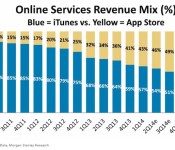
Apple’s Beats Music Deal Seen as Key to Bolstering Declining iTunes Revenue Momentum
Apple reportedly is close to inking a deal with Beats Electronics for $3 billion, an acquisition that Morgan Stanley analyst Katy Huberty believes is important if Apple wants to further monetize its 800 million iTunes user base and boost revenue in its increasingly important online services division.
Apple’s online services segment, which includes iTunes, is often overlooked because it contributes so little to the company’s overall revenue. But as Huberty points out in a recent message to investors, online services shouldn’t be so casually tossed aside as the segment “is an underappreciated growth and margin lever for Apple.” It may be small, but online services revenue is expected to grow and margins are predicted to increase in 2014, driven primarily by rising App Store revenue.

Online services hold promise, but Apple needs to address iTunes, which is losing ground to rival music services. While App Store revenue is increasing, Huberty notes that iTunes revenue is falling as users turn to streaming services such as Pandora and Spotify to meet their music needs. This decline “raises concerns about Apple’s ability to monetize the new base of emerging market customers,” writes Huberty. According to Huberty’s calculations, each iTunes account spent an average of $3.29 in the first quarter of this year, down 24% year-over-year.
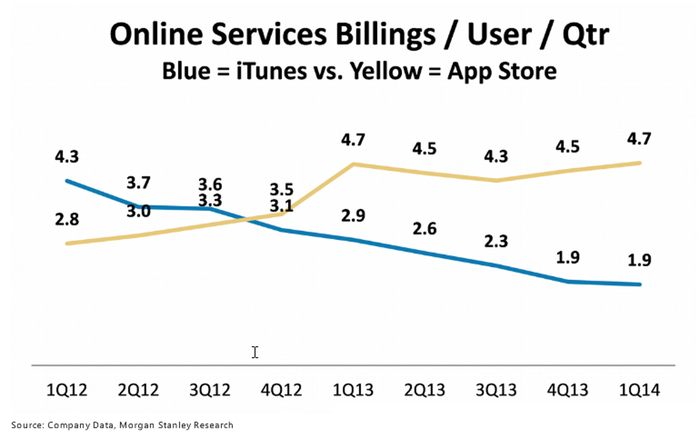
Huberty believes Apple could reverse this trend and improve monetization with the introduction of a subscription music service. One of the quickest ways to launch a subscription music service under the iTunes umbrella would be to acquire an existing service, something Apple appears to be doing with Beats Electronics and its Beats Music service.
Press reports, including the Financial Times and Wall Street Journal, suggest Apple is considering the purchase of Beats Electronics, which would give Apple an accessories business focused on headphones and a music streaming service. Apple has not commented and we have no knowledge of any pending deals. However, a subscription music service — whether organically built or acquired — is a logical extension of iTunes.
Spotify, which is generally viewed as the leader in streaming music, has 10M paying subscribers or about 25 % of its over 40M active user base (MAU). If Apple charges $10 per month, same as Spotify, every 1% penetration of Apple’s 800M user base, equates to $960M revenue annually, adding 8 pts of growth to online services and half a point to total company growth.
Apple’s acquisition of Beats would bring not only a streaming music service, but also veteran music producer Jimmy Iovine and musician Dr. Dre to Apple. The pair are considered to be the “big prizes” of the acquisition and could help Apple negotiate favorable music deals for a streaming music service.
Looking beyond Beats, Huberty argues that Apple also could bolster its online services with the introduction of a mobile payments option, an area of opportunity recently acknowledged by CEO Tim Cook. The launch of the rumored iWatch also may contribute to Apple’s online services as customers bolster App Store revenue by purchasing apps compatible with the new device.
AT&T to sell $200 Asus PadFone X on June 6

AT&T on Wednesday detailed the upcoming availability for the Asus PadFone X. The smartphone and tablet hybrid experience will be sold for $200 with a two-year service agreement when it arrives on June 6. Customers can also purchase the device on for $22.92 per month with AT&T Next 18, or $29.80 per month with AT&T Next 12. Yes, for the money, customers get both the 5-inch Android-powered smartphone and the 9-inch PadFone Station dock/table.
The PadFone X runs Android 4.4 KitKat and features a 2.3GHz Qualcomm Snapdragon 800 processor, 16GB internal storage, and a 13-megapixel rear camera.
The post AT&T to sell $200 Asus PadFone X on June 6 appeared first on AndroidGuys.

LG G Flex 2 and Vu 4 confirmed for second half of 2014
 The LG G3 wasn’t the only thing that LG announced today. While announcement events for the LG G3 took centre stage around the world, LG held a press conference in its native country of Korea to answer a few questions, one of which was when we would be seeing the LG G Flex 2. According to previous rumours, the follow-up to the LG G Flex would be coming in early 2015, however it was announced at today’s conference that the LG G Flex 2 and the Vu 4 would be released in the latter half of 2014.
While we weren’t expecting an announcement like that so soon, LG was predictably coy about leaking any details about the two devices. The original LG G Flex was one of the first devices to make use of flexible display technology, allowing it to have a curved screen. That wasn’t it’s only party trick however as it also incorporated some clever self-healing technology, something that the LG G Flex 2 is allegedly going to one-up with something even more unique. As for predictions for the Vu 4, there’s not much to go on, but it will likely continue along the lines of its predecessor with a 4:3 ratio display.
What do you think about the LG G Flex 2 and Vu 4 coming at the end of this year? Let us know your thoughts in the comments.
Source: ITToday.co.kr via Phone Arena
//<![CDATA[
ord = window.ord || Math.floor(Math.random()*1E16);
document.write('’);
//]]>
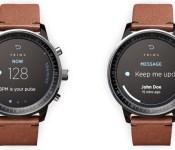
Apple’s iWatch Said to Feature Round Design, Production May Start This Summer
Based on Taiwanese supply chain sources, analyst Brian Blair of Rosenblatt Securities believes Apple’s iWatch will feature a round face, similar to a traditional watch (via Business Insider). The iWatch design will resemble Motorola’s Moto 360 smart watch, with the Apple version shipping with a slimmer profile.
 Traditional watch-style iWatch concept by Gábor Balogh
Apple may begin production of the iWatch in late July, with the goal of producing up to 21 million units in the second half of 2014, claims Blair in a research note to investors. AppleInsider also highlights Blair’s claim that Apple may partner with Quanta Computer to produce the smart watch device, instead of Foxconn which may be busy manufacturing the iPhone 6. Quanta’s involvement in iWatch production has been rumored since last August.
Blair’s sources also believe Apple may be producing multiple models of the iWatch, including one that features a sapphire display cover. This information echoes an earlier report from KGI Securities analyst Ming-Chi Kuo, who claimed the iWatch may ship at various price points and in a variety of materials that allow the smart watch to compete with both low- and high-end watches.
Apple’s iWatch is currently expected to arrive near the end of 2014, with a fashionable design and biometrics that provide basic health monitoring features. It likely will sync with an iOS device sharing data with iOS apps, including the new Healthbook app that is expected to debut in iOS 8. Though an iWatch announcement is not expected for WWDC, Apple will likely unveil some of the early details on iOS 8 at the developer conference next week.
 AIVAnet