



Someone made machines that play music with pint glasses

Forget skimming the edge of your pint glass to make music — how about some real alcohol-inspired instruments? Inventor Andy Cavatorta has built the Chalice Symphony, a quartet of devices that use Stella Artois’ signature drinking glasses to produce some decidedly uncommon sounds. Each of the instruments is surprisingly technology-laden. The Star Harp can use robotics to play itself, while the Pyrophone you see here relies on software-controlled torches to create flute-like notes. The Hive (a keyboard-driven cluster of bells) and the Violina (a spinning string-like instrument) also use complex machinery. There are currently just a few teaser videos to hint at what the symphony can do, but you’ll get an earful soon — Cold War Kids will release a track in early March that was performed using the glass-based gadgets. We have a hunch that it’s worth waiting for the song, even if you’re not a fan of Belgian pilsners.
Source: Stella Artois

Weekly Roundup: Galaxy S5 hands-on, Engadget’s 10th birthday and more!

You might say the week is never really done in consumer technology news. Your workweek, however, hopefully draws to a close at some point. This is the Weekly Roundup on Engadget, a quick peek back at the top headlines for the past seven days — all handpicked by the editors here at the site. Click on through the break, and enjoy.

Megapixels and mobile imaging
In recent years, smartphone photography has been centered around pixels. Lots and lots of pixels. But Google’s latest concept phone, dubbed Project Tango, could take mobile imaging to an entirely new level. Read on as Engadget’s Steve Dent explores the potential of handsets equipped with with multiple sensor technologies.

Nokia’s new Android smartphones
Microsoft’s acquisition of Nokia is just around the bend, but the Finnish smartphone maker apparently couldn’t wait. Say hello to Nokia’s first Android handsets: the X, X+ and XL. At $122, $135 and $150, respectively, each device packs a slightly different combination of low-end specs. Read on for our impressions and hands-on photos.

Samsung Galaxy S5 preview
Meet the Galaxy S5. Samsung’s newest smartphone features top-of-the-line specs, a 5.1-inch display and an interchangeable polycarbonate backside. What’s more, the S5 follows recent trends, packing a fingerprint scanner and heart beat sensor.

Twitch arriving on Xbox by March 11th
The second half of Microsoft’s big Xbox One update is expected just ahead of Titanfall’s March 11th release. Aside from being able to broadcast your gameplay via Twitch.tv, Xbox owners will exclusively be able to archive streams right from the console.
Filed under: Misc

SkyShield protects airliners from missile strikes, completes testing in Israel

SkyShield, created by Israel’s Elbit Systems, has reportedly been under development for the better part of a decade, but the laser-based missile deflector has just now successfully completed live testing. The Multi-Spectral Infrared Countermeasure (MUSIC) device, which is mounted on an aircraft’s belly, uses a thermal camera paired with a laser to change the direction of approaching missiles, saving airliners and passengers from destruction. When the camera detects a missile, it rotates the plane so that the belly faces the approaching weapon. It then fires a laser beam, redirecting the missile so it can explode a safe distance away. It’s not clear when the technology will begin rolling out, but according to Haaretz, SkyShield will be used on all Israeli civilian aircraft, many of which operate around the world.
Filed under: Transportation
Via: Gizmodo
Source: Haaretz, Washington Times

How would you change the Galaxy Note II?

In just three years, the Galaxy Note has grown from a niche device to a must-have, which is almost as eagerly anticipated as Samsung’s Galaxy S flagships. When we placed the Galaxy Note II in the hands of our tame phone driver, they had nothing but praise for the handset. Oh, except for its sky-high price, that is. But what of you, we ask? What particular things did you love or loathe about this particular slab of glass and plastic? Share your experiences on the forum.
Filed under: Cellphones, Mobile, Samsung
Source: Engadget Forum

Switched On: Understanding crowdfunding’s caveats, part 2
Each week Ross Rubin contributes Switched On, a column about consumer technology.

The last Switched On discussed how many of the Risks and Challenges sections of Kickstarter campaigns fail to portray an accurate picture of what might go wrong. This was true in the case of the Auris Wily. It, like many campaigns, used this section of the campaign page in the exact opposite way it should be used; they allay concerns about risks and challenges. If the Risks and Challenges section of Kickstarter campaigns reflected reality, they might include some of the following things you should keep in mind for any device project you back:
- The company could get sued out of existence for patent infringement or something else.
- The product may turn out to be impossible to make or cost so much to make that it exceeds the amount of funds raised.
- The product may unintentionally do something illegal.
- An explosion at the factory could wipe out production.
- The contract manufacturer could have lied about its capabilities.
- A critical component for the product could become unavailable.
- A defect could be found that makes the product unsafe or unusable.
- The app that the product requires could be denied by Apple or Google.
- A critical team member may get hit by a bus.
- The bus may be driven by another team member with whom there’s been a falling out.
- That apparently earnest guy humbly telling you “Here’s where you come in,” in the slickly produced pitch video could take the money and vanish to a comfortable retirement in Chile where he feigns a humble existence driving a bus.
And of course, even if the project creator delivers working products in a reasonable time frame, there’s no guarantee that it will be around to support the product long enough to honor any warranty, or that a competitor will not come out with something that does what its product does better at half the price. Given the extended gestation of many crowdfunded devices, that’s a genuine possibility.
Now, the odds of many of these things happening are very low. But so are many of the risks detailed in S-1s. And both kinds do occur. Indeed, many, if not all, of these scenarios have occurred with products in their early days and certainly happened with Syre and Jorno.
All project owners should not be painted with the cavalier brush.
All project owners should not be painted with the cavalier brush. Here are some good risks articulated by the developers of the impressive Dash earbuds that have raised more than a million dollars and pack a completely wireless MP3 player and fitness aid into a set of headphones:
“Due to the incredible small size of The Dash, we use miniature components. For some of these we only have a single supplier. Even though we have a close dialog with our suppliers, we are not in control of their actions. Every component is highly integrated into and optimized within the design, and an unforeseen component alteration can delay our launch.

As Kickstarter continues to contemplate the best way to protect consumers, it should require that these kinds of real risk factors be disclosed universally.
“The Dash has a complex Bluetooth setup that we have tested vigorously in our labs. We might encounter real life applications, where we cannot guarantee for the quality of operations. We will continue to improve our software throughout the launch to improve functionality.”
The bottom line is that making a hardware product to be delivered on a mass scale is extremely difficult and even the most experienced and resourceful companies in the world occasionally fail in attempting it. As Kickstarter continues to contemplate the best way to protect consumers, it should require that these kinds of real risk factors be disclosed universally. And if the project creators won’t do it, it should be stated on the campaign page or pledge page or both.
In the meantime, by all means we should continue to back the projects that we believe in. But like anyone giving money to a cause — be it a venture capitalist funding a startup or a pedestrian sizing up a street beggar — understand the risks, analyze the authenticity and accept that your investment may be squandered.
Ross Rubin is principal analyst at Reticle Research, a technology, media and telecom advisory firm, and founder of Backerjack, which covers crowdfunded product innovation. He blogs at Techspressive.
Filed under: Misc

Stephen Colbert’s Cloud Fog: ‘part cloud, part fog, all security’

Stephen Colbert has a lot to say about internet privacy, Edward Snowden and the NSA, and he shared his thoughts Friday evening at an Internet security conference in San Francisco. Privacy advocates had implored Colbert to skip the event, which was hosted by security giant RSA — a company that reportedly took $10 million from the NSA to give the agency a back door into its software. Said Colbert: “I looked at the signatures on the online petition, then I looked at the signature — my signature — on the bottom of the contract saying I’d be here today, and my conscience was clear, as long as the check clears. Well, it’s not actually a check. They gave me a Bitcoin voucher for Mt. Gox. And I’m sure it’s going to be fine.”
Colbert also used the event to unveil his own privacy solution, something he calls Cloud Fog. The service — which he describes as “part cloud, part fog, all security” — relies on a familiar “advanced polyhedral extruded polymer info solid” to generate random numbers. Hey, doesn’t seem any worse than many of the real security solutions out there.
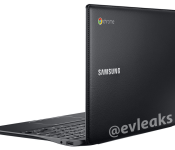
Evleaks Posts Image of the Samsung Chromebook 2

Mr. evleaks gave us a little treat today, and that treat is the new Samsung Chromebook 2. Yesterday, he teased us with just the corner of the new Chromebook, that showed that Galaxy Note 3-like faux-leather and stitching, that was also accompanied with the Chromebook logo. Now we get that full-nude backside.
I guess Samsung is just going to stick with the faux-leather look, which doesn’t exactly please my eyes, but Galaxy Note 3 users out there I guess dig it. It actually looks better on the a Chromebook than the Note 3 in my opinion, because it gives it that briefcase look to it. Not that a Chromebook is for the everyday business man, but hey, those guys need a small laptop to play around on too. Let us know what you think about the image.
Source: evleaks
HTC stopping its HTC Watch movie sales and rental service
HTC have just announced that as of March 31st 2014, HTC will be ceasing their HTC Watch movie sales and rental store.
The service had been slowly closing across a variety of countries including Spain, Italy, Sweden, Norway, the Netherlands, and Denmark, and now the United States of America, and the UK are set to follow suite.
As a user of the HTC Watch service we would like to notify you that from March 31st 2014 the store will no longer be available.
Up until this date, you willl still be able to purchase movies from the HTC Watch store as normal. Your library will not be accessible after March 31st, 2014.
Please download the movies you have purchased to your devices before the above mentioned date. If you do not find the HT Watch application in your device to download and watch the movies you have purchased, please kindly visit http://www.htc.com/support for more details.
We thank you for being a HTC Watch customer, and apoligise for any inconvenience caused.
Be sure to download your purchases from the HTC Watch App before March 31st 2014 in order to ensure they are not lost, because after this date, unfortunately they’ll fall into cyber space.
The post HTC stopping its HTC Watch movie sales and rental service appeared first on AndroidGuys.
Blackberry updating BBM to allow for larger file sharing
If you are one of the users who are still using BBM then there’s a big update coming your way which will offer larger file sharing and new features for group chats.
Bringing BBM in line with most other cross-platform messaging services, users will now be able to share photos in group chats and to assist with this the file limit for sharing files has been increased from 6MB to 16MB.
Blackberry have said that they are planning on making the emotions in the chat bigger too, so great news if that’s something you’ve been longing for.
Unfortunately, Blackberry have been scarce on an actual ETA for the update, but expect it to rollout shortly. Keep your eyes peeled to AndroidGuys for any further developments.
The post Blackberry updating BBM to allow for larger file sharing appeared first on AndroidGuys.

