


Programming on the Curriculum
As the number of computer science graduates decreases and our reliance on computers in the workplace increases there is a very real need for people to gain and develop skills in programming, coding and other IT essentials. One possible way of plugging this gap is by teaching coding and programming languages as part of the school curriculum.
Replacing French?
Over in the USA some states are beginning to realise that these are skills that we need to develop early. Some states are allowing these courses to count towards scores in Mathematics and Science, but with only 1 in 10 schools offering the courses at the moment, across the nation, it seems there’s still some way to go before it becomes part of a curriculum generally accepted as necessary for students entering the work place. Interestingly enough some schools may, it’s thought, start offering programming languages instead of a foreign language. Will this create problems in itself in an international market?
Thinking outside the computer
Here, too, the National Curriculum in England and Wales is introducing coding in its 2014 changes, recognising these needs. Children as young as five will be taught the basics and introduced to the ideas. At Key Stage One they will hopefully be taught to understand algorithms and reason out how simple programmes will work. According to the curriculum changes, by the age of 14 students will be adept at coding, as well as using some key transferable skills such as critical thinking, logic and creativity.
Scotland, too, is developing its students’ computing skills far beyond the basic word processing and MS Paint prowess the last generation was familiar with. A range of computer science skills are taught as part of the Curriculum for Excellence, including app development and coding, and like their counterparts in England, Scottish children are taught familiarity from a very early age. 3 year olds in the nurseries are adept at using computers and understanding the basics. The future workplace should, theoretically, be populated with people with at least basic skills in these key areas and it seems likely that the environment will encourage those with talent to develop it much further than was possible before.
Here and now
Where does that leave us now, before the curriculum can benefit those in the workplace already? How will we, as a business nation, handle the inevitable changes and updates in the industry? Learning coding early will help young minds to be able to adapt to changes, rather than learning from scratch. Luckily there are courses around that can help companies and individuals to fill the gaps they have in their IT knowledge, for instance, you can see here for IT training from Microsoft product training to CISCO labs. It is possible to outsource the problems, but it’s rarely cost effective to do so in the long term, especially when some of these skills are now considered ‘basic’.
It seems clear that the way we handle early coding experience will directly affect our ability to compete as a nation over the next generation. Familiarity with the concepts behind coding and programming will make it easier for students to translate those skills in the workplace into working with a variety of platforms and to learn further programming languages.

Nest is now officially a Google-owned company, ready to produce all sorts of who-knows-what

Prepare for a world of Google-controlled thermostats, smoke alarms and no doubt other mysterious projects we don’t know about yet. Shortly after receiving the green light from the FTC, the search giant announced that its $3.2 billion acquisition of home automation company Nest is now a done deal. Google’s already touting Nest as the perfect partner to”enhance its suite of products and services,” and is allowing founders Tony Fadell and Matt Rogers (both ex-members of the original iPod team) to continue operating the company under its own brand. Google’s involvement brings its fair share of privacy concerns, but Fadell says there aren’t currently any plans to change the company’s current privacy policy, and that any future changes will be both transparent and opt-in. While we don’t fully know what Google has planned, now that it has swapped smartphones for smart homes, we guess it could make a good start simply by making Nest’s existing products available in more countries, as they’re barely known outside of the US.
Filed under: Household, Internet, Google
Via: Recode
Source: Google SEC

Apple Reportedly Launching Two New iPhones with Larger Flat Sapphire Displays in September
 Apple will reportedly release two versions of its next-generation iPhone featuring 4.7 and 5.5-inch sapphire screens in September, reports the South China Morning Post. Citing industry insiders who have “seen the prototypes,” the publication also states that both phones will feature a pixel density of 441 pixels per inch (PPI) compared to the 326 PPI currently found on the displays of the iPhone 5s and iPhone 5c.
Furthermore, the Chinese newspaper adds that the new devices will feature a flat screen instead of a curved screen as suggested by prior reports, and that Apple will be discontinuing the iPhone 5c in favor of an iPhone 5s made of lower-cost materials.
Apple has been experimenting with a range of screen sizes for the next-generation iPhone since early 2013, with size rumors varying from 4.7 to 5.7 inches. The Korea Herald reported yesterday that the iPhone 6 would adopt a “bezel-free” display.
It was also reported last week that GT Advanced, the company that has partnered with Apple to open a plant in Mesa, Arizona, was gearing up to mass produce sapphire displays meant for the iPhone 6. While another report yesterday said that Apple’s initial sapphire production would target the iWatch instead of the next-generation iPhone, the volume of raw material and equipment the company is purchasing would suggest plans to manufacture approximately 200 million 5-inch sapphire displays to meet iPhone demand.
     |

[RUMOUR] Report alleges the Nokia X won’t be the last Android Nokia Phone
 Whether or not you balked when you saw the suspected specs for the Android-powered Nokia X, many within the smartphone community have been seeing the Nokia X, AKA the Nokia Normandy, as Nokia‘s last hurrah before becoming one with Microsoft. Not so, says one report, which not only says that the Nokia X won’t be the last Android Nokia Phone, but that Nokia is going to be exclusively in charge of the Asha line with lower and higher spec models due in May or June of this year.
Of course, we’ve all heard that the Nokia X likely won’t have any core Google apps like the Google Play Store, which puts it at a significant disadvantage, within the Android arena at least, compared to Android behemoths like Samsung and LG. That said, the other forked Android OS, Kindle OS, had done quite well for itself (with significant support from Amazon, of course), so it will be interesting to see how Nokia’s effort does when it makes its expected debut at MWC 2014 in just a few weeks’ time.
What do you think about this news: would you want to see a higher spec Nokia X-like device in a few months time? Let us know what you think in the comments.
Source: Tech.qq via Phone Arena

Oppo’s next smartphone due in March with 2K and 1080p display options

You may cringe at this “Find 7 [are] coming” line, but it’s actually an intentional typo, as Oppo’s releasing its Find 5 follow-up with two screen resolutions. You see, back in December, the Chinese company teased that its next flagship phone will be using JDI’s (not LG’s) 5.5-inch 2,560 x 1,440 (538 ppi) panel, which is even sharper than the 6-inch counterpart on the Vivo Xplay 3S. Then to confuse us, earlier this week a Find 7 benchmark showed up on GFXBench with a 1080p display instead, along with a Snapdragon 800 SoC and Android 4.3.
We’ve since checked with our own sources, and we can now confirm that said device will indeed be offered with more than one display option to please everyone: 2K for the spec chasers, and 1080p for the humble users. We also understand that other specs may differ between the two versions, so if all goes well, we’ll take a closer look at the Find 7 variants in Beijing’s 798 Art Zone on March 19th.
Filed under: Cellphones, Mobile
Via: Engadget Chinese
Source: Sina Weibo (Oppo), GFXBench

First-time Firefox users will soon see ads in their tabs

Advertisements? In my virgin tab page? It’s more likely than you think, new Firefox user. That’s because Mozilla will soon launch Directory Tiles, a program that’ll ensure you see something other than blank squares the first time you launch the browser. Instead, it’ll populate those spaces with various Mozilla links and, more significantly, sponsored content. Those tiles will be clearly labeled as ads, however, and the change will help make Mozilla “more sustainable as a project,” according to its blog. That sounds like a coded way of saying it’ll generate some cash — which seems reasonable, considering that its competitors have Scrooge McDuck-like vaults of money to throw at their browsers.
Filed under: Internet
Source: Mozilla
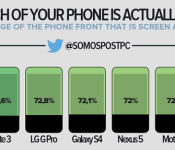
Which smartphone has the largest screen-to-phone-size percentage?
 For some smartphone enthusiasts, screen-to-phone-size percentage, that is, the ratio of the phone’s front that is screen and not bezel, is as important when choosing a phone as any hardware specification, and to a certain degree, that’s true. Devices that have thinner bezels do generally look quite attractive, and this of course means that the phone’s overall size will have been minimized while still maximizing the size of the screen. And when your phone is going to have at least a 5-inch screen, that is going to make all the difference. So exactly which smartphone has the largest screen-to-phone-size percentage?
According to @somospostpc’s infographic, the phone that has the honour of best screen-to-phone-size is the LG G2 with 75.7%, which shouldn’t come as much of a surprise considering how minimal its bezels are. As you look through the names on the infographic, what you will notice is that the newer phones do generally have a higher screen-to-phone-size ratio which is pretty much what you want when you’re getting the monstrous Note 3′s and LG G2′s of the smartphone world. What you will also notice is that even the best of the iPhones, the iPhone 5S, languishes down the order with a screen-to-phone-size ratio of just 60.6%. Just saying…

Check out the full infographic above and tell us what you think: did you see any surprises? Let us know your thoughts on screen-to-phone-size percentage in the comments below.
Source: Twitter via Phone Arena

New Samsung Galaxy S5 concept looks awfully Nexus with a side of TouchWiz
 Yesterday, Samsung teased what looked like what the icons on its new Android KitKat TouchWiz interface might be, and they looked like a significant departure from what we’re normally used to in TouchWiz UI‘s. As is usually the case, some diligent designers have been working around the clock to come up with new mockups that feature the teased icons, like this latest Samsung Galaxy S5 concept from Jinesh Shah which appears to make use of the icons we saw yesterday.
 Despite using the coloured icons from yesterday’s teaser, the appearance of the UI is overwhelmingly reminiscent of a Nexus device running stock Android given that the device has on-screen buttons; as is Samsung’s penchant, we’re expecting the Samsung Galaxy S5 to have the trademark physical home button which should be accompanied by capacitive buttons. That’s not to say it’s a 100% sure either, and I think many of us would love to think the Galaxy S5 might have a simple and clean UI like in this concept. It’s always nice to dream…
What do you think about Shah’s Samsung Galaxy S5 concept? Think the next TouchWiz UI will look anything like this? Let us know your opinion in the comments below.
Source: Behance via Concept Phones

HTC’s leaked ‘Desire 8’ mid-ranger looks big and beautiful

Despite HTC’s recent blast of Desire phones, the company admitted that it still needs to push harder in the lower price tiers. Lo and behold, here’s a leak of an upcoming “New Desire 8″ series mid-range device, courtesy of Chinese site MyDrivers and with confirmation from our own sources. This dual-SIM phone will reportedly pack a 5.5-inch display of unknown resolution, which will make it the largest non-flagship HTC phone since the Desire 700. There will also be a 13-megapixel main camera (not UltraPixel), along with a 5-megapixel front imager with beautification mode. We’re assuming that this is a plastic body — available in white, red, yellow, orange and cyan — with stereo front-facing speakers, which is now a signature feature on many HTC phones. But where are the Android buttons? Chances are this Desire model is joining the M8 flagship to embrace on-screen keys, despite their absence in this render.
The screenshot mentions “March 18th” plus Beijing, so unless Peter Chou is messing with us here, we’ll be making ourselves available that day for the launch event in China. Having said that, we might also get to see it at MWC in two weeks’ time, so stay tuned.
Update: A reliable tipster sent in the original image, so we’ve updated this article with it.
Filed under: Cellphones, Mobile, HTC
Source: MyDrivers

The FCC is working on a plan to fix net neutrality, save the internet

Remember when Verizon skewered the FCC’s net neutrality rules? It may have won the battle, but Tom Wheeler doesn’t believe that the carrier has won the war. The FCC chief has let slip that he’s working on a plan to reinstate provisions for a free and open internet in the near future. He’s backed by five Democratic senators, who are urging the head to be swift in restoring balance to the force US communications business. The belief is that, in order to get around the loophole Verizon used to such good effect, the commission will simply reclassify broadband providers as common carriers, liable to the same regulation covering phone companies. It wouldn’t go down well with Big Red and the like, but at least it’d hamper their evil plans to penalize you for that Netflix subscription.
Filed under: Internet, Verizon
Via: Electronista
Source: CNET
 AIVAnet