



Life’s good at Lenovo: shipping tons of tablets, making lots of money

Lenovo may be the world’s biggest PC maker, but it’s clearer than ever that much of the company’s growth now comes from mobile. The Chinese tech giant has reported a 30 percent year-over-year jump in its calendar fourth quarter profit ($265 million) that’s owed partly to massive spikes in non-PC shipments. Its smartphone deliveries grew by 47 percent to 13.9 million, and its tablet volume tripled to 3.4 million — apparently, the Yoga Tablet has been flying off the shelves. The combined mobile units were enough to eclipse computer shipments of 15.3 million, and “PC Plus” devices (phones, TVs and tablets) represented 16 percent of its total revenue versus the 11 percent from late 2012. That’s no mean feat when Lenovo just managed to rake in its highest-ever revenue, at $10.8 billion. And remember, this is all before the company finishes acquiring Motorola’s phone business; its best times may still be ahead.
Filed under: Cellphones, Desktops, Laptops, Tablets, Lenovo
Source: Lenovo

Apple’s New Vision for Apple TV ‘Less Ambitious’ Than Before
 Apple’s plans for its revamped Apple TV have been scaled back compared to what the company had previously planed, reports The Wall Street Journal. According to the publication, the company was originally approaching media companies directly to obtain content rights for an ambitious a-la-carte-Internet-enabled TV box.
In the current discussions, which involve at least two big media companies, Apple envisages working with cable companies, rather than competing against them, the people said. For programming, it would rely on cable providers to acquire programming rights from media companies, rather than acquire them on its own, the people said. Apple might consider seeking some rights directly in the future, one of the people said.
Apple has been trying to negotiate with companies like CBS and Disney to offer their content directly to Apple’s customers over the Internet, cutting out cable and satellite providers like Comcast, Time Warner and DirecTV. However, the media companies have constantly pulled out of negotiations, fearing that any potential deal with Apple could damage their revenue streams.
The company’s ambitious plans went further, as Apple hoped to erase the distinction between live and on-demand TV, allowing users to watch any show at any time via iCloud as well as being able to skip commercials. In addition, Apple explored the possibility of paying media companies more for ad-free TV.
Instead, Apple is asking content providers for the last five episodes of any given show rather than an entire season. The structure is similarly used by Hulu and is considered a standard amongst TV show streaming services.
Earlier today it was reported Apple was in negotiations with Time Warner Cable, who is now reported to have been purchased by Comcast. Apple is expected to unveil the new Apple TV in April in preparation for a holiday launch.
     |
CNBC: Comcast will buy Time Warner Cable tomorrow for $44.2 billion

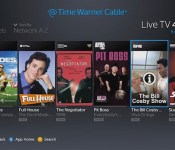
After months of rumors and a public battle with Charter Communications, CNBC reporter David Faber reports that Time Warner Cable will be acquired by Comcast tomorrow. According to sources, the number one cable TV provider in the US make an all-stock deal worth $159 per share (about $44.2 billion) to gobble up the number two provider. Of course, any such agreement would be subject to regulatory approval from the FCC, however Faber indicates Comcast is willing to ditch about 3 million subscribers to make the deal go through. Previous rumors suggested Comcast might split TWC with Charter, but that doesn’t appear to be on the table even after Charter proposed a new board of directors for TWC to get its deal done. Another rumor this might put a stake in is today’s curiously-timed Apple TV leak, although we’ll wait for an official announcement of some kind to judge that.
Comcast to buy Time Warner Cable in all stock deal worth $159 per $TWC share- sources. Deal set for tomorrow morning. Ratio is 2.875 $CMCSA.
– DAVID FABER (@davidfaber) February 13, 2014
Filed under: Home Entertainment, HD
Source: David Faber (Twitter), CNBC

Motorola CEO Dennis Woodside reportedly leaving to join Dropbox

Executive departures (voluntary and otherwise) aren’t uncommon after major acquisitions, and that may well be happening in the wake of Lenovo’s deal to acquire Motorola’s cellphone business from Google. The Wall Street Journal claims that Motorola Mobility CEO Dennis Woodside is leaving the company to become Dropbox’s first Chief Operations Officer. It’s not clear just what would be driving Woodside to take a less glamorous role; we’ve reached out to both companies for comment. If true, the move would bring an abrupt end to Woodside’s brief tenure as Moto’s leader. It wouldn’t be surprising to see him go, however — while he reinvigorated the phone pioneer and helped launch some of its best devices in recent memory, the company’s earnings didn’t follow suit.
Filed under: Cellphones, Mobile, Google, Lenovo
Source: Wall Street Journal, Amir Efrati (Twitter)

Daily Roundup: Lumia Icon headed to Verizon, the Galaxy S 5 and more!

You might say the day is never really done in consumer technology news. Your workday, however, hopefully draws to a close at some point. This is the Daily Roundup on Engadget, a quick peek back at the top headlines for the past 24 hours — all handpicked by the editors here at the site. Click on through the break, and enjoy.

HTC’s Desire 8 leaked
Looks like HTC is ready to make good on its promise to deliver more mid-range handsets. A leak suggests the Desire 8 will pack dual-SIMs, a 5.5-inch display and 13-megapixel shooter. Read on for more.

Nokia Lumia Icon headed for Verizon
Nokia’s new Lumia Icon brings the same flagship experience and specs as the Lumia 1520, just in a more pocket-friendly size. The handset will hit Verizon shelves on February 20th for $200 with a two-year contract. Click through for details.

Google’s Nest acquisition is official
The deal is done! The FTC has cleared Google’s $3.2 billion purchase of Nest and now the company’s founders Tony Fadell and Matt Rogers are free to shift their focus back to making home automation consumer friendly. Follow the link for details.

Samsung on the Galaxy S 5
Samsung’s next-gen handset, the Galaxy S 5, is just weeks away from being announced. We actually already know quite a lot about what to expect from the unveiling. Click the link for the latest on the company’s “back to basics” handset.
Filed under: Misc

LG’s extra-large G Pro 2 packs a 4K video camera and knock code unlock feature

Looks like LG wants to get out ahead of all the smartphone news soon to come from Barcelona at Mobile World Congress, as the South Korean company has officially announced the G Pro 2. As prior leaks indicated, it’s a larger version of the original G Pro — it packs a 5.9-inch screen, as opposed to its predecessor’s 5.5-inch panel. That means the G Pro 2 matches Samsung’s Galaxy Note 3 in terms of size and it packs the same 1,920 x 1,080 resolution display. Additionally, it has an evolution of the G Pro’s knock-to-unlock feature that allows you to unlock and power up the phone by tapping on the screen in a specific cadence.
LG’s latest also has an optically stabilized, 13-megapixel camera and 32GB to store your photos and any 4K videos you shoot at up to 120 frames per second. Plus, it’ll ship with Android’s latest version 4.4 (KitKat) and can be had in three colors: white, silver and black. Naturally, LG has declined to give us a price or a ship date for its new flagship here in the States, but hopefully they’ll give up all those details and more at MWC.
Filed under: Cellphones, Mobile, LG
Source: LG (Korean)

Apple Seeds Sixth Beta of OS X Mavericks 10.9.2 to Developers [Mac Blog]
 Apple today seeded build 13C59 of OS X 10.9.2 to developers, marking the sixth beta iteration of 10.9.2.
The release comes roughly a week after the fifth OS X 10.9.2 beta, build 13C53, and nearly two months after the first OS X 10.9.2 beta.
The update is available to registered developers through the Software Update mechanism in the Mac App Store as well as through the Mac Dev Center.
Apple continues to ask developers to focus on mail, messages, graphics drivers, VoiceOver, VPN, and SMB2. Earlier betas of OS X 10.9.2 began allowing Mac users to block people on iMessage and FaceTime, as can be done in iOS 7, and also introduced FaceTime Audio.
| |

Rovio Teases New Angry Birds ‘Adventure’ Game With New Bird Characters [iOS Blog]
Rovio today tweeted a teaser image of an upcoming Angry Birds game, which it calls “a big adventure with new birds.” Many of the games in Rovio’s ultra popular Angry Birds series have utilized the same group of birds introduced in the original game, each of which has its own special ability.

While the company has added some new birds and modified existing birds for select games like Angry Birds Star Wars, today’s tweet hints at some all new birds for the next Angry Birds game.
Aside from revealing new birds, Rovio’s teaser is short on information. It is not clear when the company plans to release its newest game, except for a vague “coming soon” announcement.
Big adventure with new birds coming soon! #NewAngryBirds pic.twitter.com/DWdZ7fBrXq
— Angry Birds (@AngryBirds) February 12, 2014
Rovio’s Angry Birds series has been wildly successful, garnering tens of millions of downloads and spawning an entire line of merchandise. The company has thus far released eight variations of the original Angry Birds game that debuted in 2009.
| |

NASA’s building a satellite refueling robot platform that works… in space

Currently, every satellite put into orbit will become interstellar refuse, destined to be tracked (and perhaps dismantled) by DARPA or eventually disposed of by gigantic lasers (maybe). Naturally, NASA’s not so keen on such waste, and it knows that many satellites’ shelf lives can be extended with the addition of more fuel. Enter the Remote Robotic Oxidizer Transfer Test (RROxiTT), a project aimed at building a robot platform capable of refilling satellite fuel tanks both on earth and in space.
To make it happen, scientists are working out a method for delivering highly combustible oxidizer (aka a chemical used to ignite rocket fuel) to satellites that were not designed to be serviced. Oh, and they need to be able to do it remotely and safely, of course. And that latter bit is a particular sticking point, as oxidizers are “toxic, extremely corrosive and compressed” according to NASA, which is why the system is being developed for use both on land and in orbit — why put a human in harm’s way when a robot can do the job, right?
Image Credit: NASA
The technology needed is being jointly developed by teams from Goddard Space Flight Center in Maryland, which specializes in building the robotic arms and control systems, and a team from Kennedy Space Center. That team has developed a unique oxidizer and fuel delivery and monitoring system that can safely transfer the propellent. Tests of RROxiTT are ongoing, as its creators are working out the kinks of the system here on earth before they try their luck in space.
Source: NASA

Netflix report suggests Comcast and Verizon FiOS speeds are slipping

Netflix’s latest ISP speed report is out and compared to what we’ve seen before, there are a few surprises. Comcast and Verizon FiOS have dropped quite a bit in the last four months, while Google Fiber is once again at the top of the heap. Neither Comcast nor Verizon have slumped to DSL speeds, but given Comcast’s history with net neutrality and Big Red’s stake in Redbox, some might call their decreased data rates into question. A J.P. Morgan analyst tells Recode that Netflix’s top executives don’t think that the telcos are throttling their users — reinforcing the fine print at the bottom of the report. As The Consumerist points out, last October the streaming juggernaut altered how it measures downloads, which could explain why all of the measured speeds started shifting around then.
If those speeds don’t match your in-home measurements, Netflix explains that the averages are well below peak speeds due to the different encodes used to pump movies and shows to your display, and can vary based on the networking gear in your house. So while the numbers may look discouraging, House of Cards will likely still look fine right where you are.

Filed under: Home Entertainment, Internet, HD, Verizon
Via: The Consumerist
 AIVAnet