


Fitbit Update adds Support for 7 Sony Xperia Z Devices and the Moto G
 For those of you out there that have been waiting long and patiently for Fitbit to gain more device support in the Android world, we are pleased to inform you that they have pushed an update to the app that does just that.
As of yesterday at some point, Fitbit updated in the Play Store and added in a slew of Xperia Z model support.
- Xperia Z
- Xperia Z1
- Xperia Z1S
- Xperia ZL
- Xperia ZR
- Xperia Z Ultra
- Xperia Tablet Z
Along with the update you also now have support for the Motorola Moto G too. The update adds to the list of slowly growing Android device support that was dominated by Samsung and the Droid Razr line mostly. The update also brought some Korean bug fixes and addressed crash reports.
Anyone out there with one of the newly supported devices happen to have a Fitbit available to try it out? If so, let us know if its working out in the comments.


Canon’s new Rebel T5 DSLR camera is unapologetically for beginners (hands-on)

If you’re angling to upgrade from your smartphone or your point-and-shoot to something a little more serious, you’re probably not going to jump for the top model out — unless you have that kind of money. That’s where Canon’s new entry-level DLSR comes in, with 18-55mm kit lens, for $550. The EOS Rebel T5 boasts an 18-megapixel sensor, ISO levels from 100-12800 and all the controls you’d expect to find on Canon’s understandably popular DSLR series. As the entry-level model, however, there’s bound to be some drawbacks — and there were few that we noticed during our short playtime at CP+ 2014. With 9-point autofocus, you can expect some sluggish focusing: many DSLRs have 20 times the number of focal points. Once the camera does latch onto a subject, you can expect DSLR-quality shots.
The Rebel T5 also packs in a consecutive shooting mode, but at three frames per second (hold onto the shutter key while in the right mode, and it captures away), we were hoping for something more. Perhaps we’ve been spoiled by the leaps and bounds made by ILC cameras (including Canon’s own) but the Rebel T5 is best seen as a gentle introduction to Canon’s lens selection and those subsequent camera upgrades.
Zach Honig contributed to this report.

First Xbox One update goes live

Microsoft’s spring update for the Xbox One is here! (Cue triumphant trumpets.) It’s a few days later than anticipated but, as they say, better late than never. The first major update for the console packs a host of improvements, including better Kinect voice recognition, improved all-round stability, and some key fixes to the dashboard — such as onscreen meters for the controller’s battery and free HDD space. You’ll also be able to plug a USB keyboard in, which should make web browsing and searching a whole lot less painful. The update is rolling out to customers during “off-peak” hours in their local time zones. Or as the ever eloquent Larry Hryb put it, “never fear you’ll see it sometime over the weekend.” If you’re taking advantage of Xbox’s Instant On feature, the console will check for an update next time you turn it off.
Filed under: Gaming, Microsoft
Source: Major Nelson

Microsoft Office for iPad Coming ‘Sooner Than Most Think’
Microsoft has been rumored for a number of years to be bringing its Office productivity suite to the iPad, and according to a new report from ZDNet, it is coming “sooner than most think.” Sources have indicated to ZDNet‘s Mary Jo Foley that Office for iPad may even arrive before the “touch first” Windows version that had been reported to be leading the way.
But I hear Ballmer and the senior leaders of the company may have had a change of heart towards the end of last year. According to one of my contacts, Ballmer OK’d the suggestion by the Office team that they’d bring Office for iPad to market as soon as it was ready, even though that would likely mean before the Windows 8 version. I’m hearing that new date for Office for iPad is some time in the first half of calendar 2014. (My sources last summer were hearing Office for iPad wouldn’t debut until Fall 2014.)

Foley notes that it is still unclear in exactly what form Office for iPad will arrive, but it will presumably involve Microsoft’s Office 365 subscription service and potentially integrate with the company’s OneDrive cloud storage. The company currently offers an iPhone app that offers viewing and limited editing capabilities, with the available free of charge but requiring an Office 365 subscription.
     |

iWatch May Use Optical Sensors to Measure Heart Rate and Oxygen Levels
Apple’s iWatch may include optical sensors designed to measure physical functions like heart rate and oxygen levels, according to electronics analyst Sun Chang Xu of Chinese site Electrical Engineering Times [Google Translation], who cites supply chain sources with knowledge of the matter. Xu also indicated that while Apple had planned on glucose monitoring, non-invasive methods have proven to be highly inaccurate and thus may not be included in the final product.
Measuring oxygen levels and heart rate are two features the iWatch has been previously rumored to include and optical sensors, which are used in many medical and health-related products, are a logical choice for the smart watch.
Pulse oximetry devices, which are often designed to fit over a finger, use optical sensors to measure oxygen levels in the blood. These sensors are light-based, sending two wavelengths of light through the skin. Differences in the way the light is absorbed allows the device to detect oxygen saturation in the blood. The majority of pulse oximeters clip to a fingertip or an earlobe, suggesting a wrist-based pulse oximeter is difficult, but not impossible, to develop.
Monitoring heart rate via optical sensor is a newer technology that is incorporated into several fitness products including the Mio Alpha heart rate watch. Typical heart rate monitoring in the past has required a chest strap, but with an optical sensor, a light shone on the skin can be used to measure blood flow through capillaries, thus determining heart rate.
 The Mio Alpha heart rate monitoring watch
MacRumors spoke to Mio founder and CEO Liz Dickinson about the possibility of an optical heart rate measurement tool in the iWatch, and she believes the company would absolutely opt for electro-optical sensing for such a function. She also suggested an iWatch with heart-rate measuring capabilities would need to fit tightly to the wrist.
Having said that, using electro optical sensing requires a very specific type of design in order to work accurately. The sensor needs to be in tight contact with the skin with little ability to move.
Perhaps Apple does not care about accuracy during motion but in any event, at the time readings were being taken even if the person is still, the watch, or band, would need to be flush to the skin.
Electro-optical sensing also requires careful calibration to overcome interference from motion and noise. The Mio Alpha incorporates a built-in accelerometer and noise filtration software to garner accurate readings, and it is possible Apple might adopt some of the same technology.
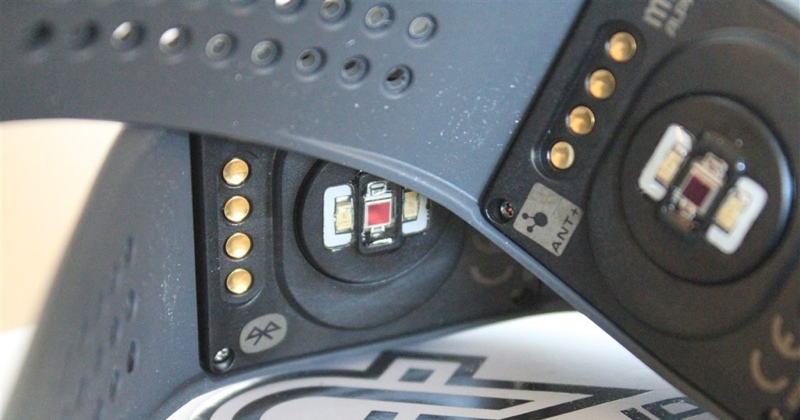 Underside of the Mio Alpha heart rate-sensing watch (Courtesy of DC Rainmaker)
Over the course of the last several months, Apple has hired a number of health experts in fields related to both heart rate monitoring and pulse oximetry. Two executives from pulse-oximetry company Masimo joined Apple, including its former Chief Medical Officer. Several of Apple’s health-related hires have also been from C8 MediSensors, a company focused on non-invasive blood monitoring sensors.
While it is unclear exactly which health-related functions the final iWatch product might measure, rumors have indicated it will include multiple sensors capable of not only measuring heart rate and oxygen level, but also movement, sleep, hydration levels, and more.
| |
Asus Entering the Chromebook Space According to Leaked Info
The Chromebook concept and idea is starting to catch some steam. The lightweight OS paired with fairly lightweight netbook style hardware is a big deal for a number of people who don’t need the clunkiness of Windows when on the go, but still need something that can access everything they need. I know my daughters middle school is very big on Chromebooks and have a couple hundred Acer Chromebooks throughout the campus for school work. It is pretty easy to do write ups, make presentations and more in Drive and simply share it to the teacher.
Currently in the Chromebook world we have a number of various manufacturers, HP, Acer, Samsung and even more recently Toshiba. Seems that more and more manufacturers are seeing the benefits and the growth of Chromebooks and each has their own little twist and take on how it should look, feel and run. Heck, we even know that Lenovo will be launching a Chromebook at some point in time. Up until this more recent leak, Asus hasn’t put anything out. They, of course, have the Nexus 7 along with the more recently announced Chromebox (more of a Chrome OS Set top box for your TV). With the history they have had, and the success they have had, with the various Transformers and PadFone devices, it would only seem natural that one of Google own partners would be creating a Chromebook at some point.
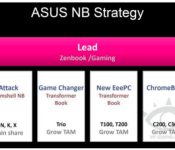
 The recently leaked ‘Asus NB Strategy’ image seen above seems to point to a C200 and C300 Chromebook offering. As always, it is just rumor and speculation built around an apparent leaked image of a future plan. It doesn’t mean a whole lot until Asus announces such a set of devices. However, if Asus is indeed working on a pair of Chromebooks there are a few things I would be interested in having them do. The first be to make it a hybrid style Chromebook. For instance, the Acer C720p was a touch screen. The Chrome OS supports touchscreens. Why not make a Chromebook in the style of the Transformer line with a detachable keyboard. Make it a full tablet style Chrome OS tablet/laptop.
What would you guys like to see Asus accomplish in Chromebook that the current gen models have seeming failed to do for you. Do you want a fully detachable keyboard, ultra long battery life and slot for your Nexus to dock in the back?
Via 9to5Google

Is this a Galaxy S5 Render?

The Galaxy S5 should be showing its pretty face at the end of the month during Samsung’s Unpacked event. Now it seems the very image you see above is floating around the internet with claims that it might be a render of the Galaxy S5. Of course there is no evidence we have that it actually is, and that it probably is just another clever Photoshop job.
What makes me not think this is the Galaxy S5, is the fact that its shape looks like the Nexus 5. If you were to just show the profiles of the two phones, you probably wouldn’t be able to tell the difference. We will let the Photoshop detectives out there take a look at this to determine if its fake or not, but let us know your thoughts about it.
Source: Move Player
Via: Phandroid
In-App Purchases Show Themselves on Web Based Play Store, Finally
It has taken some time for Google to get with the times and start helping people discover if the “free” app, or even paid app, they are about to get has in-app purchases or not. I know it was rather frustrating at times for me when I would install something that looked great to find out that progression would require money spent through the app.
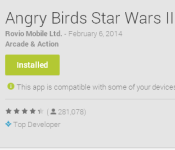
 Google made in-app purchases found in apps pretty easy to identify when browsing and installing through the Play Store on your device, but until now it wasn’t something showcased on the web version of the Play Store. Now, as you can see above, there is a nice little bit of bold text that clearly and easily identifies apps that offer such a thing.
Here is where I find myself in conflicting arguments with myself over the obviousness of displaying that a game or app has in-app purchases. Take the Angry Birds Star Wars II for example. Yes, it has in-app purchases. However, the game is completely playable without spending a penny. Here is the issue that I know fight with in my twisted brain, will more people skip great games because of the in-app purchase branding and move on to a different app, or will the general populous be smart enough to read the description and the comments to find out if the in-app purchase are too extreme and make the game unplayable?
What do you guys think? Are you more apt to skip a game, no matter how many stars and how many downloads if you see that it “Offers in-app purchases”?
Via AndroidAuthority

T-Mobile ‘Jump’ Plan to Require Customers to Pay 50% of Device Cost Before Upgrading [iOS Blog]
T-Mobile is planning to implement some changes to its “Jump” early upgrade program, according to TmoNews. The company has plans to nix the six month waiting period and eliminate limits on how often customers can upgrade their devices, but there’s a caveat – under the new terms, customers must pay off 50% of their existing device costs before being allowed to upgrade. As with the existing program, device trade-in is also required.

Previously, customers could upgrade their phone twice per year after a six month waiting period, without a specific number of payments made on a device. T-Mobile would then cover the cost of the remaining payments, whereas now, the company will only cover 50% of the cost as outlined by a T-Mobile representative.
Whenever you’re ready to upgrade, trade in your device and T-Mobile will pay your remaining device payments up to 50% of the device cost. There is no more waiting period or limit to the number of times you can upgrade per year.
For the entry-level 16GB iPhone 5s, a T-Mobile customer must pay either $648 or $27 a month with a $0 downpayment. Under the existing program, a customer could initially upgrade to a new phone after six months of payments, or $162. A subsequent, second yearly update could be even cheaper for the customer depending on the gap between updates.
Under the plan’s new terms, customers will only be able to upgrade their phones after paying half of the cost of the iPhone 5s, or $324, the equivalent of 12 payments. To upgrade more frequently than once a year, customers will need to shell out additional cash to reach 50% of the device cost.
T-Mobile is allowing current Jump customers to be grandfathered in to the existing plan, which means they will be able to upgrade before paying off half of the device costs.
Along with implementing some changes to the way Jump works, T-Mobile is also adding tablets to the plan.
The changes to Jump will go into effect on February 23.
| |

GoPro’s IPO isn’t about selling cameras, it’s about creating a media empire

It was 2001, more than a decade before GoPro would announce its intentions to go public, and its CEO Nick Woodman was facing a very expensive failure. In just two years, he’d lost nearly $4 million of investors’ money, building a social gaming startup that never took off. Unfortunately for him, he’d arrived at that particular party a little too early, and by his own admission Funbug (as it was called) was “before its time.” With fingers burnt, Woodman decided to get away for a little surfing, and to figure out what he was going to do next. The answer would come during preparations for that trip. He came up with the idea for a waterproof stills camera that he could use to take close-ups of himself and his friends right in the middle of the action. The years that followed would see that humble idea spawn something of an empire.
Nearly 10 years later, and GoPro is still growing. Not only has it recently expanded into Europe, with new offices in Germany, but it also plans to make an initial public offering. So far, the company has been coy about sharing its sales figures, but Woodman has given us some hints. He told 60 Minutes that annual revenues in 2012 had reached more than $500 million; a number he claims doubled each year, and a trend he expected to continue. The question being: Can it continue by selling cameras (and accessories) alone? GoPro’s choice to follow in Twitter’s footsteps and take advantage of the JOBS Act means actual sales numbers will remain a secret for a little while longer, as it shows its books to the Securities and Exchange Commission in private. One thing we can divine, however, is that GoPro didn’t officially reach a billion dollars in revenue as predicted in 2013, as companies with revenue above that amount can’t take advantage of the JOBS Act.
For the uninitiated, Woodman (and his team) makes action cameras. The GoPro is that small silver box you often see attached to a snowboarder’s helmets, a dirt biker’s handlebars and, these days, almost anything you can imagine (even BASE-jumping fashionistas, as above). It’s even become a popular tool in the broadcast industry. GoPro’s first camera was a far cry from the current flagship product though. It was a 35mm camera that used real film. The devices that came after made the switch to digital media and incorporated video functionality. GoPros are designed to withstand all weather conditions, take knocks and blows, survive the most extreme environments (through a protective housing) and (as technology has developed) deliver increasingly high-quality video footage in a very small device. A successful formula for Woodman that hasn’t gone unnoticed.
Where there is success, competition is sure to follow, and GoPro isn’t short of competitors. There are a great many alternatives if you are looking for an action camera; everything from major players like Sony, innovative independents like Drift, older hands like Polaroid and, of course, myriad cheap imitations. What makes the GoPro success so interesting is just how dominant it is in the market despite all that competition. In fact, its brand dominance is so strong that if it hasn’t become synonymous with “action camera” already (like Kleenex or Xerox have with their respective industries), it can’t be far off.

In an interview late last year, we asked Woodman about why his firm is so far out ahead of the pack, and his answer was self-assured: “It would seem that we built a better product, that we built a better value proposition for our customers. The value proposition that we’re trying to deliver to our customers is to remove all of the pain points in capturing and sharing immersive and engaging personal content that other people actually want to watch.”
Whether it’s that simple or not, he’s also wise enough to acknowledge that GoPro has been somewhat fortuitous in the marketing department.
“It’s a snowball of consumer’s enthusiasm, and word of mouth via their viral videos,” Woodman said. “Millions of people around the world capture and share really interesting life experiences, and the result is really interesting content; that becomes a difficult thing for anybody to compete with.” As Woodman points out, the brand has had a far-reaching impact with its Facebook page and other social media channels — including those of individual GoPro owners. These not only continually promote the brand, but also help keep it in the collective consciousness like a steadily burning fire of free publicity.

A popular product, good revenue and an enthusiastic customer base don’t mean there won’t be anything on the negative pile when the traders get their calculators out this summer. Current success is one thing, but for a company to be truly investable, it needs to have a long-term future. GoPro has a massive following now, but how many of those will buy a new camera every year? Will there even be a new camera every year? Technology has a habit of catching up with itself once the initial rapid developments are made (think about how smartphones evolved between 2007 and 2010, compared to 2011 and 2013). Given that most of the competition has access to the same Ambarella chipsets (the engine room in the camera), GoPro needs to keep laser-like focus on maintaining its strong brand loyalty, and smart use of the most engaging content.

Put another way, as much as GoPro sells cameras and an ever-growing portfolio of accessories, it also sells a lifestyle. Or as Woodman explains, “It’s not awesome just because it’s brilliant hardware, or a brilliant device. It’s awesome because of what it has enabled this person to do, and how it has made them feel. Then they think about how they did this, and think, ‘God I love my GoPro.’” This part of the business — the lifestyle aspiration, further fueled by user content — is the next well to tap. As it becomes a challenge to differentiate at a hardware level, GoPro has an option not available to its competition: become a platform as well as a product.
As anyone who’s flown Virgin America recently knows, GoPro has already entered the content game with the launch of its in-flight TV channel. We learned at CES that the channel is already set to expand, thanks to a deal with Microsoft that will bring it to Xbox One and Xbox 360 owners around summer — just in time for that IPO. It’s not hard to imagine that GoPro is already exploring other distribution routes. Woodman himself knows only too well that the content opportunities are nearly endless, potentially free and ripe to be put to use. “People have so much of their footage stored on SD cards that they never share,” he said. “We could make the argument that less than 5 or 10 percent of GoPro content is actually shared.”

At the moment, GoPro curates everything on its channel — but it’s clearly aware of the large, untapped store of media out there. Not to mention the apparently tireless appetite for it (reportedly at least one video per minute is uploaded to YouTube from one of Woodman’s cameras). Red Bull, a brand that rubs shoulders with GoPro in terms of audience, has been in the media game for a long time with magazines, events, cross-platform video and more. It’s been so lucrative for the drink-maker that it’s actually developed a whole separate business — Red Bull Media House — to focus on it. Woodman’s advantage? There’s not much of a market to buy an energy drink through your browser, TV or app.

The big question today, however, is: Will all of Woodman’s hard work (and that of his team, shown above accepting an Emmy) pay off when it floats on the market this summer? You can never predict with complete accuracy, but there are certainly many things in its favor. First, and most importantly, the company is already making money, something that puts it way ahead of Twitter, which announced its IPO in September last year. Second, GoPro makes a real-world product. Facebook, that other social powerhouse, and its intangible product famously had something of a stuttered start when it went public. Lastly, it’s got all the hallmarks of a burgeoning media company, which is no panacea, but it’s certainly an area that sets the stage for ongoing expansion. If, somehow, it doesn’t work out, though, we hear there might finally be some money to be made in social gaming.
 AIVAnet