


‘Loop Fob’ Allows Swipeless Credit Card Purchases at Any Traditional Swipe Terminal [iOS Blog]
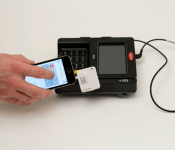
While Apple is reportedly working hard on its own mobile payment service, Boston-based startup Loop has just released its own mobile payments device — one that works at most traditional U.S. retail outlets. The Loop Fob is a small device that allows users to store credit card information on the iPhone, and then wirelessly pay at any traditional magnetic stripe reader.
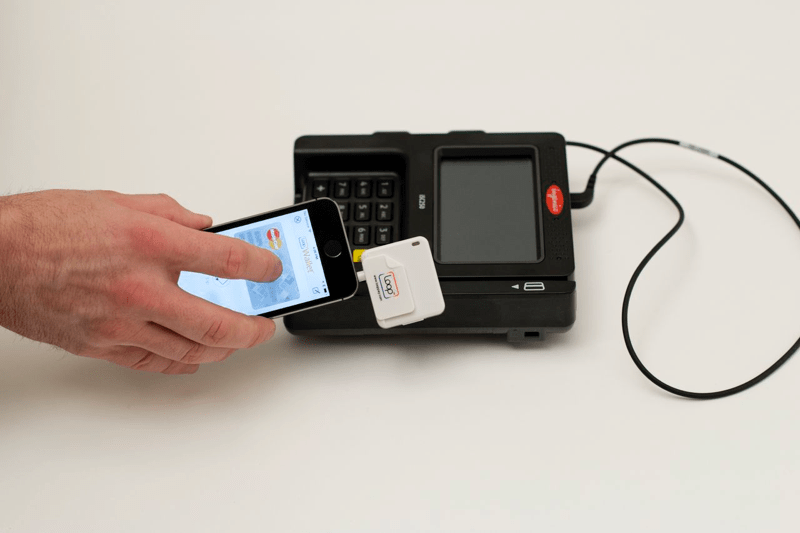
It uses “Magnetic Secure Transmission” to create a small magnetic field via an inductive loop. That magnetic field is detected by the read head of a traditional swipe credit card reader, fooling the device into thinking a normal credit card has been swiped. As a result, the device allows any credit card to be digitally stored in an iPhone and used as needed. It’s a direct competitor to the Coin prototype electronic credit card that attracted attention last year, only it’s been released to the world already. Loop recently took a $10 million funding round based on the success of its Loop Fob Kickstarter campaign.
The Loop Fob can be used while attached to the iPhone, or it can store a single card and be used separately at restaurants and bars. The company says payment data is encrypted and stored on the Loop Fob device, and no credit card info is ever stored on the iPhone.
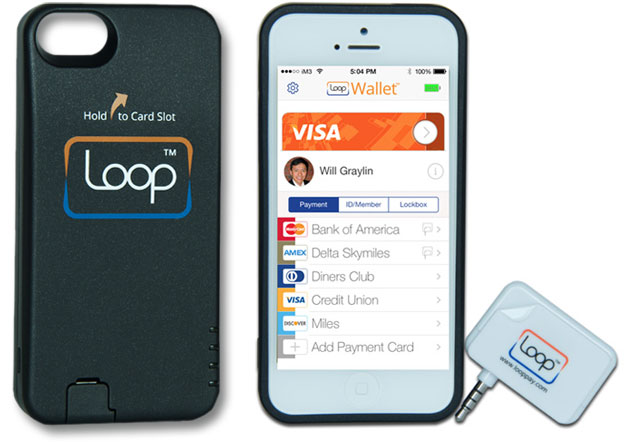
Loop also has a dedicated $99 iPhone case in the works which will be released later this year. It will allow Loop owners to make touchless credit card payments without needing a separate hardware device. All the necessary technology will be built into the iPhone case. The fob will still be used to read credit cards for storage, however.
With its patented technology, payment card data is encrypted and stored in dedicated hardware secure memory, within the Loop Fob or any Loop enabled device. Partnering with payment card issuers, Loop’s technology can also generate dynamic card data every time a payment is made, making such data unusable for those trying to clone a card. Its contactless chip does not wear out and fits into virtually any form factor that consumers want to carry – from smartphones to fobs, to charge cases, to smart watches, the possibilities are limitless.
The LoopWallet app can be downloaded from the App Store, while the Loop Fob adapter can be purchased for $39. The $99 Loop iPhone case will be released later this year.
     |
Square Teams Up With Product (RED) for Special Edition Reader to Fight AIDS [iOS Blog]
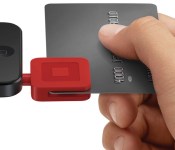
Mobile payments company Square has partnered with AIDS charity Product (RED) to introduce a new special edition “SQUA(RED)” card reader. The reader, which is bright red, is available for a $10 donation with 97.25 percent of that cost going directly to the Global Fund to fight AIDS.
Along with donating funds to charity, Square’s new reader allows customers who swipe their cards to learn more about the project and donate to Product (RED) directly from their emailed receipts.

“Square already helps millions of local sellers run and grow their business, and now with SQUA(RED) Reader, we’re empowering them to raise awareness for an important cause and help save lives in the process,” said Jack Dorsey, CEO of Square.
Apple has a long history with Product (RED) and has sold red-themed devices and accessories in support of the charity for many years. Most recently, Apple’s senior vice president of design Jony Ive teamed up with designer Marc Newson to create a range of products to benefit Product (RED), including a one-of-a-kind red Mac Pro. The duo raised over $13 million, adding to the $65 million Apple has raised for Product (RED) over the last several years.
| |

Following court defeat by Verizon, the FCC will rework its net neutrality rules

More than a month after the bulk of its net neutrality rules were struck down in a case against Verizon, the FCC has announced that it will not appeal the ruling. The court decision was a significant victory for Verizon, as it essentially validated the company’s right to favor some types of internet traffic (and services) over others, leaving it free to block or slow down websites such as Netflix.
Though the FCC won’t appeal the ruling, a spokesperson said chairman Tom Wheeler will work to establish new rules that prevent service providers like Verizon from charging companies a fee to get the highest performance speeds. These rules would work around the issue that got the FCC into a bind in the first place: its classification of broadband providers exempts Verizon and others from certain regulations that apply to wireless communications carriers. A reclassification of broadband may not be on the table, but new language would strengthen the organization’s authority in regulating the industry. The FCC’s new rules will reportedly debut in late spring or early summer of this year.
Filed under: Networking, Internet, Verizon
Source: CNBC, The Wall Street Journal
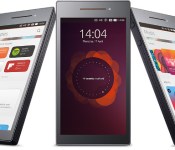
Ubuntu phones arriving in 2014 from Meizu and BQ Readers

Canonical is finally poised to enter the mobile market. After years of teases, promises and demos, the company has locked up the first two manufacturers of Ubuntu phones. Meizu and BQ Readers will be releasing handsets with the Linux-based OS installed on them sometime in 2014. Details about release date, price and specs are still to be determined, but we were told to expect more info at Mobile World Congress (which kicks off this weekend). The list of supporting carriers also remains a mystery, but at least we know that there will be consumer-ready Ubuntu phones on the market before the end of the year. Mark Shuttleworth, Canonical’s founder, is keeping things close to his chest, but he did say that two more manufacturers with “household names” should be coming on board in 2015.
The bad news is that neither of these manufacturers has a large presence in US, so the chances of picking up a high-end Ubuntu phone on Verizon in 2014 is pretty slim. But Meizu is well established in China and should help the fledgling OS build visibility, while BQ Readers has a presence in Spain. Shuttleworth said that part of the reason these two particular companies were chosen was because of their “tactical” method for delivering handsets to specific markets with carefully targeted features and specs.
The next big challenge will be luring developers to the ecosystem. Shuttleworth aims to have the top 50 mobile apps on Ubuntu by the end of the year, which is a noble, but ambitious goal. Right now, big names Evernote, LastPass and Grooveshark are already enlisted, but there’s still a lot of work to do. Presumably Canonical still has a few cards up its sleeve for MWC, so stay tuned.
Filed under: Cellphones, Software, Mobile
Source: Ubuntu

Switched On: The leader, the bleeder and the reader
Each week Ross Rubin contributes Switched On, a column about consumer technology.

Sony recently bid farewell to three device categories. The long-struggling Japanese consumer electronics giant is selling off its PC division, spinning out its TV group into a separate company and getting out of the e-book business by handing it over to Kobo. While each has a unique history, they all demonstrate the difficulties Sony has had in dominating any one category.
Sony’s introduction of the Trinitron in the 1960s accelerated its ascent to the top of the consumer electronics food chain in the following decades. By the 1980s, virtually any TV buyer knew that nothing compared to Sony and the company’s big-screen offerings were bolstered by the arrival of CRT screens that lacked the convex curve of the time. (Back then, curved screens were passé, not leading edge.)
But that all changed with the arrival of the flat-panel. While Sony sets were still regarded as among the best, they were more seriously challenged by old rivals such as Panasonic with plasma, new rivals like Samsung chasing the design and picture quality and Costco kings such as Vizio building a brand at much lower price points. The company tried to play up its HD heritage in noting that so much HD content was captured on Sony professional gear, but consumers could not keep up with Samsung’s advertising and sponsorship blitz. And Sony’s attempt to capitalize on a “3D World” certainly didn’t help when that world ended not with a bang, but with a whimper.
Unlike with TVs, Sony was a latecomer to the PC market that never found footing for its expensive footwear in the US. Along with a clever logo for VAIO that embraced both the analog wave (the “VA”) and digital data (the “IO”), Sony products featured imaginative industrial design and form factors. They not only included astonishingly thin and lightweight laptops and the elongated VAIO P, but also entrants in doomed categories like the cake-like, round home theater PC and the VAIO UX hand-held PC. While the recent allegation that Steve Jobs offered Sony an exclusive opportunity to use Mac OS on its computers was surprising, the surprise was that Apple would have licensed at all, not that the one company chosen would be Sony.

Compared with the TV and PC markets, the e-reader market is a small one. Its decimation at the hands of tablets has been far more drastic than the declines we’ve seen in TVs and PCs. That said, Sony was a pioneer with its original Japanese Librie product and the plainly named Reader in the US. While pricey, it was a hit at launch, selling out in Sony stores in its debut holiday season. Sony followed up with several more models, adding touchscreens and other enhancements. However, it missed the integrated cellular connectivity that Amazon added. That, plus the retailer’s built-in audience of book enthusiasts, quickly escalated the Kindle to the top of the e-reader category.
As Sony hands off its digital bookstore to Kobo, the company might have been more successful had it partnered with Barnes & Noble in the early days, heading off the Nook and allowing both companies to get an early jump on the Kindle. But for now, the tale of the reader is just a shorter version of what Sony saw with the Walkman without the latter product’s long stretch of success.
Ross Rubin is principal analyst at Reticle Research, a technology, media and telecom advisory firm, and founder of Backerjack, which covers crowdfunded product innovation. He blogs at Techspressive.

Apple’s iTunes Festival is coming to the US, and you can stream it live

After seven years of hosting the iTunes Festival in the UK, Apple is at last bringing the concert series to the US for 2014. The music extravaganza will be held in Austin from March 11th through the 15th, running alongside South by Southwest (SXSW). It’s a much shorter run than in the past, but it will include a mix of well-known American and European artists, ranging from Willie Nelson to London Grammar. As you’d imagine, Apple is using the event as a technological showcase; you’ll get to stream live and on-demand performances from both iTunes on the desktop as well as any iOS device. This will all sound familiar to Brits, but it’s big news for Americans that no longer have to skip work just to watch the live shows — even if they can’t make it out to Texas.
Filed under: Portable Audio/Video, Internet, HD, Apple
Source: Apple, iTunes Store, SXSW

BitTorrent’s revamped Android apps let you download just the files you want

If your Android smartphone regularly doubles as a peer-to-peer download machine, you’ll want to check out BitTorrent’s newly overhauled Torrent App and its µTorrent counterpart. Both apps have far sleeker interfaces that offer more control over transfers; you can now choose to grab only the files you want from a torrent, and you can specify where those files will go on your device. It’s also easier for newcomers to get started. Prefer to do all your downloading from a PC? You’re still getting a treat today. There’s new µTorrent desktop software (a BitTorrent equivalent is due next week) that integrates BitTorrent Bundles, letting you easily unlock music and other content from within the app. You’ll find all of the updated clients through the source links.
Filed under: Cellphones, Internet, Software, Mobile
Via: BitTorrent Blog
Source: Google Play (1), (2), BitTorrent
KitKat Update to land for T-Mobile HTC One this week, AT&T Next Week
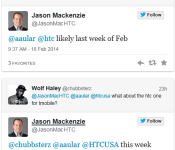
HTC and Jason Mackenzie have been doing a pretty good job of not only getting updates to the latest Android offering out, but also being open and honest about them. While they did miss their 90 targets, it has only been a few weeks off. That certainly beats a couple months off like we have seen in the past. A recommitment to keeping updates for various HTC devices transparent was made just the other day when they announced the new HTC Advantage program. In a recent set of Twitter conversations picked up by HTC Source, HTC’s Jason Mackenzie let the questioning users know when the should expect to see the much anticipated Android 4.4.2 update for the HTC One on T-Mobile and AT&T.
 As you see, Jason offers up no specific date. That is just fine as he states this week for T-Mobile and the last week of February for AT&T. We haven’t seen anyone with a T-Mobile HTC One saying they have the update yet, but it is only Wednesday. When the update does start to roll out though you can expect it to be rolled out in stages and take a few weeks for every owner to see it hit their device.
For T-Mobile users, we suggest you keep an eye on your notifications and keep your device charged up for when it does start going out. WHen we start caching wind of it, we will be sure to let you guys know.
Source: Jason Mackenzie Twitter via HTCSource

Watch Samsung’s new ad campaigns for Galaxy line
Keep an eye on your TV sets over the next few weeks and you’ll likely encounter one of Samsung’s new ad campaigns. Launching today, the latest commercials have a playful, poking tone that doesn’t stray far from previous ads.
Yes, there’s some jokes to be had at Apple’s expense; did you expect otherwise?
The post Watch Samsung’s new ad campaigns for Galaxy line appeared first on AndroidGuys.

Doom 4 re-revealed as ‘Doom,’ beta access coming with new Wolfenstein

Remember Doom, the classic first-person shooter that invented a gaming genre? Though the franchise has taken some (considerable) time off in the past decade, the latest iteration is apparently not far from prime time. Originally named Doom 4, the now (somewhat confusingly named) “Doom” is headed into beta at some point this year; access keys will ship with boxed copies of Wolfenstein: The New Order this May.
As of right now, the only way to get into said beta will be to pick up a copy of Wolfenstein on one of its many platforms (PlayStation 3, PlayStation 4, Xbox 360, Xbox One and PC). As for where the Doom beta will actually be playable is another question altogether: there are no announced platforms for Doom, though we suspect it’ll be on next-gen and PC at very least. It’s also not clear if the game will still be a showcase for id Software’s latest version of id Tech, the engine that powers id games. One thing is for certain: Doom co-creator John Carmack won’t have a hand in this one, as he’s moved on to the wiles of virtual reality at Oculus VR.
 AIVAnet