



Broadcom’s new 5G WiFi chip promises up to twice the real-world speed

It’s great to have speedy 802.11ac WiFi in a smartphone, but the technology doesn’t always live up to the promise; busy hotspots and walls often slow it down. They may not be as much of a problem once Broadcom’s new BCM4354 system-on-chip reaches handsets, though. It’s the first mobile part to combine 802.11ac with 2×2 MIMO (Multiple Input Multiple Output) antennas, giving the wireless signal a more reliable path when there’s a lot of interference. In other words, you’re more likely to get close to the chip’s 867Mbps peak speed — Broadcom reckons that the hardware is up to twice as fast as a 1×1 MIMO design. Whether or not the BCM4354 is that quick in practice, you may not have to wait very long to try it out when the chip is already in production. Just who’s using it isn’t clear, but Samsung is boasting that the Galaxy S5 is the first smartphone to support 802.11ac with MIMO. We’ve reached out to Broadcom to check whether or not the 4354 is inside Samsung’s latest flagship, and we’ll let you know if it can confirm anything.
Filed under: Cellphones, Networking, Mobile
Via: VentureBeat
Source: Broadcom (1), (2)

Get the Samsung Galaxy S5 wallpaper here now!
 The Samsung Galaxy S5 was finally announced earlier today, and despite what you feel about its appearance, it’s definitely the phone for all Android manufacturers to beat in 2014. While the back cover of the Galaxy S5 appears to have drawn the most ire from critics, it’s the front of the device that has caught some people’s eye, in particular, the Samsung Galaxy S5 wallpaper.
Luckily for us, the wallpaper has been making the rounds on the internet, and to save you the trouble of searching for it, we’ve put it here in this article. If you want the full-sized version, make sure you click the embedded picture below:

I don’t think this is quite the real deal as the resolution of the picture only comes out to a resolution of 838×1482; we know the Galaxy S5 is going to be a 1080p device. However, it sure looks the part, and if you’re wanting to get the Galaxy S5 look before you get a hold of the device, throw that wallpaper on your phone, then profit.
What do you think of the Samsung Galaxy S5? Let us know what you like or don’t like about Samsung‘s newest flagship device in the comments.
Source: Google+

US Attorney General wants law requiring notifications after data breaches

Large-scale data breaches have become all too common as of late, and US Attorney General Eric Holder wants to do more than just catch the thieves. He has asked Congress to create a federal law requiring that companies notify their customers after detecting serious intrusions. Holder’s proposal would exempt firms from reporting low-risk breaches, but it would also punish companies that either don’t send a quick alert or haven’t been doing enough to protect data in the first place. The would-be law isn’t strictly necessary when 45 states have notification requirements in place, but it would hold corporations to a similar standard across the country.
Filed under: Internet
Via: PCWorld
Source: Department of Justice

Bing Maps Preview now lets you explore more cities in 3D

Microsoft’s been hard at work on enhancing the Bing Maps experience within Windows 8.1, and it all started with the release of a preview application last year. With one of the focus areas being 3D exploring, Bing has announced that Maps Preview can now provide a 360-degree view of 15 more cities, both from the US and abroad. Here in the States, this includes Montgomery, Alabama; San Francisco, California; Tallahassee, Florida; and Seattle, Washington, to mention a few. Meanwhile, in Europe, Bing has added 3D mapping access to Duisburg and Dresden in Germany, as well as Marbella and Murcia in Spain. The Redmond-based outfit says we can expect the list to keep growing, too, as it is always working to support additional places.
Filed under: Internet, Software, Microsoft
Source: Bing

Facebook shutters its unpopular @facebook.com email service

After three years, Facebook is killing its @facebook.com email service. When it launched in late 2010, Zuckerberg and Co. touted the system’s basic approach to messaging (think: no attachment or CC/BCC features). However, in a statement given to The Verge, the outfit confirmed that barely anyone was using the service. If you did use it, though, don’t fret: any incoming mail will now be forwarded to your primary email address.
[Image credit: Marco Paköeningrat/Flickr]
Filed under: Internet, Facebook
Source: The Verge

Qualcomm cuts the price of its Toq smartwatch to $250

As you may have noticed, the smartwatch space has been heating up — not good news for Qualcomm, whose $350 Toq smartwatch has been one the more expensive wearables on the market. The company isn’t sitting still, however, and has just revealed that it quietly dropped the Toq’s price to $250 on February 21st. The chip designer didn’t explain its move, although it’s not hard to see the motivation when watches like the Pebble Steel sit at the same price level. Whether or not the discount helps Qualcomm’s bottom line, those who couldn’t justify the Toq before may want to give it a second look.
Filed under: Peripherals, Wearables
Source: Qualcomm
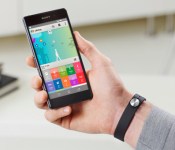
Sony’s Core-equipped SmartBand and Lifelog app arrive in March (video)

We caught a glimpse of Sony’s Core activity sensor back at CES, and it seems the masses will be able to outfit their wrists with one this spring. At Mobile World Congress, Sony announced that the SmartBand (SWR10) that houses the Core and its accompanying Lifelog app will be available in March. If you’re in need of a refresher, the Bluetooth and NFC-compatible activity tracker is waterproof with a micro-USB port and will arrive in only in Black… initially. Color options are set to arrive after launch with a 2014 FIFA World Cup model as part of the group. The Lifelog app is the control center for the Core, collecting your daily stats, tracking sleep, logging places and storing other activity on an Android device. Similar to other activity tracking software, Lifelog allows you to set goals and monitor progress right from your mobile device. When you’re heading out of range or when you need to get out of bed, the SmartBand will alert you to keep things in check. Tweets, emails, calls and other messages will prompt the SmartBand to vibrate as well. When used alongside Sony’s Walkman app, the wearable can be used to play, pause, and skip tracks. Unfortunately, there’s no word on pricing, but we’re sure to get more info on that when the exact release date is announced.
Filed under: Wearables, Software
Source: Sony

Statue Honoring Steve Jobs Destined for Apple Headquarters Unveiled in Belgrade
A bust of Steve Jobs by famed Serbian sculptor Dragan Radenovic was unveiled in Belgrade today, the result of a competition covering more than 10,000 submitted works that will see the statue placed at Apple’s headquarters in Cupertino.
The statue unveiled today is a maquette, a sculpture substantially smaller than the final version for demonstration purposes, that features Jobs’ head at the top, with a pair of Cyrillic letters and the binary digits one and zero. According to a report in the Serbian press [Google Translate], sketches of the proposed status were sent to Apple executives, who said they were very interested in the sculpture and liked “the imperfections of his work”.

The sculptor will head to Apple HQ next to discuss the final version of the statue, which will be approximately 3 to 5 meters in height — 10 to 16 feet — and will be shipped to Cupertino upon completion.
Thanks Ivan!
     |

‘Rogue’ Series6XT Graphics for Future iOS Devices Detailed [iOS Blog]
Back in January, Imagination Technologies announced its next-generation Series6XT graphic architecture, providing a glimpse at the graphics capabilities likely to make their way into Apple’s future A-series chips. Apple, a minority investor in Imagination Technologies, has used the company’s integrated graphics since the original iPhone back in 2007, with Apple’s latest A7 chip using the G6430 Series6 graphics package.

AnandTech has now published an in-depth look at the so-called “Rogue” architecture used in Imagination’s current and upcoming graphics packages. The piece was made possible by Imagination taking a rare step to provide increased transparency about its technology as part of an effort to compare and contrast its offerings with NVIDIA’s highly publicized Tegra K1 processor with 192-core Kepler graphics.
Imagination’s principle blog, Graphics cores: trying to compare apples to apples, opens up with an argument over just what a “core” is and how it should be counted. Imagination doesn’t name any names, but from the context of their blog it’s clear that they’re worried about being in a core war and losing based on who’s counting cores and how.
The article is a fairly technical discussion of how GPUs in general and the Rogue architecture in particular function, but basically it outlines how Imagination is trying to redefine “cores” with respect to its designs. Imagination has historically described its graphics architectures in terms of Unified Shading Clusters (USCs), popularly referred to as “cores” as in the “quad-core” G6430. But with NVIDIA now advertising 192-core graphics, Imagination needs to show how its upcoming six-cluster GX6650 can equal or outperform NVIDIA’s Tegra K1.
Imagination lays out its case for emphasizing the use of more efficient but less powerful 16bit Arithmetic Logic Units (FP16 ALUs) over FP32 (32bit) ALUs in its Rogue pipelines, a move that actually makes for improved overall performance in mobile-focused settings. With the upcoming Series6XT, Imagination has placed even greater focus on FP16 ALUs, improving performance even more. MacRumors forum member chrmjenkins provides an excellent summary of what all of the technical details mean:
In short, Rogue pipelines have wide FP16 (floating point 16 bit) ALUs (Arithmetic Logic Units), which allows them to do many FP16 operations in one cycle. Desktop GPUs have done away with FP16 ALUs all together and usually have 2 FP32 ALUs per pipeline (As does Rogue). This obviously saves space since they don’t waste space with FP16 units, but ImgTec has determined that mobile workloads are better suited to using FP16 ALUs, which right away would make them more efficient since they’re using less power to do a FP16 operation (which would waste power on a FP32 unit). In fact, ImgTec made it so that 6XT can execute even more FP16 operations per cycle with respect to 6, so they must really believe in this solution. 6XT can do four FP16 operations per cycle, in comparison to just the two FP32 operations it can do, along with its competitors.
So, if you have an even number of “cores” with a Rogue design vs. a K1 design, you’re probably talking about more actual throughput for a Rogue design in a mobile environment due to its ability to focus on those FP16 operations.
AnandTech compares the specifications of GX6650 to NVIDIA’s Tegra K1 and Imagination’s G6430 from the A7 chip, showing the significant improvements possible for future iOS devices.

As for when Apple will be able to bring the new Series6XT graphics to its iOS devices, historical data on intervals between announcement of new designs from Imagination Technologies and their implementations suggests that A9 chips in 2015 would be the most likely target, but it is possible that Apple could surprise and bring the new graphics to the A8 later this year. As shown in delivering a 64-bit architecture for the A7 last year, Apple has shown that it is able and willing to be aggressive in its chip designs, and as a significant investor in Imagination Technologies likely is able to press forward more rapidly than other licensees.
| |
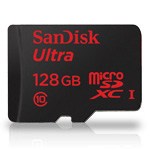
SanDisk Kicks up Mobile Storage with new 128GB Ultra microSDXC

SanDisk has announced a new mobile memory card solution today that might make your jaw drop. Not just for the price tag, but what it is. SanDisk now offers a 128GB microSDXC card.
“The new SanDisk Ultra microSDXC card again demonstrates how SanDisk continues to expand the possibilities of storage so that consumers can benefit from our latest technology advancements,” said Susan Park, director, retail product marketing, SanDisk. “With 128GB of removable storage, consumers will enjoy the freedom to capture and save whatever they want on a smartphone or tablet, without worrying about running out of storage space.”
To put that size into to terms of data, SanDisk sums it up to 16 hours of HD video, 7,500 songs, 3200 photos and more than 125 apps on a single card. The card has a read speed of 30MS/s, class 10 performance, waterproof, temperature-proof, X-ray-proof, magnet-proof, shockproof and has a 10 year warranty.
What will 128GBs of storage on a card the size of your pinky nail set you back? Quite a bit, the new 128GB cards start at $199.99.
SanDisk also announced the iNAND Extreme embedded flash flash drive. The thinnest, fastest and most sophisticated embedded nand storage product from SanDisk to date. These are coming in at 64Gbs and are being sampled in various devices by various manufacturers. Expect to see some new Android powered phones and tablets hitting the 64GB internal storage marker at launch eventually.
 AIVAnet