


Key Benefits of Using HP Laserjet Toners and Cartridges

In today’s business environment, many businesses are looking for ways to save money and remain in the black. There are quite a few office expenses which can be cut, but others that are best left as-is. One of the regular expenses for many businesses is purchasing printing supplies. Starting a business or running a business can cost a lot of money but things like printing supplies are important to your business. Especially when printing your own checks, you must make sure the right equipment is used and it meets the standards. Should you consider refilling your toner cartridge or should you only use new, genuine HP LaserJet toner cartridges? The answer may surprise you.
There is no denying that purchasing new toner cartridges represents a much higher price when compared to refilled cartridges. When you consider the possibility for cartridge failure and the reduction in print quality, many businesses are recycling the empty cartridges and purchasing new. We are going to take a look at 2 different issues that could occur with toner cartridge refills so you can make an educated decision, according to the needs of your company.
Cartridge Failure – Although the toner can be effectively refilled in many toner cartridges, there are other parts of the cartridge that also need to be considered. For example, the print heads of the cartridge, as well as the nozzles will experience some deterioration after the first run and beyond. (Source: http://www.extremetech.com/computing/126821-should-you-refill-your-printers-ink-cartridges-hp-says-no-of-course) This could result in lower quality printing, and the possibility for related issues in some industries. It is always advisable to buy cartridges from the manufacturers or authorized vendors because you can ensure that it meets the standards. Without using authentic toners and cartridges, it affects the printing quality of the check or sensitive documents.
Print Quality – For many of the same reasons why cartridge failure may be an issue, there is also the possibility for a reduction in print quality. Although this may not be an issue with all businesses, high quality printing is essential for others. This is an especially important issue for financial institutions and other businesses that are printing their own checks. Poor print quality could result in checks that do not clear the central banking system, as well as any associated charges. Furthermore, printing your own checks can be dangerous when it doesn’t meet standard quality. Businesses need fraud prevention to protect sensitive data and documents. When the printing quality doesn’t meet the standards, unauthorized person can alter checks or cash out the check without permission.
After carefully considering the pros and cons of refilling your toner cartridges, you will be able to make a decision that is best for your company. Although some businesses will be able to deal with the issues associated with printer cartridge refills, others will certainly want to avoid the problems. You should not avoid problems like choosing a toner or cartridge for your printer because it can harm your business. Think wisely on areas you can or cannot cut business cost.
About the author:
Corey Rogan has worked in the IT industry for a number of years. To learn more about laserjet toners and cartridges visit,http://www.troygroup.com/cm/documents/cartridgewhitepaperrev2007.pdf. Feel free to connect with him over at Google+.

This is how Xbox One’s game broadcasting works

It’s true: Xbox One is getting its long overdue gameplay broadcasting functionality on March 11th, just in time for the launch of Xbox/PC-exclusive multiplayer blockbuster Titanfall. Some folks will get a chance to try out that functionality early through the beta program, but no one outside of Microsoft and Twitch have ready access to the service just yet. That’s not stopping Microsoft from touting the service as, “the first truly next-gen Twitch experience, one that can’t be matched by any other console.” So, uh, what does that mean?
It boils down to two main aspects of Twitch on Xbox One that aren’t available on PlayStation 4: archiving live feeds and the ability to view all of Twitch (read: any game on any game console). The latter ability already exists on your Xbox One; load up the Twitch app and watch any broadcast you want. When the app gets updated on March 11th (yes, there will be one application — Twitch — that handles broadcasting), it gets the ability to broadcast games out as well. Initial setup requires two basic audio/visual choices: if you’re using video, where do you want the picture-in-picture of your face to show up in the feed? if you’re using audio, there are some “basic levels” to work out. Looking to replicate the ease of use of PlayStation 4′s Share button ability? Say, “Xbox, Broadcast!” and you’re there. If you don’t have/don’t want to use a Kinect? That’s less simple.
Xbox Live program manager Chad Gibson tells Engadget it’s question of completing the following steps (from in-game): pushing the Home button, opening Snap, choosing Twitch and jumping back into the game. Not aggressively complicated, but certainly not as simple as the voice command option (or a Share button, for that matter).
Like Twitch on PS4, you can turn off video/audio capture as you wish and toggle comments. Also like the competition, streaming controls can be left or removed as “snapped” along the right rail — should you choose to unsnap it, a “bug” will let you know that recording’s on. And no, despite the HDMI-in ability (not to mention the myriad other media playing options) on Xbox One, you won’t be able to stream anything other than games to Twitch. All our dreams of a CNN-based Mystery Science Theater 3000 knockoff, dashed in one instant!
It’s not clear if Xbox One’s broadcasting has a similarly adorable standby screen to PS4 if you dump to the Dashboard during a broadcast, but it will outright cut off (read: end, non-restartable) if you attempt to load media in place of a game. The broadcast can be restarted, of course, but anyone watching must rejoin and, well, it sounds like kind of a hassle.
Twitch, like the Xbox One’s other software, will evolve as time goes on. We expect to see far more customization abilities in the future, as neither console is coming anywhere close to the level of support offer on PC. For now, though, we’re glad to see competition between Microsoft and Sony driving innovation in console-based broadcasting.

Tesla’s feature-packed Model S tops Consumer Reports’ 2014 auto picks

Tesla’s Model S has scored an inordinate amount of coverage since its inception some five years ago, but there’s perhaps no honor greater than landing the premier spot in Consumer Reports‘ Top Picks. 2014′s award-winning autos also include Toyota’s Prius in the green category and Audi’s A6 in the top luxury slot, but the Tesla Model S scored Best Overall, despite an unfortunate battery fire and that infamous report in The New York Times. Minor setbacks aside, the EV has performed phenomenally in many reviews and safety tests, and with Superchargers now available throughout the US, it’s possible to take the Model S on a cross-country road trip without spending a cent on fuel.
As for this most recent win, Consumer Reports cites the vehicle’s “blistering acceleration, razor-sharp handling, compliant ride, and versatile cabin,” along with its “massive, easy-to-use 17-inch touch screen… totally keyless operation, full Internet access, and ultra-quiet, zero-emission driving experience.” Overall, a very solid achievement for Mr. Musk.
Filed under: Transportation
Source: Consumer Reports

Apple Releases OS X 10.9.2 With Fix for Major SSL Vulnerability, FaceTime Audio
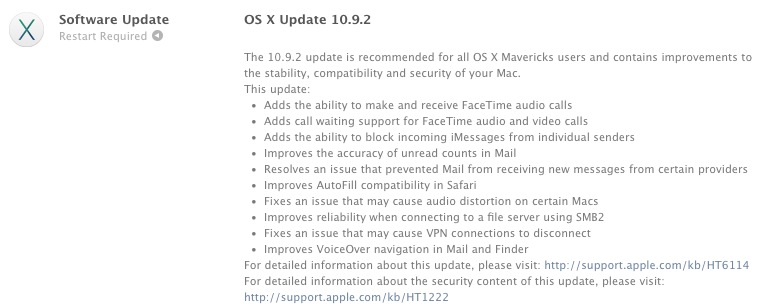
Apple today released OS X 10.9.2, which includes a fix for a major SSL security flaw that first came to light on Friday, after the release of iOS 7.0.6.
The bug, which was introduced in the form of a single line of errant code that allowed an attacker to bypass SSL/TLS verification routines, left OS X users vulnerable to a man-in-the-middle attack. Shared wired or wireless networks could allow an attacker to intercept communications on affected machines, acquiring sensitive information like login credentials and passwords, or injecting harmful malware.
While the SSL vulnerability was first introduced to iOS in 2012, it only affects Macs running OS X 10.9. Lion and Mountain Lion users are not affected.
OS X 10.9.2 was first seeded to developers in December and has seen seven beta iterations since that time. Along with an emergency fix for the SSL bug, OS X 10.9.2 also includes FaceTime Audio and new blocking controls for iMessage and FaceTime.
It is recommended that all users running OS X 10.9 Mavericks upgrade to OS X 10.9.2 as soon as possible to disable the vulnerability.
     |

Engadget giveaway: win one of two Acer Chromebooks courtesy of Karma!

Sure, you share your heart out in food photos and selfies, but providing WiFi to those less fortunate might be more magnanimous. That’s where Karma comes in, with its portable WiFi hotspot that pays you back in data for a bit of bandwidth benevolence. The company has provided two Acer C720 Chromebooks and a pair of its Karma WiFi hotspots (1GB bundles) so that two lucky Engadget readers can join in spreading the connectivity. Those in need can hop onto the shared hotspot using their own Karma account, earning both them and their host a cool 100MB in data. Accounts dictate usage, so you get to keep your own pay-as-you-go data safe, while doing your part in opening up the interwebs to those around you. Just head on down to the Rafflecopter widget for up to three chances at winning. To keep the good vibes flowing, the company is also offering 20 percent off to all Engadget readers for the duration of this giveaway.
- Entries are handled through the Rafflecopter widget above. Comments are no longer accepted as valid methods of entry. You may enter without any obligation to social media accounts, though we may offer them as opportunities for extra entries. Your email address is required so we can get in touch with you if you win, but it will not be given to third parties.
- Contest is open to all residents of the 50 States, the District of Columbia, and Canada (excluding Quebec), 18 or older! Sorry, we don’t make this rule (we hate excluding anyone), so direct your anger at our lawyers and contest laws if you have to be mad.
- Winners will be chosen randomly. Two (2) winners will each receive one (1) Acer C720 Chromebook (C720-2848) and one (1) Karma Hotspot 1GB bundle (201212196301).
- If you are chosen, you will be notified by email. Winners must respond within three days of being contacted. If you do not respond within that period, another winner will be chosen. Make sure that the account you use to enter the contest includes your real name and a contact email or Facebook login. We do not track any of this information for marketing or third-party purposes.
- This unit is purely for promotional giveaway. Acer, Karma and Engadget / AOL are not held liable to honor warranties, exchanges or customer service.
- The full list of rules, in all its legalese glory, can be found here.
- Entries can be submitted until February 26th at 11:59PM ET. Good luck!
Filed under: Announcements, HD, Mobile, Alt, Acer

TiVo’s co-founders want you to use internet video for your own TV network

When TiVo co-founders Jim Barton and Mike Ramsay reunited a couple of years ago to come up with a new venture, they knew internet video was the next big frontier they wanted to conquer. To their dismay, they found it to be a mess. “There are all these different sources of video, and it’s search is just a mess,” says Ramsay in an interview with us. They also discovered that the social aspect of recommendation and sharing doesn’t seem to be as prevalent for videos as it is with music services like Spotify and Rdio.
After some trial and error, the two finally came up with the idea of QPlay, a streaming video service that launches today. According to Ramsay, the driving force behind QPlay is entirely focused on making sure there’s always content you want to watch. At the core of QPlay are “Qs,” which is the company’s term for personalized video streams. Think of them as playlists, but ones that you curate and share with friends. You can create these fancified queues with videos from a variety of sources such as Vimeo, YouTube, Vine, Instagram, Twitter and Facebook. It’s not just limited to adding individual videos either; for example with YouTube, you can create a Q of just your channel subscriptions, and that Q will update automatically each time there’s new content. Right now you can add videos to your Q via a browser bookmarklet, though there might be additional ways to do so in the future.
But that’s only one piece of the puzzle. QPlay itself is composed of three parts: the cloud service that hosts the Qs, an iPad app and an optional TV adapter. As QPlay does not have a web interface at launch, the app is absolutely integral to the service. Aside from watching your own curated Qs on the app, it also offers a set of Qs that are curated by the service itself. These Q categories include News, Sports, Comedy, Photography, Popular (what’s trending on the service) and What’s New, which should be self-explanatory. These particular collections are completely automated and cobbled together from sources such as CNN, MSNBC, Al-Jazeera and CBS. As these categories are automated, the Qs are theoretically infinite — they’re constantly updated with the latest videos.

The real value of the iPad app, however, is the other key idea behind QPlay: Social. With the app, not only can you share your curated Qs (either with the public or just your friends), you can also discover the hand-picked selections of others. You can either select one from your friends, or choose one from the public at large. Simply enter a keyword like “Winter Olympics” or “Stand-up comedy” to find appropriate Qs that others have curated. If you like them, you can drag and drop those Qs right into your own feed so you’ll always know when they’re updated. If only one video in a lineup strikes your fancy, just drag that single clip into a Q of your own.
“These Qs are more sophisticated than a playlist,” says Ramsay. “They can be curated for a specific need, and can be overlaid on anything. The videos can come from anywhere, be assembled by a person or a machine… We’re essentially letting you assemble your own TV network on the fly.”
The third and final component is the tiny TV adapter teased late last year. No larger than a deck of cards, the adapter lets you stream whatever it is on the iPad app over to your television. Simply plug it into a power source, hook it up to your TV via an HDMI cable, set it up over WiFi to recognize your iPad, and away you go. In TV mode, the slate acts solely as a second screen remote. As the Qs and video content are stored in the cloud, you can even shut down your iPad and the stream will continue to be played on your television, so there’s no fear of draining your tablet’s battery.

And that’s not all. At a private meeting in San Francisco, Ramsay gave us a sneak peek at a Netflix application that they’re beta-testing. Yes, you read that right: Netflix. He did a keyword search for “The Hunt for Red October” on the app, and, lo and behold, a result came up with a Netflix logo beside it. He tapped it, and after a few seconds of buffering, the movie came up on the TV. This is what Ramsay calls a premium service, and it’s one of many that’s in the works — he name-dropped Hulu and HBO Go as other possibilities.
Further, the company says it doesn’t need any special relationships with these providers since their architecture uses the same access to metadata as other apps in the wild. “We have the ability to scale this as far as we need to go,” he says. With both the Qs and the premium providers, the goal is that the end-user no longer needs to find the source of what they want to watch. Just as with TiVo, they can just search for it in QPlay, and it’ll be there.
The road to QPlay’s launch has been a long one. On the software side, the team had to figure out how to automatically curate queues. Going out to different sources, placing the newest videos in front of the queue and finding just which social sources to trust has been challenging. The hardware side was even more of an issue. Ramsay didn’t want to get into hardware initially, but after fact-finding missions at Google and other set-top providers, they couldn’t find anything that did what they wanted.

“We concluded we needed something that would work particularly with our Qs,” Ramsay says. “You see, the TV adapter is aware of the Q, the tablet is aware of the Q, and they’re kept in sync with our cloud service — there’s no other device out there that works with queues like we do […] We also wanted the videos to play across multiple applications. It was a thing that nobody else did, that we had to invent on our own.” The end result is a TV adapter whose WiFi design and antenna placement is tailored specifically to their needs. For example, it’s made so that the device needs to be placed in front of the TV for the best possible reception.
All that said, it’s still early days yet for QPlay. In addition to the premium services mentioned earlier, it wants to let you upload home videos eventually. Even live events are on the feature wish list, which would certainly make QPlay stand out amongst the competition. Until then, though, the outfit needs to see if it can muster enough support to grow.
That’s why, as part of its launch, QPlay is offering the iPad app and the TV adapter in an introductory bundle for $49 each, which is being sold immediately on the company’s website on a limited, first-come first-served basis. If you feel like being an early adopter and want to take a chance on a young startup like QPlay, go ahead and hit the source link, or take a quick tour of it with the video demo below. Who knows, this might be viable alternative to those who think the Chromecast is just a touch too simple.
Filed under: HD
Source: QPlay

PlayStation 4 moves just shy of 350K units in first two days at Japanese retail

By Japanese game console launch standards, the PlayStation 4 is off to a great start. In the first 48 hours of availability, Japanese console buyers snapped up just under 350,000 PlayStation 4 systems (322,083 to be exact, according to Famitsu). That’s roughly four times what the PlayStation 3 moved at launch back in 2006 and about six times what Xbox 360 sold in 2005 — not too shabby!
That’s just a drop in the bucket for PS4′s worldwide sales thus far, which crested 5 million last week (well ahead of Sony’s sales estimate for its current financial quarter). It also inches the PS4 ever closer to 6 million units sold worldwide, putting it well over the competition’s (admittedly not recently updated) numbers.
You might be wondering, “Why does this matter to me?” It might not! But it certainly doesn’t hurt your chance of playing more great games if the console makers are doing well and facing stiff competition. It’s like the opposite of the slogan for Aliens vs. Predator: Whoever loses, we win!
Source: Famitsu

Amazon bolsters UK streaming library ahead of tomorrow’s relaunch

Tomorrow, Lovefilm becomes Amazon Prime Instant Video, and unless you take advantage of the various early adopter discounts, it’ll cost you an up-front annual fee of £79. On the upside, the company is pushing to add more TV shows to the service in the hope of clawing back some of Netflix’s lost ground. First up, Amazon has signed a deal with Warner Bros. that’ll see the first seasons of Arrow, The Following and Revolution appear on UK Prime within the next few days. The agreement will also see Hostages and The 100 appear in 2015, with subsequent seasons of all five shows added afterward. At the same time, the retailer has confirmed that UK users will be able to watch its original TV comedy Alpha House, which is a bit like House of Cards, but with more jokes.
Filed under: Home Entertainment, Internet, HD, Amazon

Huawei’s flagship phablet is only $300 in China, and its CMO explains why

Huawei’s recently announced MediaPad X1 has caused quite a stir — it’s the lightest and smallest-ever 7-inch tablet (let alone a phablet), while also packing decent features like a 1,920 x 1,200 display, 5,000mAh battery and 150 Mbps LTE. The retail price quoted at the launch event was €399 or about $550 for the LTE model, but back in China, it appears that Huawei’s slapped an insane discount on the same quad-core tablet, albeit under a slightly different name. Dubbed the Honor X1, the 3G model will retail for just CN¥1,799 or about $290, and the 4G version will go for just CN¥1,999 or $330. That’s a $220 drop for the LTE model! So when we caught up with Huawei Device’s CMO Shao Yang at MWC, we had to ask him: What was he thinking? Well, it’s all about the way consumers perceive this device in different regions.
The exec explained that his company conducted different tests in four countries: China, Germany, Saudi Arabia and Russia. For the China tests, many people identified the X1 as a phone, which isn’t surprising given the increasing popularity of phablets in Asia. Folks from other countries, however, saw the X1 as a tablet that can be used as a phone.
“As Honor is our online brand, we’re saving channel costs and can therefore offer a further deal.”
“Under these circumstances, we priced the device according to the way it’s perceived in each region,” said Yang. “In Europe, the iPad mini with LTE costs about €499 to €599, so our partners are still extremely happy with our €399 price point over there. In China, it’s a special case: the X1 is sold under the Honor brand. As Honor is our online brand, we’re saving channel costs and can therefore offer a further deal.”
Of course, it’s no coincidence that the Honor X1 is priced the same as the Xiaomi Phone 3 — which doesn’t even have LTE, nor storage expansion — and other flagship phones from similar Chinese online brands. It’s apparent that Huawei’s willing to drastically squeeze its margins just to starve its local online competitors, in order to hold or even leap from its number four position in China. But at the same time, you have to also admire Huawei for innovating in the wearable space to reach this goal, and Yang told us to stay tuned for more later this year.
Filed under: Cellphones, Tablets, Mobile

Freescale makes the world’s smallest ARM controller chip even tinier

Apparently, Freescale didn’t think the diminutive Kinetis KL02 was tiny enough — it just unveiled the KL03, the new world’s smallest ARM microcontroller. At 1.6mm by 2mm, the Cortex-M0+ chip is 15 percent smaller than its ancestor. That’s miniscule enough to comfortably fit inside the dimple of a golf ball, folks. Despite the shrunken profile, it’s both easier to program and more energy-efficient. The size isn’t just for bragging rights, of course. Freescale sees the KL03 helping out the internet of things, where a fraction of a millimeter can make a big difference. Companies can’t start using the chip in earnest until it enters full production this June, but it may lead to very compact smart appliances and wearables once it arrives.
Filed under: Household, Wearables
Via: CNET
Source: Freescale
 AIVAnet