



Google looses Chromecast SDK on developers
Google has rolled out the official Google Cast SDK for all developers, which could, in essence, open the door to a bunch of new apps with Chromecast support. Those developers wishing to utilize the tools should note that the SDK has “undergone a thorough overhaul since the developer preview release”. In other words, be sure to read through the documents, notes, and other files before starting up.
Just incorporate the SDK into your existing mobile and web apps to bring your content to the TV. You are in control of how and when you develop and publish your cast-ready apps through the Google Cast developer console. The SDK is available on Android and iOS as well as on Chrome through the Google Cast browser extension.
Is there a particular app or game that you would like to see take advantage of the Google Chromecast?
The post Google looses Chromecast SDK on developers appeared first on AndroidGuys.
Ting lowers off-contract data plans
Ting, a MVNO partner of Sprint, has lowered its data rates on the carrier’s two year anniversary. Nearly every rate plan on the no-contract carrier’s lineup has been dropped; one (XXL) has been removed altogether.
This is not a promotion, these are just our new rates. Current customers do not need to weigh a move to a new plan. New customers do not need to come from any particular provider or sign up for a particular plan. You don’t need to buy a device or make any commitment. We are simply dropping our prices.
Ting, as some readers know, piggybacks off of Sprint’s network and lets users choose their own rate plans based on specific needs. What’s more, it lets users bring a number of previous Sprint devices to their network to be serviced through the Ting brand.
Highlights in the new rate plans include:
- Every data graduation beyond the $3 ‘Small’ is cheaper.
- We’ve dropped the XXL level across the board so pure per-unit pricing kicks in sooner.
- Perhaps most importantly for our heavy data users and business customers, we have dropped the per-unit pricing on megabytes beyond 2,000 from 2.25 cents to just 1.5 cents. That means a gig (or gigabyte or GB) of data is $15 beyond the XL level.
- Finally, just to make sure that jump from XL to unit pricing is a win for everyone, we dropped the pricing on minutes beyond 2,000 from 2 cents to 1.9 cents, raised the ceiling on the XL minutes bucket to 2,100 and raised the ceiling on the XL messages bucket to 4,800. Do the math, I promise it works.
Existing Ting customers will see the new rate plans on the next billing period.
The post Ting lowers off-contract data plans appeared first on AndroidGuys.
WSJ: Sprint chairman, CEO want to meet with FCC
Sprint chairman Masayoshi Son and CEO Dan Hesse are expected to meet with the FCC this week to discuss the potential for a T-Mobile acquisition. The rumors of such a deal, as some know, have been circulating for more than a few months. As to why the duo want to meet with the government, the WSJ says it’s to convince the FCC that it’s better for consumer interest. According to a source, the chairman wants to argue that this would create a real competitor to Verizon and AT&T.
The meeting will cover a range of issues and wasn’t called to discuss a specific transaction…
…yeah, right.
Sprint and T-Mobile are said to be working on a deal which could range from $20 billion to as high as $50 billion. That is, of course, if the U.S. government doesn’t shoot it down first.
The post WSJ: Sprint chairman, CEO want to meet with FCC appeared first on AndroidGuys.

Google Now comes to the desktop in Chrome and Chrome OS betas

Rumblings of Google Now on the desktop first started surfacing back in December of 2012, but it wasn’t until a couple of weeks ago that it actually broke cover. If you were a user of the Canary build of the Chrome browser, you could enable the card alerts by ticking an option buried deep within the recesses of chrome://flags. This week though, Google will bring the desktop version of its virtual assistant to the betas of Chrome on Windows and OS X, as well as Chrome OS. You won’t need to dig through any advanced options; you’ll just need to sign in with the same account you use on your handset — so long as you have Now enabled on your phone. Unfortunately, it sounds like Linux users are left out in the cold for now. Presumably that has something to do with how Now ties into existing notification systems on those other platforms (we’ve asked Google to clarify). With Now hitting the beta channel, enabled by default, it’s only a matter of time before Mountain View brings the feature to the masses. But if you’re anything like us, you’re already using the beta build and are maniacally hitting the update button hoping to be among the first customers it rolls out to.
Filed under: Internet, Software, Google
Source: Google Chrome Blog
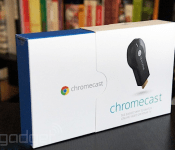
Google finally opens Chromecast SDK, invites developers to get hackin’

The Chromecast is already a pretty easy sell: It’s $35 and brings most of the biggest names in streaming media to your TV with minimal hassle. So, now that Google has opened the SDK to developers, it’s pretty much a no-brainer. While there are no specific apps to announce at the moment, it’s safe to assume the Play store will be flooded with updates soon enough. The SDK will allow coders to add a cast button to their app or site, be it on Android, iOS or in Chrome. The obvious use is for video apps, but there are plenty of other potential options here as well. If a developer decides to create a “custom receiver application” (rather than use the pre-built one provided by Google), they can put any standard web technologies on the big screen. So expect at least a few games and productivity apps to make the jump to Chromecast as well. Imagine firing up a presentation from Google Drive, displaying it on your 4K TV and controlling it with your phone. Or maybe Sony will build a version of Jeopardy where the board and clues are shown on the TV and your handset acts as the buzzer. Obviously, we’re just speculating right now, but if we see those ideas come to fruition, we’ll be expecting a nice royalty check. If you’re more technically inclined, check out the video overview of the Chromecast SDK after the break.
Filed under: Home Entertainment, Software, Google
Source: Google Blog, Chromium Blog

Mobile carrier Ting turns two, celebrates by lowering data prices

What would a birthday be without presents? Instead of receiving gifts, wireless provider Ting is celebrating its second birthday this week unwrapping lower data prices. Most data “buckets” on the service are now a bit cheaper, with the deepest discounts happening for its heaviest users.
While traditional carriers are looking at new and different takes on mobile phone contracts, Ting ditches the idea of having a phone plan entirely. Instead of picking a plan, Ting bills you at the end of the month based on how much (and how) you use your phone. Usage is divided up like shirt sizes (from S-XL); and you’re charged for messages, minutes and data based on your monthly usage. That could equal savings if your mobile mileage varies from month to month and there’s decent Ting coverage in your area.
XL data users already rocking one of the handsets on Ting’s fairly impressive list of supported devices will see the most benefits from Monday’s drop, scoring 100 more minutes and 800 additional messages each month for the same amount. New pricing automatically kicks off for existing customers on their next billing cycle, or for new customers starting today. Check out all the deets after the break.

Filed under: Cellphones, Wireless, Mobile
Source: Ting
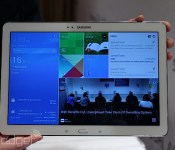
Samsung’s Galaxy Note Pro 12.2 ships in the US February 13th for $850, up for pre-order now

Arriving in the US just in time for Valentine’s Day, the Samsung Galaxy Note Pro 12.2 is set to ship stateside February 13th with an equally beefy $850 price tag. If you’ll recall, the 12.2-inch behemoth was announced back at CES and sports the same S Pen chops as the Galaxy Tab Pro 12.2 outed then as well. The 64GB WiFi version is up for pre-order for folks in the States over at Office Depot, should you be looking for extra screen real estate and don’t mind the added heft that it requires. Need a quick refresher on the device? Take a peek back at our hands-on to do just that.
[Thanks, Matt]
Source: Office Depot
Facebook, Google and Yahoo now say when the US government requests user content

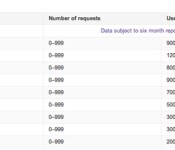
Last week, the US government finally relented on letting technology companies publish more detail about national security requests; today, some bigger firms are taking advantage of the looser rules. Facebook, Google, LinkedIn and Yahoo have updated their transparency reports to reveal the range of FISA requests that covered user content like posts and photos, not just user names and other basic information. As is often the case with national security affairs, there are strict limits involved. The reports still have to cover broad ranges that aren’t very helpful, and reports must be delayed by six months — we won’t get request numbers for the last half of 2013 until the middle of this year. None of the companies are completely happy with the government’s move, and they’ve promised to keep pushing for greater accountability. It’s not a perfect solution, then, but it will shed at least a little more light on the US’ online surveillance activities.
Filed under: Internet, Google, Facebook
Source: Facebook, Google Official Blog, Yahoo, LinkedIn

Facebook’s ‘Paper’ Now Available for Download Despite Protests From FiftyThree [iOS Blog]
First announced last week, Facebook’s new news creation and curation tool, Paper, is now available for download in the United States.
Paper is a news reader that obtains content from a user’s Facebook News Feed and from well-known online news sites and publications. Like competing apps such as Flipboard and Zite, Paper features a magazine-style layout with individual section categories for content.
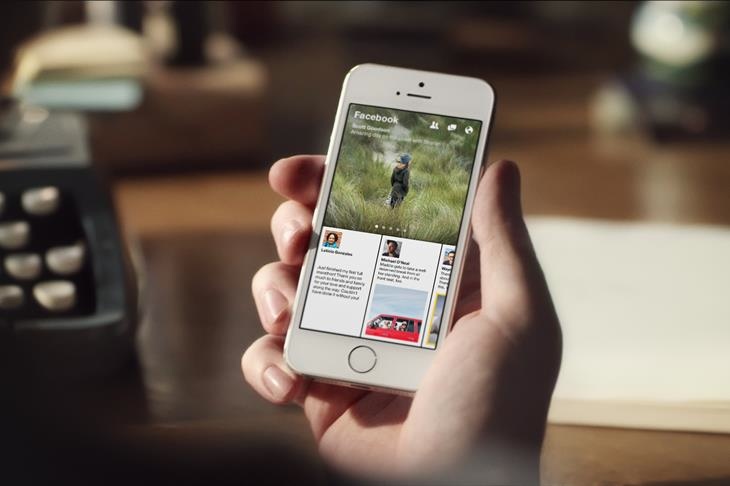
Your Paper is made of stories and themed sections, so you can follow your favorite interests. The first section in Paper is your Facebook News Feed, where you’ll enjoy inspiring new designs for photos, videos, and longer written posts. You can customize Paper with a choice of more than a dozen other sections about various themes and topics—from photography and sports to food, science and design. Each section includes a rich mix of content from emerging voices and well-known publications.
Designed to replace the traditional Facebook News Feed, stories within Paper are card-based and can be flipped through by swiping. Content like status updates from friends appears alongside news stories and photos in a simple layout aimed at enhancing readability.
Though newly introduced, Facebook’s Paper app shares its name with the popular Paper sketching app from FiftyThree, which has been available in the App Store since 2012.
Earlier today, FiftyThree published an open letter on its website, noting its surprise with Facebook’s naming choice. The company asks Facebook to stop using its brand name and to “build a brand name of their own.” According to FiftyThree co-founder Georg Petschnigg, who spoke to The New York Times, Facebook has thus far opted to continue with the app launch.
“We have, in writing, asked Facebook to refrain from using the name,” Mr. Petschnigg said. “But their response was that they apologized for not letting us know sooner, but as it stands, they are continuing with their launch.”
“Paper by FiftyThree” is trademarked in the United States and in several additional countries, which could lead to a legal standoff between FiftyThree and Facebook in the future.
Paper by Facebook can be downloaded from the App Store for free. [Direct Link]
     |

Pebble Debuts New Appstore for Pebble Smart Watches
First announced back in December, Pebble today launched a dedicated Pebble appstore featuring an array of apps that can be downloaded onto the company’s line of smart watches.
The appstore, which functions similarly to other app repositories from companies like Apple and Google, aggregates all of the third-party apps developed for the Pebble Smart Watch. While apps have existed for the smart watch for quite some time, having a central download location will improve content discovery on the device.
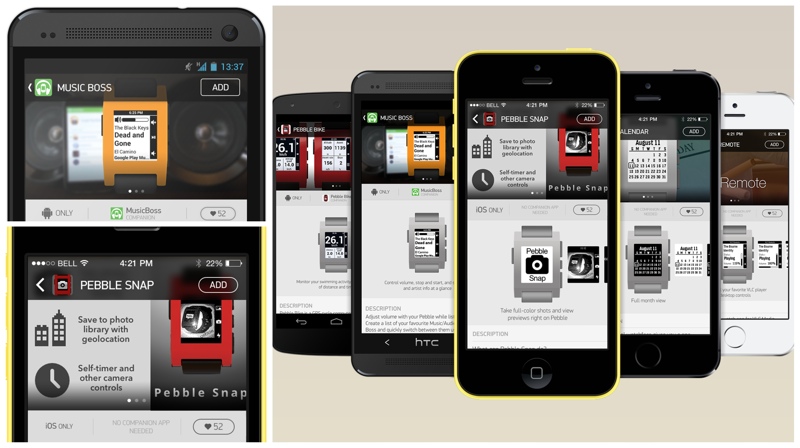
Pebble’s mission is to make products that mesh easily with your life. Until now, Pebble users discovered apps and watchfaces through several awesome third party resources like MyPebbleFaces. The Pebble appstore changes all this by providing a simple one-stop-shop for you to discover, manage, and install apps and watchfaces.
Pebble’s original Pebble Smart Watch and the Pebble Steel can both access the appstore, which organizes apps into individual categories complete with ratings. The Pebble appstore is the first official Pebble app and can be accessed directly on the Pebble watch following an iOS app update that is currently rolling out.
Pebble owners can use the appstore to download and manage their smart watch apps, as the Pebble watches are limited to eight apps each. Though there is an app limit, Pebble does incorporate a Pebble Locker allowing frequently used apps to be installed and uninstalled quickly.
The appstore is organized into six different categories, including Daily, Tools & Utilities, Notifications, Remotes, Fitness, and Games. Like Apple’s App Store, each category features a selection of both new and top apps.
Watchfaces are also available in a separate category and at the current time, all Pebble apps are available for free as the appstore does not support paid applications. Developers can, however, create apps that work alongside an iOS companion app.
More than 1,000 apps are published in the Pebble appstore, including apps from major companies that Pebble has partnered with, including ESPN, Yelp, GoPro, and Foursquare.
As part of its Pebble Steel review, Engadget took an early look at the Pebble appstore and was satisfied with the number of apps available.
As is, we were wholly satisfied with the number and scope of available apps — even in its beta stage, we don’t feel there are any “must-haves” missing.
Pebble’s line of smart watches can be purchased from the Pebble website for $150 to $249. The accompanying Pebble Smartwatch app can be downloaded from the App Store for free. [Direct Link]
| |
 AIVAnet