



Apple Acknowledges Airplay Mirroring Issues for Late 2013 MacBook and Mac Pro on Slower Wi-Fi Networks [Mac Blog]
Apple today released a new support document that offers a solution for Late 2013 MacBook Pro and Mac Pro owners having difficulty with Airplay mirroring when connecting to an 802.11 b or g network.

The company suggests that users who are experiencing issues with dropped connections and frozen images on the television when using Airplay mirroring should turn off Bluetooth.
Turning off Bluetooth can enhance the performance of Airplay considerably. To turn off Bluetooth, locate the Bluetooth icon in the menu bar on the upper-right corner of your screen. Click the icon and choose Turn Bluetooth Off.
While it is unclear how widespread the Airplay mirroring issue is, there have been complaints about Airplay performance with the newly released MacBook Pros on both our forums and the Apple Support Communities. Users have noted both image freezing and significant lag when attempting to use Airplay mirroring.
Complaints about Airplay picked up in November, shortly after the October release of the latest Retina MacBook Pro models. Though there have been few complaints about the Mac Pro due to its limited availability, it is also displaying the same problem.
Because the issue is limited to b or g networks so another fix could include a router replacement supporting the n or ac standards.
     |
Apple Enforces Adobe Flash Player Security Upgrade with Updated Malware Definitions [Mac Blog]
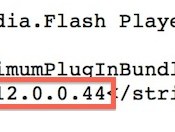
Following Adobe’s release of a “critical” update for Flash Player yesterday to address a security issue that is currently being exploited in the wild, Apple has updated its “Xprotect” anti-malware system to disable older versions of the plug-in. The move forces users to upgrade to the latest version of Flash if they wish to continue using the still-common media plug-in.
 Updated Xprotect definitions requiring new 12.0.0.44 version of Flash Player
Apple’s Xprotect for OS X was introduced as part of OS X Snow Leopard in 2009 as a rudimentary anti-malware system that allowed Apple to block installation and running of the relatively rare cases of known malware targeting Mac systems. By 2011, Apple had upgraded the system to allow users’ Macs to automatically check for updated definitions every 24 hours, ensuring up-to-date protection.
While primarily targeted specifically at malware protection, the Xprotect system also allows Apple to enforce minimum versions of plug-ins such as Flash and Java, and the company has on occasion blocked older versions of both of these plug-ins to ensure that users upgrade their systems.
Apple’s use of the Xprotect system has, however, declined in recent months, perhaps signaling a slowdown in malware and other security issues affecting Mac systems. The most recent significant update to Xprotect definitions prior to yesterday came in mid-September to address the OSX/Leverage.A malware.
| |
Jelly Bean powers three in five Android devices
It’s a new month which means new Android platform figures. We like to check in once every few weeks to see how the Android landscape looks and get a sense for which versions of the platform are growing and which are waning.
According to the latest numbers, Jelly Bean (Android 4.1+) now accounts for 60.5 percent of all devices accessing the Play Store in the last seven days. Gingerbread remains in second place at 20 percent of the platform; Ice Cream Sandwich pulled in 16.1 percent. As for the newest release of Android, 4.4+ KitKat, it’s now at 1.8 percent, up slightly over the last month.
Considering how many Android devices are sold and activated each day, we expect Jelly Bean to hold strong for most of 2014. That is, of course, until the new flagship models begin rolling out. Nearly every major manufacturer has key KitKat models in the pipleline today.
The post Jelly Bean powers three in five Android devices appeared first on AndroidGuys.
OtterBox Preserver case for Galaxy S4 review
The first thing that I noticed about the OtterBox Preserver case for the Samsung Galaxy S 4 is that the size difference between it and the defender case is negligible. Which is great if you’re upgrading, however the cons in moving up are; the back is plastic rather than the grippy rubber of it’s little brother, the back isn’t curved, so it may feel a bit awkward at first, and it doesn’t come with the incredibly stylish belt clip.
In comparison to other waterproof cases, the plugs for the headphone and charging port covers are really nice and easy to open and close, but not to the point of them popping open on their own. However, I did notice that the foam covering the inside of the charging port cover sticks up a little too high, when inserting the device into the case you’ll want to put the bottom in first or you risk ripping that foam off.
When you’re securing the back onto the case, you’ll notice a lot of resistance, there’s a nice gasket going around the inner edge of the back plate. All of the holes are covered by reassuring plastic covers attached by what appears to be more rubber gaskets. The speaker covers are mesh on both inside and outside, presumably with some sort of black magic trapped in between to prevent moisture from getting through.
Opening the case will be frustrating at first, it will make you want a tiny little crowbar you might even be worried that you’re going to damage the case, but once one of the clasps releases, it’s fairly easy to liberate the phone without worrying about accidentally throwing it across the room.
The volume and power buttons are just as stiff as you’d expect from the OtterBox brand, although the home button isn’t quite as hard to depress.
The one thing I was worried about with the size and fortitude of the case was maintaining the functionality of the IR blaster, but it actually seems to work better and more consistently than with any of the other cases I’ve used. As far as the functionality you might expect to be hindered, for the most part, the device behaves the way you’d expect. Speaker and mic during phone calls are acceptable although the earpiece buzzes on low tones. The camera doesn’t seem to be impeded at all, they did the right thing separating the sensor and flash windows. The only one of the port or sensor covers that doesn’t quite live up to expectations is the proximity sensor, it seems to always think your face is next to the device. Literally the moment you tap “call” or “answer” the screen shuts off leaving you to fiddle with your home key to startle the device awake if you need to utilize the display while on a call.
All-in-all, if you’re in need of a waterproof case, and you don’t mind the size of the OtterBox Defender series, At an MSRP of $89.99 this is a totally viable option. It doesn’t offer the color customization options you’ve come to expect from the defender series as the case is only 2 pieces, but to have complete protection is a give and take.
The good:
- The size is comparable to their Defender series
- Strong build quality
- Very small amount of functionality lost
- The price, Sub $100 to protect your $600 phone
The Bad
- The proximity sensor issue might be a deal-breaker for some
- Slight sound distortion from earpiece speaker
The post OtterBox Preserver case for Galaxy S4 review appeared first on AndroidGuys.
Samsung partners with Swarovski for limited edition Galaxy Note 3 cover
“At Samsung, we embrace the creativity of fashion and enable it through our technology. Together with Swarovski, we’re celebrating that creativity with a specially-designed backstage lounge and a limited-edition custom cover for one of our latest smartphones during this season’s Mercedes-Benz Fashion Week. The gorgeous, Swarovski crystal-covered cover adds a glamorous touch to the beautifully designed Galaxy Note 3 to make it the must-have device this MBFW.”
The post Samsung partners with Swarovski for limited edition Galaxy Note 3 cover appeared first on AndroidGuys.
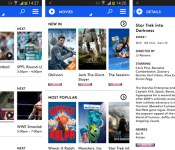
Sky’s Now TV beta lets you stream shows on most Android devices

Android-toting Sky subscribers won’t have to worry about what hardware they use to catch up on their favorite shows. The British broadcaster has just launched a new Now TV beta that runs on most devices using Android 4.0 or higher, including tablets like the Nexus 7. It also introduces support for the £5 Entertainment Month Pass, which offers 10 live channels that include Comedy Central and Sky1. You can still use the earlier Now TV app if you’re running an older Android version, but don’t count on the software hanging around — Sky plans to phase it out later this year.
Filed under: Cellphones, Home Entertainment, Tablets, HD, Mobile
Source: Google Play, Now TV

Panasonic reverses its fortunes amid electric vehicle boom

Not every struggling company story has to have a depressing ending. Though its troubles are far from over yet, Panasonic has just announced 73.7 billion yen ($730 million) in net earnings for Q3. That’s up 20 percent over last year, a disastrous period that saw nearly $10 billion in full-year losses and painful company-wide layoffs. While those cuts are finally helping the bottom line, Panasonic also said it’s no longer relying on its consumer electronics division for profits. Instead, it saw the most growth in the automotive sector, highlighted by booming battery sales to EV makers like Toyota and Tesla — a key part of new president Kazuhiro Tsuga’s strategy. Unfortunately, another part of the plan is to keep eliminating unprofitable divisions until March, 2016. That means the recent death of its much-loved plasma TV unit isn’t the end of the slashing.
Filed under: Transportation

Visitors to Sochi Olympics should expect to be hacked (video)

There’s little question at this point that the logistics in Sochi, from hotel rooms to public infrastructure, are a mess, but one of the greatest threats to visitors is one they can’t even see. According to NBC, it’s a near-guarantee that connected devices are being watched by hackers within Russia, who use malware downloaded on smartphones and laptops to steal personal information. It can be assumed that visiting dignitaries, athletes, and journalists face a particular risk when it comes to unauthorized access. NBC’s Richard Engel came to Russia with brand-new gear littered with fake accounts, testing the waters while limiting exposure to his legitimate data and contacts. The “honeypot” was a success, with Engel’s Galaxy S4, Mac and Windows laptop all compromised within a day of arrival.
If you’re headed to Sochi (or anywhere else in Russia, for that matter), you should exercise extreme caution while browsing the web and opening email attachments. Hackers will likely need to get malware onto your machine in order to easily access files, but with deadline pressures and limited free time to surf online, it may be unreasonable to expect the majority of users to avoid falling victim to these attacks. In fact, many visitors may already be sharing their online movements with hackers, and with the exception of pulling the plug entirely, at this point there’s little hope. According to NBC, the US State Department has informed Americans traveling to the Olympics that they should have “no expectation of privacy” while in Russia. And if a device is infected, it could continue transmitting information back to The Motherland long after tourists return home. At this point, clear tap water and a pillow on every bed may be the most some Olympics visitors can hope for.
Filed under: Internet
Source: NBC
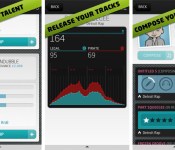
Music Inc. is anti-piracy propaganda posing as a casual game

UK Music and Britain’s Intellectual Property Office don’t believe that most music games tell the whole story — while they show the tunes, they omit labels struggling to find good artists and deal with piracy. To help widen the public’s perspective, they’ve just launched Music Inc. for Android and iOS. The label management game challenges you to foster talent while keeping your company profitable in a market that doesn’t always pay for your songs. The free title underscores a real problem for labels, and it may have you thinking twice about swiping that new album. However, it’s also very one-sided. The game sees every pirated copy as a lost sale, and it doesn’t question the copyright model or the need for labels in the first place. As long as you’re aware of the broader issues, though, it won’t hurt to try the game today.
Filed under: Cellphones, Gaming, Internet, Mobile
Source: App Store, Google Play

NYT: Samsung Galaxy S5 and Galaxy Gear 2 will be announced in three weeks

As Mobile World Congress approaches, it appears to become more and more evident that Samsung has chosen the Barcelona event later this month as the venue to launch the Galaxy S 5. This morning, the New York Times has confirmed through its sources that this will indeed be the case, and it’s going to be quite a bit different from last year’s Galaxy S flagship launch. Whereas last year’s controversial show featured Broadway-style antics and blatant stereotyping, the NYT reports that “Unpacked 2014 Episode 1,” the launch event, will be much more low-key.
The publication also mentions a few details about the device itself. The GS5 will reportedly feature some design enhancements and spec improvements, such as a fancier camera and better processor (we’d wager that we’ll see a 16MP camera and a choice of Exynos 6 or Snapdragon 805), but it sounds like Samsung plans to dial back the number of new firmware features. Curiously, the same sources tell the Times that the S5 oddly won’t come with a bump in display resolution to Quad HD (2,560 x 1,440); if this is indeed the case, it likely means we’ll be seeing a 1080p screen on two Galaxy S flagships in a row. We find this a bit surprising, but we wonder if supply constraints could be a reason why Samsung is holding off for now. The report also claims that we won’t see an eye scanner this time around.
Finally, the Times reports that Samsung isn’t going to wait for its usual yearly product cycle to launch a new Galaxy Gear — apparently, the second version of the smartwatch is also on the Unpacked agenda just a few months after its predecessor arrived. The product’s quick turnaround would certainly be a huge surprise, but given its relatively poor reception and reportedly low sales, it’s not unreasonable to suggest that the company wants to push out a new and improved version as soon as possible.
Filed under: Cellphones, Wearables, Wireless, Mobile, Samsung
Source: NYT
 AIVAnet