



Gaming deals of the week: 2.5.14

For those folks out to nab up a bit of fun this week, we’ve compiled a few gaming deals that will certainly lend a hand. From the latest Call of Duty installment to a 17-inch gaming laptop, we’ve got a variety of picks to suit a range of gamer sensibilities. Browse the options we’ve selected just past the break.
Just window shopping? No worries. Join us and add the gadgets you’re shopping for to your Want list; every time there’s a price cut in the future, you’ll get an email alert!
Alienware 17

Price: $1,600
Regular Price: $1,800
Engadget Score: 87
Buy: Amazon
We gave the Alienware 17 high marks for its gaming performance, solid keyboard/trackpad and build quality. What didn’t we like? Well, we found this 17-incher to only last about three hours into a Battlefield 4 marathon before needing a charge. See for yourself how this beast matches up with the best gaming laptops available with our compare tool.

Nintendo 3DS XL

Price: $170
Regular Price: $200
Engadget Global Score: 82
Buy: Amazon
Nintendo outed the larger version of its 3DS handheld back in 2012, and now it’s now available at $30 less than original sticker price — if you don’t mind the red/black color scheme. The larger screen is the key feature here, but the in-hand feel and improved battery life (under certain conditions) are also welcome improvements. According to our price drop tool, the $170 price tag is on par with the 90-day low for the most part. Want to hold out for a bit? You can keep an eye on the 3DS XL to save a few more bucks by adding it to your Want list.

Call of Duty: Ghosts

Price: $39-$40
Regular Price: $50
Buy: Xbox 360, PS3, Wii U and PC
Released back in November ahead of the new console launches, the latest installment of the CoD franchise dropped $11 on Xbox 360 and PS3 — one dollar less than the PC and Wii U options. Our pals over at Joystiq gave the title 3.5 out of 5 stars (PS4 version).
Ion iCade Core

Price: $13
Regular Price: $100
Engadget Global Score: 84
Buy: Provantage
How about an arcade-like feel for your iOS gaming exploits? Ion’s iCade Core can do just that. The device doesn’t have the retro stylings of the first-gen iCade, but we were quite pleased to find that it worked as advertised. Of course, a modest $13 investment is a minimal risk to give the device a shot. This price is consistent with the lowest we’ve seen in the last three months, thanks to our trusty price drop tool.

Filed under: Gaming
booq Mamba Courier 15″ review
The booq Mamba Courier 15″ bag (grey) is a neatly crafted messenger bag with equal parts versatility and style.
Storage
The 15″ Courier is very roomy and has compartments for pretty much anything you would carry on a daily basis. You can tuck your umbrella, notebook, laptop, tablet, charger, and more inside this bag – all at once.
Build Quality
The build quality on this messenger bag is amazing. I found it to be extremely sturdy and would certainly rank it among the best built bags I’ve spent time with. You can tell that this isn’t your standard run-off-production bag just by the textures and durability.
Lost & Found
Just in case you misplace your booqbag, (something you should never do), booq includes a Terralinq ID. So, if a kind enough stranger finds your booqbag and want’s to do the sincere and proper act of returning to the owner, Terralinq works with the finder and contacts you through a special website available on the bag and booq’s site.
Overall/Pricing
Point blank, this is one of the best messenger bags that I’ve ever used. I have no reservations about recommending this to anyone in the market for a high quality durable messenger bag. The booq mamba courier 15″ is priced at $125.00, I believe that the cost is well worth the quality and care that your bag receives.
The post booq Mamba Courier 15″ review appeared first on AndroidGuys.
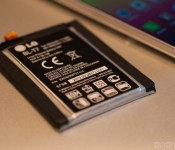
Apple to Use ‘Stepped Battery’ Technology from LG Chem for iWatch
Apple will use lithium-ion batteries supplied by Samsung SDI, Tianjin Lishen Battery, and LG Chem for its upcoming iWatch, reports The Korea Herald. LG Chem in particular produces stepped batteries that are said to offer both greater longevity and greater flexibility, as they can be made in a variety of shapes.
 LG Chem’s Stepped Battery, courtesy of Android Central
“Apple will utilize LG Chem’s stepped battery since it offers better longevity than others and can be applied for different shapes,” a source said, declining to be identified.
A stepped battery is similar to a traditional lithium-ion battery but it also includes an extra ridge or “step” on the back that increases the battery’s capacity. According to LG Chem, the design boosts capacity by 16 percent, which results in three extra hours of battery life in the LG G2 smart phone. Apple would, of course, need to use a much smaller battery, but such a design could help it eke out extra longevity.
Battery life is said to be one of Apple’s major iWatch developmental issues, with a report from last year suggesting the company was seeing just one to two days of battery life in prototype devices. Another January report indicated Apple is still having trouble reaching its target goal of four to five days of battery life.
Along with its efforts to increase battery life, Apple has also been experimenting with a number of effortless charging methods that could make it easier for consumers to charge their devices on a frequent basis. Inductive charging, for example, would allow the iWatch to be charged wirelessly, alleviating the need for a traditional cable charging method. The company has also investigated solar and movement-based charging, but it is unlikely these technologies will be included in the iWatch.
Apple’s iWatch remains in the developmental stages, but the company reportedly has a multitude of employees working on the device. It has hired a number of health and fitness experts in recent months and it appears that the device could include an array of battery-intensive functions and health sensors. It is unknown when the iWatch might be released, but recent reports have suggested that late 2014 could be a target goal, possibly alongside iOS 8 and the next-generation iPhone.
     |

Steve Jobs wanted Sony VAIOs to run Mac’s operating system

If Steve Jobs had gotten his way, that VAIO in your lap could’ve been running OS X, Apple’s operating system. It sounds like fiction, but consider the source: former Sony president Kunitake Ando. The revelation, which stems from an interview Ando gave to Japanese journalist Nobuyuki Hayashi in 2011, highlights the close relationship Jobs reportedly shared with Sony’s co-founder Akio Morita — a relationship that led Jobs to make an exception to Apple’s walled off ecosystem. And according to Ando, it was on a 2001 golf trip in Hawaii that Jobs decided to surprise Sony executives with a version of Mac OS X running on a VAIO, four years before the Intel transition was made public.
As we all now know, that Apple/Sony partnership wasn’t meant to be. For Sony, the proposal was simply a case of bad timing, as it ran counter to not only the success the VAIO line was experiencing at the time, but also the wishes of its engineering team. After having spent so much time optimizing VAIO for Windows, Ando says Sony’s engineering team saw OS X on VAIO as a diversion of resources and were “opposed [to] asking ‘if it is worth it’.” It was because of these two factors that Sony never pursued the prospect of Mac-compatible VAIOs any further.
While we’ll never know the impact Mac-compatible VAIOs would’ve had on Sony’s bottomline today, the news does come at an odd time for the struggling Japanese tech giant. Recently, its VAIO PC division’s been surrounded by rumors of a possible sale; rumors Sony isn’t exactly dismissing as inaccurate. And with Sony now looking to home entertainment and gaming as two key areas for growth, that potential sale seems right in line with the company’s current strategy.
Filed under: Desktops, Laptops, Software, Apple, Sony
Via: The Verge
Source: Nobi.com

Amazon now indulges in your GI Joe fan fiction

Admit it — as a kid, you got a little tired of the GI Joe team winning the battle in every cartoon episode. Wouldn’t it have been nice if Cobra emerged victorious now and then? Thankfully for you, Amazon has just given you the freedom to rewrite your childhood memories: it has reached a deal with Hasbro to sell GI Joe fan fiction in Kindle Worlds. And if you didn’t spend your youth watching animated soldiers, you’ll be glad to hear Amazon has also scored licenses from Warner Bros. and Valiant Entertainment. The arrangements let you post stories set in Veronica Mars, the Pretty Little Liars spinoff Ravenswood and new Valiant comics like The Lizzy Gardner Files. Amazon’s expansion still leaves just 20 Kindle Worlds to choose from, but it should please anyone who wants to give Cobra Commander his due.
[Image credit: Pat Loika, Flickr]
Filed under: Amazon
Via: Kindle Worlds Blog
Source: Amazon

Newegg’s $50 Premier is like Amazon Prime, but without the video streaming

While Amazon’s debating whether or not it should hike Prime subscription fees in the US, now its decision may have to take into consideration a potential competitor. This morning, Newegg introduced Premier, a $50 shipping service that aims to cope with the likes of Amazon Prime. For that yearly fee, Newegg promises to get stuff to your doorstep in three days or less, as well as a number of other benefits including no restocking fees, free returns and dedicated customer service. You will, however, miss out on the Instant Video streaming offered through Prime, but this also means you’ll end up saving $29 per year — which is something that could make sense to folks who are already subscribed to Netflix. Or, there’s always Newegg’s free option, Super Eggsaver; just be prepared to wait a lot longer for your online purchases to arrive.
Via: TechCrunch
Source: Newegg
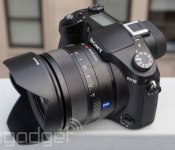
Sony Cyber-shot RX10 review: impeccable performance and versatility make this cam an industry leader

To many photographers — amateurs and professionals alike — digital SLRs represent quality. The fact that you can remove the lens and swap it for another is inconsequential to those who never buy a second optic, and it’s that segment of the market that Sony’s targeting with its Cyber-shot RX10. Everything about the RX10 is DSLR-like — its form factor, built-in EVF, focusing performance and image quality are all on par with many higher-end SLRs — but its mighty 24-200mm lens is permanently attached. By opting for this comparatively inflexible design, Sony’s able to deliver a constant f/2.8 aperture and very high-quality optics in a comfortable package, with a price tag far below what a similar removable lens would command, were it to exist in the first place. The result, put simply, is spectacular, but as $1,300 is at the high end of even deep-pocketed consumers’ budgets, you’ll want to catch our full review before making a purchase.
Hardware

Aesthetically, the RX10 is similar to a digital SLR in nearly every way. There’s a pronounced grip, a top-mounted monochrome LCD, a pop-up flash, a hot shoe (in this case, Sony’s Multi Interface Shoe), dedicated mode and exposure-compensation dials, an XGA OLED viewfinder, a 3-inch 1.23M-dot LCD that tilts up 84 degrees and down 43 degrees and a relatively large SLR-like lens up front. Internally, however, the RX10 is akin to its smaller counterparts, the RX1 and RX100 Mark II. In fact, the 10 features the same 20.2-megapixel 1-inch BSI CMOS sensor as that latter model, which, while still quite large, is smaller than the APS-C and 35mm chips in conventional DSLRs. It also includes Sony’s powerful new BIONZ X processor, which can also be found in the Alpha 7 and 7R, along with Sony’s recently announced A5000.
But back to that lens. The 24-200mm Zeiss Vario-Sonnar T* optic is undoubtedly the star of the show, thanks in no small part to its constant f/2.8 aperture. Why is that significant, you ask? Most zoom lenses, especially those permanently attached to a camera, include variable aperture lenses. While some may let you shoot at f/2.8 at the widest focal length (24mm in this case), you won’t find many point-and-shoots that offer that same aperture at the tele end as well. Typically, a lower-end lens supports apertures no larger than f/5.6 or f/6.3 at 200mm, and with f/2.8 available instead, you’ll be able to snap much sharper images in low light, or shots with creamy bokeh (shallow depth of field) during the day. You still have f/5.6 (all the way up to f/16) at your disposal, of course, directly accessible using the dedicated ring dial around the base of the lens, should you be after different imaging effects, instead.
We’ll speak more to the camera controls in the next section, but there are still plenty more hardware components to explore, too. Sony’s put a lot of emphasis on connectivity with the RX10. On the audio front, you’ll find headphone and mic jacks, stereo microphones up top and compatibility with Sony’s advanced audio accessories using the accessory port that doubles as a hot shoe — for mounting wireless receivers and shotgun mics. There’s an HDMI port with clean, uncompressed output, a micro-USB port for data transfers and charging the camera’s 1,080mAh battery pack (the same cell included with NEX cams and select recent Alphas), a dual Memory Stick/SDXC card slot and a tripod socket on the bottom. The camera is very comfortable to hold, and while it’s heavier than you’d expect, it won’t weigh you down as it dangles from the neck strap.
User interface

Sony hasn’t changed its UI much since the NEX series’ inception in 2010, but like the other RX models and recent Alphas, the RX10 features a tab-based interface that we much prefer. Settings are easy to locate and with everything presented in a linear format, it’s easy to jump from category to category to make all the adjustments you require without first returning to a home screen. Shooting options like file size, ISO and SteadyShot are presented in the first tab; custom key adjustments and display options are in the next tab, followed by wireless-connectivity features, then playback; and finally general settings like volume levels and monitor brightness are in the fifth tab.
There are also plenty of dedicated controls on the camera, so you won’t actually need to spend much time in the main menu at all. A function button to the right of the LCD launches a quick-adjust mode, with direct access to drive mode, flash options, ISO, white balance, metering, et cetera. A display button cycles through different display modes, including a full-screen live feed, an advanced settings panel with histogram and physical alignment indicators and an image preview screen with a comprehensive settings readout positioned at the border. There’s also a dedicated video capture button, a secondary settings dial and a control ring on the rear. Up top, there’s a backlight button for illuminating the monochrome LCD, a flash release button, a user-configurable button, an exposure-compensation dial and a zoom toggle around the shutter release. There’s also a focus-mode selector on the front of the camera, just below the lens.
With built-in WiFi, you can also control the camera using a smartphone or tablet running Sony’s PlayMemories Mobile app. After connecting to the camera’s wireless hotspot, you can only shoot in auto mode through the app — as soon as you connect, auto will override any of the current camera settings. Images are transferred to the connected device immediately after capture. While this is a decent solution for group self-portraits or other tripod shots, due to the lack of control options, we’d recommend shooting directly on the camera then transferring images to the app either from the camera’s playback mode or the live gallery viewer in the app. Wireless connectivity makes sharing images online a breeze, however — your Instagram account will benefit tremendously from the RX10′s large sensor and powerful lens.
Performance and battery life

At launch, Sony’s RX100 came along with an ambitious price tag — $650 was a tremendous sum for a point-and-shoot, particularly one that didn’t look much unlike a model half its price to the untrained eye. But phenomenal performance — for any camera, really; not just a pocketable compact — made this the must-have everyday cam of 2012. You could make the same argument here. The RX10 brings that level of performance to a significantly larger, albeit more versatile form factor. Shutter lag is more or less nonexistent and the camera’s speed overall is virtually flawless. Even wireless transfers are more seamless than we’ve experienced with most other cameras, including past models from Sony.
The camera can power on and capture its first shot in a hair over 1.5 seconds. When moving the frame between a dark wall six feet in the distance and a computer-based stopwatch inches from the lens, the RX10 was able to expose and refocus in about 0.25 second. Meanwhile, in the speed-priority continuous mode, we were able to shoot 20 consecutive JPEGs at nine frames per second, compared to the “approximately 10 fps” that Sony quotes in its specifications. As for transferring images wirelessly, it took 17 seconds from selecting an image on the camera to receiving a 2-megapixel image on the phone, including the time required for the phone to connect to the RX10′s WiFi. Transfers were much speedier when selecting images on the phone instead, as the two were already paired. A 2-megapixel image took about one second to transfer, while a full-resolution shot took just five seconds.
Battery life, as you’d expect from a camera this large, is excellent. The RX10 uses the same cell as every past NEX camera and the recent Alpha mirrorless cams, so you may already have spare NP-FW50 1,080mAh packs sitting around. Cheap knockoffs are available for less than 20 bucks, or you can pick up an OEM Sony model for roughly twice that price — if you’re planning to be away from an outlet for a few days, it wouldn’t hurt to grab a spare. Still, we managed to make it through each full day of shooting with plenty of juice to spare. For the sake of completing this review, we spent two days shooting without recharging the battery. The power meter reflected a 31 percent charge remaining after capturing more than 700 images and five minutes of 720p video, along with several WiFi transfers and a few on-camera image reviews.
Image quality
As if you didn’t already have enough to look forward to with the RX10… Image quality, no surprise, is spectacular. Really, with a $1,300 price tag, we wouldn’t settle for anything less. Regardless of whether you’re shooting in bright daylight or a night street scene lit by a single dim lamp, shots are sharp and free of noise, even at ISO 6400. Video looks fantastic as well, even when captured at night. Let’s take a look at some samples.

The RX10′s fast power-on and focus times make it easy to get the shot. In this case, I heard the helicopter approaching just moments before, and after a quick adjustment on the mode dial, I was able to snap this frame without delay. The exposure and color balance are accurate, and details are relatively sharp (keep in mind that both the chopper and the bird were flying along very quickly).

The tilt-up display and 24-200mm lens give you a lot of flexibility. For this shot, I was able to shoot from the waist and at a distance, allowing me to avoid alerting my subjects. For street photographers, this is a must. Details are very sharp, and while the colors appear muted here, they do accurately reflect the diffused light caused by cloudy conditions in Zurich.

This shot, from a Tel Aviv park, is accurately exposed. Again, colors don’t appear to be terribly vibrant, but they do accurately reflect what I saw at the scene. With the camera selecting a sensitivity of ISO 1250, the noise-reduction processing kicked in, resulting in slightly soft details around the dog’s eyes and nose.

ISO 3200 enabled a sharp capture in this relatively dim alcove in Jerusalem’s Old City. Colors are accurate (if you forgive the abundant fluorescent light), and details (such as the text on a cloth bag) are quite clear and noise-free, despite the high sensitivity.

The RX10′s aperture ring, mounted around the lens, lets you access specific f-stops directly. I selected f/16 for this star sun effect, but the small aperture also resulted in slightly blurry details, as you can see with the electricity poles in the inset image. The frame looks great otherwise though, with excellent exposure and color balance.

The RX10 handled these snowy Zermatt conditions with ease, snapping hundreds of photos on the slopes with excellent exposure. This frame is no exception, and with the aperture set at f/8, details in both the foreground and background are quite sharp. The camera also held up very well in the cold weather conditions — it didn’t skip a beat, even in heavy snow.

Look at that detail! The RX10 is a master of focus and exposure, as evidenced by this shot through a Swiss jewelry store window. Elements throughout the foreground are incredibly sharp, despite the relatively high ISO, while the watches in the background are properly blurred, as you’d expect with an f/2.8 aperture.
Video quality is equally impressive. We shot the majority of our sample clips at 1,440 x 1,080 with MP4 encoding for easy uploads, but the RX10 is able to capture at resolutions of up to 1080/60p with AVCHD encoding. Exposures were spot-on across the board, and even video captured at high sensitivities (ISO 12,800) looked better than expected. We stuck to ISO 3200 for the sample reel, however, which you can see embedded above. You can also click through our full gallery of images below, and download full-res samples for evaluation at the source link.
The competition
As with Sony’s QX10 and QX100 lens cameras, the full-frame Alpha 7 and 7R and even the RX100 Mark II and RX1, the RX10 doesn’t have a lot of competition from other manufacturers, particularly if you’re looking for very similar specifications and performance. That’s not to say you don’t have other options, but if an integrated, fixed-aperture, telephoto zoom lens paired with a 1-inch sensor are what you’re after, there’s ultimately nowhere else to look. You can, of course, opt for a traditional digital SLR, and if you already have a collection of lenses (or you’re planning to build one), an interchangeable-lens camera is probably your best bet.
Canon’s 70D and the D5300 from Nikon both offer serious still photo and video chops, and they include integrated WiFi, to boot. You’ll need to bring your own lens into the mix, and at $1,200 body-only for the Canon and $800 for the Nikon, plus the cost of lenses, you’ll far exceed the RX10′s $1,300 price tag once you’ve added in the necessary optics. As for superzooms, Panasonic’s Lumix FZ200 also includes a lens with a constant f/2.8 aperture, with a whopping 25-600mm focal length, but the 1/2.3-inch 12.1-megapixel sensor is considerably less capable than what you’ll get with the Sony. The FZ200 does have affordability on its side, though — it’ll run you just shy of 600 bucks.
Wrap-up

Ultimately, we love the Sony RX10. In fact, we struggled to populate the cons section down below with anything other than a high price tag. But your $1,300 goes a very long way here, and if you need to capture sharp images and full-HD video clips in pretty much any lighting condition, with a vast focal range, you’d be hard pressed to find a more suitable shooter. This is the best fixed-lens camera we’ve ever used, and we wouldn’t be surprised if the RX10 Mark II, whenever that comes about, is the only comparable model worth considering.
Source: Sample Images (Dropbox link)

Toshiba Chromebook arrives in the US and UK, slightly pricier than expected

Back at CES, Toshiba told us that its new Chromebook would be shipping on February 16th. It appears, though, the company has decided to make it available ahead of time, as the 13-inch Chrome OS laptop is now up for grabs in the US and UK. In a small twist, however, Toshiba is listing the Haswell-powered Chromebook for $300 on its website, a small bump over the $279 price it was announced with earlier this year. That said, retailers like Adorama and Amazon do have it for around $280, so you could still enjoy that lower price after all. Meanwhile, in the United Kingdom, Amazon’s selling the Toshiba Chromebook for £249, with shipments expected to begin February 10th.
Filed under: Misc, Laptops, Google
Via: Android Community
Source: Toshiba

Oculus to co-publish EVE:Valkyrie as launch title for Oculus Rift VR headset

EVE:Valkyrie is no longer just a neat proof-of-concept demo for Oculus’ prototype VR headset — it’s now an exclusive launch title. Today, Oculus announced that it’d be entering into a co-publishing agreement with developer CCP Games to make its space dogfighter one of the Rift’s first AAA “made-for-VR” games.
That Oculus would seek to back EVE:Valkyrie in this way shouldn’t come as much surprise to those following the nascent VR outfit’s saga. The two companies have had a closely intertwined relationship that reaches back to Oculus’ Kickstarter days. So when CCP revealed plans to develop the VR shooter as a standalone title within its EVE Online universe back in August of last year — previously a go-to demo for the Rift — it seemed likely the title was destined for Oculus. At the time, CCP had even mentioned 2014 as a target for the games’ commercial release, a date which coincided neatly with the same vague release window Oculus had set for a commercial launch of the Rift.
Filed under: Gaming
Source: Oculus VR
BBM for Android updated with “find friends” functionality
Blackberry is rolling out an update to BBM for Android and iOS that lets users search and find friends from their contacts. Previously, there wasn’t really a decent way to find other users. Now, it will read your contacts and let you know who is using the service.
Also, if your contacts haven’t yet experienced the wonders of BBM, you can send them a quick (and non-spammy) email or SMS message, inviting them to do so! So, for the few who are using BBM for Android, look for an update sometime this week.
Source: Inside Blackberry
The post BBM for Android updated with “find friends” functionality appeared first on AndroidGuys.
 AIVAnet