


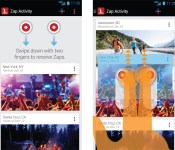
Motorola drops device exclusivity from Droid Zap photo sharing app

Would Twitter, Instagram or Vine be any fun if you couldn’t participate in the social experience? No, probably not. This is the problem that Motorola’s Droid Zap had: it was a unique, localized photo-sharing service that left non-Droid owners out to dry. Users of any Android phone could call up the app and see what other users in a 1,000-foot radius were sharing, but were barred from sharing anything unless their device was Droid-branded. Now, Motorola is finally letting other phone owners become part of the conversation, opening the app’s photo-sharing features to all Android devices. Unfortunately, the full experience still isn’t available to everyone: the new Zap Zone feature (a timed, live and shared photo album) is exclusive to Droid devices, as is the ability to send videos and regular files. Still, with the ability to participate at least a little, non-Droid users finally have a reason to try the app.
Filed under: Cellphones, Mobile
Via: Android Police
Source: Google Play

Here’s a sample of what to expect from Panasonic’s 4K-ready LUMIX GH4

It’s been a mere couple of days since Panasonic unveiled its next-generation GH camera, the LUMIX GH4. But, since there’s no release date information as of yet, chances are it’s going to be a little while before interested parties can take this new shooter out for a spin. Luckily, Panasonic has already let some professionals have their go at its GH4; Hungary, Japan and Northern Kenya are all places where sample photos were taken, and there’s also an incredible 4K video (embedded after the break) that was shot in Yucatan, Mexico. The results produced by Panasonic’s Micro Four Thirds camera are definitely impressive, but we wouldn’t have expected any less from something that could be priced at around $2,000. For more, head to the source link below, where you’ll find the entire set of pictures and some extra behind-the-scenes stuff.
Via: PetaPixel
Source: Panasonic

Weekly Roundup: Satya Nadella named Microsoft CEO, Sony sells its PC business, and more!

You might say the week is never really done in consumer technology news. Your workweek, however, hopefully draws to a close at some point. This is the Weekly Roundup on Engadget, a quick peek back at the top headlines for the past seven days — all handpicked by the editors here at the site. Click on through the break, and enjoy.

Meet Satya Nadella
The speculation has ended. Earlier this week, Microsoft named its enterprise chief Satya Nadella as the company’s third CEO. Like Ballmer, Nadella has history with Redmond, but their personalities couldn’t be more different. Click on through for more about the man tasked with reinventing Microsoft.

Kill-switch for stolen smartphones
The New York Times is reporting that smartphone theft in California is so rampant that lawmakers are stepping up their game. A proposed bill would require manufacturers to include kill-switch measures on all devices. If ignored, companies could receive a $2,500 fine for each handset sold. Follow the link for more.

Experience Rugby with an Oculus Rift
Virtual reality may still be in its infancy, but its influence on entertainment is sure to grow. And to prove it, the UK mobile network O2 and English rugby team combined nine GoPro Hero 3s and an Oculus Rift for the ultimate immersive experience. Click on through for details.

Sony sells its PC business
Sony announced it’s shifting focus toward post-PC products, and unfortunately, part of that decision means the company letting go of its VAIO business. Click through to read more about the sale.

6 Things To Look For When Choosing A Cell Phone Plan
 If you don’t really know what you’re looking for, then every cellular provider might seem good. It’s easy to find a cheap provider or one that offers a lot of data, but how do you find a really good provider that gives you everything that you need? You need to know what to look for. It’s not too difficult, but don’t fall in love with the first provider that you see.
Basic Services
Every provider offers three basic services: minutes, data and text messages. While many people still have feature phones that don’t need a data plan, the majority of devices are smartphones that require all three services.
How much are you getting? Are you getting enough for your basic needs, or will you have to upgrade to a premium plan? You should also check the price to ensure that you aren’t getting ripped off. Some providers charge much more for data than others, so shop around.
While these are the basic services, they are very important because you will be mainly using your phone to send messages, browse the Internet and call people. If the provider doesn’t give you enough resources, or if the prices are just too high, then find someone else.
Tethering Charges
Manydevicnoes function as mobile hotspots that can power your laptop and other devices at the expense of your data plan. This can be very beneficial, but you have to consider the price. Some carriers offer tethering for free, but others can charge between $10 and $40 a month without giving you additional data.
Signal Strength
How is the carrier’s signal strength in your area? Most national brands claim to have total coverage, but this is far from the truth. Not only that, but most people will stay in one general area, so it’s best to find a carrier that really supports your area. There’s no reason to buy a mobile phone if you can’t even call people with it.
The majority of providers will show you a map of their coverage area. Make sure that your area is well canvassed before considering the carrier.
Contract
This has recently become a hot topic. Do you want a carrier that forces you to sign a contract? Most carriers offer you a free or discounted device in exchange for a two-year contract. No-contract providers will give you service at a lower rate, but you have to supply the device.
Contract-based providers tend to have somewhat better service, but you’ll be paying more and the level of service isn’t that much better. No-contract providers are typically half the price, but you must buy an unlocked device. This can mean a high initial investment if you want an iPhone or Samsung Galaxy device.
Phone Selection
If you choose a contract-based provider, then check the provider’s phone selection. For example, many providers can’t support iPhone. Android devices are very common, but be sure that they meet your needs. A good carrier will have a number of modern phones to choose from.
Most no-contract providers sell phones, but what’s more important is ensuring that your device is supported. Some providers are still having a hard time getting used to 4G speeds, and certain Android or iOS smartphones may not be supported.
Overages
How are overages handled? Some carriers will cut your service once you go over the limit with data or text messages, but this has become very uncommon. Most will just charge you an extra fee that is much higher than the normal service fee. For example, you might be charged $10 to $20 per GB of extra data.
If you have an unlimited plan, then you still have to worry about overages. Most carriers have soft limits. For example, you’ll get unlimited data, but only the first 2GB will be at 4G speeds. Check the limits to see if the unlimited plan really supports your needs.
Conclusion
Choosing the right provider largely depends on the basic services and coverage area, but you also need to consider other factors such as overages, supported devices and contracts. Just remember that you might be stuck with your decision for the next few years unless you choose a no contract cell phone plan.
Kim Dotcom’s Mega cloud app for iOS now auto-uploads your snapshots

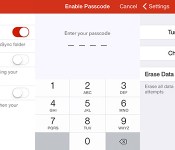
Sure Kim Dotcom recently dropped an album, but that doesn’t mean he’s leaving his other projects to rot. His Mega cloud storage app for iOS just got a refresh, and it now comes with PhotoSync, which enables the app to automatically upload any new pictures you take, just like Dropbox and other backup services. It’s pretty customizable, and you can toggle on cellular data upload in the absence of WiFi, as well as turn on an option that instructs Mega to sync images whenever you change locations. In an effort to protect those images (and other files) from prying eyes, Mega also added a four-digit passcode protection system. It has the power to erase all data after ten failed attempts at guessing the combination, so no nosy friend can see the selfies you took while rocking out to Change Your Life.
Source: iTunes, MegaPrivacy (Twitter)

Verizon-ready Nexus 7 tablet sneaks into stores

Verizon has repeatedly promised that it would officially support the Nexus 7 on its LTE network, only to fall short each time. However, it now seems that a launch really is close at hand — a Droid-Life tipster has revealed that a Big Red-approved Android tablet is making its way into Verizon stores, complete with the carrier’s logo on the box. While staffers can’t sell the Nexus 7 just yet, the arrival supports rumors that the device would be available on February 13th. It’s coming too late for anyone content to use the regular LTE model, but it could be handy as a last-minute Valentine’s gift for the tablet lover in your life.
Filed under: Tablets, ASUS, Google, Verizon
Source: Droid-Life

Meizu’s elusive founder returns to office, promises to lead team to a new start

As Chinese phone maker Meizu approaches its eleventh anniversary come March 14th, its notoriously reclusive founder Jack Wong made a surprise return — in front of cameras, no less — to his company’s Zhuhai headquarters this weekend. Wong, who is now 40 years old, has apparently avoided setting foot in his office for years — he even used to leave home just once a month to get his haircut, and he only held meetings with just a handful of key employees, according to our sources. During yesterday’s recorded Q&A session, the slightly brash yet charismatic exec confirmed this odd little fact, blaming a series of events several years ago that led to exhaustion. But now he’s ready to go full time again, instead of just occasionally posting on his company’s online forum and designing prototypes at home.
“I plan to lead everyone, lead Meizu, lead the whole team to make a new start, to a more extraordinary, more prosperous 10 years,” Wong said in front of his employees.
Wong’s first objective is to get his one billion yuan (about $165 million) funding, which will eventually help him list his company, as well as attracting more talents and developing more connections in the industry. He confessed that finance was never his strong point back in the day, even when Lei Jun, an investor of Meizu before starting rival company Xiaomi, tried to convince Wong that stock options are beneficial to the company and its employees.
“I recall some years ago, when Lei Jun was still at Kingsoft, he told me that even his driver was already very rich (by buying stock). I didn’t quite believe it then, but today, I really believe it,” Wong said, before taking another puff on his cigarette while his team applauded.

Li Nan (pictured above), VP of Marketing and Sales, said earlier that Meizu’s been operating just fine without funding over the last ten years. The exec claimed his company’s selling around 300,000 to 400,000 units per month these days, covering markets in China, Russia (with three flagship stores), Ukraine, Israel, Saudi Arabia and Hong Kong. This year, Meizu aims to crack the North and South American markets, with the former already initiated with e-tailers Light In The Box and Amazon, as well as a Best Buy-like chain store. Li added that while there’s a growing demand for unlocked smartphones in the US, his company’s also talking to the carriers there for potential partnership.
Both Wong and Li confirmed that Meizu will continue its one-year product cycle, while offering a refresh model in between. Shortly after CES this year, Meizu posted a few photos of its flagship MX3 phone running on Ubuntu, which suggests we might see an Ubuntu-powered MX4G — as Wong’s been calling it in his forum — this summer. Li couldn’t comment on this matter when we asked him about this, but he did point out that Meizu fans remained loyal despite the shift from Windows CE on the controversial M8 to Android since the M9. We’ll take that as a hint at a somewhat customized version of Ubuntu on the next Meizu phone.
Looking ahead, Wong said the US is still the top place to be for technology companies, and he hopes to set up an R&D center there to stay ahead of the curve. The founder even joked that had he returned to work full time sooner, maybe it would have been Meizu instead of Lenovo buying Motorola. If you want to see the rare footage of the once media-shy Wong in action (and don’t mind a bit of Mandarin Chinese), then head over to the source link below.
Filed under: Cellphones, Mobile
Source: Sina Weibo, Youku

GoPro files for IPO to become publicly traded company

It’s safe to say GoPro’s camera business is quite successful — and there are plenty of things which prove this to be the case. Still, GoPro doesn’t want to stop there, so much so that it has now started the process to take its (adventurous) efforts to the next level. The company, which is based out of San Mateo, California, recently announced it has formally filed for IPO, indicating that it will be maturing into a public company pretty soon. We can expect more details once the SEC finishes reviewing all the confidential paperwork — for now, here’s the official statement from GoPro:
GoPro, Inc. announced today that it plans to conduct a registered initial public offering of its common stock. The offering is expected to commence after the SEC completes the review process initiated by GoPro’s confidential submission on Friday February 7, 2014 of its draft registration statement.
This announcement is being made pursuant to and in accordance with Rule 135 under the Securities Act of 1933. As required by Rule 135, this press release does not constitute an offer to sell or the solicitation of an offer to buy securities, and shall not constitute an offer, solicitation or sale in any jurisdiction in which such offer, solicitation or sale would be unlawful prior to registration or qualification under the securities laws of that jurisdiction.
Source: GoPro

IRL: Motorola Droid Mini

After a quiet first half of the year, Motorola finished off 2013 by releasing a staggering five devices. Three of them were sold under Verizon’s exclusive Droid brand, and here’s the crazy part: aside from differences in battery life and screen size, they were exactly alike. We reviewed the two higher-end models, known as the Ultra and the Maxx, but we now want to return our attention to the smallest of the three, the Droid Mini. This 4.3-inch device came out a few months ago, but it’s aging quite well, having recently received an update to Android 4.4 KitKat. Also, it’s now free on-contract, so it’s definitely worth a closer look, especially compared to the Galaxy S4 mini which costs $50 with the usual two-year agreement.

The Mini is perhaps the most compelling of the three Droid devices in that it’s smaller than its bigger siblings, but just as good. Indeed, what it lacks in battery size it makes up for in other specs: much like the Moto X and the other Droids, the Mini takes advantage of an X8 system-on-a-chip with a dual-core 1.7GHz processor, 2GB of RAM, a 720p TFT display (which promises a pixel density of 342 ppi), a 10-megapixel rear camera, 16GB of internal storage, wireless charging, NFC, Bluetooth 4.0+LE, dual-band WiFi with 802.11ac and — as of December 19th — KitKat, the latest version of Android.
Is it the device of everyone’s dreams? Not really, but it does a fantastic job of delivering solid performance in a small and inexpensive package — a difficult feat, it seems, now that phone makers are turning more of their attention to handsets with large screens. Just like the Ultra, the Mini sports a layer of woven DuPont Kevlar fiber locked into place by resin and covered by a plastic casing. At 121.3 x 61.3 x 8.9 mm (4.78 x 2.41 x 0.35 in), the Droid Mini is thinner, narrower and shorter than the HTC One mini, and nearly the same exact dimensions as the Galaxy S4 mini (albeit, Moto’s version is a tad shorter). However, it’s also heavier than those other two phones at 4.59 ounces (versus 4.3 and 3.77).
The Mini almost gets lost in my hands, but it’s a perfect size for those of you who don’t want anything larger than five inches. The plastic casing feels a bit cheap, with creaky spots and a slick finish that picks up fingerprints. Needless to say, I would’ve rather seen Motorola simply do away with it altogether, like it did on the Maxx. Still, that doesn’t seem to make the phone any less durable.
Even though this is a Verizon-branded smartphone, Motorola outfitted the Mini with enough radio frequencies to be useful in other parts of the world. In addition to having Verizon-specific LTE, it offers quad-band HSPA+ (850/900/1900/2100), quad-band GSM/EDGE and the requisite CDMA/EVDO bands for use in North America. And because the phone’s unlocked, you’ll be able to stick in an AT&T nano-SIM and get HSPA+ data. I’d love to see more LTE support on the Mini, but that’s the only major complaint I have here.

In general, the Mini offers an experience consistent with the Droid Ultra and Droid Maxx thanks to the large similarity in its specs and user interface. One area in which the Mini completely differs from its siblings, however, is the display. Whereas the Ultra and Maxx both feature AMOLED panels, the LED screen on the Mini is brighter and less color saturated. And thanks primarily to the fact that it uses the same pixel count in a smaller display, it’s actually the sharpest-looking of the three Droids.
It’s worth repeating that the Droid Mini is now running Android 4.4, the latest version of Google’s mobile OS. This is a big deal, because Verizon devices using custom OEM user interfaces often don’t get upgrades to the newest installment of Android, and if they do, it can take a while. But here we have the Droid Mini, whose update came through pretty quick. Along with the usual KitKat features, Verizon also threw in enhancements to the phone’s image quality (better color and less noise), along with Fitbit support and a new version of Droid Zap, Moto’s multimedia-sharing feature. And let’s not forget Moto Assist, a contextual app that automates tasks based on things like your location, scenario, calendar appointment and even speed.
Fortunately, not only will your user experience be the same regardless of which Droid you buy, but the performance will be the same as well. The Mini features Motorola’s X8 architecture, which consists of a dual-core 1.7GHz Snapdragon S4 Pro CPU, Adreno 320 GPU, 2GB of RAM and two cores reserved for natural language processing and contextual computing. Active notifications and touchless control work just as well here as the Moto X and the other Droids, and I experienced very few hiccups and frame skips when gaming and multitasking.

The Droid Mini’s 2,000mAh battery is naturally smaller than on the other Droids. As such, don’t expect it to last more than a day with moderate use. In our video rundown test, the Droid Mini made it through six hours and 45 minutes before needing a recharge, which was just short of the GS4 mini’s results — a bit of a shock, since the Droid’s battery is technically a hair larger. I can’t suggest that you put the phone through a lot of gaming, multitasking and other processor-intensive activities without keeping a car charger or external battery pack near you at some point during your day, but I’m confident you’ll be OK in most scenarios (read: you should have enough juice to get you through the work day).
The Droid Mini may not grab as much attention as the Moto X or the Droid Maxx, but it’s a compelling device for those of you who don’t want to go with a big smartphone, or would simply rather not pay anything for the hardware. Its Verizon branding certainly limits its appeal, since it’s officially only available on one carrier (even though it’s unlocked to GSM SIMs), but if you’re a Big Red customer or a frequent international traveler, it’s not a bad deal for $350 at full retail or free with a two-year contract. The Galaxy S4 mini is also $350 off contract, but agreeing to two years of your life with Verizon will cost $50; for that money you’re getting a worse display, smaller battery, slower GPU, less internal storage (although Samsung at least offers microSD compatibility) and slightly lower camera resolution. All told, this is a great phone if you want a smaller screen and solid specs but can’t afford to pay a flagship price.
Filed under: Cellphones, Mobile, Google

Flappy Bird no longer available from the App Store or Google Play

Oh no! We sure hope you were able to download Flappy Bird before its imminent extinction. Because, as promised, developer Dong Nguyen has officially removed the insanely popular game from both the App Store and Google Play. There’s no need to shed tears if you’ve already installed it, since you can still play it and continue to frustrate over how terribly low your scores are. Even so, it’s a little sad to see Flappy Bird go — especially given that there are probably some people (like this editor’s mom) who never got to experience it. Who knows, maybe it’ll make a triumphant comeback one day.
Filed under: Misc, Gaming, Internet, Apple
Via: MacRumors
 AIVAnet