



Sorry, shredders: Tony Hawk’s new game is a mobile-only affair

After Tony Hawk’s massively popular Pro Skater game series faded into the sunset (and the Ride/Shred series lit that sunset ablaze with nuclear warheads), the world went a few lonesome years without a new Tony Hawk title. 2014 is apparently the year that all changes, as Tony Hawk’s back with a new game headed to mobile phones.
In a wide-ranging Bloomberg interview, Hawk said, “We are working on a game for mobile devices this year, and we’ve never gone exclusively that direction yet.” While the leaves the door open to a wide variety of genres (Tony Hawk first-person shooter? Tony Hawk match three?), we’re betting it’s of the skateboarding variety.
Filed under: Cellphones, Gaming, Handhelds, Software, HD, Mobile
Source: Bloomberg

Bitcoin-Stealing OS X Trojan Now Masquerading as ‘Angry Birds’ and Other Popular Mac Apps
 A Bitcoin-stealing trojan has been detected in downloads claiming to be cracked versions of popular Mac applications, reports security firm ESET through its We Live Security blog. The OSX/CoinThief.A malware was discovered in popular Bitcoin software earlier this month by SecureMac, but is now being used to target users of more mainstream apps.
The trojan initially surfaced on open source software hosting site GitHub, and it was quickly bundled into several Bitcoin apps available through multiple download sites. Further investigation by ESET has now uncovered the trojan masquerading as cracked versions of popular Mac apps such as BBEdit, Pixelmator, Angry Birds, and Delicious Library.
OSX/CoinThief.A involves a malicious browser add-on used to intercept logins for Bitcoin wallet sites and related exchanges such as MtGox, BTC-e, and blockchain.info. Stolen login credentials are then forwarded to the malware’s developer.
There is clearly strong evidence that the trojan was specifically designed to profit from the current Bitcoin craze and fluctuating exchange rates.
According to detection statistics gathered by the ESET LiveGrid, the threat is mostly active amongst Mac users based in the United States.
The websites where these files are being distributed from have not been revealed, but Mac owners can prevent infection by avoiding pirated software and downloading titles directly from the developer’s website or the Mac App Store. Users can find instructions on how to check for and remove the malware on SecureMac’s blog post.
     |
Moov Personal Training Device Tracks and Evaluates Motion to Improve Workout Efficiency [iOS Blog]
The Moov fitness tracker is a new wearable fitness device that is designed to sense both motion and 3D form in order to analyze the wearer’s movement, giving tips to improve physical activities and workouts. It uses 9-axis sensors, including accelerometer, gyroscope, and magnetometer to evaluate form.
Acting as a digital personal trainer, Moov can analyze activities like running, weight lifting, boxing, swimming, biking, and more, providing real-time audio advice and feedback. When running, for example, Moov can monitor cadence and analyze landing impact to prevent injury, and when boxing, it can analyze power and form, matching moves with certified trainers.
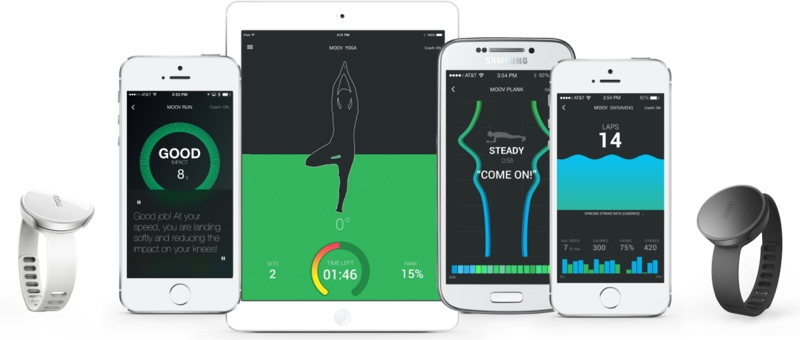
Moov provides a two-fold benefit: firstly, to enable users to maximize their workouts, and secondly, to prevent injuries by providing real-time coaching based on a complex analysis of your body’s position while you are exercising.
Existing fitness trackers in the market today are brilliant in that they help people to become more aware of their activity levels, and with Moov, we want to help you turn your data into actionable insights. Our goal is to give users the same experience with Moov as they would with an actual personal trainer. Well, a close-enough experience. How so? Moov operates like a virtual coach – it “sees” your motion and systematically “tells” you how to correct your form.
After launch, Moov will gain features allowing users to improve yoga workouts through posture tracking and enhance golf games with swing analysis. All data gathered is also stored within an accompanying app, for at-a-glance statistics on workouts and performance.
Moov, designed in collaboration with a former Apple software engineer, is able to be worn in several different locations on the body, including the wrist and ankle, for specialized motion tracking for a range of activities. The device is waterproof and will come in several different color arrangements at launch. Two or more Moov devices can be used in conjunction for improved activity monitoring for actions like boxing.
Moov can be pre-ordered from the Moov website for $59.99, a 50 percent discount off of the standard price. Moov is expected to ship in the summer of 2014.
| |

Your smartphone’s WiFi hotspot might double as a disaster rescue beacon

When disasters strike, communication services tend to go down; you can’t simply call for help or share your location online. However, engineers at the Fraunhofer Institute for Applied Information Technology have found a way to use a smartphone as a rescue beacon when there aren’t any available networks. The researchers have written a victim app that inserts an SOS alert into the name of the phone’s WiFi hotspot. Emergency crews just have to use a companion app to find you up to 330 feet away. It’s a simple trick, to be sure. The big challenge is getting people to use the software in the first place — the team would like its code built into your phone’s interface, but they might have to find a way to distribute their apps in the field. If Fraunhofer’s staff succeed in making the tools commonplace, though, you may soon find a ready-made distress signal in your pocket.
[Image credit: United Nations Photo, Flickr]
Filed under: Cellphones, Networking, Mobile
Via: Gizmodo
Source: New Scientist

British spy agency reportedly collected millions of webcam images from Yahoo users

Britain’s surveillance agency, GCHQ, hasn’t fared much better than the NSA these past several months; the latest leak shared with the Guardian claims that Britain has been collecting millions of webcam images from Yahoo users. What’s more, it appears that these images were used to discover “targets” and match users with existing persons of interest via automated facial recognition.
According to documents provided by Edward Snowden, GCHQ intercepted still images of Yahoo video calls — including those done with Yahoo Messenger — in bulk and saved them as part of a program code-named Optic Nerve. The agency apparently collected these images whether or not users were deemed intelligence targets — in a six-month period in 2008, it amassed webcam pics from more than 1.8 million Yahoo users around the globe. The documents also reveal that these images were collected with the purpose of identifying targets using facial-recognition tools to compare Yahoo users to existing GCHQ targets.
Though the revelation that GCHQ has been collecting and viewing Yahoo user’s private webcam chats is remarkable in and of itself, the agency’s naiveté is also a bit surprising; according to documents, the agency observed that “unfortunately… it would appear that a surprising number of people use webcam conversations to show intimate parts of their body to the other person.” GCHQ reportedly instituted efforts to shield explicit images from its staff, but it doesn’t require a huge leap to understand the privacy issues at stake for Yahoo users who assume their webchats aren’t being monitored.
Yahoo, which has taken measures to protect users in light of recent privacy concerns, told the Guardian it wasn’t aware of this program, and GCHQ has declined to comment. It remains unclear whether Optic Nerve is still up and running, though we’ll be sure to report on any additional leaks if they become available.
Filed under: Internet
Via: The Next Web
Source: The Guardian

EU Meeting With Apple and Google to Discuss Concerns Over In-App Purchases [iOS Blog]
 Apple and Google are meeting with the European Commission to discuss concerns over in-app purchases. The two technology leaders will be asked to provide solutions that protect customers, particularly children, from errant and costly in-app purchases.
Commissioner Neven Mimica, responsible for Consumer Policy said: “Consumers and in particular children need better protection against unexpected costs from in-app purchases. National enforcement authorities and the European Commission are discussing with industry how to address this issue which not only causes financial harm to consumers but can also put at stake the credibility of this very promising market. Coming up with concrete solutions as soon as possible will be a win-win for all.”
The EU commission and other European enforcement authorities will focus on four main issues involving the false advertising of freemium games as “free”, the targeting of children by in-app purchases, the need for explicit consent when processing orders for in-app items and the provision of an email for consumers to contact companies about inadvertent charges.
Apple recently settled with the U.S. Federal Trade Commission and agreed to provide full refunds to parents whose children purchased unauthorized in-app items. Apple also settled a 2011 class-action lawsuit filed by parents whose children racked up hundreds of dollars in in-app charges while playing games like Tap Fish.
Apple introduced in-app purchases in iOS 3.0 and started requiring passwords for these transactions in iOS 4.3 after concerns about over-spending on unauthorized purchases surfaced. iOS owners can disable in-app purchasing completely using the Restrictions feature of iOS.

| |

Google adds the ‘Polar Bear capital of the world’ to Street View

One of the more immediate effects of climate change is that the icy habitats of the Polar Bear are very rapidly evaporating. In an attempt to connect people more directly to the issue, Google and Polar Bears International have teamed up to bring the evidence straight to Street View. Attaching a Trekker Backpack to the charity’s specially adapted vehicle, the pair have mapped the frozen tundra of Churchill, Manitoba, otherwise known as the “Polar Bear capital of the word.” In addition to the harsh landscape, the team have captured a few of the most famous four-legged residents, so if you fancy getting up close and personal with nature, head down to the source link and get looking.
Source: Google Maps, Google Blog

BBC head wants all iPlayer users to pony up the licence fee

The BBC’s budget is getting squeezed, and as such, everyone who uses its service is going to be made to pay up. Lord Hall, the BBC’s Director-General, has announced that he’s pushing to close the famous iPlayer Loophole, adding around £72 million to the corporation’s budget. Currently, only Britons who watch live broadcasts on TV or online have to pay the £145.50 annual fee — but around 500,000 homes avoid the charge by only watching shows after they’ve aired. The move will require approval from government, but we can’t see it resisting — the other option to save money is to axe BBC Four, and that just won’t do.
Filed under: Home Entertainment, Internet, HD
Source: The Times
Google+ updated with new photo editing and management features
Google is currently rolling out a major update to its Android Google+ app which brings some nice features to the photo sharing and management. The update also brings the usual bug fixes and speed optimisations, but the big story here is the added functionality users now get to their photos stored on Google+.
The four major changes that the upgrade brings to Google+ are:
- Non-destructive photo editing across devices — Starting today you can start your edits on one device, and continue (or start over) on another. This means you can backup full-resolution photos from your desktop, edit them in seconds on your phone, then add some finishing touches from your tablet. (And you can revert to your originals at any time!) The technical term for this experience is non-destructive editing in the cloud, and we think you’ll really enjoy it.
- Brand new filters and creative tools — Now when you edit your photos, you’ll have a powerful set of tools (like crop and rotate), 1-touch filters, and Snapseed-inspired enhancements (like Drama, Retrolux, and HDR Scape). Mix and match to make your photos look their absolute best.
- A single view of all your photos — The new ‘All’ view displays your entire photo library — whether it’s on your current device, or backed up in the cloud. If your library is really large (> 10s of thousands of photos), the app won’t show all your photos initially. But stay tuned, because we’re supporting larger and larger libraries over the next few weeks.
- An easy way to browse your photos by date — In addition to search, there’s now another way to find your photos fast. Just swipe through your photos in the ‘All’ view, and look for the scroll bar on the right. Dragging the scroll bar up or down will quickly move you forwards or backwards in time.
The update should be live now on the Google Play Store, so go ahead and hit update on your Google+ App to get all the new photo goodness.
The post Google+ updated with new photo editing and management features appeared first on AndroidGuys.

Google+ for Android learns even more photo editing tricks from Snapseed

Google+ has been taking cues from Snapseed ever since the company snapped up the app, and this refresh for Android is no different. The update introduces tools like crop, rotate and one-touch filters. It also comes with Snapseed-like enhancements, including HDR Scape, which made its debut on the web interface early this month.
While the update brings these familiar features onboard, you’ll also come across something entirely new: “non-destructive editing in the cloud,” which gives you the power to edit photos on one device and pick up where you left off on another. Finally, you can now see every photo you’ve saved on the device and in the cloud (arranged by date) on the new All tab. Since people upload more than a billion images a week on Google+, this definitely won’t be the last photo editor upgrade you’ll see. We just hope whatever the social network comes up with in the future is a lot better — and a lot less cheesy — than its Valentine’s Day stunt.
Filed under: Cellphones, Misc, Tablets, Mobile, Google
Source: Todd Kennedy (Google+)
 AIVAnet