


Qualcomm’s Snapdragon 801 is no minor update from Snapdragon 800
Despite its nearly identical model number, Qualcomm’s Snapdragon 801 processor does not all that closely resemble the Snapdragon 800 chipset. And, given that it was announced after the Snapdragon 805, the average consumer may be confused as to what’s happening at the top of Qualcomm’s food chain. Thankfully, the chipmaker has outlined a few details which clear the air a bit.
Both the Snapdragon 800 and 801 share the same software and pin compatibility, however that’s about the extent of the similarities. The new CPU features an upgraded Krait 400 core with a maximum clock speed of 2.5GHz. What’s more, the processor offers integrated 4G LTE Category 4 and 802.11ac Wi-Fi connectivities directly into the module.
The imaging processor is also improved in the Snapdragon 801, picking up a 45% jump in speed and the capability of handling more powerful camera sensors down the road.
The Snapdragon also tosses in support for dual-SIM/dual-active (DSDA) service for devices which ultimately end up in the Chinese market.
Unlike the recently announced Snapdragon 805, the 801 is already in production. In fact, this is the processor that powers the brand new Samsung Galaxy S5. While it does fall under the 805, the 801 is a formidable upgrade from the 800. We’ll have to wait until closer to the end of the year for the first Snapdragon 805 devices to begin shipping.
The post Qualcomm’s Snapdragon 801 is no minor update from Snapdragon 800 appeared first on AndroidGuys.

Amazon ‘pulls a Netflix,’ revives cancelled BBC detective show

Did yesterday’s news about Arrow coming to Lovefilm Amazon Instant Video UK disappoint you? This might just change your mind. The company, perhaps inspired by Netflix’s revival of Arrested Development and The Killing, has signed a deal to save cancelled BBC drama Ripper Street. Unlike other online video agreements, however, the BBC will be entitled to broadcast the series a few months after its Amazon-based debut. This deal, we should add, only applies in the motherland, as it’ll remain on BBC America in the States. It’s the first time that a UK TV series has been saved by a streaming service, but Amazon isn’t shy about throwing money at the project. In fact, producers have already said that the budget will remain the same — so expect plenty of grisly Victoriana when it arrives later this year.
Filed under: Home Entertainment, HD, Amazon
Source: The Guardian, BBC News

United activates ViaSat’s blazing fast satellite WiFi on select 737s

JetBlue’s Fly-Fi satellite internet has been online since November, but while a handful of United’s 737s have been equipped with the necessary components to launch its own version of the service for the same period of time, that legacy carrier has kept passengers in the dark. Until this week. According to travel blogger Wandering Aramean, United has since flipped the switch on its latest WiFi effort. But unlike the Gogo available on its transcontinental 757s and the Panasonic satellite-based service aboard select A319, A320 and 747 aircraft, this latest version connects to the ultra-fast ViaSat-1 satellite, letting you surf at 30,000 feet with speeds you’d normally only find on the ground. We tested the same connection aboard a JetBlue A320 in November, and unlike United’s existing connectivity options, which are often sluggish and spotty, this service flies.
Unfortunately it’s not clear where to find the Ka-band equipped aircraft today, but if you’re on a United 737 with DirecTV, there’s a small chance it’ll also have ViaSat satellite WiFi onboard. We’re also not sure of pricing — JetBlue is charging an introductory rate of $9 per hour for faster service, with basic connectivity available for free for the next few months, but United has yet to confirm its own fee structure. Based on the airline’s current satellite WiFi pricing, we’d expect the new service to run between $10 and $15, depending on the length of your flight. We’re of course eager to get onboard, so if you happen upon a United 737 with super-fast internet, please mark the tail number and give us a holler.
Filed under: Transportation, Wireless, Internet
Source: Wandering Aramean, United (Twitter)

Titanfall collector’s edition is titan-sized, sadly doesn’t include jump jets (video)

For half the price of an Xbox One, you can have your very own titan mech! Well, a 18-inch “Atlas Titan statue,” care of the folks behind Titanfall. And yes, that means it doesn’t move. And no, there aren’t any jump jets in the massive “Collector’s Edition” box which holds the aforementioned statue, your copy of Titanfall, a big fancy art book and a poster. Dammit!
Again, to be clear, that’s $250. Take a look at a video from Respawn Entertainment tearing apart the “very limited” edition of Titanfall just below; it’s available on March 11th in North America, March 13th in Europe.
Filed under: Gaming, Software, HD, Microsoft
Via: VG24/7
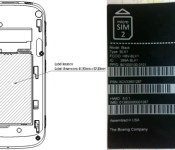
Boeing’s extra-secure smartphone finally reaches the FCC

Boeing said way back in 2012 that it was working on a high-security Android smartphone. Almost two years later, it appears that the company is finally close to a launch — the hardware, identified as Black, has just passed through the FCC. It’s built for AT&T’s LTE and HSPA networks, and will be rare among American phones in carrying dual SIM slots. We’re not expecting it to be a media powerhouse when the label dimensions hint at a mid-size device, though. Boeing hasn’t formally revealed Black yet, but it’s doubtful that you’ll find it at your local carrier store. This is more likely to be a direct-order device for corporations and the military, and it may carry a premium over the more consumer-oriented Blackphone.
Filed under: Cellphones, Mobile, AT&T
Source: FCC

Soundgarden Added to SXSW iTunes Festival Lineup [Mac Blog]
Apple today announced that it has added Soundgarden to the concert lineup for its new iTunes Festival at SXSW in Austin, Texas next month [iTunes Store]. Soundgarden will headline the March 13 concert, with supporting acts yet to be announced.

As noted by The Loop, Soundgarden will play its landmark Superunknown album in its entirety, celebrating 20 years since the album’s release.
An expansion of the long-running iTunes Festival held in the UK each year, the SXSW concert series was announced by Apple last week, but at the time performers were announced for three only of the five dates. Other performers announced so far include Coldplay, Imagine Dragons, London Grammar, Pitbull, ZEDD, G.R.L, Keith Urban, Willie Nelson, and Mickey Guyton.
Tickets to the shows are available to SXSW attendees free of charge on a lottery basis, and live and on-demand streams of the shows will be available through the iTunes Store on iOS devices and computers, the iTunes Festival app on iOS devices, and Apple TV.
     |
[Op-Ed] MWC 2014 was evolutionary, not revolutionary
Given that I am only seventeen, I have to say that my passion for mobile technology started at a very young age.
When I was seven my parents bought their first mobile phone — for the sake of getting in touch with the school in case something happens to me.
I cannot recall the precise name, though it was one of these clunky Nokia handsets sporting a tiny white and black display weighing as much as a TV back in the day.

That’s the one, anyone remember the model number?
The memories of me rocking the snake game still linger in my mind after all these years that have gone by.
For the last three and a half years I’ve been sharing my knowledge on mobile technology via YouTube and blogging. Since mid 2012 I solely focused on writing and recently it became sort of my job, if you will.
Well, after all these years of watching how the industry develops, from the 5cm thick Nokia handset to the LG G Flex featuring a flexible body, my eyes have seen a radical change in this section of technology.
As a mobile tech enthusiast, Mobile World Congress is something that I am looking forward every single year. Especially this year’s where two flagship phones where once rumored to be unveiled, the Samsung Galaxy S5 and the new HTC One. As many of you know HTC made a last minute announcement that their handset will be revealed in a separate event. Oh well, what can you do?
Fundamentally, MWC 2014 points of interest were two; Xperia Z2 and Galaxy S5. To be quite honest with you, I didn’t expect Sony to release the successor of the Z1, just five months after its launch. I am aware that the Z1 was announced five months after the original Z as well, though Sony had to do this mostly due to the fact that the first Xperia Z was steps back compared to competition.
With that said, both handsets constitute a clear indication that two of the front running names in the industry are facing a dead end from a hardware standpoint. Samsung and Sony have been following Apple’s two-year strategy with its respective line ups, though both extended it to a three year one.
Irrefutably, when the Galaxy S line up commenced back in 2010 it was an auspicious sign for Android’s future as it offered a spec sheet much better than the iPhone and a beautiful — cheap-ish — design.
A year later the incredibly thin dual-core S2 hit the market, as the 4S component, making users reconsider about Android phones.
Same thing about the S3; all-new design, double the speed, enhanced camera etc. And frankly, that is what consumers found incredible about the S line. The fact that every year they saw a successor years ahead of its predecessor.
In 2013, the downhill begun and all the above started fading out.
Eleven months ago Samsung released the S4, which practically was an S3, featuring a bigger display. In fact, I’ve ranted about the specific matter for another website I used to write, so feel free to take a look.
And now the S5, a water and dust proof S4, with squared bezels, an enhanced rear sensor and fingerprint scanner. Oh, let’s not forget the sensor on the back that rates your heart beat, because you know, heart beat sensor is a must on a cellphone.

From left to right: Galaxy S3, Galaxy S4, Galaxy S5.

Beside the GS5, another much anticipated smartphone was surprisingly revealed as well during the conference.
Sony took the stage and announced its 2014 flagship too. Unfortunately, design resemblance between the latest gen and the previous ones is something you’ll certainly spot in this case as well. Sony continued its signature stylish glass front and glass back design that has been offering since the Z, announced back in February of 2013.
Now in the particular occasion, I’d say it is sort of obvious to see the same design language for three consecutive generations, since the company managed to launch three flagship phones of the same line up in twelve months.
But why? Evidently, the company assumes that phone releases is the same thing with software updates. You push out a new one whenever you find a flaw or the mood strikes you.

Left: Xperia Z1 Honami
Right: Xperia Z

Left: Xperia Z1 Honami
Right: Xperia Z2
The big question here is, what new does the Z2 offer over the Z1? Practically, nothing. Don’t get me wrong, the screen upgrade to IPS thus featuring sharper viewing angles is great, but that’s it. And no, 4K video recording is not a significant integration to me.
Back to the purpose of this piece — which is to point out the design resemblance between the fresh and the stale — in three words, it is terrifying. The fact that we’ll see no major hardware enhancements, until nano technology is implemented, scares the hell out of me.
I don’t like repeating myself so bottom line; I hope the above companies prove me wrong. And sooner, rather than later.
The post [Op-Ed] MWC 2014 was evolutionary, not revolutionary appeared first on AndroidGuys.

Kazam wants you to come for the hardware, stay for the service

Kazam has a battle on its hands. The company may have been launched by former HTC execs, but it can only trade on that association for so long. That’s something the firm is directly addressing here at MWC, it seems, with the launch of two new octacore handsets — the Tornado 2 5.0, and Tornado 5.5. Two phones that it hopes will have mass appeal. We got to look at a pre-release version of the former, which uses MediaTek’s MT6592 (clocked at 1.7GHz) that launched late last year. The Tornado 2 5.0 will also come with a 5-inch, 720p IPS display, sport an SD card slot (to augment the 8GB onboard), have dual SIM capabilities, and an 8-megapixel camera. When it launches in Europe later this year, it’ll do so somewhere in the £250 region (depending on markets).
The device itself is unassuming in its design. The all-black body and minimal design are simplistic. While not at all unattractive, it’s not a handset you will be able to pick out at a distance. The version we got to spend some time with didn’t have final software, so we’re unable to comment on its performance, but that’s something we hope to be able to report on in more detail sooner rather than later. That’s also why you’ll see capacitive buttons, and on screen ones in the gallery below.
More important than the phone itself, is that we got to learn a bit more about the mysterious Kazam. The company informed us it’s not just trying to make reasonably priced phones, the plan is broader than that. While the phones it makes will likely continue to be affordable, Kazam is also putting an emphasis on high-quality after sales customer support, such as offering a free cracked screen replacement scheme and remote assistance with your device. Will that be enough to pull it out from the shadows of its origins? Well, ironically, it’s already receiving the sincerest form of flattery from HTC, which is a promising start.
Filed under: Cellphones, Mobile

WSJ: Four ways to distance the NSA from phone records that’ll be considered by government

President Obama has his work cut out for him as he tries to restore faith in the US government following the whole NSA spying scandal. He first talked of surveillance reform last year, then in a January 2014 speech promised to revamp the NSA’s program for collecting phone records. While the agency must now seek court approval to access phone data, The Wall Street Journal is reporting that “administration lawyers” have finished drafting several proposals that would bring about more radical changes to the program by taking the database out of the NSA’s hands. These are said to be part of a wider report due in March, in which other scenarios that strip some power from the government spy agency will be explored.
One of the proposals would see phone companies responsible for managing the records, which the NSA would then request on a case-by-case basis. Apparently the idea hasn’t gone down too well, with companies wary of being inundated with data requests from elsewhere; not to mention they haven’t been involved in crafting the proposals. (Besides, do you trust AT&T and Verizon anymore than the government?) Another idea would see a different government entity such as the FBI (which is allegedly a contender, despite its own indiscretions) or Foreign Intelligence Surveillance Court be put in charge. It’s also been suggested a new independent organization be created that would technically be neither a part of the government nor a phone company. Though, the concern there is any newly created body would ultimately end up serving as an extension of the NSA.
Of course, there’s always the last option of doing away with the phone surveillance altogether, which we’re sure many would celebrate, but seems highly unlikely. There’s always the possibility that another solution is agreed upon, but for now these seem to be the primary options available to the Commander in Chief.
Filed under: Cellphones, Mobile
Via: The Verge
Source: The Wall Street Journal
Qualcomm Toq available for $249.99
The Qualcomm Toq is recognized for its nice design along with great specs, yet after the smartwatch was released last year it hasn’t gotten the attention it deserves. Qualcomm has been fighting for the Toq, to get it to become a recognizable smartwatch. Its newest step is lowering the price to $249.99.
The Toq’s main competition is the Pebble smartwatch. The Pebble is mainly popular due to the fact that it has many apps, along with the fact that it introduced the smartwatch concept to the consumer world. As for Toq, its major selling point is the color display, which many people do in fact look for when buying a smartwatch.
While the Toq lacks traditional “apps” Qualcomm has released an SDK to allow 3rd-party developers to fix that. By releasing an SDK and by slashing the price by $100, from $350 to $250, Qualcomm’s Toq has a great chance to excel in this market.
We’ve already seen a number of app enhancements and new features over the last few weeks. Perhaps Qualcomm is stepping on the gas here in 2014.
The post Qualcomm Toq available for $249.99 appeared first on AndroidGuys.
 AIVAnet