



IBM wants to put the power of Watson in your smartphone

Watson, IBM’s Jeopardy-conquering super computer, has set its sites on mobile apps. Not long ago, the recently created Watson Business Group announced that would offer APIs to developers to create cloud-based apps built around cognitive computing. Now IBM is launching a competition to lure mobile app creators to its new platform. Over the next three months the company will be taking submissions that leverage Watson’s unique capabilities like deep data analysis and natural language processing to put impossibly powerful tools to the palm of your hand. IBM is hoping for apps that “change the way consumers and businesses interact with data on their mobile devices.” It’s an ambitious goal, but considering the way Watson spanked Ken Jennings, it seems something that is well within its reach. The machine has already changed the way we view computers and artificial intelligence, not only by winning Jeopardy, but by making cancer treatment decisions and attending college. Now it wants to make your smartphone smarter than you could ever hope to be.
Filed under: Software

Google denies making a bid for WhatsApp

Rumors that Google engaged in a bidding war with Facebook over WhatsApp are false — at least, if you ask Google’s Sundar Pichai. The Senior VP tells The Telegraph that his company “never made an offer” to buy the messaging giant, and that any claims to the contrary are “simply untrue.” We’re inclined to believe him, although the denial suggests that Facebook may have paid $19 billion so that it wouldn’t have to compete with Google (or anyone else) on yet another important acquisition.
Filed under: Cellphones, Internet, Mobile, Google, Facebook
Source: The Telegraph

Hands-on with Gionee’s super slim, octa-core Elife S5.5 smartphone (video)

It’s only been a week since Gionee debuted its super thin Elife S5.5 Android phone in China, but luckily for us, the company also brought it along to MWC. After playing with the 5.55mm-thick device for some time, we were left very impressed with its build quality. The aluminum frame was nicely machined and felt solid, whereas the Corning glass back panel added an extra premium feel, despite leaving fingerprints behind. We still struggled to believe that there’s a 1.7GHz octa-core SoC inside such a slim device, let alone a 2,300mAh battery and two nice cameras — 5 megapixels on the front and 13 megapixels on the back. It should be noted that the rear imager and its LED flash do stick out a little, but it’s not that noticeable in the corner. The S5.5 will come in several colors, with our favorite being the white and gold combo.
We managed to have a quick chat with Gionee’s president William Lu, who was amused by how folks from Sony, Samsung and Nokia kept going back to his booth to inspect his company’s masterpiece. Well, if they don’t mind splashing out about $375, they can grab one for themselves in China come March 15th; but the phone will eventually arrive in other countries (though the US is definitely not on the list). Meanwhile, feel free to check out our hands-on video after the break.
Filed under: Cellphones, Mobile

Barnes & Noble will revive its Nook tablet line with a new model this year

You’d be forgiven for thinking that Barnes & Noble’s tablet range was on ice; while the firm did promise to work with third parties on new models, it went through all of 2013 without fresh devices. The bookseller will soon reward patient fans, however. It just revealed that there will be a new “Nook color device” early into the company’s fiscal 2015, which roughly translates to this summer. However, we don’t know what the new Nook slate will offer, or even who’s making it. Barnes & Noble says it’s still talking to multiple “world-class hardware partners” about development and distribution, so it could be a long while before we know what to expect. The company does have some breathing room to implement its Nook strategy, though. It swung to a $63.2 million net profit for its fiscal third quarter versus a $3.7 million loss a year ago, and it now has more than twice as much cash in the bank. Even though the company is making half as much revenue from its Nook business as it did at this point in 2013, it’s not facing a dire financial crisis.
Filed under: Tablets
Via: GigaOM
Source: Barnes & Noble

Google finally releases Now Launcher to the Play store, for Nexus and Play Edition devices

Most of us assumed it was only a matter of time before Google released the Now launcher that debuted on the Nexus 5 to the Play store. Now that day has come… provided you’re the owner of a Nexus or Play Edition handset that runs KitKat. The new homescreen is the one you’ve already come to know and love on the newest Nexus phone, complete with the ability to say “Ok Google” from any home screen to automatically launch Now’s voice command functions. Breaking the launcher out from the core Android code also means it’ll be easier for Google to update and add features to it going forward, without having to release an entirely new version of the OS. Now the next step will be getting the launcher on more phones, even if it still requires you to have KitKat. Though, as the internet giant successfully breaks its own apps and services away from the Android core, the Nexus program becomes less and less important.
Filed under: Cellphones, Software, Mobile, Google
Via: Droid Life
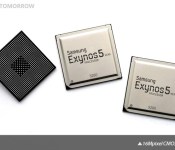
Samsung trots out two new Exynos processors
Samsung added two new members to its portfolio of Exynos mobile processors at Mobile World Congress this week. In one hand we have the eight-core Exynos 5 Octa 5422 while the other hand holds a six-core Exynos 5 Hexa 5260.
The Octa 5422 is designed for high-end “premium” devices and employs four ARM Cortex A15 cores at 2.1GHz and four ARM Cortex A7 cores at 1.5GHz. The A15 cores are geared for more intensive use while the A7 cores are for lower-power needs. According to Samsung, this chip can support displays as high as 2560×1440 pixels.

The Hexa 5260, for its part, features two ARM Cortex A15 cores at 1.7GHz and four ARM Cortex A7 cores at 1.3GHz. Aimed at mid-range devices, it can support 1080p HD video capture and playback as well as WQXGA displays.
The Octa 5422 will be available for mass production later in the first quarter while the Hexa 5260 is already underway.
The post Samsung trots out two new Exynos processors appeared first on AndroidGuys.
Browse flyers and weekly ads from 300+ retailers with Flipp [App of the Day]
Today in our App of the Day column we will tell you about a new Android app known as “Flipp: Flyers and Weekly Ads”. The app was once exclusive to iOS, however Wishabi recently made it available for Android.
If you are a shopaholic then Flipp is a must-have-app for you. It’s an app that aggregates retail flyers from all of your favorite local stores such as Target, Macy’s, Sports Authority and Dollar General. Combined, this list is available on your smartphone; making it easy for you plan your shopping.
The features of the app are listed below:
- Flip: Rapidly flip and browse between and within weekly flyers
- Search: Easily search for a store, item, or brand
- Clip: Clip items from any flyer straight to your shopping list
- Discount slider: Highlight items on sale to find the best deals and savings
- Favorites: Save your favorite store’s flyers for easy reference and a personalized shopping experience every week
“Flipp is receiving exceptional reviews and users are telling us that Flipp is changing the way they shop. Countless consumers have been asking for Flipp on Android, so this launch will only add to the great momentum we are seeing as we give people the innovative shopping experience they want,” said Wehuns Tan, CEO of Wishabi.
Offering digital flyers from at least 190 local stores in the US and 80 local stores in Canada, Flipp is an app that will literally innovate the way you shop. If you are interested, download it by clicking the link below.
The post Browse flyers and weekly ads from 300+ retailers with Flipp [App of the Day] appeared first on AndroidGuys.

Glucose Sensing Likely Too Challenging to Include in First-Generation iWatch
Apple’s iWatch has been rumored to include a glucose monitoring feature, but how that feature would be implemented is still unknown. One report from earlier this month indicated that a “Healthbook” app under development for iOS 8 will be able “to read glucose-related data,” while another report has warned not to expect glucose sensing built directly into the initial iWatch. The two reports are not necessarily conflicting given the possibility of Healthbook interfacing somehow with third-party glucose-monitoring devices, but a new report from Network World argues that the technology is indeed too early in its development to be incorporated into a mainstream consumer device such as the iWatch.
Heisler points to C8 Mediasensors and its non-invasive continuous glucose monitoring (CGM) device, the HG1-c, as an example of how this technology is still in its infancy. It’s a relevant example as Apple has hired several research scientists and engineers from the now defunct company and is presumably using their knowledge to explore bringing CGM to the iWatch.
The HG1-c device relied on Raman spectroscopy to indirectly measure a person’s blood glucose level. This technique shines light through the skin in order to excite blood glucose molecules and cause them to vibrate. An optic sensor then analyzes the amount of light reflected off these vibrating molecules and returns a reading that is used to calculate an approximate glucose level.

Though innovative, the technology has flaws that make it impractical for a wrist-worn device. The sensor unit was attached to a belt that was worn around the waist and required a large battery pack to operate. It also needed a gel to accurately measure light levels, which were influenced by ambient sunlight. This sunlight sensitivity was highlighted by former C8 employee Charles Martin, who spoke to Network World.
Yes, the camera sensor had to be shrouded in darkness to function. You have to understand that Raman Spectroscopy is looking for a very faint signal emitted by the glucose molecules. A rough analogy: try to pick out someone’s voice in a noisy room. The sunlight was this kind of noise that the camera sensor was not calibrated against. They did try to implement algorithms to discount measurements against sunlight anomalies, but some of the anomaly criteria these algorithms were supposed to detect, overlapped. This made things hard to verify and test on the device.
Apple likely can overcome many of these limitations, but it will take time to transform the technology to the point where it is reliable enough to be used as a diagnostic or monitoring device. Once Apple improves the technology, it will need to receive FDA approval, which is a painstaking process with extensive clinical trials and documentation.
If Apple goes down this route, it could take up to 18 months just to receive approval necessary to sell the device. Given this lengthy approval process and the fact that evidence of Apple earnestly assembling its iWatch biometric research team only started surfacing around early 2013, Heisler believes “the notion that this feature will appear in the first iteration of the device is highly improbable.”
Instead of measuring glucose levels, the iWatch may allow users to monitor glucose levels by importing them from a glucose monitoring device or by manually entering them into the accompanying Healthbook app for iOS. Apple is rumored to be working on the health and fitness app, which uses a card-based interface to track vital health statistics such as heart rate, weight and step count.
     |

‘Social Network’ Director David Fincher in Talks to Helm Sony’s ‘Steve Jobs’ Biopic
 Director David Fincher is in talks to direct the Aaron Sorkin-scripted Steve Jobs biopic based on Walter Isaacson’s biography, claims The Hollywood Reporter. Sorkin last month completed the script for the film, which is said to take place across three 30-minute scenes at three Jobs-led product launches.
Fincher has experience with broad-appeal Silicon Valley films after his Oscar-winning turn with the The Social Network — also written by Sorkin — which won three Academy Awards and was nominated for five more, including Best Picture and Best Director.
Like Zuckerberg, Jobs was a complicated visionary who became a polarizing figure. Under Jobs’ watch, Apple revolutionized several business, including personal computers, music, computer-generated animation and mobile phones. In the process, he became known as one of the greatest innovators of his generation. At the same time, he was unapologetic about his difficult personality, was at one point ousted at Apple and was criticized for the harsh treatment of workers in China who assembled Apple products.
Among Fincher’s other directing credits include Fight Club, Panic Room, the American version of The Girl With the Dragon Tattoo, and several others.
With Sorkin wrapping the screenplay, Sony’s next step will be to sign on a director and then move forward on casting, as no actors are known to be in talks for any roles. Apple co-founder Steve Wozniak is working as a consultant on the film, which has no potential release date yet.
| |

Wacom lets people share handwritten notes across devices and platforms

Wacom has been pushing into the world of mobile for a while, and its efforts have just culminated in a pretty bold move: A single, cross-platform standard for sharing handwritten notes and sketches between users, regardless of whether they’re using a stylus or a finger, an iPhone or a PC, an app or a browser. The tool is called “WILL” — “Wacom Ink Layer Language” — and it captures a pen stroke’s coordinates, pressure and the identity of its creator (through a unique “Pen ID”), as well as allowing the scribble to be edited by others. Users can also see other people’s handwriting being created in real-time, i.e. we’re not just talking about static images.
Beginning next month, Wacom will promote WILL by distributing SDKs for iOS, Android, Mac OS and Windows, as well as for browsers and cloud platforms. These SDKs are meant to make it easier for developers to create apps that accept signatures scrawled on a touchscreen, or DIY smileys, or hand-drawn highlights on a cloud document, or any other sort of handwritten input. Of course, the concern with any such format is that it’ll need to be embraced by a large number of companies in order to reach a tipping point and become widely accepted. Wacom doesn’t seem to be ready to announce even a single partner just yet, but where there’s a will… (Ahem, sorry.)
Filed under: Cellphones, Tablets, Internet, Mobile
 AIVAnet