


Sony’s Xperia Z2 brings a richer display and 4K video recording

Sony’s flagships have struggled to find success, but that hasn’t stopped the company from quickly iterating its smartphone line to keep up with its rivals. With the Xperia Z now over a year old and the Xperia Z1 staring its six month birthday in the face, Mobile World Congress comes at the perfect time for Sony to unveil its latest flagship: the Xperia Z2. It certainly borrows a lot from its predecessor in terms of looks and features, but the company’s breathed some extra life into the phone to set it apart from its older siblings. What’s it added, you ask? Head past the break for the lowdown.
Since we know you’re dying to find out what’s fresh, let’s dive straight into the details. The Z2 features a 5.2-inch full HD (1080p) Triluminos display encased in an one-piece aluminum housing. Look inside and you’ll find a 2.3 GHz quad-core Snapdragon 801 supported by 3GB of RAM, 16GB of internal storage (with microSD support) and a 3,200mAh battery. Sony’s using the same 20.7-megapixel Exmor RS camera found in the Z1 (although there’s 4K recording support tucked away), opting for a slightly improved 2.2-megapixel shooter on the front. That’s all protected from a watery demise by IP58 waterproof certification.

The end result is a handset that has been upgraded in nearly all departments, something that Sony consistently done across its Z-series smartphones, at least in the past year. While it’s slightly taller and thinner than the Xperia Z1 you’d be hard pressed to identify it in a lineup alongside its younger sibling.
One area that Sony has improved is the display. In an effort to further optimize its screens, Sony got its TV division involved and has outfitted the Z2′s Triluminos IPS screen with BRAVIA tech. Live Color LED is a one example of that, generating brighter and more consistent color using a mix of red and green phosphor as well as blue LEDs. Our short time with the handset allowed us to see the Xperia Z2 and Z1 displays side-by-side and we noticed significant improvements across the board.

Sony’s strong optics make for impressive photos, but its desire to futureproof its handsets has led to developments in the video department too. The Z2 includes 4K video recording at 30 frames per second with SteadyShot image stabilisation. You’re not going to witness the full glory when you play a 4K video back on the Z2′s 1080p screen (Sony maybe hopes that you’ll buy one of its 4K TVs too), but you’ll still be able to zoom in and inspect the stunning detail of your recordings on the device.
If specs aren’t enough, Sony’s also developed some new custom camera apps to get even more mileage out of it: there’s Timeshift video, which’ll let you shoot and quickly edit slow motion video at 120 frames per second, new creative effects, background defocus, and augmented reality options are now available for video. Unfortunately, Sony’s limited Timeshift videos to 720p at 120 frames per second, putting a dampener on those plans to record a slo-mo of yourself on a slip-and-slide in high-definition.
A strong entertainment focus helps set Sony apart from many of its rivals, and it’s looking to push that angle a little more with the Xperia Z2. If the device ticks all of the right boxes and you find yourself heading out on launch day to grab Sony’s latest flagship, Sony willl bundle a pair of MDR NC31EM headphones in the box as a little thank you. They’ll do a pretty great job at isolating ambient noise on their own, but with a little help from the Z2′s built-in digital noise cancelling algorithms, you’ll be oblivious to most of the great outdoors.
Sony tells us that for the Xperia Z2 “the difference is in the experience,” but given the spec bumps across the board, it’s certainly trying to appeal to consumers who want industry-leading hardware and software. The phone is light but sturdy, fast and responsive, and continues to utilize all of the best features from other Z-series smartphones. There’s plenty to like about Sony’s new flagship, we just hope that stays true when it our hands on it for a full review. It’s set to launch globally from March, so we won’t have long to wait.
Filed under: Cellphones, Mobile, Sony
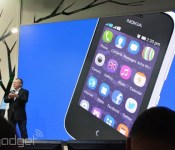
Nokia reveals the Asha 230 and Nokia 220 budget phones

Nokia’s got a little press shindig going on in Barcelona right now, showing off the phones destined for emerging markets and budget-minded buyers. First up is the Nokia 220, an “aspirational” feature phone that’ll be priced at 29 euros. Coming with a 2.4-inch display, the 220 is available in single or dual-SIM variants and will connect to 2G internet, enabling users to take advantage of the pre-loaded Twitter and Facebook apps, as well as Bing search baked right into the express browser.
The Asha 230, meanwhile, is designed for people who are moving on from feature phones and onto their first smart device. Which is priced at 45 euros.
Developing….

Sony’s Xperia M2 offers respectable specs at a mid-range price

Sony’s come to Mobile World Congress with three brand new devices. Its new flagships, the Z2 smartphone and Z2 Tablet, may attract all of the attention but there’s a budget-friendly handset it also wants you to get to know: the Xperia M2. Acting quickly to replace the still youthful Xperia M, which only launched in June last year, Sony has injected new life into its mid-ranger by including a larger 4.8-inch qHD display, a 1.2GHz quad-core processor, 8-megapixel camera, 2,300mAh battery and LTE support to take care of your increasing thirst for data.
While the Xperia M was far from a benchmark buster, Sony tells us that its successor is the best in class on device thickness, display size, camera resolution and processor cores. We’d say its main competition comes in the form of the Moto G, which impressed us when it launched last year. Its slim 8.6mm profile, NFC and LTE support certainly help in that regard, especially as the Moto G is 3G-only, but the Xperia M2′s 960 x 540 display is some way off its rival’s.
For Sony, diversity certainly isn’t key when it comes to handset design. The Xperia M2 may lack the top-level internals found in the Z2, but it’s rocking the same “OmniBalance” design as Sony’s new flagship. You’ll notice on closer inspection that its lacks the premium finish of the Xperia Z2, but for those looking for flagship looks at a mid-range price, the Xperia M2 will still invoke the odd double-take.
We’re still waiting on exact pricing info, but what we do know now is that Sony is looking around the €220 ($302) mark. It’s not limiting its launch either: black, white and purple variants are all set to hit stores when the device launches the Xperia M2 globally in April.
Filed under: Cellphones, Mobile, Sony
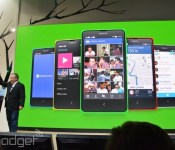
Nokia announces the X and X+, its first Android phones

Nokia is officially launching its very first Android devices, known as the X and the X+, on stage at its annual Mobile World Congress press conference. We were all taken aback by the second (and third) device (since only one leaked), but either way it’s still incredible to see Nokia take this particular approach. The X will have a 4-inch, 840 x 480 IPS screen, 512MB RAM, 4GB of storage expandable storage via microSD slot and 3-megapixel camera, while the X+ sports the same specs but more RAM (768 MB) and an included 4GB microSD card. You won’t be getting Google’s apps or Play store, however as both handsets will be based on the forked AOSP Android OS. Nokia says that’ll have the advantages of the Android ecosystem, but with a “differentiated experience.” So far, Here Maps, MixRadio, Skype and Outlook are being featured on the Nokia Store. You can access the Nokia and third party stores using the devices, but not Google Play, obviously.
The new devices are featuring a ported version of FastLane for Asha devices, to give a similar experience as its other budget handsets. When you swipe across it, it’ll bring up a sort of notification bar showing recently used apps, missed calls and texts and other activities. During the demo, Elop showed both the Nokia Store also Yandex, where he pulled down Aero Express, a Russian-flavored app. The X will be available immediately in growth markets (ie, not the US) and run 89 euros. The X+, meanwhile, will run 99 euros but won’t arrive until sometime in Q2 this year.
Filed under: Cellphones, Mobile
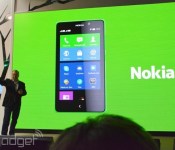
Nokia introduces a third Android device, the 5-inch Nokia XL

Well, Stephen Elop is just full of surprises today. On top of two other Android devices just launched, the Nokia X and the Nokia X+, we now have the Nokia XL, a bigger 5-inch Android device. It’ll have a WVGA IPS screen, a 5-megapixel rear / 2-megapixel front camera with an LED flash, 768MB of RAM and 4GB of storage, expandable via microSD. As with the X and X+, there will be no Google services or Play store, so you’ll have to access apps through Nokia’s store and other third-party Android markets. It’ll also feature the Android version of FastLane borrowed from Asha for easy access to apps and text and call notifications. It’ll arrive sometime to emerging markets in Q2 2014 at 109 euros — but not to the US, for now.

Alcatel’s ‘smartbook’ concept: a laptop powered by a smartphone over the air

At MWC, Alcatel was kind enough to give us a preview of its working “smartbook” prototypes. The idea isn’t too far off from Motorola’s doomed Lapdock or the first-gen ASUS PadFone, where an Android phone powers an otherwise brainless laptop. What’s different with Alcatel’s implementation is that instead of having to physically dock the phone somewhere, you hook it up to the laptop wirelessly: video signal over WiFi, and keyboard plus trackpad input over Bluetooth. What’s more, the final product will let you use the two screens somewhat independently — at least you’ll be able to see the caller ID on the phone for incoming calls.
The pairing process itself is also quite interesting: instead of using an NFC coil, the laptop showcases MediaTek’s cheaper Hotknot technology, which involves a little capacitive pad at the bottom right of the keyboard. The signal from the capacitive coupling between the pad and any phone’s touchscreen is what helps identify the devices; so in other words, even non-NFC phones can be supported.
The prototype smartbook we saw featured a MacBook-like aluminum body, along with an 11-inch 1080p IPS display and a “full day” battery of somewhere between 5,000 to 6,000mAh. There’s no touchscreen here, so instead, you’ll be using the multitouch glass trackpad to point and scroll. An Alcatel rep told us that this is to keep the hardware cost low, but we’d still like to see a touchscreen option for the sake of consistency across the phone and laptop UIs.
We’ve been told that this project is far from ready for public consumption (it was slightly buggy when we played with it), but we can expect a much better demo at IFA come September. It’ll be interesting to see how this pans out, especially given Alcatel’s track record of delivering good products with great affordability, though the company does plan to limit this feature to its own octa-core smartphones.
Brad Molen contributed to this article.
Filed under: Cellphones, Laptops, Mobile

Fujitsu plans to launch feel-o-vision haptic tablets by 2015

Back in 2012, we were all excited at the idea of haptic technology — touch screens that fool you into thinking that you can feel what’s on display. As quickly as we saw Senseg and NEC’s implementations, however, haptic fell out of the mainstream. Now, however, Fujitsu is working on an ultrasonic system, that varies the friction between your finger and the glass, which could be ready for prime time. In the demonstration, users are apparently able to pluck the strings of a Japanese harp, turn a combination lock and even stroke an Alligator. The company has knocked together a prototype in time for MWC, and Fujitsu has a goal to get the tech into commercial hardware by 2015 — assuming, of course, that realistic lizard stroking is the one feature you’ve been waiting for.

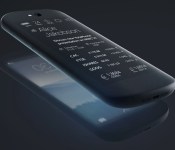
Dual-screen YotaPhone has a second shot at greatness

If you caught our review of the YotaPhone at the end of last year, you’ll know we were cautious about recommending it — in fact, we said it was probably safer to hold out for a second-gen device. Well, here’s a surprise: that replacement is already at the prototype stage and it brings some big improvements that could undo many of the criticisms we leveled at the original. Most importantly, the rear E-Ink panel is now fully touch sensitive, which means you’ll be able to a lot more with this phone without ever needing to engage the traditional, power-hungry display on the other side. Calls, texts, emails, browsing, tweeting and more can be handled using the “always-on” 4.7-inch E-Ink display, with the only sacrifice being predictably slower refresh rates.

Although we’ve been hands-on with a very early and fragile prototype, the physical improvements are immediately obvious. When you turn the phone over to its “normal” side, for example to watch video or use the camera, you’ll notice that the 720p LCD panel has been upgraded to a slightly bigger 5-inch, 1080p, AMOLED one. Android performance will also benefit from the inclusion of a 2.3GHz Snapdragon 800 instead of the old Snapdragon 600, and overall thickness has been reduced to 8.9mm (0.35 inches). Assuming that the price doesn’t soar much higher than the original’s 499 ($675), these are all very welcome changes.

Unfortunately, it sounds like you still won’t be able to run the whole of Android (and all Android apps) on the E Ink side, despite the addition of full touch sensitivity. That’s a shame, because there are literally thousands of mainstream apps that could be put to good use in low-power mode (not least major e-book readers and music streamers). However, Yota Devices has a plan: It’s making its SDK open to everybody today, which should make it easier for developers to tweak their code to support the rear panel, and it says it’s still in talks with Google, Amazon and Barnes & Noble to make all those apps compatible. So, who knows? If they can get some of this support in place by the time this next-gen YotaPhone launches later in the year, we could be looking a drastically superior product.
Filed under: Cellphones, Mobile

Audience’s new motion sensing chip lets your phone track longer, more detailed runs

Not been seduced by the quantified self movement yet? Well if it’s ever going to happen, it’ll be thanks to companies like Audience. More specifically, thanks to products like its new MQ100 motion processor. What does it do? Well the MQ100 allows for always-on motion tracking, similar to how its existing VoiceQ product enables mobile devices to “listen” for your voice commands, even when in standby. As the new sensor relieves the host device’s main processor of these motion-sensing duties, it opens the door for constant activity tracking, without the battery drain — similar to how Apple implemented its M7 motion sensor in the iPhone 5s. The MQ100 has an accelerometer, gyroscope, magnetic and other “environmental” sensors at its disposal, which makes it ideal for fitness tracking, indoor mapping, and a whole host of other sensory, movement-related applications. The MQ100 will also be bundled into a more complete sensor package that uses all of Audience’s mobile technology (it’s eS700 range for those that need to know) which could mean a chip that listens for your commands, tracks movement all day, reduces wind noise in calls and more. Yup, your phone is about to get to know you and your walking/talking habits a whole lot better. Especially once it starts finding its way to the manufacturers’ labs in the next few months.
Filed under: Cellphones, Wearables, Mobile

Live from Sony’s MWC 2014 press event!

The time has almost come for Sony to pull back the curtains on its next Xperia Z flagships at Mobile World Congress in Barcelona. You’re just here a little early. But that’s okay — we admire your spunk. Just make sure to check back at 2:30AM EST / 8:30AM CET when you’ll have a live, front row look at all the news as Kaz and co. reveal it. Don’t worry, we know you like your tech news fresh and up to the minute. And that’s exactly how we’ll be serving it up!
Filed under: Cellphones, Tablets, Wireless, Mobile, Sony
 AIVAnet