


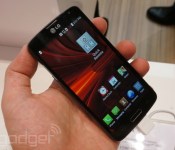
LG updates F Series with two new LTE phones (hands-on)

With all this G2 mini and G Pro 2 talk recently, you’d be forgiven for forgetting that LG also has other handset lines. On the table (literally and figuratively) today are the F70 and F90 mid-rangers. The former is a 4.5-inch (WVGA) device with a 1.2 GHz quad-core Snapdragon 400 taking care of bi’niz, pls a 5-megapixel camera, 2,440 mAh battery and just 4GB of internal storage. As for the F90? Well, it’s a little bigger at 4.7-inches, but has the same chipset and onboard memory. You will get a slightly better camera though, with LG giving it an 8-megapixel shooter. Thankfully, both come with a microSD card slot to augment that lacklustre amount of onboard storage.
The phones themselves? Well they’re a plucky pair, that’s for sure. It’s easy to dismiss mid-spec handsets like these out of hand in the design department, but LG has clearly made enough effort to make sure that they feel well-built and don’t look entirely terrible. The textured back panels go along way to brush off that low-end feel you can sometimes get at this level, and the small details around the edges, ports and buttons also add a nice aesthetic touch. The menu and UI, however, definitely feels like it’s more intended for users who like to keep things simple with bigger fonts and basic options, and that’s no bad thing. Power users will of course already be looking elsewhere. One other thing to remember is that, toe to toe, these two cheeky chaps aren’t all that different in specification to the LG G2 mini, even down to the much touted “knock knock” feature. Food for thought right there.
Filed under: Cellphones, Mobile, LG
A Buyers Guide To Wireless Antenna
Just like buying any device, picking an antenna will entail a lot of consideration. You have to know the purpose while not taking your preference aside. While there are different antennas to choose from, wireless antenna is the one which gained highest popularity due to its everlasting contribution to today’s communication and technology. But the question it, how to choose the best wireless antenna?

Do you need to buy a wireless antenna for personal use of for business purposes? To address corporate needs, you have to arrive to the best decision you could possibly make. And depending on the nature of business, you have to pick the most suitable one.
Here are some of the high quality antennas available in the market.
- Yagi antenna
- Parabolic dish antenna
- Cell tower sector antenna
- External wireless antenna
- Mobile antenna
- Broadband and Ultra Wide Band antenna
Yagi antennas are directional antennas ideal for signal coverage of long distances. This is commonly used in setting up wi-fi network. It is also known as an effective approach to offset cost of individual installation among urban residents within closed quarters. Parabolic dish antennas are also for directional applications. These are solid dish which is known to have improved front-to-back ratios and higher gain.
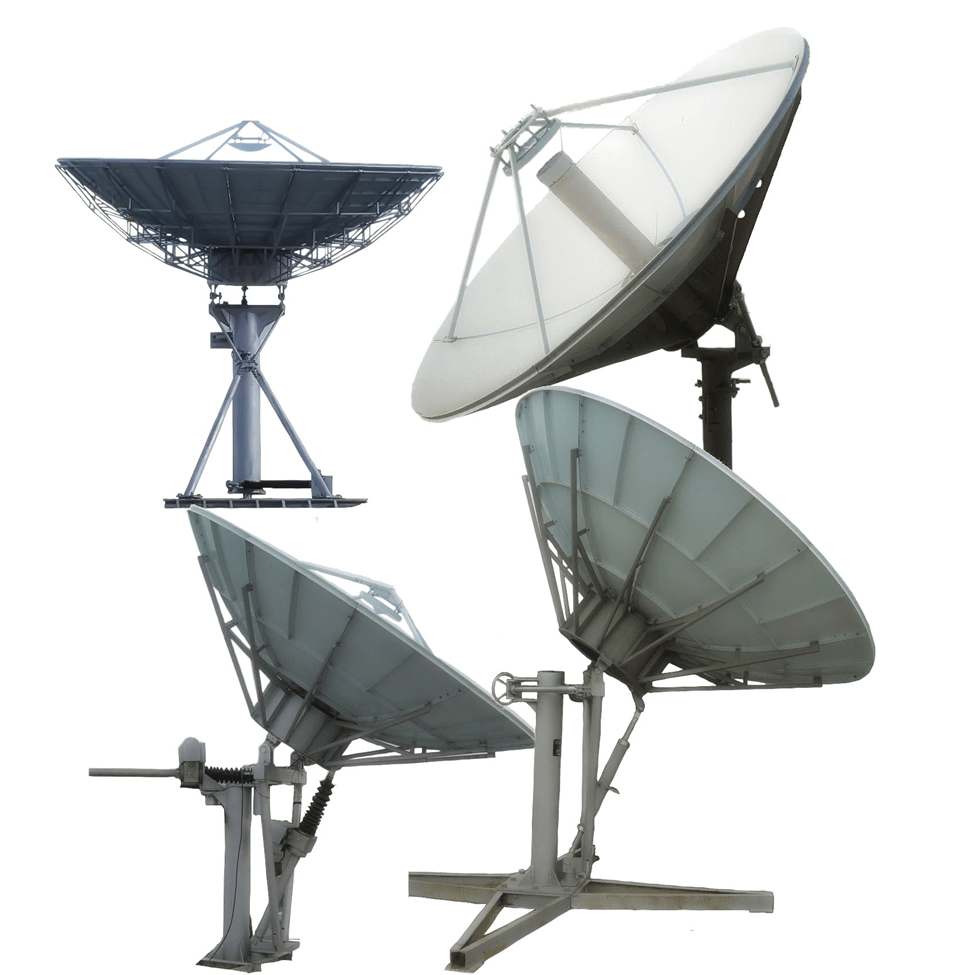
For WiFi,WiMAX Wireless LAN, Wireless Video Links and Cellular, sector antennas would be perfect. This “cell-site” antenna is made of heavy-duty plastic fiberglass radome with mounting system adjustable from 0 to 15 degrees.
While external antennas are mainly for outdoors, mobile antenna are very flexible for its omnidirectional feature. It is commonly designed for vehicular application due to its superb mechanical and electrical performance. Broadband antennas are also available in the market for 900 MHz, 2.4 GHz, 5 GHz applications.
We all want steadier and faster connections so we only want wireless antennas with outstanding performance. There are quick ways to spot them but here are more tips on how to choose wireless antenna while shopping online from reputable sellers such as ZDA Communications and Excel Wireless:
- Determine antenna’s functionality. You must be aware of the different types and choose accordingly based on your needs. For example, you want to cover wide-angle areas, go for wide band or multi-band designs.
- Look for weather resistant and water proof antenna so that you can preserve its longer life-span. Physical appearance is also important especially if you have limited space or cramped location.
- Pick a wireless antenna which performs best whether indoors or outdoors.
- Make sure it passed strict quality testing and has good warranty period.
- If the shop offer free signal boosters as a bundle, know first the reason beyond that. Is it because they expect the wireless antenna to have poor signal, or is it as a genuine customer reward. Never fall for false marketing strategies.
- Ensure that they offer technical support for installation, maintenance and repair.
- Consider the compatibility and upgradability of your wireless antenna.
These are just some of helpful reminders for you when choosing antennas. The salesperson can always help you with your questions but it is better to do your homework before shopping.
YotaPhone debuts next-gen smartphone at MWC
Yota Devices, the company behind the dual-display smartphone experience, has announced a second-generation device at Mobile World Congress.
Key among the differences from the first model is that both the e-paper display and 5-inch AMOLED panel are touch. The phone itself is more curvy and comfortable to hold; internally, the handset is now powered by a Snapdragon 800 processor and features NFC.
One of the benefits of the e-paper technology is that it only draws power when the screen is changing. This way users can see information such as clocks and widgets without putting strain on the battery.
The next-gen YotaPhone is planned for release in Russia and Europe by the end of the year followed by the United States in 2015.
via YotaPhone
The post YotaPhone debuts next-gen smartphone at MWC appeared first on AndroidGuys.
French handset maker Wiko calls up first Tegra 4i LTE smartphone
French handset maker Wiko Mobile has created Europe’s first smartphone with an integrated Tegra 4i LTE processor. Featuring a 4.7-inch 720p display, the Wiki WAX also provides users with an 8-megapixel rear camera, and LTE and HSPA+ support. The Tegra 4i processor is a quad-core CPU with NVIDIA’s i500 LTE modem.
The Wiko WAZ will be offered across multiple European markets starting in April. Among the countries on the horizon include France, Spain, Portugal, Germany, Italy, UK and Belgium. Pricing was not disclosed as of press time.
The post French handset maker Wiko calls up first Tegra 4i LTE smartphone appeared first on AndroidGuys.

Google and LG Working on Android Smart Watch Set for June Reveal
Google and LG are working on a smart watch that will likely be unveiled at the Google I/O developer conference in June, reports CNET. Google will reveal details on the device’s operating system in advance of the hardware announcement, giving developers time to create apps for the device’s retail launch.

Google’s smart watch endeavor will mirror its Nexus line of mobile devices, with Google providing the software and a manufacturer partner designing the hardware. Google is said to be working with LG on the smart watch, continuing a partnership established with the development of the Nexus 4 and Nexus 5. Similar to their work on the Nexus devices, Google will lead the marketing and sale of the smart watch, while LG will focus on developing the hardware.
Google’s smart watch will be powered by a version of Android that will integrate the company’s Google Now voice assistant and search feature. The Wall Street Journal also adds that Google’s smart watch will be compatible with a variety of Android devices, setting it apart from other smart watches such as the Samsung Galaxy Gear and Gear 2.
Apple is rumored to be working on its own iWatch smart watch that could debut later this year. Recent reports suggest the device may include advanced sensors to track several health-related functions, such as blood glucose and hydration levels. Other rumors also suggest that Apple is developing Healthbook, an iOS 8 app that would utilize both the iPhone and iWatch for monitoring health statistics like weight, heart rate, calories and step counts.
     |

WhatsApp to Add Voice Calling in Q2 2014 [iOS Blog]
 WhatsApp CEO Jan Koum has announced at Mobile World Congress 2014 that the company will add voice calling to its popular messaging platform in Q2 2014, reports TechCrunch. The voice service will be added to iOS and Android first, with other platforms receiving the update at an unannounced future date.
We use the least amount of bandwidth and we use the hell out of it,” he said. “We will focus on simplicity.” Voice will come to Android and iOS first and then following on some Nokia and BlackBerry phones, he added.
Koum also announced the popular cross-platform messaging service has grown to 465 million monthly active users and 330 million daily users, an increase of 15 million from the statistics released last December. The company recently was acquired by Facebook in a deal worth up to $19 billion, including $4 billion in cash, $12 billion in Facebook stock and an additional $3 billion in employee restricted stock units.
Little will change for WhatsApp users following the Facebook acquisition. Koum assured users the service will remain autonomous and operate independently of Facebook. It also won’t change its “no marketing, no ads” strategy and will continue to remain reasonably priced with a $0.99 annual fee after the first free year.

| |

Panasonic’s newest Toughpad isn’t a smartphone, except when it is

When Panasonic said that it was done making smartphones, it meant it. The 5-inch Toughpad FZ-E1 and FZ-X1, you see, are very small tablets that just happen to make calls, okay? Both come with a 5-inch 1,280 x 720 LCD display, 2GB RAM, 32GB of on-board storage and a microSD card slot. Another way in which these devices aren’t smartphones are in the connectivity stakes, after all, you wouldn’t see a smartphone with 802.11 a/b/g/n/ac WiFi, Bluetooth 4.0, HSPA+, WCDMA, EV-DO, 3G and LTE radios, not to mention HD Voice, GPS and GLONASS, would you? Since these are Toughpad devices, they’re both ruggedized to withstand drops, dust and water to MIL-810G, IP65 and IP68 — so you can use the device’s 8-megapixel camera and 1.3-megapixel front-facing lens in any conditions. There’s also a staggering 6,200mAh battery tucked inside, which the company promises will keep you trucking for 14 hours of continuous use and up to 1,000 hours of standby. The only real difference between the two smartphones small tablets is the choice of operating system, with the E1 running Windows 8 Embedded and the X1 packing Android 4.2.2. There’s no specific word on pricing, but we could expect ‘em to retail for around 130,000 yen ($1,300) when they both drop later in the year.
Filed under: Cellphones, Tablets, Mobile
Via: Reuters
Source: Panasonic (Translated)
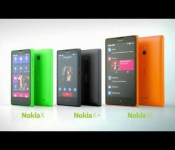
Nokia debuts Android-powered X, X+, and XL
All eyes were pointed at Nokia during Mobile World Congress for a glimpse at the long awaited “secret” Android powered devices the company was said to be working on. These were considered a last gasp effort at exploring Android before being absorbed by Microsoft. However, it seems that the tactics extend far greater than just an experiment with Android.
Nokia has just announced the Nokia XL which has a huge 5-inch IPS display, available in early Q2 of 2014 to over 109 growing markets in Europe.
With CEO Stephen Elop reinforcing that the flagship products are still their Lumia lineup and therefore Windows Phone (obviously), it seems Android is part of a strategy to offer lower-end devices to extend the reach of Microsoft’s services, as the Nokia X lineup will be priced below the Lumia offerings. Nokia XL is running an AOSP build of Android and you can expect it to be preloaded with all of Microsoft’s cloud services.
Rather than introducing just one model at Mobile World Congress, Nokia has delivered no less than three devices: Nokia X, X+, and XL. Save for very minor details, the first two are nearly identical to each other.
The basic specifications for the three breaks down as so:
Nokia X
- 4-inch (800 x 480) display
- 3-megapixel rear camera with fixed focus
- 1GHz dual-core Snapdragon S4 processor
- 512MB RAM
- 4GB internal storage (microSD expansion)
- Bluetooth 3.0
- Also available in dual-SIM
Nokia XL
- 5-inch (800 x 480) display
- 5-megapixel rear camera with fixed focus
- 1GHz dual-core Snapdragon S4 processor
- 768 MB RAM
- 4GB internal storage (microSD expansion)
- Bluetooth 3.0
- Also available in dual-SIM
It is worth pointing out that Nokia makes no references to the particulars of Android and that the devices do not feature any Google Play services or Google apps. Nokia has opted, as their wont, to include their own services and app selection.
The Nokia X will go on sale immediately, starting at EUR 89*** and rolling-out in Asia-Pacific, Europe, India, Latin America, the Middle East and Africa. The Nokia X+ and Nokia XL are expected to roll out in these markets starting early second quarter, priced at EUR 99 and EUR 109, respectively.
The post Nokia debuts Android-powered X, X+, and XL appeared first on AndroidGuys.
Qualcomm rolls out 8-core Snapdragon 615 CPU
Qualcomm on Monday kicked off Mobile World Congress with a pair of new mobile processors. Today sees the chipmaker adding the Snapdragon 615 and 610 to its lineup.
The Snapdragon 615 is the company’s first commercial octa-core CPU solution with integrated LTE and 64-bit capabilities. Yeah, we’re talking next-level stuff. Featuring support for a wide variety of LTE bands, HSPA+ 42, and CDMA, it also packs in an Adreno 405 GPU.
The Snapdragon 610 is a quad-core version of the chipset with many of the same features.
Both the Snapdragon 615 and 610 processors will begin sampling in the third quarter of the year with the first commercial devices arriving by the end of 2014.
The post Qualcomm rolls out 8-core Snapdragon 615 CPU appeared first on AndroidGuys.

[MWC 2014] The Nokia X is finally official, as are its brothers, the Nokia X+ and Nokia XL
 One of Nokia‘s most anticipated phones, at least for us Android folk, the Nokia X is finally official, announced at MWC 2014 today, and it’s bringing some friends with it. The oft-leaked Nokia X has been announced by Nokia today, and it will be accompanied to the Android market by two other phones named the Nokia X+ and the Nokia XL in their bid to reach emerging markets with these affordable handsets.
The Nokia X specifications are as we expected: a QualcommSnapdragon S4 processor clocked at 1GHz, 512MB RAM, 4GB storage (with microSD slot), a 4-inch 800×480 IPS display and a 3MP rear camera. The Nokia X+ shares almost all the same hardware as the Nokia X except that it will have 768MB RAM instead. The Nokia X will go on sale immediately for €89 (or around $120 USD) in the Asia Pacific, Europe, India, Latin America, the Middle East and Africa, while the Nokia X+ is due to go on sale for €99 (around $135 USD) sometime in Q2 this year.
As its name suggests, the Nokia XL is a larger version of the Nokia X, upping the screen size to 5-inches, but keeping the same Snapdragon S4 and 768MB RAM as the Nokia X+. The Nokia XL will also have better cameras, fixing a 5MP camera to the back and a 2MP camera to its front. It is also expected to release in the same time-frame as the Nokia X+ and will go for €109 ($150 USD).
As alluded to in leaks, the Nokia X, X+ and XL will all run a forked version of Android meaning that they will not have access to the Google Play Store or its apps, instead utilizing Nokia’s own app store. We’re still to see how this pans out, but they are attractively priced and Nokia have traditionally made phones of impressive quality, so we’ll see what the reviews say.
Are you interested in getting one of the Nokia X, X+ or XL? Let us know what you think of these budget handsets in the comments below.
Source: Phones Review
 AIVAnet