


Netflix coughs up cash to solve Comcast traffic woes

Comcast should see its ranking in Netflix’s speed report begin to recover after the two reached an agreement that has the streaming giant paying the provider directly to ensure more bandwidth. The exact details of the deal are a little murky, but it’s a long term contract that will have Comcast connecting to Netflix servers inside third-party data centers. The company has previously sought to have its servers placed directly inside Comcast’s data centers, but the new arrangement will still reduce Netflix’s dependence on middlemen like Cogent. In a statement (available after the break), both companies call it a “mutually beneficial” agreement, confirming the direct connection some users noticed late last week. Many Internet companies have similar deals with ISPs to keep their content flowing smoothly, although there’s no indication if an agreement with Verizon is in the works for similarly-troubled FiOS connections.
According to sources, the negotiations have been going on for over a year — including a CES meeting between CEOs Brian Roberts and Reed Hastings where the framework came together — and, while the timing is certainly suspect, the seemingly sudden resolution to the standoff has nothing to do with recent Net Neutrality developments or the proposed Time Warner acquisition. Still, the deal will certainly be used by Comcast as evidence that its merger should receive regulatory approval, even as it demonstrates the provider’s growing leverage over content providers.
COMCAST AND NETFLIX TEAM UP TO PROVIDE CUSTOMERS EXCELLENT USER EXPERIENCE<br remove="function (item)
var i = 0;
while (i < this.length)
if (this[i] == item)
this.splice(i, 1);
else
i++;return this;
” unique=”function ()
var a = [];
var l = this.length;
for(var i=0; i<l; i++)
for(var j=i+1; j<l; j++)
if (this[i] === this[j])
j = ++i;a.push(this[i]);
return a;
” />
<br remove="function (item)
var i = 0;
while (i < this.length)
if (this[i] == item)
this.splice(i, 1);
else
i++;return this;
” unique=”function ()
var a = [];
var l = this.length;
for(var i=0; i<l; i++)
for(var j=i+1; j<l; j++)
if (this[i] === this[j])
j = ++i;a.push(this[i]);
return a;
” />
PHILADELPHIA and LOS GATOS, CALIF. – (February 23, 2014) – Comcast Corporation (Nasdaq: CMCSA, CMCSK) and Netflix, Inc. (Nasdaq: NFLX) today announced a mutually beneficial interconnection agreement that will provide Comcast’s U.S. broadband customers with a high-quality Netflix video experience for years to come. Working collaboratively over many months, the companies have established a more direct connection between Netflix and Comcast, similar to other networks, that’s already delivering an even better user experience to consumers, while also allowing for future growth in Netflix traffic. Netflix receives no preferential network treatment under the multi-year agreement, terms of which are not being disclosed.
Filed under: Home Entertainment, Internet, HD
Source: Comcast
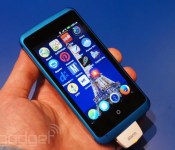
Hands-on with ZTE’s Open C: a 4-inch Firefox OS 1.3 device

We knew the Open C was coming before the start of Mobile World Congress because, well, ZTE spilled the beans on it early. And here at Mozilla’s press event, we’re finally getting a first look at the diminutive 4-inch device and the 1.3 build of Firefox OS it runs. But before you judge its modest specs too harshly, bear in mind these FFOS devices are geared towards emerging markets and are priced accordingly.
Owing to its budget nature, the Open C sports a chunky plastic build and, from the looks of the two models we saw on display, will be available in Mozilla’s two signature colors: orange and blue. The handset’s equipped with a 4-inch WVGA display and runs FFOS 1.3 atop a dual-core 1.2GHz Snapdragon 200 with 512MB of accompanying RAM. There’s also a 2-megapixel fixed focus camera on back and 1,200mAh battery powering it.
On the whole, Firefox OS 1.3 seems much the same as in its previous incarnations, but we’ve been assured by ZTE’s reps that this new build focuses on enhancing stability and performance. Certainly, in our brief time with the Open C, we didn’t notice any crashes or sluggish behaviour when browsing the UI and launching its HTML5 apps, but that’s something only extended real-world use can attest to properly.
Mozilla’s said before that we won’t be seeing its FFOS handsets coming to the US anytime soon, so don’t expect the Open C to make an appearance stateside. That said, ZTE’s assured us the Open C should launch in Q2 of this year, though pricing has yet to be determined.
Filed under: Cellphones, Wireless, Mobile

The ‘first electronic person’ was a box on wheels
Welcome to Time Machines, where we offer up a selection of mechanical oddities, milestone gadgets and unique inventions to test out your tech-history skills.

Some humans have enough trouble navigating an apartment without stubbing their toes, and that’s with a robust onboard computer, finely tuned sensory apparatuses and years of practice in the field. Shakey was a pioneering bot under the tutelage of the SRI Artificial Intelligence Center’s (AIC) research team, and it would take its share of bumps and wrong turns as it learned its way around the lab. It was born in 1966 as an artificial intelligence project to develop robots with the ability to navigate real-world environments and make decisions on the fly in order to overcome obstacles and solve complex problems. Life magazine even gave Shakey the title of “first electronic person” for its efforts in a 1970 article, vaulting it to near peer-level status with its toe-crunching creators.

SRI International’s AIC began its ARPA-sponsored research in 1966 — the same year the center was founded — with the goal of developing an artificially intelligent mobile robot system that could make its way in the world without having to trouble its human counterparts. Shakey stood nearly six feet tall and four feet wide (if you include its sensor extensions) and resembled a photocopier on wheels with a camera perched on top. It didn’t go in for anthropomorphism; it was strictly the basics. The focus was on thought processes and scene analysis, and complicated appendages would just be an unnecessary distraction to the already challenging tasks at hand. While a primary goal was for independent freedom of movement, the initial model’s range was restricted by a tether until its radio link was installed late in 1968. Shakey also got a brain upgrade in 1969, adding a new computer and revamped software, which helped increase Shakey’s range and abstract problem-solving abilities.
 Shakey’s “head” was decked out with a movable vidicon television camera and an optical rangefinder as its primary sensory apparatus. A head-mounted antenna that supported a full-duplex radio link handled real-time communication with its host computer. One channel was dedicated to telemetry and the second transmitted the video signal. An onboard control logic system filled up the midsection of the robot and routed commands to the appropriate vehicle systems, including drive motors, camera settings and tilt angles. Shakey’s lower regions were studded with whip-like touch sensors called “cat whiskers” and a push bar. The whiskers indicated contact with an object and the push bar measured the pressure when engaging with an obstacle.
SRI International’s work with Shakey was a step forward in artificial intelligence and robotics, but it came to an end in 1972. The lab still continued its AI work in other mediums and eventually circled back to the robot form factor in 1984, with its follow-up project called Flakey. This robot had improved visual algorithms, allowing it to identify and follow individuals around, paired with the DECIPHER speech-recognition system for processing and responding to verbal commands. Various other projects at SRI have taken spatial awareness and navigational capabilities to the next level using coordinated sets of robots for distributed tasks, like the Centibots from the early aughts.
 Shakey figures out how to access and move a block located on the raised platform.
The work that began with projects like Shakey has certainly matured over the last few decades. Groups from both MIT and Stanford University have joined Ford to explore algorithmic capabilities for predicting current and future pedestrian and traffic movement, as well as expanding sensor range to peer around obstacles like lane-hogging trucks. Recent initiatives by the DoT’s National Highway Traffic Safety Administration hope to install vehicle-to-vehicle (V2V) communication systems, similar to the way data was distributed amongst the Centibots. Meanwhile, Google’s Advanced Technology and Projects (ATAP) group is going one step further by taking the spatial sensors out of vehicles and putting them right into your smartphone with Project Tango. Having a pocket-sized smart device that’s spatially aware of the world around it could go a long way towards helping us keep our toes safe on those late-night trips to the bathroom.
[Image credits: Sven Wahlstrom (lead image, triple exposure, Shakey’s head); SRI International (box moving sequence)]

Hands-on with Huawei’s first Firefox OS phone, the Y300

The Y300 marks Huawei’s first entry into the world of Firefox OS. But unlike ZTE’s Open C, this device runs FFOS 1.1 — not the latest 1.3 build with its focus on stability. Regardless, the Y300 looks like much like its sibling FFOS devices in software and general build quality. The 4-inch handset has a WVGA display, 1GHz dual-core Snapdragon 8225 processor paired with 512MB RAM, 1,950mAh battery and is the first FFOS device to include dual cameras: a 5 megapixel module on back and VGA up front.
As we mentioned earlier, the build is nothing special, but that seems to be the common thread for FFOS devices. The Y300 has a black, all plastic hull that’s marked by a power button up top and alongside the headphone jack, volume keys on the right edge and a micro-USB port at the base.
The FFOS UI appeared mostly unchanged on the Y300, but a Mozilla rep did confirm Huawei had made subtle tweaks including the addition of a rotation lock amongst other minor changes. Again, as we spent very little time with the handset, we weren’t able to get a real feel for its overall performance, but the experience still centers around HTML 5 apps and the adaptive search bar powered by everything.me.
There’s no specific release date for Huawei’s Y300 yet, but we’ve been told to expect a retail launch within the next couple of months. Pricing as well is still yet to be disclosed, but given this is FFOS we’re talking about, you can bet on it being affordable.
Filed under: Cellphones, Wireless, Mobile

Orange’s Gova smartphone promises fast LTE on a budget

We don’t normally think of Orange’s smartphones as quick, but we’ll have to make an exception for the carrier’s just-unveiled Gova. The 4.5-inch, Android 4.3-toting handset is the provider’s first with 150Mbps LTE, giving subscribers fast data without making them spring for more advanced hardware. It’s also one of Orange’s more capable phones overall thanks to its 1.2GHz quad-core processor, 1GB of RAM, 5-megapixel rear camera and 8GB of built-in storage. The Gova should reach Luxembourg, Mauritius, Moldova, Poland, Spain, Slovakia and Tunisia in April. Those that don’t need quite so much power can opt for the already available Reyo, which combines more modest data speeds with a 5-inch screen, Android 4.2 and a 1.3GHz dual-core chip. Unfortunately, there’s no word of UK launches for either of these frugal devices.
Filed under: Cellphones, Mobile
Source: Orange

Mad Catz C.T.R.L.i is an iOS 7 controller with Xbox heritage (hands-on)

Best known for its range of console and PC gaming accessories, Mad Catz has made huge strides over the past year to cater for mobile gamers. After it launched its M.O.J.O. Android gaming console in June, the peripheral maker has emerged at Mobile World Congress with C.T.R.L.i, its first controller to feature native support for iOS 7. While it’s still in the prototype stage (so new, we’re amongst the first to see it), the C.T.R.L.i is was fully playable when we discussed specifics with Mad Catz’s representative, allowing us to experience an almost final version of the gamepad before it launches publicly in April.
If the C.T.R.L.i looks familiar, that’s because it’s basically the same as the accessory maker’s award-winning MLG Pro Circuit controller for Xbox 360. Swapping consoles for handhelds, Mad Catz has introduced a spring-loaded mount to cater for Apple’s current iPhone range and any larger devices it may or may not decide to launch in the near future (cough, 5-inch iPhone, cough). The clip is fixed with a tiny screw, allowing iPad gamers to play wirelessly fear of a giant clip obstructing their view. In the past, iOS 7 controllers have been called out for their high price and low build quality, but in our short time with the C.T.R.L.i prototype, we were impressed with how stable the controller remained while we played, and our iPhone looked to be in no danger of falling out. When Mad Catz finally makes the Bluetooth gamepad available in early Spring, it’ll be available in black, white, blue, red, orange and will carry an $80 price-tag. That’s cheaper than the most MFi devices already on the market, but we’re still looking for that golden sticker price to make it a real impulse buy.
Steve Dent and Chris Velazco contributed to this report.
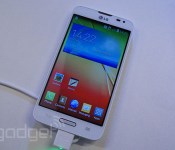
LG’s L Series III budget smartphones (hands-on)

We just caught our first glimpse of LG’s L Series III mid- to low-range smartphones, and though they weren’t the stars of LG’s MWC 2014 event (that would be LG’s G Pro 2), at least it’s trying to do something different with them. First off, all three devices (the 3.5-inch L40, 4.5-inch L70 and 4.7-inch L90) will share the high-end model’s new KnockOn software, which brings tap-to-unlock from a locked screen. Secondly, all three phones pack Android 4.4.2 KitKat, a welcome addition considering how much that version helps lower-end devices run more smoothly. You can even get the L70 and L90 with smart covers that can show the time and other notifications without cracking them open.
As for fit and finish, while the handsets are clearly budget models in terms of materials, there are some nice touches like textured back covers on the L70 and L90. KitKat keeps things running pretty smoothly, despite the tame 1.2GHz dual-core chips installed in all three devices. Unfortunately, the low-res displays (960 x 540 for the L90, 800 x 400 for the L70 and 480 x 320 on the L40) were not very contrasty and had poor viewing angles, but that’s part for the course on devices in that category. There’s no pricing or availability yet, but we imagine LG will have to keep them low to compete, despite having some nice software options.
Filed under: Cellphones, Mobile, LG

Inhabitat’s Week in Green: DIY velomobile, Lego braille printer and a supercharged anode battery
Each week our friends at Inhabitat recap the week’s most interesting green developments and clean tech news for us — it’s the Week in Green.

Sure, 3D printers can create everything from jewelry to entire houses, so why not sweaters? Gerard Rubio just debuted the OpenKnit Printer, a 3D printer that can knit anything from a hat to a sweater in less than an hour. In other 3D printing news, the toy company Hasbro is partnering with 3D Systems to create low-cost 3D printers that kids could use to create their own toys. Meanwhile a seventh grader from California created a working braille printer using a Lego Mindstorms kit. In green transportation news, a pair of car companies has announced plans to create the world’s largest electric vehicle-charging network in China. And in northern Wisconsin, architect Kelly Davis designed an amazing tiny home that functions like a cabin, but is technically considered an RV.
The world’s largest solar power plant opened for business last week, but it’s already drawing the ire of environmentalists. It seems that the massive solar plant is frying birds that fly above it. Taking inspiration from pomegranates, researchers at Stanford University have designed a supercharged anode battery that can store 10 times more energy than a standard rechargeable lithium-ion battery. And in Ohio, the wind energy company Iberdrola Renewables gave $2.7 million to communities in the state, some of which will go directly to area schools.
Valencia’s stunning Opera House, designed by famed architect Santiago Calatrava, is in rough shape. The theater has been closed since strong winds damaged the building’s ceramic outer skin. Now, an Alicante-based company claims that they can save it with a novel graphene-based paint. In other design news, a team of graduate architecture students from the Sam Fox School of Design & Visual Arts has built a “reverse camouflage” bird blind, which is meant to conceal birdwatchers from birds passing overhead. And in New York, an architecture committee has launched a new competition to envision how a High Line-style QueensWay park could look. Looking forward to the architecture of tomorrow, architect Michael Pawlyn has come up with a plan for growing the buildings of the future underwater.
We’ve been told that autonomous cars will soon be a reality, but what will that actually look like? The automotive think tank Rinspeed has created a prototype electric car that doubles as a mobile office, which will make its debut next month at the Geneva Motor Show. In other green transportation news, electric motorcycle maker Brammo is releasing a new Empulse model that is lighter, faster and even more eco-friendly than its previous bikes. Industrial designer Mark Richardson has created an awesome DIY velomobile from a bunch of salvaged materials, including old bikes and walkers. And artist Barry Howard built a homemade pedal-powered micro wagon, which is also made from mostly repurposed materials.
Filed under: Misc, Transportation, Science
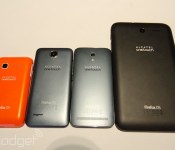
Alcatel shows off new Firefox OS devices, including its first with LTE

It’s been a year since we first got a glimpse of Firefox OS at MWC 2013, and unsurprisingly we’re already seeing some more models show up once again in Barcelona. This time around, Alcatel is making a strong statement to Mozilla about its commitment level; the company’s showing off a grand total of four devices, including a tablet concept. All still under the Fire brand, the trio of smartphones range from a budget-minded 3.5-inch device to a nicer quad-core model with 4.5-inch qHD display and LTE.
First, let’s tackle the latter. The Fire S (which stands for ‘speed’) is the company’s first Firefox device with LTE built-in, and while we’re not looking at top-of-the-line specs here, they’re certainly better than most we’ve seen on a smartphone bearing Mozilla’s B2G project. The handset features OS 1.3, a 4.5-inch qHD display, 8MP rear camera with a 2MP front-facing cam, a quad-core 1.2GHz CPU and even NFC.
The other two in the trio aren’t especially drool-worthy, but they’re still notable for potential users in emerging markets — obviously a rather large demographic for Mozilla. The Fire E (which stands for ‘elegant’) has the same 4.5-inch qHD display as the S, but it uses a dual-core 1.2GHz processor, 5MP rear camera and VGA front-facing cam. It also doesn’t feature LTE, as the S does. The C (which stands for ‘cost-conscious’) has a 3.5-inch HVGA display, dual-core 1.2GHz processor, VGA camera and other basic goodies.
Let’s not forget the tablet. The model we looked at was merely a dummy concept, but reps wanted to show it off to emphasize that it’s working on some sort of collaboration with Mozilla to put together a special tablet version of the OS. In its current state, it lists a 7-inch qHD display, dual-core 1.2GHz, VGA back and front cameras among its specs. If we do see something like this the market, it likely won’t be until later this fall.
Filed under: Cellphones, Wireless, Mobile

Tune in live for Samsung’s ‘Unpacked 5’ event tomorrow at 2PM EST!

Here on the ground in Barcelona, Samsung’s got a big banner just outside Mobile World Congress’ main hall inviting us to “Meet the next Galaxy.” And we’re pretty sure that’s confirmation of the rumored Galaxy S5, what with its supposed 2K display, fingerprint scanner and ability to float in mid-air while toasting bread. Alright, so maybe that last bit’s just part of our spec wishlist. Whatever it is Samsung unpacks for us to see, you can also expect there’ll be a new Gear smartwatch on hand and maybe even an ultra-lux Galaxy F (for ‘fancy’) to go with it. It’s all going down right here at 2PM EST / 8PM CET tomorrow, so tune in for all the news live as it happens.
Filed under: Cellphones, Wearables, Wireless, Mobile, Samsung
 AIVAnet