


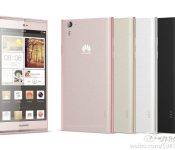
Huawei Ascend P7 looks ready to be revealed at MWC 2014, alongside Huawei’s first Smartwatch
 For anyone keeping track, Huawei has been doing a pretty good job in the smartphone world as of late. Despite not having a particularly big presence in the U.S., Huawei had a 6% market share in the smartphone industry to finish 2013 which puts them third among all phone manufacturers behind Samsung and Apple; not a bad achievement at all. Huawei is looking to start 2014 with a bang by bringing in a successor to its Ascend P6 device, presumed to be named the Huawei Ascend P7, only 8 months after the P6 was launched.
The P7 is expected to have a 5-inch 1080p display, a quad-core HiSilicon processor clocked at 1.6GHz, 2GB RAM and a 13MP camera. Those specs, and pending the price, should put the P7 somewhere in the mid-range to upper-mid-range phones available on the market. And if its 6.18mm older brother is anything to go by, the P7 will likely have lost some millimetres on its waistline. The Ascend P7 is expected to debut at MWC 2014 next week, along side a rumoured smartwatch, the first from the Chinese manufacturer. While there aren’t many details about the wearable device, we only have a few more days before MWC 2014 begins and from the look of it, it’s going to be one filled with surprises.
What do you think about the Huawei Ascend P7: is this a device you would get? And what do you think about Huawei outing a smartwatch? Let us know what you think in the comments.
Source: Phone Arena (1), (2), (3)

Arr Jim lad: Nokia’s Treasure Tags keep your phone and wallet within 50 paces of each other

Phone, wallet, wooden leg. That’s the mental, if not physical, pat down today’s urban pirate typically goes through as they leave the house. Nokia’s Treasure Tag hopes to remove some of that anxiety. The “tag” part attaches to your “treasure” and connects to your phone over Bluetooth (with NFC pairing). Should your gold and your phone be parted — say, as you leave one on your desk as you dash out for lunch — both pieces of hardware alert you with an alarm. The sonic part also helps you find the forgotten item, should you not remember where you left it. There’s also a companion app that will locate your lost bounty on a map. The extra forgetful can pair unto four tags with one phone, and disable/enable alerts for each at will, and with battery life claimed to be around six months, you’re good for a long while. It comes in Nokia’s four favorite/regular hues, and costs $30 a pop. It’s not restricted to Windows Phone, either, it seems, as Nokia states there will be support for third-party iOS and Android apps. What if you’re prone to forgetting you keys and phone together? Then you probably don’t deserve nice things in the first place, swashbuckler.
Filed under: Cellphones, Mobile
Source: Nokia Conversations
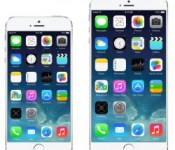
Sketchy Report Claims Apple Will Release 4.7-Inch iPhone and 5.6-Inch ‘Experimental’ Phone Without iPhone Branding [iOS Blog]
 Apple is planning on introducing two new phones this year featuring displays of 4.7 and 5.6 inches, with the former using a traditional Gorilla Glass display and the latter featuring a sapphire screen, according to a new report from Taiwan’s Economic Daily News [Google Translate] (via Mac Otakara). The report also states that due to its experimental nature, Apple’s 5.6-inch phone will not be known as an iPhone.
While it is somewhat probable that Apple could release two versions of the iPhone as previously suggested by other reports, it is very unlikely that the company would drop the iPhone name for the larger phone given the iconic reputation of the brand.
The report adds that Apple’s next-generation phones will once again be assembled at primary supplier Foxconn (also known as Hon Hai Precision Industry Co.), with other suppliers including Cheng Uei Precision Industry and Simplo Technology also helping with production. Furthermore, the sapphire displays to be used in the 5.6-inch phone are said to come from new Apple partner GT Advanced, which was reported to be gearing up for massive production of devices with sapphire displays earlier this month.
Apple has been experimenting with a range of screen sizes for the next-generation iPhone since early 2013, with size rumors varying from 4.7 to 5.7 inches. Last week, the South China Morning Post stated that the company would be launching two new iPhones with larger flat sapphire displays in September, while The Korea Herald reported that the iPhone 6 would adopt a “bezel-free” display.
In addition to a new display, other reports have indicated that the iPhone 6 will feature a slimmer profile due to thinner and lighter backlights and a 10-megapixel or higher camera with an improved filter. The iPhone 6 is generally expected to arrive in the same September-October timeframe seen in recent years.
     |
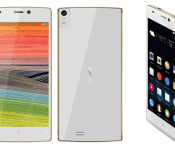
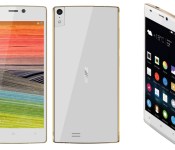
The Gionee Elife S5.5 is the world’s thinnest smartphone at just 5.5mm Thick
 Smartphone manufacturers in general appear to have shied away, at least for the time being, from attempting to make their phones any thinner than they have to. One of the last phones to claim the title of ‘thinnest smartphone’ went to the Huawei Ascend P6 at 6.2mm. Gionee has other ideas, however, as it has come out with the Gionee Elife S5.5 which measures just 5.5mm thick. That’s wafer-thin territory and from the press images (see image above), it makes slim look pretty darn good.
Hardware for the Elife S5.5 includes a quad-core 1.7GHz processor, 2GB RAM, a 5-inch display and a 2,300mAh battery.While those specs might not look like much, the minute thickness of the device more than likely influenced what was possible to be included. The Elife S5.5 will be available in 3G and LTE versions, and while the 3G version is now available for pre-order in China for around $370 USD, the LTE version won’t be available till June. While Gionee is saying that it will be releasing the Elife S5.5 in 40 other countries, it is yet to specify exactly which 40 they are.
Would you be interested in getting the new ‘thinnest smartphone’ on the market? Let us know what you think about the Gionee Elife S5.5 in the comments.
Source: engadget via Phona Arena
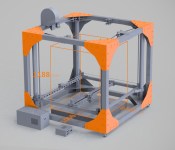
BigRep’s ONE can 3D print full-sized pieces of furniture

While consumer 3D printers are cheaper and more efficient than ever before, their small size often means designers are limited to creating hand-sized models and figurines. With the launch of its open-source ONE printer, German studio BigRep is looking to expand things quite significantly, by letting you print your own full-sized pieces of furniture. With a build volume of 45 x 39 x 47 inches (that’s 46 cubic feet), BigRep’s machine can fashion things out of the usual plastics, but can also be tweaked to print using a mixture of wood fibers and polymers, as well as Laybrick, a sandstone-type filament. If you fancy crafting a new side table for your home or office, the ONE will set you back a hefty $39,000 — just make sure you have plenty of spare room in your garage.
Filed under: Household
Via: CNET
Source: BigRep
Gionee’s 5.5mm thick smartphone can make calls all day, slice tomatoes

Gionee’s trying to stand out from the Huaweis and Oppos of smartphone-mad China with its new Elife S5.5, which it claims is the world’s thinnest at 5.5mm. If so, that would edge out the 5.75mm Vivo X3, the current champ (for reference, the iPhone 5s is 7.6mm thick). If “battery life” is the first thing that pops into mind for such a phone, Gionee claims it’ll last all day like its (much thicker) flagship, the Elife E7, thanks to a 2300mAh battery. Other than that, it’s fairly tame with a 5-inch display of unknown resolution, Gionee’s “Amigo” Android-based OS, an unspecified 1.7GHz quad-core CPU, 2GB of RAM and 13-megapixel back/5-megapixel front cameras. The 3G model is now up for pre-order in China for around $370, with an LTE version arriving in June. Gionee also said it’ll launch in 40 other countries, though eager small-pocketed consumers will have to wait to find out which.
Filed under: Cellphones, Mobile
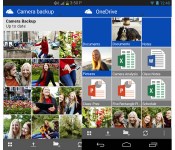
Microsoft intros monthly storage plans for OneDrive, Android app now does automatic camera backups

Nope, not SkyDrive — OneDrive. In case you haven’t heard, Microsoft’s cloud storage service is going by a new name, and it’s finally going into effect today; you should see in the upper-left corner the next time you log in. But that’s not all that’s new: the company also updated its Android app with automatic camera backups, so that any photos or video you take on your device will automatically be sent to OneDrive. If you recall, this is a feature you’ll already find on the company’s iOS app — for whatever reason, it just took a bit longer to make its way to Android. As ever, you can opt to have OneDrive upload on WiFi only, ensuring you don’t exceed your monthly data cap. You can also put limits on image sizes if you want to make the most of your 7GB of free storage space.
Additionally, the company introduced monthly storage plans, starting at $4.49 a month for 50GB and going up to $11.49 a month for 200GB. Simple math tells us that’s more expensive than buying the same amount of storage on a yearly basis, but hey, some of you might be commitment phobes, and we get that. Lastly, you’ll want to keep an eye on Microsoft’s new OneDrive Twitter account today: the company will be giving away 100GB of free storage for a year, with freebies going to the first 100,000 people who log in at a designated time. The catch: Microsoft hasn’t said yet what time folks will need to log into their accounts, so if you want a chance of winning, you’ll just need to watch OneDrive’s Twitter feed. Sneaky, but them’s the breaks.
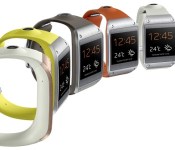
[RUMOUR] Is the Samsung Galaxy Gear 2 going to be running Tizen instead of Android?
 While the star of Samsung‘s Unpacked event at MWC 2014 is inevitably going to be its new flagship, the Samsung Galaxy S5, there are rumours that several other Samsung devices are going to be sharing the stage come February 24th in Barcelona. One of these devices is the follow-up device to its maiden smartwatch, expected to be called the Galaxy Gear 2. We’ve heard our fair share of rumours regarding the new smartwatch, including the fact that it will be a completely different in design to its predecessor. But USA Today has come out with a story today that poses a tantilizing question: is the Samsung Galaxy Gear 2 going to be running Tizen instead of Android?
The report quotes an anonymous source who says that Samsung is abandoning Android for its new smartwatch, instead electing to use the HTML 5-based Tizen OS. The source also corroborates the rumour that the new Galaxy Gear 2 smartwatch will be announced at MWC 2014 in just under a week.
This is definitely an interesting move by Samsung who’s first attempt at a smartwatch had its fair share of critics. While Samsung’s attempts to launch Tizen-based smartphones have been hampered over the years, a move to Tizen-based smartwatches might be an opportunity for Samsung to develop a monopoly over the wearables software scene. After all, we know that Tizen can run on devices with as low as 256MB RAM, which would be far more useful for the tiny devices. Though, we have to say this might be for naught if Samsung keeps its device exclusivity like it did for the first Galaxy Gear, possibly that device’s greatest criticism.
What do you think about this rumour: do you think Samsung would really make the Galaxy Gear 2 with the Tizen OS? Let us know what you think in the comments below.
Source: USA Today via Phone Arena
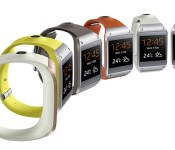
Samsung’s new Galaxy Gear might run Tizen instead of Android

Sure, the Tizen Association just welcomed new members, but the mobile platform is still having a tough start overall — a Japanese carrier even canceled a Tizen smartphone release in January. So, Samsung (the platform’s biggest backer) is reportedly taking matters into its own hands and loading Tizen on one of its upcoming devices: Galaxy Gear 2.0. According to USA Today’s sources, the South Korean company is slated to launch an updated smartwatch running the HTML 5-based Tizen OS at the Mobile World Congress a few days from now.
Samsung is reportedly dropping Android in favor of the fledgling platform due to a number of reasons, including its hopes to gain greater control (and revenue) from associated software and services. Also, the company’s apparently concerned that the Android flavor Google’s developing for wearables may not be as open as the other versions. Whatever Samsung’s reasons are, we just hope the new Gear has a longer list of compatible devices than its predecessor does.
Filed under: Wearables, Mobile, Samsung
Source: USA Today
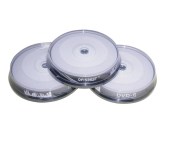
DVD Replication: – An Advanced Process Of Producing High Quality Dvds
Do you need copies of the DVDs in huge volumes? Then you should take professional help, they are able to provide you with the high quality replicated DVDs similar to the original ones. If you want high quality DVD copies, then the only way to achieve this is by CD Replication. This process is not like you burn DVDs at home. It is much more advanced than that and you will have guaranteed that you are going to get high quality CDs which are produced.
 Replication Is Different From Duplication
There are many people who are confused among replication and duplication. Replication of the DVDs is far more different than the duplication process. The latter is getting the original content of the device to another with the utilization of the software while the former is physically copying the reality that is original CD. The similar geometry of the original disc is therefore found on the CD that is replicated, ensuring a high quality. Each disc will have quality like the original disc. DVD replication is an amazing process. This process cannot be done at home because it is complicated and needs high quality robotic equipments which you are going to find with the professionals.
Replication Of The Dvds
One unit of replication could produce 1000 DVDs in one day. The process is rapid and you will be amazed seeing the site where robots replicate DVDs in a non stop process. This process is also considered as a low cost method of producing high quality DVDs. This is the perfect way of producing DVDs in small budget and short period of time. With the help of this process you are going to get real value for your money. There are many professional companies which are present on the internet for the convenience of their customers. Whether you need a thousand CDs or fifty thousand CDs you can contact them online and tell them about your projects. There are companies which are having more than one plant for replication and duplication of the CDS.
DVD replication service providers
If you need high quality DVD replication services, hassle free and professional look for your DVDs and CDs then you can approach these companies. They serve in different parts of the world. In case you need unique look, then also you can trust these companies. One of the great things about this service is that it is cost effective and you really get high quality discs. If you are in the business where you need a huge amount of backup for your business or personal use then also you can approach these companies.
They are in the business for many years and can serve you well with their high quality services. You can easily find their websites on the internet and have a look at their projects and services. You can even call them on their numbers to inquire about your projects. They also offer print and packaging services so that your CDs are ready for the immediate distribution when they are delivered to you.
Author bio
We are in the DVD replication Business for many years. We have high tech technology equipments, which are bound to provide you with high quality disc replication and duplication and cheap dvd replication services. You can visit our website to know more about our services.
 AIVAnet