



Aerial Photograph Shows Substantial Demolition Progress at Apple Campus 2 Site [Mac Blog]
Work at Apple’s Campus 2 is well underway with most of the existing buildings now demolished and parking lot pavement removed, as shown in a recent aerial photograph (via MacGeneration) from Ron Cervi, a news and traffic reporter for KCBS. Demolition on the site began in November after Apple received unanimous approval for the project from the Cupertino City Council.
 Photo by Ron Cervi
Earlier photographs from a street level view revealed the first stages of demolition back in December, with partially demolished buildings visible from a nearby highway. Several sidewalks were closed, while bulldozers and other heavy equipment started clearing debris from the 176-acre parcel.
Apple’s Campus 2 is a short distance away from the company’s current headquarters at 1 Infinite Loop in Cupertino, California. Eighty percent of the barren landscape shown above will be vegetated with over 4,500 trees in an endeavor that will “bring California back to Cupertino.” The remaining 20 percent of the landscape will be dominated by a circular, 4-story building designed to hold 13,000 employees. The project has a target completion date of 2016.
     |
OnLive creator’s next project could put an end to cellular reception woes

Remember Steve Perlman? The serial entrepreneur has moved on from OnLive’s messy transition and launched an enterprise called Artemis, with the lofty goal of fixing the cellular congestion plaguing modern carriers. Called pCell, it works by forcing frequencies that normally interfere and bog down a network to gang up for better reception, instead. Congestion could be thus relieved by adding more antennas, a strategy that doesn’t work with current networks due to crosstalk. A demonstration to the New York Times showed Netflix HD and 4K videos streaming to at least a half dozen devices in the same room over a local LTE network, a feat the company said would be impossible on current networks. There’s no word from any US carriers about any plans to adopt the tech, but Verizon did say that it was aware of it. In the meantime, Artemis said large scale tests will start in San Francisco later this year, with a commercial launch by the end of 2014. Check the video after the break for more.
Filed under: Wireless, Internet
Via: The Verge
Source: Artemis

Loop’s mobile payment Fob now available online for iOS devices

When we were introduced to Loop in October, the mobile payments company was just launching its Kickstarter campaign. The idea was different than an NFC-based mobile payment service (such as Isis or Google Wallet): using a 3.5mm Fob attached to your phone, you can make purchases on almost any point-of-sale system that accepts credit cards. Fortunately, Loop has kept busy the last few months; not only was its crowdfunding campaign a success, it also secured plenty of additional financing on its own. Now that the Fob (shown above) has made its way to Kickstarter backers, interested buyers in the US finally get their chance to buy the $39 device and its corresponding iOS LoopWallet app, which serves as the hub for all of your credit, gift and loyalty cards. An Android version is still in the works and will be ready in April, and there’s no word on when it’ll reach other parts of the globe. Check out the video below for a closer look at how Loop works.
Filed under: Cellphones, Wireless, Mobile
Source: Loop
LG announces the G2 mini ahead of MWC launch date
A few days ago, LG posted a photo on Facebook hinting at a Mobile World Congress launch date for the LG G2 mini. The company came out today, ahead of the launch date, and officially announced the new miniature phone.
A decent amount of the specs were already leaked, so there isn’t a whole lot of surprise. Sony’s take at a mini phone with the Z1 Compact is something to aspire to. While encompassing a smaller screen size, it boasts almost all the same specifications as the Z1. Sadly, it’s a different story for the G2 mini.
It has a 4.7-inch display with a 540×960 qHD resolution, 1.2 GHz quad-core processor, and 1 GB RAM. It also has an 8 MP rear-facing camera and a 1.3 MP front-facing camera, 8 GB of internal storage, a 2,440 mAh removable battery, and expandable storage via microSD.
Probably the most notable feature is that it’s launching with Android 4.4 Kit Kat, something that we didn’t think would make it on the phone right away. On top of launching with Kit Kat, the mini includes LG’s Guest Mode and other features.
It will be available in Russia beginning in March, and will quickly roll out to the Middle East, Asia, Europe, and Latin America. There is no word on a US release quite yet, but we will cover that as soon as we can.
As you can see, the specs are so-so, and they definitely don’t compare to the G2 the way we would like them to. Hopefully LG recognizes this and sells it for a good price, considering the sacrifices. Keep checking back for more on the G2 mini and other MWC 2014 coverage!
Source: GSMinfo.nl
Via: The Verge
The post LG announces the G2 mini ahead of MWC launch date appeared first on AndroidGuys.
Amazon Coins now available directly from Android devices
Amazon on Wednesday announced that customers living in the US, UK and Germany can now use (buy, spend, earn) Amazon Coins directly from their Android phones and tablets. Previously exclusive to the Kindle Fire tablets, Amazon Coins can let users buy apps, purchase add-ons, unlock features, and other fun stuff inside of apps and games. The virtual currency, which has been around for roughly one year now, seems to work rather well for developers.
The post Amazon Coins now available directly from Android devices appeared first on AndroidGuys.

Apple Becomes China’s Fifth-Largest Smartphone Vendor in Q4 2013 [iOS Blog]
 According to a new report from market research firm IDC (via The Wall Street Journal), Apple became China’s fifth largest smartphone manufacturer during the fourth quarter of 2013, taking 7% of total market share in the country. Notably, the report does not include iPhone sales numbers from the region’s largest carrier China Mobile, which began selling the iPhone through a partnership with Apple last month.
According to research firm IDC, Apple’s market share in mainland China rose to 7% in the quarter from 6% in the third quarter. The fourth quarter was the first full quarter after Apple launched its iPhone 5S and 5C in China in late September, on the same day the new phones came out in the U.S. and a host of other markets. In the past, iPhones went on sale in China months after they were launched in the U.S.
Apple is still behind other smartphone vendors in the country including Samsung, Lenovo, and Huawei, with those companies coming in at first, second, and fourth place, respectively. Apple also remained slightly ahead of newcomer Xiaomi, which notably hired former Google vice president of product management Hugo Barra in August 2013.
Apple has made strides towards improving its presence in China over the past few years, opening new Apple Stores in populated regions and establishing an official store on Chinese e-commerce site Tmall in addition to partnering with China Mobile. CEO Tim Cook has also visited the country numerous times throughout the past few years to meet with both China Mobile executives and government officials to discuss market growth.
| |

TPK to Reportedly Supply Flexible AMOLED Panels For Apple’s iWatch
 Apple may be choosing TPK as a touch panel supplier for its rumored iWatch, says a report in China Times (Via Digitimes). The Taiwan-based company will supposedly begin mass production of flexible AMOLED panels for the iWatch in the second half of 2014.
The report said the iWatch will come equipped with a flexible AMOLED display and 3D protective glass. The rumors also speculated that the iWatch will use silver nanowire touch screen technology developed by TPK in conjunction with Japan-based Nissha Printing.
The rumor suggests Apple will use silver nanowire touch screen technology in the iWatch display. Current flat touch panels use indium tin oxide (ITO), which is brittle and not suitable for a flexible display. Silver nanowires, however, are nanometers thin and can be applied to a 3D curved glass surface, like a watch band in a solution-based, roll-to- printing technique. The silver wire matrix is transparent to the eye and conductive, making silver nanowires perfect for a flexible touchsreen display.
Last year, TPK signed a deal with Japanese firm Nissha Printing to start producing silver nanowire touchscreen displays. Production will ramp up in Q2 2014, with a manufacturing output of two million 6-inch touch panels per month.
TPK is among the world’s top touch panel manufacturers by volume and has been supplying Apple with panels for several years. The Taiwanese company was one of the primary suppliers of the touchscreen for the original iPad and provided up to 80% of the panels for the iPhone 4S models.
| |
LG’s G2 mini is a smaller flagship by name, not by nature

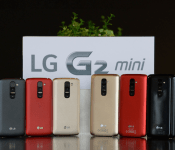
LG’s not left much to the imagination before this month’s Mobile World Congress. After it confirmed the G Pro 2 last week, the Korean phone maker today officially announced a smaller version of its current Android flagship: the G2 mini. If you were expecting LG to take a similar approach to Sony, which crammed impressive specs into its Z1 Compact, the G2 mini has its fair share of drawbacks. In that regard, the device is powered by Qualcomm’s quad-core Snapdragon 400, the same chip found in the Moto G, while its smaller 4.7-inch display boasts a rather unflattering 960 x 540 qHD resolution.
The handset also features 1GB of RAM, an 8-megapixel camera, 8GB of onboard storage, and retains the same unique backside as its bigger brother, where the volume rocker and power button are placed just below the rear camera. LG has, however, equipped the mini with Google’s latest OS, Android 4.4 KitKat, and will port its custom knock-to-unlock and Guest Mode features over from the flagship G2. The mini is set to go on sale in Russia from March and roll out across Europe, the Middle East and Latin America shortly after. Given the specs, we’re looking at a low-priced handset but we don’t know yet how low LG will go. Hopefully it’ll share more details at MWC next week.
[Image Credit: Android Planet]
Filed under: Cellphones, Mobile, LG
Via: The Verge, Android Planet
Source: Tweakers
‘All New’ HTC One leaks again with a bright gold paint job

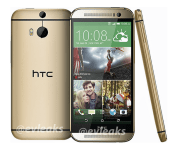
Is there anything that hasn’t already leaked about HTC’s photography-focused successor to the One? Not much, except that we haven’t seen any publicity renders quite as detailed as the one just shared by @evleaks. It suggests that the dual-camera handset will be offered in a gold flavor, alongside the rumored silver and black options. Furthermore, @evleaks — who has a generally reliable track record — claims to know how the new phone will be branded. It’ll apparently skirt around tricky numerical conventions by adopting a slightly Apple-esque alternative: the “All New HTC One.” A name like that should roll right off the tongue, shouldn’t it?
Filed under: Cellphones, Mobile, HTC
Source: @evleaks [Twitter]
LG G2 Mini is now official, probably closer to a Lite than a Mini
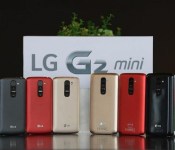
 LG has been hinting for a few weeks now that they are about to announce a smaller version of their flagship device, the LG G2. That device was expected to be called the LG G2 Mini and today that name was confirmed as the device was officially announced. All the major smartphone manufacturers have started making ‘mini’ versions of their flagship devices like the HTC One Mini, Samsung Galaxy S4 Mini and Sony Xperia Z1 Compact, just to name a few, so it’s not surprising to see LG follow suit. ‘Mini’ smartphones have had the unfortunate perception of being a capitalization of their flagship device’s fame, Xperia Z1 Compact aside, and it appears LG has taken this concept a step further than any manufacturer before it.
The LG G2 Mini comes with either a Snapdragon 400 processor or Tegra 4i chipset, likely determining whether the device has LTE support or not, as well as 1GB, 8GB storage with microSD slot and 2,440mAh battery. Probably the most surprising specification for this 4.7-inch device is the 960×540 pixel resolution of its display, which makes for a pixel density of 234ppi; for reference, the 4.3-inch HTC One Mini has a pixel density of 342ppi. This is quite a large difference in screen clarity, and given that the G2 Mini will only be 0.5 inches smaller than the original, it makes the G2 Mini seem more like a G2 Lite; hopefully the price of the G2 Mini, which has not been detailed, is more representative of its abilities than its namesake.
The LG G2 Mini is expected to release in Russia in March, and the Middle East, Latin America, Asia and Europe in April. Would you be interested in the LG G2 Mini assuming its pricing was appropriate? Let us know what you think about this ‘Mini’ device in the comments.
Source: GSMInfo.nl via Phone Arena
 AIVAnet