



Canon’s new Rebel T5 DSLR camera is unapologetically for beginners (hands-on)

If you’re angling to upgrade from your smartphone or your point-and-shoot to something a little more serious, you’re probably not going to jump for the top model out — unless you have that kind of money. That’s where Canon’s new entry-level DLSR comes in, with 18-55mm kit lens, for $550. The EOS Rebel T5 boasts an 18-megapixel sensor, ISO levels from 100-12800 and all the controls you’d expect to find on Canon’s understandably popular DSLR series. As the entry-level model, however, there’s bound to be some drawbacks — and there were few that we noticed during our short playtime at CP+ 2014. With 9-point autofocus, you can expect some sluggish focusing: many DSLRs have 20 times the number of focal points. Once the camera does latch onto a subject, you can expect DSLR-quality shots.
The Rebel T5 also packs in a consecutive shooting mode, but at three frames per second (hold onto the shutter key while in the right mode, and it captures away), we were hoping for something more. Perhaps we’ve been spoiled by the leaps and bounds made by ILC cameras (including Canon’s own) but the Rebel T5 is best seen as a gentle introduction to Canon’s lens selection and those subsequent camera upgrades.
Zach Honig contributed to this report.

First Xbox One update goes live

Microsoft’s spring update for the Xbox One is here! (Cue triumphant trumpets.) It’s a few days later than anticipated but, as they say, better late than never. The first major update for the console packs a host of improvements, including better Kinect voice recognition, improved all-round stability, and some key fixes to the dashboard — such as onscreen meters for the controller’s battery and free HDD space. You’ll also be able to plug a USB keyboard in, which should make web browsing and searching a whole lot less painful. The update is rolling out to customers during “off-peak” hours in their local time zones. Or as the ever eloquent Larry Hryb put it, “never fear you’ll see it sometime over the weekend.” If you’re taking advantage of Xbox’s Instant On feature, the console will check for an update next time you turn it off.
Filed under: Gaming, Microsoft
Source: Major Nelson

Microsoft Office for iPad Coming ‘Sooner Than Most Think’
Microsoft has been rumored for a number of years to be bringing its Office productivity suite to the iPad, and according to a new report from ZDNet, it is coming “sooner than most think.” Sources have indicated to ZDNet‘s Mary Jo Foley that Office for iPad may even arrive before the “touch first” Windows version that had been reported to be leading the way.
But I hear Ballmer and the senior leaders of the company may have had a change of heart towards the end of last year. According to one of my contacts, Ballmer OK’d the suggestion by the Office team that they’d bring Office for iPad to market as soon as it was ready, even though that would likely mean before the Windows 8 version. I’m hearing that new date for Office for iPad is some time in the first half of calendar 2014. (My sources last summer were hearing Office for iPad wouldn’t debut until Fall 2014.)

Foley notes that it is still unclear in exactly what form Office for iPad will arrive, but it will presumably involve Microsoft’s Office 365 subscription service and potentially integrate with the company’s OneDrive cloud storage. The company currently offers an iPhone app that offers viewing and limited editing capabilities, with the available free of charge but requiring an Office 365 subscription.
     |
iWatch May Use Optical Sensors to Measure Heart Rate and Oxygen Levels
Apple’s iWatch may include optical sensors designed to measure physical functions like heart rate and oxygen levels, according to electronics analyst Sun Chang Xu of Chinese site Electrical Engineering Times [Google Translation], who cites supply chain sources with knowledge of the matter. Xu also indicated that while Apple had planned on glucose monitoring, non-invasive methods have proven to be highly inaccurate and thus may not be included in the final product.
Measuring oxygen levels and heart rate are two features the iWatch has been previously rumored to include and optical sensors, which are used in many medical and health-related products, are a logical choice for the smart watch.
Pulse oximetry devices, which are often designed to fit over a finger, use optical sensors to measure oxygen levels in the blood. These sensors are light-based, sending two wavelengths of light through the skin. Differences in the way the light is absorbed allows the device to detect oxygen saturation in the blood. The majority of pulse oximeters clip to a fingertip or an earlobe, suggesting a wrist-based pulse oximeter is difficult, but not impossible, to develop.
Monitoring heart rate via optical sensor is a newer technology that is incorporated into several fitness products including the Mio Alpha heart rate watch. Typical heart rate monitoring in the past has required a chest strap, but with an optical sensor, a light shone on the skin can be used to measure blood flow through capillaries, thus determining heart rate.
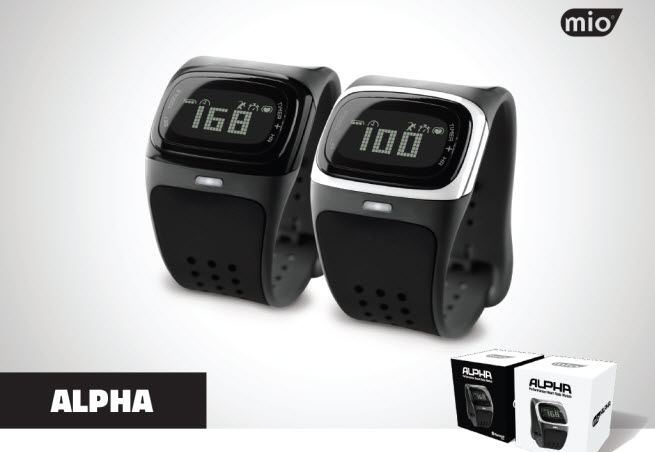 The Mio Alpha heart rate monitoring watch
MacRumors spoke to Mio founder and CEO Liz Dickinson about the possibility of an optical heart rate measurement tool in the iWatch, and she believes the company would absolutely opt for electro-optical sensing for such a function. She also suggested an iWatch with heart-rate measuring capabilities would need to fit tightly to the wrist.
Having said that, using electro optical sensing requires a very specific type of design in order to work accurately. The sensor needs to be in tight contact with the skin with little ability to move.
Perhaps Apple does not care about accuracy during motion but in any event, at the time readings were being taken even if the person is still, the watch, or band, would need to be flush to the skin.
Electro-optical sensing also requires careful calibration to overcome interference from motion and noise. The Mio Alpha incorporates a built-in accelerometer and noise filtration software to garner accurate readings, and it is possible Apple might adopt some of the same technology.
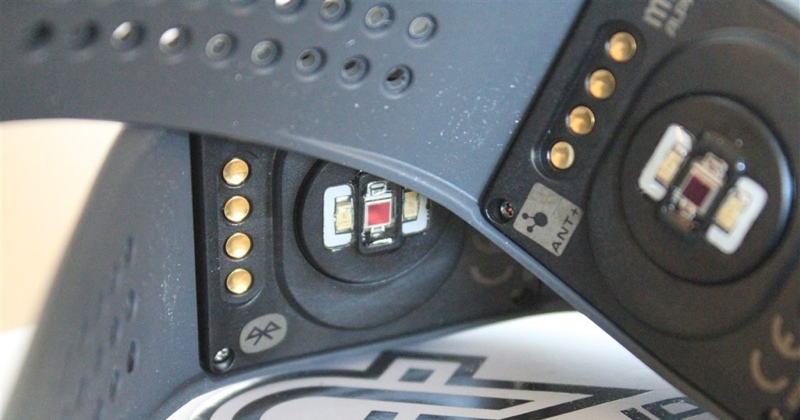 Underside of the Mio Alpha heart rate-sensing watch (Courtesy of DC Rainmaker)
Over the course of the last several months, Apple has hired a number of health experts in fields related to both heart rate monitoring and pulse oximetry. Two executives from pulse-oximetry company Masimo joined Apple, including its former Chief Medical Officer. Several of Apple’s health-related hires have also been from C8 MediSensors, a company focused on non-invasive blood monitoring sensors.
While it is unclear exactly which health-related functions the final iWatch product might measure, rumors have indicated it will include multiple sensors capable of not only measuring heart rate and oxygen level, but also movement, sleep, hydration levels, and more.
| |
 AIVAnet