


HTC M8 Render Created from All the Supposed Leaked Images

Past couple weeks, the HTC M8 has made a splash in the Android Community with all these supposed leaked images that have surfaced online. From shots showing us a dual-camera, to leaked screenshots that show us a polished Sense 6, it was only a matter of time before some crafty Photoshop artist created a render for the anticipated phone.
The render above showed up from an anonymous artist that Phone Arena got a hold of. He just posted the render giving us a good look at the HTC M8 sporting one of the wallpapers that was leaked out by evleaks. Looks rather pretty, and I wouldn’t be surprised if the actual press render ends up looking like this. Let us know what you think of it.
Source: Phone Arena

Two-thirds of Americans now have smartphones

The US has officially become a smartphone nation — at least, if you ask Nielsen. The research group’s latest Digital Consumer Report estimates that 65 percent of all Americans owned one of the devices in 2013. That’s a big step up from 44 percent in 2011, and smartphones are now more common than game consoles (46 percent) and digital cable (54 percent). Americans are also increasingly tech-laden, with an average of four devices per person; 29 percent of them have a tablet versus just 5 percent two years ago.
That shift toward mobile is affecting how many spend their free time. Americans spent an average of 34 hours per month using mobile apps and browsers in 2013; that’s more time than they spent online with their PCs, which chewed up 27 hours. Social networking use is declining on the desktop, too, while it’s surging in mobile. Smartphones aren’t as ubiquitous as TVs at this stage, but they’ve clearly taken hold of the public consciousness.
Filed under: Cellphones, Home Entertainment, Tablets, HD, Mobile
Source: Nielsen (1), (2)

Canon updates high-end PowerShot lineup with $799 G1 X Mark II

Canon introduced its PowerShot G1 X at 2012′s CES, and two years later, the pricey high-end point-and-shoot is ready for an update. This year’s iteration, the G1 X Mark II, includes a 12.8-megapixel CMOS sensor, and like its predecessor, this new chip measures 1.5 inches diagonally, enabling some pretty spectacular images. There’s a 24-120mm f/2-3.9 zoom lens, so you can expect shallow depth of field throughout the maximum-aperture range, and sharp shots even in low light. It includes a 1.04M-dot 3-inch tilting touchscreen, a DIGIC 6 processor, 12,800 top ISO and 1080/60p MP4 video capture. Additionally, you can pair the Mark II with Canon’s companion apps via WiFi and NFC for remote shooting and wireless image transfers. There will also be an XGA electronic viewfinder accessory that mounts on the hot shoe, should you prefer an EVF. Pricing for that add-on is TBA, but expect the G1 X Mark II to hit stores in April for $800.
Sony debuts three superzooms and two compact Cyber-shots for CP+

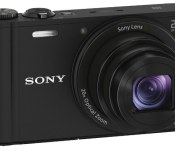
Sony announced but one camera at CES, an entry-level mirrorless interchangeable-lens model called the Alpha 5000. With CP+ gearing up just outside Tokyo, however, it’s time to lift the point-and-shoot floodgates. There are three superzooms and two pocketable cams on the docket this year, in addition to the brilliant A6000. The HX400V and WX350 are arguably the most compelling offerings in each category, and they’re joined by alternatives that should appeal to a broad range of consumers — the H400, the H300 and the (relatively) petite W800. All but that last model include 3-inch LCDs (the W800′s display is 2.7 inches), but the similarities end there.
The HX400V ($500) features a 20.4-megapixel CMOS sensor, an f/2.8-6.3, 24-1200mm (50x) lens with OIS, a top sensitivity of ISO 12,800, a 10 fps burst mode, 1080p video and 4K still image output. There’s GPS, WiFi and NFC, a BIONZ X processor under the hood and a Multi Interface Shoe for connecting a variety of Sony add-ons. The H400 ($320), which shares a nearly identical model name, falls a bit short on the spec front. There’s a 20.1MP CCD sensor, an f/3.4-6.5, 24.5-1543mm (63x) lens with OIS, a 3200 top ISO, a 0.8 fps burst mode and 720p video capture. The H300 ($220), meanwhile, sports a 20.1-megapixel CCD sensor, an f/3-5.9, 25-875mm (35x) lens with OIS, a top ISO of 3200, a 0.8 fps burst mode and 720p video. That model runs on four AA batteries, while the other four are powered by Lithium-Ion cells.
Moving on to the compacts, the WX350 ($320) shares the BIONZ X processor of its larger sibling, the HX400V. There’s an 18.2-megapixel CMOS sensor, an f/3.5-6.5, 25-500mm (20x) G lens with OIS, a top sensitivity of ISO 12,800, a 10 fps burst mode, 1080p video capture and 4K still image output. It sports WiFi and NFC connectivity, and can fire off 470 shots on a single charge. Finally, if you’re on a very tight budget, the W800 ($80) covers the basics with a 20-megapixel CCD sensor, an f/3.2-6.4, 26-130mm (10x) lens, a top sensitivity of ISO 3200, a 1 fps burst mode and 720p video capture. You can pick up that model in March, along with the HX400V, H400 and WX350, while the H300 is expected in stores later this month.
Head 82 feet below the surface with Canon’s waterproof PowerShot D30

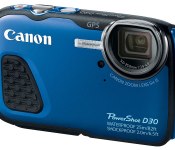
It’s a very busy CP+ for Canon. The camera maker has a handful of new models for the show, including one of the waterproof variety. The PowerShot D30, which replaces 2012′s D20, boosts the waterproof rating from 33 feet to 82 feet, making it a suitable choice for all but the deepest scuba dives. There’s a 12.1-megapixel CMOS sensor, a DIGIC 5 processor and support for 1080/30p video. The 5x 28-140mm lens isn’t as fast as we’d like for dim underwater shoots, with an f/3.9-4.8 maximum aperture, but with the ISO bumped up a bit, it should perform decently. You can frame shots on the 3-inch 461k-dot LCD, which sports a sunlight mode for use in brighter conditions. The camera is shockproof and cold-resistant as well, and while there’s no WiFi on board, it does include GPS. The PowerShot D30 is expected in stores by mid-April with a $330 MSRP.


Canon PowerShot SX700 HS ships in March with 30x lens, WiFi, $350 price tag

In the market for a compact superzoom? Canon’s new PowerShot SX700 HS is definitely worth a look. This SX280 HS replacement includes a 16.1-megapixel CMOS sensor paired with a DIGIC 6 processor, an f3.2-6.9 25-750mm (30x) zoom lens and a 3-inch 922k-dot LCD. The camera’s small enough to tuck away in a jacket pocket, but it still includes a new extended hand grip on the front, making it comfortable to hold with the lens extended. It also supports 1080/60p video capture, and has WiFi and NFC on board, for remote app controls and wireless uploads to the web. Expect the SX700 to hit stores next month in black and red for $350.

Meet Canon’s latest budget PowerShots, a trio of ELPHs

Canon’s higher-end PowerShot cameras are certainly more compelling, but they’re also expensive. If you’re on a budget, you might want to settle for one of these ELPHs. Canon is introducing three new models this week, including the ELPH 150 IS, 140 IS and 135 — they’re priced at $150, $130 and $120, respectively. The latter duo replace the A2600 and A2500, while the 150 is a new addition to the lineup. That model includes a 20-megapixel CCD sensor, while the other two feature 16-megapixel CCDs. All three have DIGIC 4+ processors and 2.7-inch 230k-dot LCDs. They also shoot 720p video, which should certainly suffice for casual web use. The pricier two models include optical image stabilization — in fact, the 140 IS and 135 are identical, save for the 135′s lack of OIS. Those two include 8x optical zoom lenses, while the 150 IS packs a 10x zoom. All three cameras are scheduled to ship later this month.
EOS Rebel T5 is Canon’s cheapest DSLR, priced at $550 with 18-55mm lens

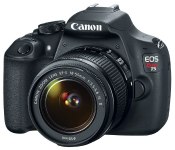
If you’re on a tight budget and looking to buy a DSLR, we might suggest you consider a mirrorless camera instead. But if you’re dead set on building out your EOS lens collection, Canon’s Rebel T5 is at least a more capable choice than its predecessor, the 2011-era T3. This year’s model includes an 18-megapixel APS-C CMOS sensor, a DIGIC 4 processor, a sensitivity range of ISO 100-12,800 and 1080/30p video capture. There’s also a 9-point AF system and 3 frames-per-second continuous shooting — generally not much to write home about, but as a starter cam it’ll do just fine. The T3i will remain for sale, and can be had for $509 including a lens over at Amazon. The T5, for its part, is set to retail for $550 including an 18-55mm f/3.5-5.6 kit lens, or $450 for the body only. Expect to see it in stores next month.

Sony’s A6000 is the mirrorless camera you’ll want to own, ships this April for $800 with lens

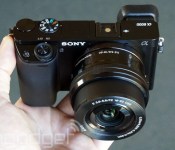
Well, Sony’s really done it this time — your still-crisp NEX-6 may now be marked for an early retirement. The A6000 is here to replace one of 2012′s most exceptional shooters, and despite the NEX-6′s success, this fresh 2014 model is the one to own. There’s a brand new 24.3-megapixel CMOS APS-C sensor paired with a BIONZ X processor at the core, enabling what Sony’s calling the “world’s fastest autofocus.” We’re talking lag of just 0.06 second, thanks to the 179 phase-detect and 25 contrast-detect AF points. You also get 11 fps continuous shooting with tracking AF. Those focusing improvements are most notable in our book, but the price drop is surely worth a mention, too. The A6000 will ship for $800 with a 16-50mm power-zoom kit lens, compared to the $1,000 Sony was commanding for the NEX-6 back in 2012.
Like other recent Alpha CSCs, the A6000 includes an OLED viewfinder with 100-percent frame coverage and a tilting 3-inch 921k-dot LCD. You have two interface options here: the love-or-hate-it six-tile NEX menu that dates back to 2010 with the NEX-3 and NEX-5, or the recently refreshed tab-style Alpha UI, which we prefer. There’s a pop-up flash, a Multi Interface Shoe, 1080/60p and 24p video capture with clean HDMI output, seven customizable buttons and 4K still image output to a compatible TV. Like its predecessor, the A6000 also includes WiFi and NFC, so you can shoot via the Android or iOS app, or transfer images from the camera to a smartphone or tablet. You also get a handful of apps on the camera itself, ranging from the free Direct Upload (for sharing images online) and Photo Retouch applications, to a few that you’ll need to purchase, such as Time-lapse and Lens Compensation (for minimizing lens distortion).
We had a few minutes to check out the A6000 ahead of CP+. We poked around the new interface, which we found to be a refreshing change from the NEX format of yesteryear. The A6000 is actually noticeably larger than the NEX-6, but not significantly so. The design aesthetic is similar, though the newer model has a slightly more premium look and feel than its predecessor. There are separate dials for shooting mode and settings adjustments, compared to the two-in-one control on the NEX, but the button layout is quite similar otherwise, and if you’re familiar with previous NEX cameras, you should feel at home here. You can try one out for yourself at retailers this April, or peruse our hands-on shots in the gallery below.

Sony’s VAIO Flip 11A convertible is now available for $799

Even though the VAIO Flip 15 and 13 are both pretty solid PCs, some people might find one to be too big and the other too expensive. To alleviate this, Sony introduced the VAIO Flip 11A, an 11.6-inch laptop with the same Yoga-like design as the other, larger Flips. Available now for $799, Sony’ newest convertible ships with Windows 8.1 and is powered by Intel’s 2.16GHz Pentium N3520 CPU. What’s more, there is also that included copy of Adobe Photoshop Elements 12, a 1,920 x 1,080 IPS screen, NFC Support and 128GB of solid-state storage alongside 4GB RAM. It appears Sony is only selling its Flip 11A in the US at this time; that being said, let us know in the comments if you see it up for grabs elsewhere. Or maybe it’s all part of the company’s new business plan.
Filed under: Laptops, Tablets, Sony
Source: Sony
 AIVAnet